Brand creator fit is the degree to which a creator's content, audience, and style line up with your app's product, tone, and goals. For a consumer app, the practical test is simple: can this creator show your product solving a specific problem, in a format their audience already watches, without the video feeling like an ad? If yes on all three, you have fit. If not, no amount of reach will rescue the campaign.
This guide gives growth teams a working method: a scorecard for vetting creators, a way to build content angles and pillars, a small-batch test for your value proposition, and the signals that tell you whether to change the format or change the creator.
TL;DR
- Fit is a four-way match: what your app needs viewers to understand, what the creator can already make, what their audience expects, and what you can safely stand behind.
- Vet every creator on the same scorecard: hook, product demo, audience fit, delivery, reliability, rights, and claims.
- Define three to five content pillars from your positioning, then test one angle per pillar across several creators before scaling.
- Compare angles by trial starts and paid subscribers, not views alone. If a creator's median views are weak, fix the format before adding more creators.
- Paid creator posts need clear disclosure under FTC rules in the US.
Table of Contents
- What brand creator fit actually means for an app
- Build a creator scorecard before you shortlist
- From fit to content angles
- Define content pillars that match your positioning
- Use creators to test your value proposition
- Read the signals: change the format or change the creator?
- Protect the fit with disclosure and guardrails
- Our perspective
- Put the method to work with Cult Media
- A 30-day plan to get started
- Common mistakes to avoid
- FAQ
- Sources
What brand creator fit actually means for an app
Most definitions of fit stop at "relevant audience." That is necessary, not sufficient. An app is a product people must download, learn, and keep using, so the creator has to carry a viewer from a feed to an install, and ideally to a trial or paid plan.
A useful way to break it down is a four-way match:
- What the product needs the audience to understand. A budgeting app may need viewers to grasp one idea, such as seeing every subscription in one place. A complex product needs a creator who can explain.
- What the creator already knows how to make. A creator who excels at day-in-the-life vlogs will struggle with a rapid screen-recording tutorial, and the reverse is also true.
- What the creator's audience expects. Followers who trust a creator for blunt reviews will punish a scripted pitch.
- What the brand can safely stand behind. Claims, rights, and tone must hold up when the video runs as an ad.
Notice what is missing: follower count. Size matters for cost and reach, but fit determines whether the reach converts. This is also why a creator who works for a fashion brand may fail for a finance app even with an identical audience size.
Build a creator scorecard before you shortlist
Subjective picking leads to inconsistent results and impossible-to-debug campaigns. Score every candidate on one sheet. A common vetting set covers hook, product demo, audience fit, delivery, reliability, rights, and claims. Here is how we would apply it to an app, scored 1 to 5 per row.
| Criterion | What to look for | Red flag |
|---|---|---|
| Hook | First two seconds create a reason to keep watching, in the creator's own voice | Generic openers, "hey guys" with no tension |
| Product demo | Can narrate and show a screen flow clearly | Only talks about the app, never shows it |
| Audience fit | Comments mention the problem your app solves | Comments are mostly giveaway or emoji replies |
| Delivery | Voice, pacing, and framing feel native to the platform | Over-produced, ad-like footage |
| Reliability | Meets deadlines, accepts revisions | Slow replies, missed drafts |
| Rights | Clear terms for usage and paid distribution | Vague ownership of the footage |
| Claims | Willing to stay inside what the app really does | Exaggerated outcomes, unverifiable promises |
Watch the content the way a viewer would
A practical vetting habit is to watch recent videos twice: first with the sound off, to judge the visual story, then with sound on, to judge voice quality and pacing. Silent viewing tells you whether the video works for people scrolling in public. Audio tells you whether the creator is someone viewers will listen to.
Read the comments, not just the posts
Comments are the cheapest audience research available. Look for viewers describing their own use cases, asking where to get a product, or naming the category you compete in. A creator whose audience asks "what app is that?" under organic posts is a stronger fit than one with higher views and silent comments. Also check how past sponsored posts performed relative to their organic content. A sharp drop signals audience fatigue with promotion.
From fit to content angles
Fit tells you who. Angles tell them what to say. An angle is the specific reason a particular viewer should care about your app right now, and it is the unit you test.
The approach laid out by Airbridge is to start from a customer tension, make the problem specific enough to build a video around, and then check whether different creators and hooks can express it. Their test for a usable angle has four parts:
- The frustration the viewer feels
- When it occurs
- What changes with the product
- What the creator can show instead of merely claim
Take a habit-tracking app. "Build better habits" is a category, not an angle. "You set a goal on Sunday and forget it by Wednesday" names the frustration and the moment. The creator can then show the Wednesday reminder, the streak, and the change in their own routine. That is a video, where the first version is a slogan.
Turn each angle into a brief creators can use
A brief should shape the message and leave the delivery to the creator. Strong app briefs usually include a concept name, the viewer and tension, a hook direction, story beats, proof, the call to action, format, references, extra footage to capture, and don'ts. A seven-part version adds platform specifications, brand tone, and guardrails. If you want finished examples, see our breakdown of creator brief examples that actually get used and the one page creator brief for apps. For a look at how finished videos map to briefs, these video marketing examples show what each campaign teaches about structure.
Define content pillars that match your positioning
Pillars keep a creator program from becoming a random pile of videos. They are the three to five recurring themes that every piece of content ladders up to. Mobile marketing guides commonly build strategy around a few connected pillars such as app store visibility, creative execution, tools, and honest measurement. For creator content, we recommend deriving pillars from the app itself, not from a generic list.
A workable process:
- Write your positioning in one sentence. Who is the app for, what job does it do, and why is it better than the alternative the user has today (often a spreadsheet, a notes app, or nothing)?
- List the audience's top tensions. Pull them from support tickets, app store reviews, onboarding survey answers, and comment sections.
- Group tensions into themes. Each theme becomes a pillar. Name it in plain words.
- Assign a proof type to each pillar. Screen recording, before and after, side-by-side comparison, or a real-life scenario.
- Limit the set. If you cannot test every pillar with at least three creators, you have too many.
Example pillars for a personal finance app:
| Pillar | Viewer tension | Proof the creator shows |
|---|---|---|
| Clarity | "I do not know where my money goes" | Linking an account and seeing categories |
| Control | "I overspend on small things" | Setting a limit and getting an alert |
| Confidence | "I avoid looking at my balance" | A calm weekly check-in flow |
| Shortcuts | "Budgeting takes too long" | Setup in under two minutes, on screen |
Pillars also help with creator selection. A creator whose audience asks about saving habits fits Control. One who makes tutorial content fits Shortcuts. Fit is rarely absolute; it is fit to a pillar.
Use creators to test your value proposition
Creators are a fast, low-cost way to learn which promise lands before you commit paid budget behind it. One suggested method is to run five micro-creators on five distinct propositions in parallel and measure engagement and trial conversion velocity. Treat this as a starting design rather than a law; the principle is what matters: change one variable at a time and give each proposition more than one voice.
A clean test plan:
- Pick three to five angles, one per pillar.
- Assign each angle to at least two creators with different styles, so you can separate the idea from the person.
- Keep the call to action, landing path, and tracking identical.
- Run for a set window long enough to see installs and trial starts, not just views.
- Compare by angle first, then by creator within the winning angle.
This mirrors the angle-level comparison of trial starts and paid subscribers, then making more creative for promising angles and dropping the rest. If you are still deciding on a small set of testable creative angles before producing many videos, resist the urge to cover everything at once. For early-stage teams, our UGC strategy for startups playbook covers how to size the first batch.
Read the signals: change the format or change the creator?
When a video underperforms, teams usually blame the creator. Often the format is the problem. One practical rule from an app UGC playbook: when a creator's median view count is below 1,000, fix the content format before hiring more creators. Treat that as a rule of thumb for early-stage accounts, not a universal threshold.
Use this decision table.
| What you see | Likely cause | What to do |
|---|---|---|
| Low views across many creators | Weak hook or format | Rework hook and structure, retest |
| Good views, few installs | Angle or call to action mismatch | Sharpen the proof and CTA |
| Good installs, low trial starts | Landing or onboarding gap | Fix the funnel, not the creative |
| One creator wins, others do not | Fit is creator-specific | Source more creators with similar audience and style |
| One angle wins across creators | Angle is strong | Scale it with more creators and paid distribution |
If views are weak because a creator's reach is inconsistent, think about the cause before reacting. When you see a creator's views stalling, look at format and posting patterns first, and only then widen creator sourcing. Never try to patch weak performance with purchased engagement; it pollutes the very signals you rely on to judge fit.
For how creator-led content compares against traditional sponsorships in measurement terms, see our UGC vs influencer marketing performance playbook.
Protect the fit with disclosure and guardrails
A good fit still needs clean execution. In the US, the FTC's Endorsement Guides say that when a connection between an endorser and a marketer would affect how people evaluate the endorsement, it should be disclosed clearly and conspicuously, and payment or free product usually counts. Put disclosure language in the brief, and require creators to keep claims inside what the app actually does. Rules differ outside the US, so check local requirements for each market you advertise in.
Other guardrails worth writing down:
- Which features and outcomes can be mentioned
- Words and comparisons to avoid
- Usage rights for organic and paid distribution
- Approval steps before posting
Our perspective
We have seen the same pattern across consumer app campaigns: fit is not found, it is built and measured. The best creator in the abstract is rarely the best creator for a specific angle. That is why we start from the angle, not the roster, and let performance data decide who gets more volume.
Three convictions shape how we work:
- Pay for results you can verify. Our model ties pricing to verified organic views delivered by managed creators, so fit problems are our problem to solve, not yours.
- Test angles before scaling creators. A great creator on a weak angle still loses. A decent creator on a strong angle often wins.
- Close the loop with paid. Organic winners are the best raw material for paid distribution, because they have already earned attention.
If you remember one thing, make it this: define fit as a testable hypothesis, score it, run it, and let the data update the scorecard.
— Jax
Put the method to work with Cult Media
If you would rather not build the vetting, briefing, and measurement machinery yourself, we run it for consumer apps. Our commission-only creator network covers custom UGC strategy, end-to-end creator management, and multi-platform distribution, with pricing tied to verified organic views.
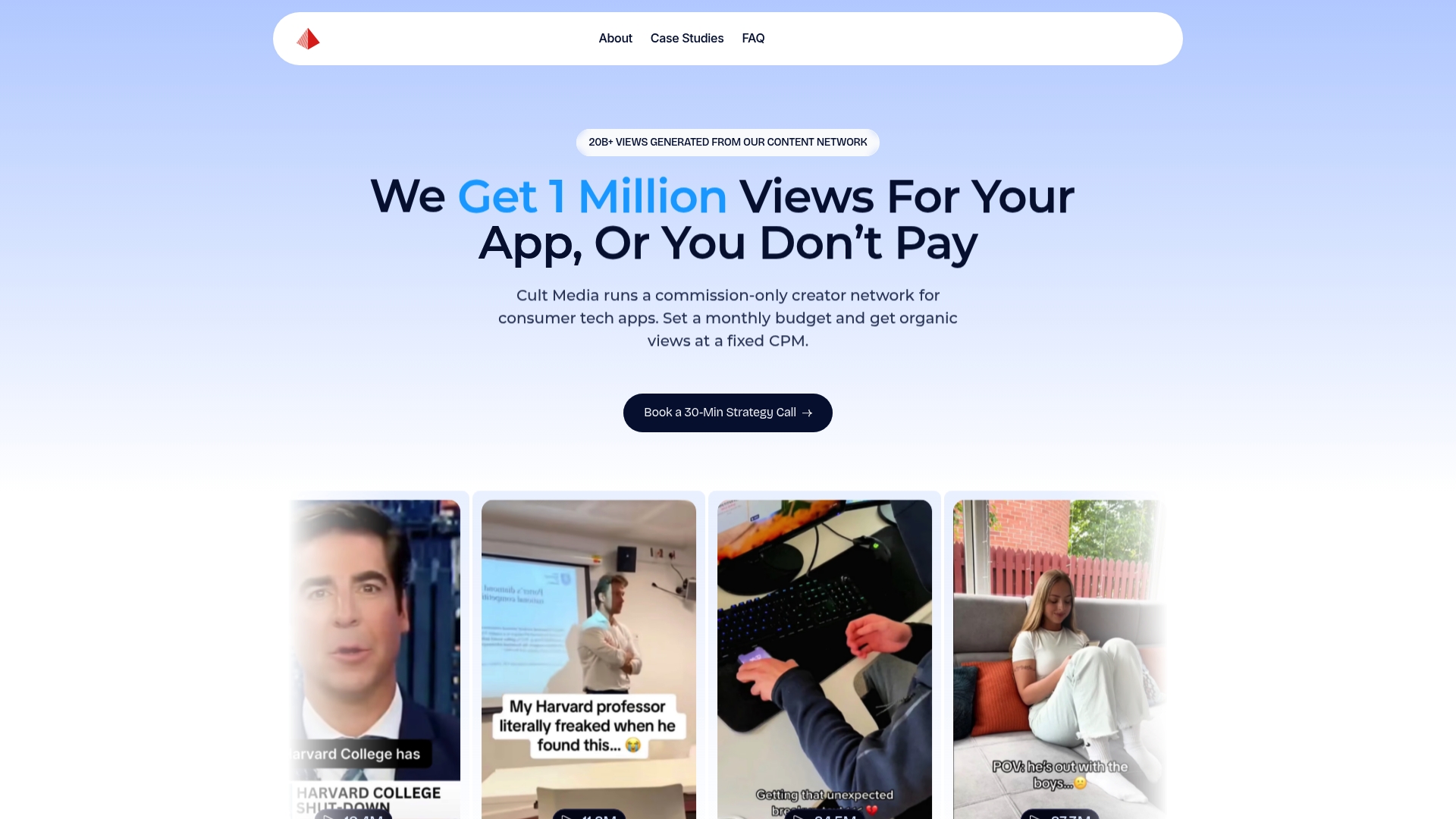
You can see what this looks like in practice in our case studies, including 42,500 signups from organic UGC and the content engine behind 0G Labs. Ready to talk through your app? Start here.
A 30-day plan to get started
Teams often ask for a concrete starting sequence. This is the one we would use.
Week 1: Foundations. Write the positioning sentence, collect tensions from reviews and support, and draft three to five pillars. Build the scorecard and agree on a pass mark.
Week 2: Sourcing. Shortlist creators per pillar. Watch recent content with and without sound, read comments, and check rights terms. For help with sourcing channels, see our guide to the best UGC platforms for consumer app growth.
Week 3: Production. Send briefs with one angle each. Request alternate hooks so you can test openings without re-shooting. Keep the creator's voice intact.

Week 4: Read and decide. Compare by angle, then by creator. Kill the weak angles, scale the strong one, and update the scorecard with what you learned. Our overview of creator campaign management explains how to keep this cycle running, and the high converting UGC tactics post goes deeper on creative.
Common mistakes to avoid
- Choosing on follower count. Reach without relevance produces views and no installs.
- Testing too many angles at once. You cannot read the results, and creators receive muddled briefs.
- Over-scripting. Briefs that dictate every line strip out the native feel that earns attention.
- Judging on views alone. Track trial starts, paid conversion, and cost per acquired user by angle.
- Ignoring the funnel. If the landing path or onboarding is weak, even perfect fit will look like failure.
- Skipping rights and claims. Problems surface later, when a winning video cannot be used in paid.
More articles on creators and paid growth are collected in our insights library.
FAQ
What is brand creator fit?
It is how well a creator's content, audience, and style align with your brand's product, tone, and goals. For an app, it also means the creator can demonstrate the product naturally and their audience has the problem your app solves. Judge it by recent posts and audience comments, not follower count.
How do I know if a creator fits my app?
Score them on hook, product demo, audience fit, delivery, reliability, rights, and claims. Watch recent videos with sound off and then on, and read the comments for signs of relevant use cases. Then confirm with a small paid test against one clear angle.
How many content pillars should an app have?
Three to five is a practical range. Each pillar should come from a real audience tension and be testable with at least three creators. More than that spreads your budget thin and makes results hard to compare.
Can creators really test a value proposition?
Yes, if you change only the angle and keep the call to action, tracking, and landing path the same. Use more than one creator per angle so you separate the idea from the person. Compare trial starts and paid conversions by angle before scaling.
Do creator posts for apps need disclosure?
In the US, yes when the creator was paid or received something of value, since the FTC expects material connections to be disclosed clearly and conspicuously. Put the requirement in the brief and check posts before they go live.
Sources
- Product-to-Creator Fit: Creator Vetting Framework
- How to Find UGC Creators for Your App
- Creator Marketplace: How Brands Vet Creators
- Find an angle worth testing
- UGC Brief Guide: App Store Compliance 2026
- Mobile App Marketing Guide 2026
- The Modern Creator Playbook
- The UGC Playbook for Apps
- FTC's Endorsement Guides: What People Are Asking