Four templates cover almost every campaign you'll run: a one-page performance UGC brief, an influencer/campaign execution brief, a TikTok/Reels UGC brief built around hooks and beats, and a fuller campaign brief for multi-deliverable partnerships. Use the one-page version for paid UGC ad testing, the execution brief for organic or whitelisted influencer work, and the beat-based template whenever the deliverable is short-form video.
Each format solves a different problem. The one-page brief exists because short, constrained briefs reduce unusable creative and speed up turnaround compared to longer documents that bury the goal in paragraphs. The execution brief exists because paid partnerships need explicit usage rights and payment terms in writing. The beat-based brief exists because short-form video lives or dies in its first three seconds, and creators need timecodes, not vibes.
Copy-paste templates and three fully worked examples follow below, along with the field-by-field checklist that separates a brief creators can act on from one that gets you a confused first draft.
- One-page performance UGC brief — for paid ad testing where you need multiple hook variations fast
- Influencer/campaign execution brief — for organic or whitelisted influencer partnerships with usage rights
- TikTok/Reels beat-based brief — for any short-form video deliverable, regardless of platform
- Full campaign brief — for multi-creator, multi-deliverable partnerships spanning weeks
Key Takeaways
A creator brief succeeds when it commits to one goal, one measurable CTA, and enough structure to prevent ambiguity without dictating every word the creator says.
| Point | Details |
|---|---|
| Use the one-page rule | Cap performance UGC briefs at one page to force a single goal and hook, not three. |
| Write one persona, not a segment | Describe one named human with a specific frustration in 15 to 25 words. |
| Separate briefs per hook | Test multiple angles with individual one-page briefs instead of one document listing four hooks. |
| Send calibration examples | Pair every brief with one video that worked and one that missed, instead of long do/don't lists. |
| Tie payment to verified performance | Cult Media's commission-only network bills clients per guaranteed view, so briefs double as the measurement contract. |
Table of Contents
- What Is a Creator Brief, and What Must It Actually Do?
- The Canonical Brief Checklist: Fields to Copy Into Your Template
- Copyable Templates and Three Worked Examples
- The TikTok/Reels UGC Brief: Hooks, Beats, and Specs
- Common Brief Mistakes That Kill Creative Quality
- How Cult Media Briefs Creators for Guaranteed-View Campaigns
- Running Briefs Through a Live Campaign Without Losing Weeks
- What Fifteen Minutes With a Bad Brief Taught Me
- Turn Better Briefs Into Guaranteed Views
- Templates and Guides Worth Bookmarking
- Sources
- FAQ
What Is a Creator Brief, and What Must It Actually Do?
A creator brief is a working document that tells a creator what to make, why it matters, and what "done" looks like, without dictating every line of dialogue. It's not a script. A script tells someone exactly what to say; a brief tells them what problem the content needs to solve and trusts them to solve it in their own voice. That distinction is where most briefs go wrong; brands confuse briefing with directing, and the resulting content sounds like an ad instead of a person talking.
A good brief has to do one job well: give the creator a single primary goal and one measurable call to action. Everything else in the document, tone notes, product context, hooks, exists to support that one goal. If your brief lists three objectives (drive downloads, build brand awareness, and generate UGC for paid), you've written three briefs stapled together, and the creator will pick whichever one seems easiest.
Use a brief when you're commissioning content from a creator who has creative latitude. Use a contract or statement of work instead when the terms (payment, exclusivity, usage duration) are the primary concern and the creative direction is already locked. Use a full proposal when you're pitching the campaign concept to a client or stakeholder before any creator is involved.
- Definition: a working brief, not a script
- Primary job: one goal, one measurable CTA
- Use case fit: brief for creative latitude, contract for locked terms, proposal for internal pitching
The Canonical Brief Checklist: Fields to Copy Into Your Template
Every high-converting creator brief, whether it's for a nano-creator's first paid UGC piece or a six-figure influencer campaign, converges on the same set of fields. Industry templates treat these as the minimum, not the maximum:
- Campaign goal (10 to 20 words). One sentence. "Drive app installs from women 25 to 34 who've tried three other habit trackers and quit."
- Key message (one sentence). The single idea the viewer should walk away with, not a list of features.
- Target persona (15 to 25 words). One human, not a demographic slice. "Maya, 28, downloads productivity apps constantly, deletes them within a week, and is tired of feeling like she's the problem."
- Product context and allowed claims. What the product does, what it does not do, and any compliance language (health claims, financial claims) the creator legally cannot say.
- Required hooks (3 to 4 options). Give creators a menu, not a mandate. Let them pick the angle that fits their voice.
- Deliverables and specs. Format, length, aspect ratio, number of versions, platform destination.
- Shot list or beat outline. Loose enough to preserve improvisation, specific enough to prevent a wasted first draft.
- Disclosure and legal requirements. Where "#ad" or "#partner" goes, and which regulatory standard applies to the market you're shipping in.
- Usage rights and whitelisting terms. Organic only, or can the brand run this as a paid ad? For how long?
- Timeline, payment, and reporting metrics. Submission date, payment trigger, and what proof of performance the creator needs to hand over.
The word caps matter more than they look like they should. A persona description that runs 80 words usually means you haven't actually decided who you're targeting; you're describing a segment. A goal statement that needs two sentences usually means you have two goals. Constraint forces clarity, and a brief you can't fit on one page is usually a brief where the primary hook hasn't actually been chosen yet.
Pro Tip: If you're testing multiple hook angles for the same product, write a separate one-page brief per hook instead of listing all four hooks in a single document. Creators produce sharper, more testable assets when the brief commits to one angle instead of asking them to choose.
Before a creator accepts a brief, they should be able to answer these five questions without emailing you back:
- Do I know exactly what action the viewer should take after watching?
- Do I know what I'm legally not allowed to say about this product?
- Do I know whether this brand can run my content as a paid ad?
- Do I know when I'm getting paid and what triggers it?
- Do I have at least one example of the tone this brand wants?
If a creator can't answer all five from the document alone, the brief needs another pass before it goes out.
Copyable Templates and Three Worked Examples
Here's the one-page performance UGC brief, filled in for a fictional D2C skincare brand testing paid ad creative:
Goal: Drive purchases of the Overnight Retinol Serum from women 30 to 45 with early fine lines who've tried drugstore retinol and found it too harsh. Key message: A gentler retinol that still works, without the peeling. Persona: Dana, 38, has sensitive skin, has quit two retinol products from irritation, and is skeptical of "gentle" claims because she's been burned before. Allowed claims: "Clinically formulated for sensitive skin." Do not say "no irritation" or "instant results." Hooks (pick one): (1) "I quit retinol twice before this one." (2) POV: showing the bottle with a skeptical face. (3) "Dermatologists told me to stop using retinol. Here's what changed." (4) Side-by-side of old irritated skin vs. now. Deliverables: One 30 to 45 second vertical video, raw footage plus one edited cut. Disclosure: "#ad" in the first line of caption and verbally stated if talking to camera. Timeline: Draft due five days from brief acceptance; payment on approval plus verified delivery.
The influencer/campaign execution brief adds the fields a paid partnership needs that a one-page performance brief doesn't: usage rights, exclusivity, and reporting. For an app-install campaign, that means specifying whether the brand can whitelist the post as a paid ad, for how many days, and what analytics screenshot proves the creator's organic reach before payment releases. Detailed execution briefs that spell out deliverables, usage rights, and reporting cut down on the back-and-forth that otherwise eats a week of a campaign timeline.
A full organic influencer brief example, for a budgeting app targeting college students, would specify: tone (funny, self-deprecating, not corporate), three do's ("show your actual bank app," "keep it under 60 seconds," "use trending audio if it fits"), two don'ts ("don't say 'get rich'," "don't read from a script on camera"), and expected deliverables (one TikTok, one Instagram Story repost, raw files within 48 hours of posting). The brand never dictates dialogue. It dictates the boundaries dialogue has to stay inside.

The TikTok/Reels UGC Brief: Hooks, Beats, and Specs
Short-form video has a nonnegotiable rule: the first three seconds decide whether anyone watches the rest. If your brief doesn't address the hook explicitly, the creator will improvise one, and you'll get a scroll-stopper about half the time. Address it directly and you shift the odds in your favor.
Give creators a menu of four hook types rather than one mandatory line:
- Confession hook. "I was skeptical about this until..."
- Question hook. "Why does nobody talk about this?"
- Visual cold open. Show the result before any words, then cut to explanation.
- Contrarian hook. "Everyone tells you to do X. Here's why that's wrong."
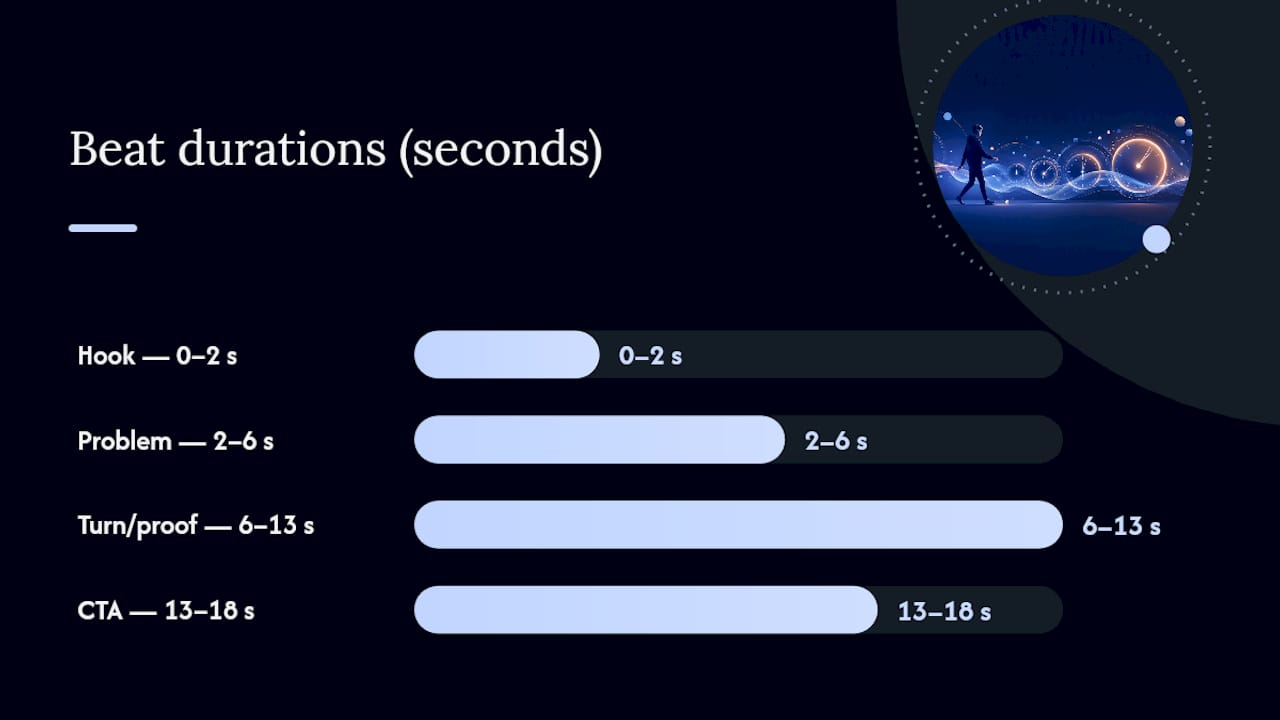
Below the hooks, lay out the video in beats with timecodes rather than a paragraph of instructions:
- 0 to 2 seconds: hook line or visual, no logo, no branding yet
- 2 to 6 seconds: the problem, stated fast and specific
- 6 to 13 seconds: the turn or proof, showing the product doing its job
- 13 to 18 seconds: clear call to action, spoken or on-screen text
Beat-based briefs with explicit timecodes and 3 to 4 hook openers consistently outperform loose creative direction because the creator knows exactly where the pressure points are and where they have room to play.
Specs stay simple: 9:16 vertical, 15 to 45 seconds depending on the platform's current sweet spot, and disclosure ("#ad" or "#partner") placed in the first line of on-screen text or spoken in the opening beat, not buried in a caption nobody reads. Watching current short-form video format trends will tell you whether 15 or 30 seconds is winning attention that month, since the sweet spot shifts.
The single most useful thing you can attach to any beat-based brief isn't more instructions. It's one example of a video that hit the brief and one that missed it, sent together. Creators calibrate faster against two examples than against three paragraphs of do's and don'ts.
Common Brief Mistakes That Kill Creative Quality
Most bad creative traces back to one of five brief failures, and every one of them is fixable before you hit send.
- Over-briefing. A five-page document with scene-by-scene dialogue produces content that sounds scripted, because it was. Stick to one page for performance UGC.
- Under-briefing. "Just talk about the app however feels natural" produces content with no hook and no CTA. Creators need a starting point, not a blank page.
- Generic audience descriptions. "Women 25 to 45 interested in wellness" describes a spreadsheet segment, not a human. Write one person with a name and a specific frustration.
- Missing or vague CTAs. If the brief doesn't name the one action you want, the creator won't either, and the video ends on a shrug.
- No usage rights clause. Skipping this guarantees a second, tenser conversation later when you want to run the content as a paid ad and the creator says no.
The operational fix for most of these is the same: one brief per hook when testing multiple angles, and one calibration link (a video that worked) attached every time.
How Cult Media Briefs Creators for Guaranteed-View Campaigns
Cult Media runs a commission-only creator network built around one constraint: clients pay per verified view, so every brief has to translate directly into measurable, billable performance. That changes what goes into the document. The goal line and the CTA aren't just creative guidance; they're the metric the payment trigger is built on.

Calibration matters more here than in a standard influencer campaign, since the network is testing multiple creators against the same hook simultaneously and needs consistent tone across dozens of assets. Whitelisting terms get spelled out up front, because a guaranteed-view model depends on knowing exactly which content can be amplified as paid media and for how long.
Before signing with any performance-based network or agency, ask three questions: What exactly triggers payment, a view count, a click, an install? Who owns the content after the campaign ends? And what happens if a creator's content underperforms the guaranteed threshold?
Pro Tip: Ask any performance-based partner to show you a sample brief before you sign. If the brief doesn't specify the payment trigger in writing, the guarantee isn't as firm as the pitch made it sound.
Running Briefs Through a Live Campaign Without Losing Weeks
A brief is only as good as the workflow around it. The sequence that keeps revision rounds low looks like this:
- Send the brief with a clear acceptance deadline, usually 24 to 48 hours.
- Collect concept or hook selection from the creator before any filming starts, so you catch direction problems early.
- Review the first draft against the brief's goal and CTA, not against your personal taste.
- Approve or request one round of specific revisions, tied to the brief's fields, not open-ended notes.
- Confirm the publish window and disclosure placement before it goes live.
- Collect reporting proof, analytics screenshots, raw files, and delivery confirmation, before releasing payment.
Ask for raw files alongside the edited cut every time; you'll need them if you decide to whitelist the content later. Structured briefs with clear approval and payment stages consistently shorten this cycle compared to open-ended direction.
- Version every brief (v1, v2) so creators and internal teams reference the same document.
- Set a rights renewal date if usage extends past the original campaign window.
- Keep a one-line "what worked" note per brief for the next campaign's calibration example.
A clear content moderation and approval workflow prevents the single biggest time sink in creator campaigns: ambiguous sign-off responsibility.
What Fifteen Minutes With a Bad Brief Taught Me
The worst brief I've reviewed listed four different campaign goals, six required talking points, and no CTA. The resulting videos were competent, well-lit, and completely useless, because the creators had correctly guessed there was no single job to do, so they made general brand content instead. The fix took fifteen minutes: delete three goals, write one CTA, done.
If you do nothing else after reading this, open your last brief right now and count the goals. If there's more than one, pick the single most important action you want the viewer to take, delete the rest, and resend it. That fifteen-minute edit will do more for your next batch of creative than any template swap.
— Jax
Turn Better Briefs Into Guaranteed Views
A tighter brief gets you better creative, but creative quality still doesn't guarantee the views or installs it takes to move CAC. Cult Media closes that gap with a commission-only creator network built specifically for consumer tech apps: you brief creators using the exact templates above, and Cult Media ties payment to verified views actually delivered, not impressions promised upfront.
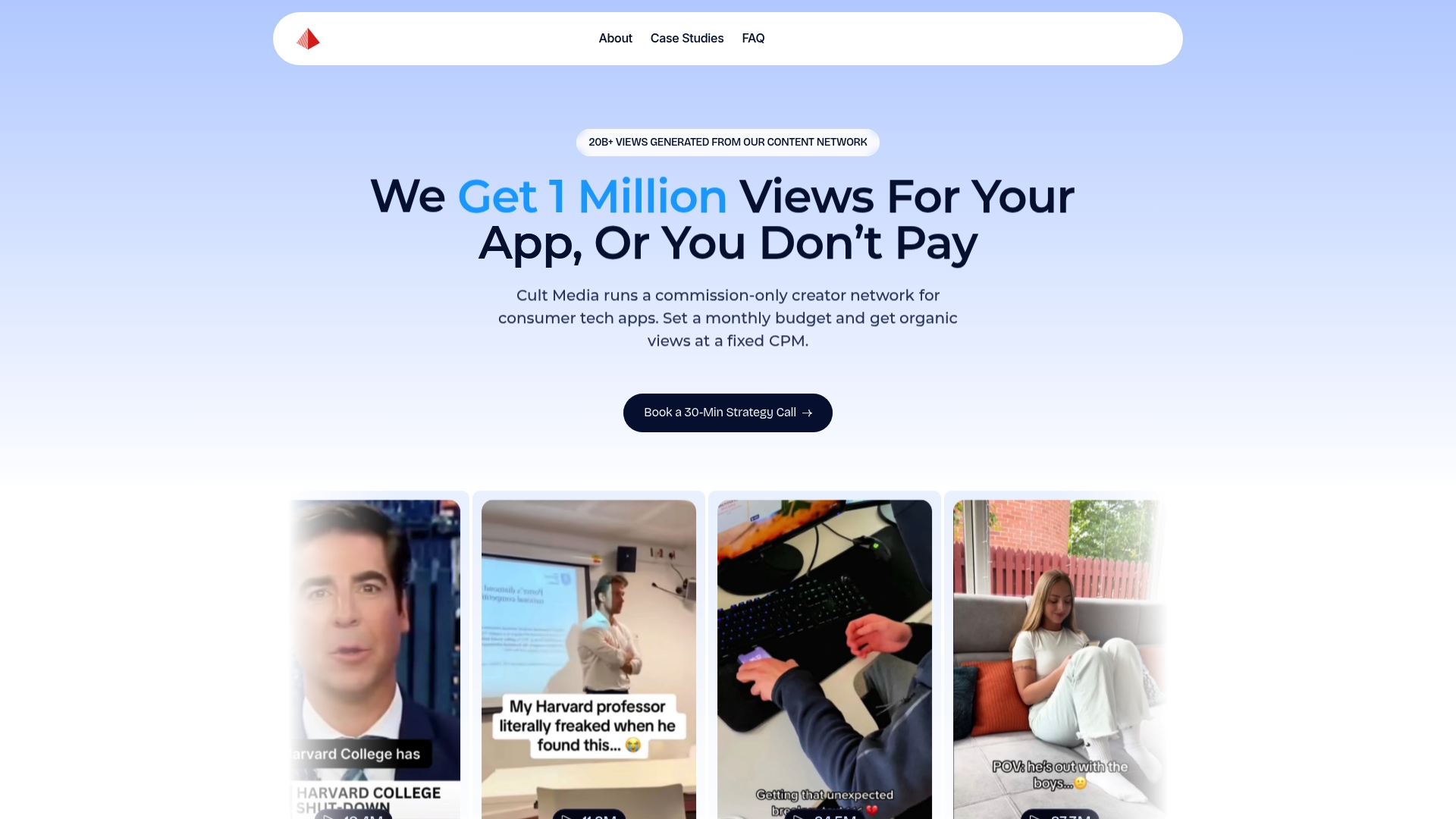
That structure matters most once your briefs are dialed in and you're ready to scale hook testing across more creators than an in-house team can manage alone. Rather than negotiating retainers and hoping the creative lands, you pay for performance you can verify. If your next campaign needs volume behind a brief you've already sharpened, see how Cult Media's guaranteed-view model works and check whether your app category fits the network.
Templates and Guides Worth Bookmarking
- AgencyChange's UGC creator brief template walks through the one-page format with a worked example you can adapt directly.
- Sponsorship covers the detailed execution fields, deliverables, usage rights, and disclosure, that paid partnerships require.
- Spark UGC's brief template and guidance is the strongest resource for beat-by-beat, timecode-based short-form briefs.
- Notion's influencer brief template gives you a ready structure to duplicate into your own workspace.
- MakeInfluence's influencer and UGC campaign brief template is useful for multi-deliverable campaign briefs spanning several weeks.
- The public influencer brief generator is a quick option if you want a fillable form instead of a static document.
- Cult Media's guide on micro versus macro influencer ROI helps size your creator persona field before you write the brief.
- Cult Media's UGC versus influencer marketing playbook helps you pick the right brief format based on whether you need reach or conversion.
Sources
- AgencyChange — UGC creator brief template and one-page example
- Sponsorship
- Spark UGC — UGC brief template and guidance
- Notion template — Influencer brief
FAQ
What Is the Best Example of a Creative Brief?
The strongest examples are one-page documents with a single goal, one persona, and 3 to 4 hook options, since short, constrained briefs reduce unusable creative far more reliably than long, multi-goal documents.
What Is an Example of a Brief Statement?
A brief statement is a single sentence combining the goal and audience, such as "Drive app installs from women 25 to 34 who've tried three habit trackers and quit." It should read as one clear line, not a paragraph.
What Are the Core Parts of a Creator Brief?
The essential fields are the campaign goal, key message, target persona, product context and allowed claims, hook options, deliverables and specs, disclosure requirements, usage rights, and timeline and payment terms. Most industry templates converge on this same set of fields regardless of platform.
How Long Should a Creator Brief Be?
A performance UGC brief should fit on one page; longer campaign briefs with multiple deliverables can run two to three pages but should still isolate one goal per hook being tested. If a brief can't be condensed to a page, the primary hook usually hasn't been chosen yet.
Does a Creator Brief Need to Specify Payment Terms?
Yes. Payment trigger, timeline, and reporting metrics belong in every brief, whether it's a one-page performance UGC document or a full influencer execution brief, so both sides agree on what "done" and "paid" mean before content is filmed.