
The dominant short-form video trends in 2026 cluster around three non-negotiable priorities: UGC-first creative, AI-assisted production at scale, and platform-native optimization tuned to attention and completion signals. Short-form now accounts for roughly half of the global video ad spend, and a large majority of marketers report sub-60-second content delivers the highest ROI of any video format. If you are allocating creative budget without a UGC pipeline and a repurposing workflow, you are already behind.
Three actions to take this week:
- Produce UGC-style videos at scale. Aim for at least 20 creator variants per campaign cycle, not 3–5 polished brand spots.
- Build an AI-assisted repurposing pipeline. Convert every long-form asset into platform-native short cuts before you shoot anything new.
- Run platform-specific duration tests. The 60–90-second sweet spot for monetization and rewatch is real, but it varies by platform and vertical.
Pro Tip: Before you test hooks, audit your last 30 days of short-form data for first-3-second drop-off rate. That single metric tells you whether your creative problem is the hook or the body.
Key Takeaways
Short-form video in 2026 is won by teams that combine UGC-first creative, AI-assisted production volume, and platform-native optimization tuned to attention and completion signals.
| Point | Details |
|---|---|
| UGC volume is the creative baseline | Produce at least 20 creator variants per campaign cycle to outpace creative fatigue. |
| Animated captions are non-negotiable | 86.6% of analyzed creator exports use captions; silent-first design directly drives completion rate. |
| Platform signals differ by destination | TikTok rewards rewatch and 60–90s formats; YouTube Shorts favors 30–60s; Instagram penalizes reposts. |
| Attention KPIs outrank raw views | First-3-second survival rate and watch-through rate predict distribution and downstream install performance. |
| Cult Media | Commission-only creator network for consumer apps; clients pay per verified view, not per retainer month. |
Table of Contents
- Short-form video trends 2026: priority snapshot
- 1. Short-form is the default attention product — here's how to win the first 3 seconds
- 2. UGC and creator content are now the creative baseline, not a supplement
- 3. AI-assisted production lets you scale volume without burning through creative
- 4. Personalization and localization at scale are now operationally achievable
- 5. Platform-specific optimization: what changed per platform in 2026
- 6. Captions and silent-first design are non-negotiable for retention
- 7. The KPI stack that actually matters for short-form in 2026Prioritize attention signals first, then downstream conversion. Raw view counts are a vanity metric. The KPIs that predict whether a short-form campaign drives installs and revenue are first-3-second survival rate, watch-through rate, rewatch rate, CTR on the CTA, and cost per install (CPI).
- 8. Monetization and creator partnerships: the paid-plus-organic model
- 9. Tools and workflows to scale short-form production in 2026
- 10. When a performance-based creator network is the right choice
- 11. A practical 90-day roadmap to adopt the top short-form trends
- 12. Audience segmentation and targeting for short-form platforms
- 13. Privacy and data considerations for short-form video strategies
- 14. AR and VR integration in short-form video
- What these trends actually mean for campaign outcomes
- Cult Media delivers guaranteed views, not retainer invoices
- Sources
- FAQ
Short-form video trends 2026: priority snapshot
The table below maps each major trend to its estimated impact level and the fastest window to validate it.
| Trend | Impact | Time to Test |
|---|---|---|
| UGC-first creative style | Very High | 30 days |
| AI-assisted repurposing | High | 30 days |
| Platform-native duration optimization | High | 30 days |
| Animated captions and silent-first design | High | 30 days |
| Personalization and localization at scale | Medium–High | 90 days |
| Creator partnership and commerce stacking | Medium–High | 90 days |
| AR/VR format integration | Medium | 180 days |
| Privacy-first targeting architecture | Medium | 90 days |
Short-form's share of global video ad spend has crossed the halfway mark of total video budgets, making it the single largest video investment category. Platforms are rewarding content that earns rewatches, not just views, which means completion rate and rewatch rate now outrank raw impression volume as planning signals.
- UGC-style content consistently outperforms polished brand creative on trust and CTR metrics.
- Animated captions appear in 86.6% of analyzed creator exports, making caption-first design a production baseline, not an option.
- Platform-level data confirms that YouTube Shorts, TikTok, and Instagram Reels each reward different duration and format signals.
Stat: 77% of marketers say short-form video under 60 seconds delivers the highest ROI of any video format they use.
1. Short-form is the default attention product — here's how to win the first 3 seconds
Algorithms on TikTok, YouTube Shorts, and Instagram Reels all use early-exit signals to decide distribution. If viewers leave in the first 3 seconds, the platform suppresses the video before it reaches a meaningful audience. Rewatch rate functions as a secondary amplifier: a video that earns replays gets pushed into broader distribution pools regardless of its total view count.
The practical implication is that your hook is not a creative flourish. It is a distribution lever.
What to test in your next creative sprint:
- 3-second interrupt: Open mid-action or mid-sentence. Drop context entirely and force the viewer to stay to understand what is happening.
- Question-based hook: Lead with a question that names a specific pain point your audience already has ("Why does your app's install rate drop after the first ad view?").
- Bold statement hook: Make a claim that is counterintuitive or specific enough to create friction ("Most UGC campaigns fail in week 3, not week 1.").
- Micro-cut pacing: Keep individual cuts to 2–5 seconds in the first 10 seconds of the video. Rapid visual change sustains attention before narrative context is established.
Statista's TikTok duration data confirms that platform duration distributions have shifted, with creators increasingly producing content in the 60–180-second range, which means the sub-30-second format now competes less for algorithm favor on TikTok specifically.
Pro Tip: Test two hooks per creative concept, not two full videos. Swap only the first 3 seconds and hold everything else constant. This isolates the hook variable and gives you clean data within a single campaign cycle.
2. UGC and creator content are now the creative baseline, not a supplement
UGC-style short-form outperforms polished brand ads on trust and conversion. The reason is structural: platform algorithms treat native-looking content as less likely to be skipped, and viewers process creator-style delivery as peer recommendation rather than advertising. The cost advantage compounds this: a single high-production brand spot costs multiples of what a batch of 20 creator clips costs, and the creator batch generates more usable data.
Key operational moves:
- Volume target: Produce a minimum of 20 UGC variants per campaign cycle. Creative fatigue on short-form platforms typically sets in within 7–14 days of a single creative running at scale.
- Brief structure: A functional creator brief covers the hook format (question, bold claim, or demo), the core benefit to communicate, the call-to-action, and any compliance or disclosure requirements. Keep it to one page.
- Rights and usage terms: Secure perpetual usage rights for paid amplification in the initial contract. Retroactive rights negotiations slow down whitelisting and paid seeding workflows.
- Diversity of format: Mix talking-head, screen-record, voiceover-only, and reaction formats across your creator batch. Different formats perform differently by platform and audience segment.
Sample creator brief structure:
- Hook format: [question / bold statement / demo]
- Core message: [one sentence — the single benefit to communicate]
- Visual requirement: [product shown in first 5 seconds / app screen visible / no competitor mentions]
- CTA: [specific phrase or action]
- Disclosure: [#ad or #sponsored per FTC guidelines]
- Deliverable: [raw file + caption text, delivered within X days]
Pro Tip: Ask creators to submit two hook variations per brief. You get double the test data at no additional production cost, and you identify which hook style fits each creator's natural delivery.
For a deeper look at how to evaluate and select UGC platforms for consumer apps, Cult Media's resource covers the key criteria growth teams use to compare sourcing and management workflows.

3. AI-assisted production lets you scale volume without burning through creative
AI's role in short-form production in 2026 is not to replace creators. It is to close the production gap between the volume of content platforms reward and the volume human teams can produce manually. Analysis of 756,851 creator exports found that 55.3% of videos used AI voiceovers, confirming that faceless, AI-narrated formats are now a mainstream production choice, not an experimental one.
The hub-and-spoke workflow is the most reliable production architecture for teams scaling short-form:
- Hub: One original long-form asset (a 10-minute tutorial, a podcast episode, a product demo) serves as the source.
- Spokes: AI-assisted tools clip, caption, translate, and reformat the hub into platform-native variants for TikTok, YouTube Shorts, Instagram Reels, LinkedIn, and X.
- Variant testing: Each spoke becomes a test cell. You measure hook performance, completion, and CTR per variant, then rotate the top performers into paid seeding.
Implementation steps:
- Select tools with native caption generation, aspect-ratio conversion, and multi-language output.
- Set a freshness threshold: rotate creatives before day 14 if frequency-per-user exceeds 3 exposures.
- Label AI-generated content per platform policy. TikTok and YouTube both require disclosure for AI-generated or AI-altered content.
- Track variant fatigue by monitoring CTR decay. A drop of more than 30% from peak CTR signals that a creative needs rotation.
"The risk with AI-assisted production is not quality — it is homogeneity. When every team uses the same repurposing tool with default settings, the output converges on the same pacing, the same caption style, and the same hook structure. The teams that win are the ones that use AI for volume and human creative judgment for differentiation." Kineclip's 2026 trend analysis supports this, noting that AI-assisted uploads are growing to a notable share of new content while platform algorithms are simultaneously improving at detecting and deprioritizing templated output.
This is your differentiation layer. AI handles the volume; humans handle the signal.*
4. Personalization and localization at scale are now operationally achievable
Personalized and localized short-form content materially increases reach and conversion when produced at scale using AI audio, auto-translate, and region-specific editing. The barrier used to be cost and turnaround time. AI voice cloning and translation tools have reduced both to the point where a single campaign can produce regional variants in 5–10 languages within the same production cycle.
When to localize vs. use global creative:
- Localize when your target market has a primary language other than English and your category has local competitors.
- Localize when Pew Research Center data or platform analytics show significant demographic concentration in a specific language group.
- Use global creative when your product's core visual demonstration is language-independent (app UI walkthroughs, before/after formats).
- Localize audio before subtitles when the creator's delivery style is central to the hook's credibility.
Operational checklist for batching localization:
- Produce the master version with clean audio separation (voice track isolated from music/SFX).
- Run AI translation on the voice track, then have a native speaker review the output for tone and idiom accuracy.
- Adjust pacing: some languages run 15–20% longer at natural speaking speed, which affects caption sync and video duration.
- Test regional variants as separate ad sets with separate budgets before consolidating spend.
Pro Tip: Build localization into the creator brief from day one. Ask creators to deliver a version with a 2-second silent pause after the hook — this gives your localization team a clean insertion point for dubbed audio without re-editing the full video.
5. Platform-specific optimization: what changed per platform in 2026
Each major short-form platform rewards different signals in 2026. Running the same creative across all four without format adaptation leaves significant distribution on the table.
| Platform | Key 2026 Signal | Optimal Duration | One Action to Test First |
|---|---|---|---|
| TikTok | Rewatch rate + >60s monetization threshold | 60–90s | Test a 75s narrative arc with a mid-video hook reset |
| YouTube Shorts | Daily view volume + 30–90s sweet spot | 30–60s | Test a 60s demo with a hard CTA near the end |
| Instagram Reels | Original audio preference + repost detection | 15–60s | Use original audio or trending sounds; avoid TikTok watermarks |
| Professional context signals + dwell time | 30–60s | Lead with a data point or industry claim in the first 5 seconds | |
| X (Twitter) | Autoplay completion + reply engagement | 15–30 seconds | Test a bold claim format that invites reply or quote-post |
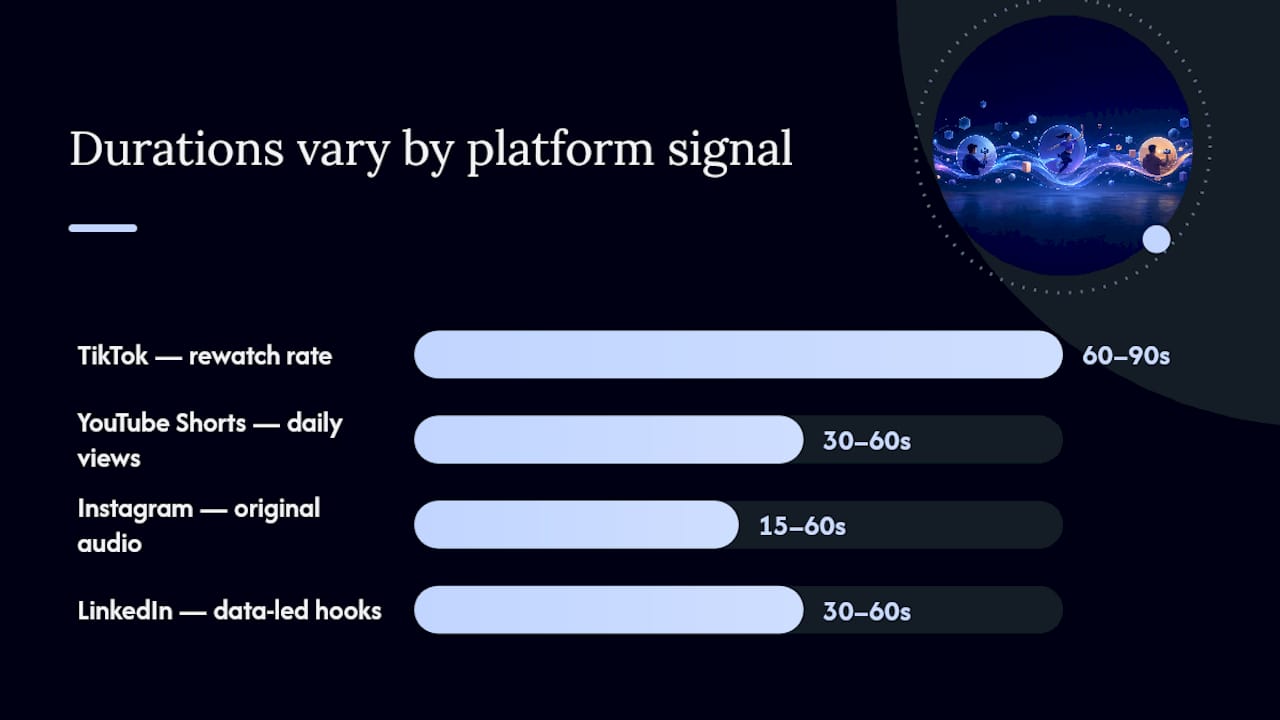
Platform-level view data confirms that YouTube Shorts and TikTok each generate massive daily view volumes, but the audience behavior and content discovery mechanics differ enough to require separate creative strategies.
Key format notes:
- TikTok detects and suppresses cross-posted content with Instagram or YouTube watermarks. Export clean versions for each platform.
- Instagram Reels deprioritizes content that its algorithm identifies as previously published on another platform.
- YouTube Shorts now supports monetization for videos over 60 seconds, which has shifted creator incentives toward the 60–90s range.
- LinkedIn's short-form feed rewards professional framing: data-led hooks and industry-specific language outperform lifestyle or entertainment formats.
6. Captions and silent-first design are non-negotiable for retention
Revid.ai's analysis of 756,851 videos found that 86.6% used captions, with animated captions being the dominant style. This is not an accessibility feature anymore. It is a retention mechanism. A significant share of short-form video is consumed in silent or low-volume environments, and viewers who cannot follow the audio without captions exit early, which tanks completion rate and distribution.
How to implement caption-first design:
- Use animated, word-by-word captions rather than static subtitle blocks. Animated captions maintain visual attention between cuts.
- Place captions in the lower-center or center of the frame, avoiding the bottom 15% where platform UI overlays appear.
- Use high-contrast text (white with a dark outline or shadow) that reads clearly on both light and dark backgrounds.
- Keep caption font size large enough to read on a 5-inch mobile screen without zooming.
- Sync captions to the speaker's natural emphasis points, not just word-by-word timing. Emphasis-synced captions feel more dynamic and hold attention longer.
Additional format considerations for silent viewers:
- Open with on-screen text that restates the hook visually, even when the creator speaks it aloud.
- Use visual cues (arrows, highlights, zoom cuts) to direct attention without relying on audio.
- Avoid music-only intros longer than 1 second. Silent viewers will exit before the spoken content begins.
Stat: Animated captions appear in 86.6% of analyzed creator exports, making them the production standard for short-form content in 2026.
7. The KPI stack that actually matters for short-form in 2026Prioritize attention signals first, then downstream conversion. Raw view counts are a vanity metric. The KPIs that predict whether a short-form campaign drives installs and revenue are first-3-second survival rate, watch-through rate, rewatch rate, CTR on the CTA, and cost per install (CPI).
| KPI | Benchmark Range | Notes |
|---|---|---|
| First-3s survival rate | 60% | Below 60% signals a hook problem |
| Watch-through rate (full video) | about 50% | Varies by duration; shorter videos trend higher |
| Rewatch rate | 5–15% | Strong rewatch signals algorithm amplification |
| CTR (swipe-up / link) | 1–3% | Higher for UGC vs. brand creative |
| CPI (consumer apps) | Varies by vertical | Use platform benchmarks as directional only |
Benchmark ranges are directional. Vertical, region, and platform all affect expected values.
A simple A/B test cadence for short-form:
- Run two hook variants against the same audience for 7 days with equal budget split.
- Check first-3-second survival rate at day 3 as an early signal. Do not optimize spend before day 3.
- At day 7, compare watch-through and CTR. The variant with higher watch-through and CTR wins.
- Scale the winning variant and introduce a new challenger hook in week 2.
Pro Tip: Set your attribution window to 24–48 hours for short-form campaigns driving app installs. Longer windows inflate CPI by attributing organic installs to paid creative. For organic vs. paid view attribution, the distinction matters significantly when reporting campaign ROI.
8. Monetization and creator partnerships: the paid-plus-organic model
Stacking revenue across platforms and mixing paid distribution with organic creator content is the dominant monetization model for short-form in 2026. Brands that treat creator content as purely organic leave significant paid amplification efficiency on the table. Creator whitelisting, where paid ads run from the creator's account rather than the brand's, consistently delivers lower CPA than brand-account ads because the creative retains its native, trust-signaling context.
Checklist for structuring paid-plus-organic creator deals:
- Secure whitelisting rights in the initial contract. Retroactive negotiation adds weeks of delay.
- Define KPIs per deal type: organic posts target reach and engagement; whitelisted paid posts target CPI and CTR.
- Set a minimum posting frequency (e.g., 2 posts per week per creator) to maintain algorithm momentum.
- Include a content exclusivity clause for direct competitors during the campaign period.
Key metrics for creator business models:
- RPM (Revenue per Mille): Platform-paid revenue per 1,000 views. Relevant for creators evaluating platform mix.
- CPM (Cost per Mille): Brand's cost per 1,000 impressions in paid seeding. Use this to compare creator whitelisting vs. brand-account ads.
- CPA (Cost per Acquisition): The downstream metric that determines whether the creator partnership is profitable for the brand.
Commerce integration: shoppable clips on TikTok Shop and Instagram Shopping allow direct purchase from the video. For consumer apps, the equivalent is a deep-linked CTA that routes to the app store listing. Track post-click install rate separately from organic install rate to isolate creator-driven conversion.
A brief legal note: the FTC requires clear disclosure for paid creator partnerships. "#ad" or "#sponsored" must appear in the caption, not buried in a list of other hashtags. Platform-native disclosure tools (TikTok's "Paid Partnership" label, Instagram's branded content tag) satisfy this requirement and should be used in addition to caption disclosure.
9. Tools and workflows to scale short-form production in 2026
A lean production stack covers four functions: editing and formatting, AI-assisted repurposing, caption generation, and distribution with measurement. You do not need every tool in each category. You need one reliable tool per function and a clear handoff between them.
Core tool notes:
- Visla: AI-powered video creation and editing platform suited for teams producing scripted or structured short-form content at volume. Strong for turning text briefs into draft video assets.
- Vidico: Video production agency and platform focused on high-quality short-form for tech brands. Best for campaigns where production quality needs to match brand standards without a full in-house team.
- Opus.pro: AI repurposing tool that clips long-form video into short-form highlights with automated captions and aspect-ratio conversion. Designed specifically for the hub-and-spoke workflow.
- Cult Media: Commission-only creator network for consumer tech apps. Delivers guaranteed-view campaigns through managed creator partnerships, with performance-based pricing tied to verified organic views.
Sample production pipeline:
- Campaign brief: Define hook formats, core message, CTA, and compliance requirements.
- Creator output: Managed creators produce raw clips per brief. Target 20+ variants per campaign.
- AI clean and translate: Run clips through repurposing tools (Opus.pro for clipping, Visla for structured edits) to generate platform-native cuts and localized versions.
- Variant generation: Produce 2–3 hook variants per clip. Label each variant for A/B tracking.
- Paid seeding: Whitelist top-performing creator accounts and seed variants with paid budget. Start with equal split across variants.
- Measurement loop: Check first-3-second survival at day 3, watch-through and CTR at day 7. Rotate underperformers. Introduce new challengers in week 2.
Pro Tip: Build a creative rotation calendar at the start of each campaign. Assign a "retirement date" to each creative based on your average fatigue window (typically 10–14 days at scale). This prevents the common failure mode of running a single creative until CTR collapses.
10. When a performance-based creator network is the right choice
Use a performance-based creator network when you need guaranteed scale, transparent CPM, and predictable user acquisition outcomes for a consumer app. The model is specifically suited to growth teams that have validated their onboarding funnel and need volume, not teams still testing product-market fit.

How the model converts views into downloads: managed creators produce UGC-style content aligned to the app's core use case. The network distributes that content across TikTok, Instagram Reels, and YouTube Shorts. The brand pays only for verified views delivered, not for production time or platform impressions that do not convert. This aligns the network's incentive directly with the brand's UA outcome.
Vendor-selection checklist for a managed creator network:
- Guaranteed view minimums with verified delivery reporting (not estimated reach).
- Performance-based pricing tied to actual views, not retainer or flat-fee structures.
- Creator vetting process that matches creator audience demographics to the app's target user.
- End-to-end management: brief, production, distribution, and reporting handled by the network.
- Rights and whitelisting included in the base contract.
Cult Media's TikTok app marketing playbook covers the specific creator systems behind high-volume consumer app campaigns, including how to structure briefs and measure creator-driven installs.
Pro Tip: When negotiating a creator network contract, insist on three contract KPIs: guaranteed view floor, maximum CPM cap, and a creative rotation clause that requires fresh variants every 14 days. These three terms protect you from creative fatigue and cost overruns simultaneously.
11. A practical 90-day roadmap to adopt the top short-form trends
The fastest teams prioritize execution over planning. The 90-day window below is designed to get a short-form program from baseline to optimized with clear milestones and role assignments.
Days 1–30: Foundation
- Audit existing short-form assets for first-3-second survival rate and watch-through rate.
- Brief and onboard 5–10 creators. Produce first batch of 20 UGC variants.
- Set up the repurposing pipeline (hub-and-spoke) for any existing long-form content.
- Launch first A/B hook test on the highest-priority platform (TikTok or YouTube Shorts based on your audience).
- Establish baseline KPIs: first-3s survival, watch-through, CTR, and CPI.
Role assignments for Days 1–30:
- Creative team: brief development, creator onboarding, first batch production.
- Paid media: campaign setup, budget split for A/B test, attribution window configuration.
- Data/analytics: KPI dashboard setup, day-3 and day-7 checkpoint schedule.
- Legal: FTC disclosure review, creator contract rights clauses.
Days 31–60: Optimization
- Rotate underperforming hooks. Scale the top 3 variants from the first test.
- Launch localization for the top-performing creative in 2–3 regional variants.
- Add animated captions to all active creatives if not already implemented.
- Test creator whitelisting on the top-performing creator account.
- Review CPI against platform benchmarks. Adjust bid strategy if CPI exceeds target by more than 20%.
Days 61–90: Scale
- Expand creator roster to 15–20 active creators producing weekly.
- Implement the full measurement loop: weekly creative rotation, bi-weekly KPI review, monthly creator performance audit.
- Evaluate AR/VR format tests on TikTok or Instagram if your product category supports visual demonstration.
- Decision gate: if CPI is within target and watch-through exceeds 35%, scale paid budget by 2x. If not, run a second hook test before scaling.
Success criteria: by day 90, you should have a validated hook format, a functioning repurposing pipeline, at least one whitelisted creator account, and a CPI trend line that is flat or declining.
12. Audience segmentation and targeting for short-form platforms
Short-form platforms have moved well beyond age and gender as the primary segmentation axes. Behavioral signals, interest clusters, and content consumption patterns now drive the most precise targeting available. Pew Research Center's 2025 social media usage data shows distinct demographic concentrations across platforms, which directly informs where to allocate creative volume and budget.
Practical segmentation approach:
- Platform-first segmentation: Match your audience's platform behavior to your content format. TikTok skews toward younger demographics with high daily time-spent. LinkedIn short-form reaches professional decision-makers. YouTube Shorts spans the broadest age range.
- Interest-cluster targeting: Use platform interest categories (not just demographics) to reach users who are already consuming content adjacent to your product category.
- Lookalike audiences from install data: Upload your existing user list to build lookalike audiences on TikTok and Meta. These consistently outperform broad interest targeting for consumer app campaigns.
- Retargeting with short-form: Users who watched 50–75% of a short-form video but did not convert are a high-intent retargeting segment. Serve them a different hook format or a social-proof variant.
Behavioral signals to prioritize: completion rate by audience segment tells you which creative resonates with which user cluster. It is a targeting signal.
13. Privacy and data considerations for short-form video strategies
Privacy regulation is reshaping how short-form campaigns are measured and targeted. The deprecation of third-party cookies, state-level privacy laws (California's CPRA, Virginia's CDPA, and others), and platform-level data restrictions all affect attribution accuracy and audience targeting precision.
Key considerations for 2026 short-form campaigns:
- First-party data is the targeting foundation. Build email and phone number lists from owned channels and use them as the seed for platform lookalike audiences. This reduces dependence on platform-native interest targeting, which is increasingly restricted.
- Platform-level attribution tools are not neutral. TikTok's Attribution Analytics, Meta's Conversions API, and Google's enhanced conversions each attribute differently. Run a multi-touch attribution model alongside platform-reported data to get a more accurate picture of creator-driven installs.
- Consent and disclosure: FTC guidelines require clear disclosure for paid partnerships. State privacy laws may require additional consent mechanisms for retargeting pixels embedded in creator content landing pages.
- Data minimization in creator contracts: Specify what user data the creator's tracking links collect and ensure compliance with applicable state laws before campaign launch.
The practical implication: teams that build first-party data infrastructure now will have a structural targeting advantage as platform-level data access continues to narrow. Short-form campaigns that drive app installs generate first-party data at the point of install, making the install itself a data asset, not just a conversion event.
14. AR and VR integration in short-form video
Augmented reality filters and effects have been a feature of short-form platforms since Snapchat popularized them, but the integration is maturing in 2026. TikTok Effect House and Meta's Spark AR allow brands to create interactive AR experiences that users can apply to their own short-form content, effectively turning every user into a distribution node for the brand's creative.
Where AR adds measurable value in short-form:
- Product visualization: Consumer apps and physical products that benefit from "try before you buy" experiences see higher engagement with AR-enabled content. A finance app showing a live portfolio overlay or a fitness app showing a workout tracker in AR context creates a demonstration that static video cannot replicate.
- Branded effects as UGC amplifiers: When a branded AR filter goes viral, users generate content using it organically. This is UGC at zero marginal cost per piece of content.
- VR short-form: Spatial video formats are available on Apple Vision Pro and Meta Quest, but the audience is still small relative to mainstream short-form platforms. The 180-day test window in the priority table reflects this: VR short-form is worth monitoring, not prioritizing budget against in Q1 2026.
The practical constraint is production complexity. AR filter development requires technical resources beyond standard video production. For most consumer app teams, the highest-ROI entry point is using platform-native AR effects (existing filters, not custom-built ones) in creator briefs, rather than building proprietary effects from scratch.
What these trends actually mean for campaign outcomes
The 2026 short-form environment rewards teams that treat creative as a data product, not a brand expression exercise. Volume, testing cadence, and platform-native formatting matter more than production polish. The teams burning through creative fastest are not the ones with the biggest budgets. They are the ones with the tightest feedback loops between creative output and performance data.
Two observations from campaigns at scale: creator fatigue windows are shorter than most teams plan for. A creative that performs well in week 1 often shows measurable CTR decay by day 10, not day 21. Teams that plan 30-day creative cycles without rotation built in are effectively running dead creative for the last two weeks of every cycle.
The second observation is about the quality-versus-scale tradeoff. AI-assisted production solves the volume problem, but it introduces a homogeneity risk. When every team uses the same repurposing tool with default settings, the output converges. The differentiation layer is human creative judgment applied to hook development and creator selection, not to post-production polish.
Over-automation is a real failure mode. The teams that perform best use AI for the mechanical work (captioning, clipping, aspect-ratio conversion, translation) and keep human judgment in the loop for hook sequencing, creator matching, and creative direction. The moment a team automates the hook itself, they lose the signal that makes short-form work.
Cult Media delivers guaranteed views, not retainer invoices
Consumer tech app teams that need short-form scale without committing to a monthly retainer regardless of results have a direct alternative. Cult Media operates a commission-only creator network built specifically for consumer apps, charging per verified organic view delivered, not per hour of agency time or per impression estimated.
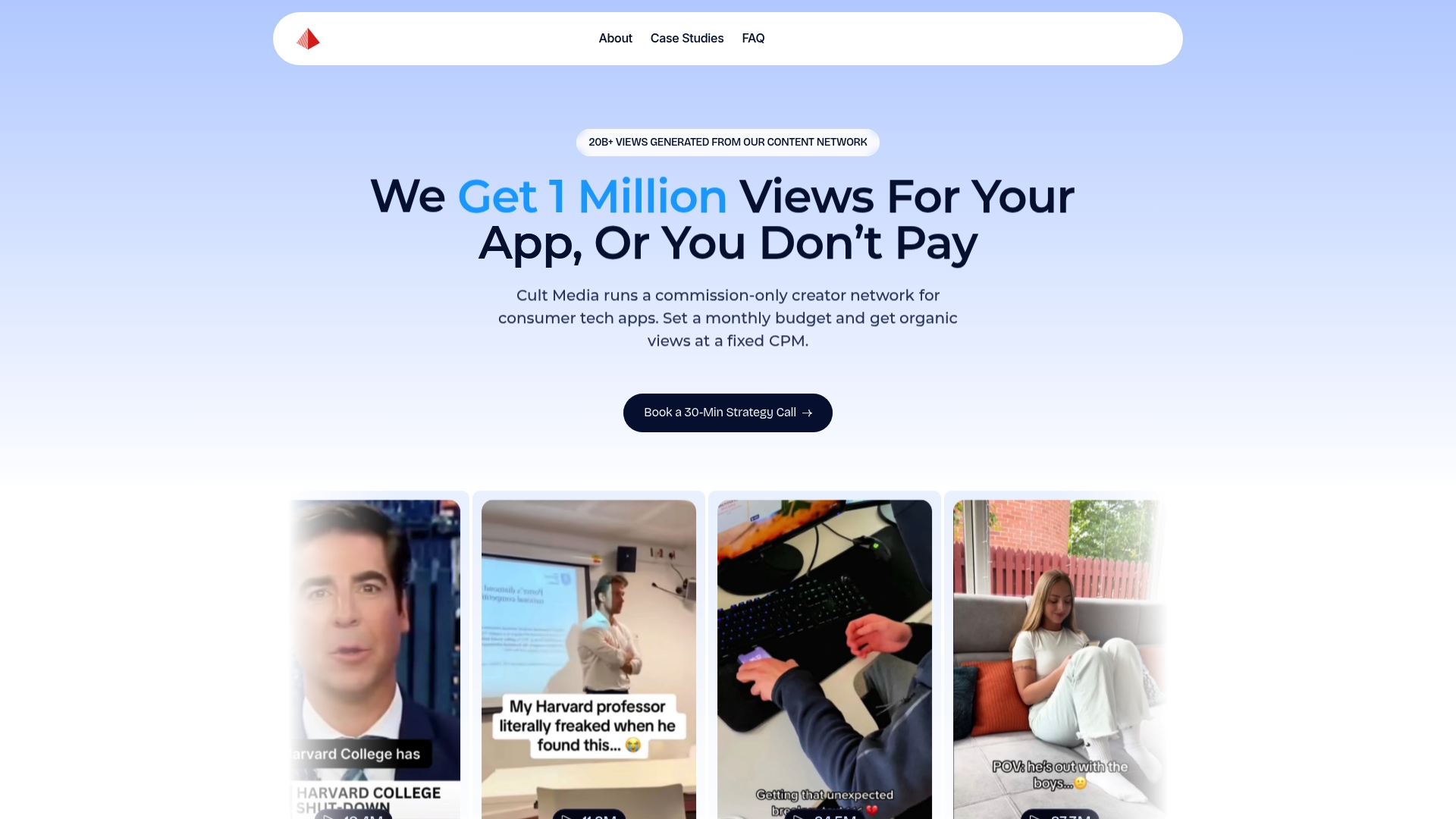
The model is straightforward: Cult Media manages creator briefs, production, distribution across TikTok, Instagram Reels, and YouTube Shorts, and performance reporting. Clients pay a fixed CPM only for views that are verified and delivered. There are no retainer fees, no production markups, and no ambiguity about what was delivered. For a consumer app team running a 90-day UA campaign, this means the budget goes entirely toward verified reach, not overhead.
Campaigns are structured around guaranteed view minimums with fresh creator variants rotating every 14 days to prevent creative fatigue. The first 90 days typically establish a validated hook format, a functioning creator roster, and a CPI trend line the team can project forward.
To see how the model works for your app category, visit Cult Media and request a campaign brief review.
Sources
The sources below provided benchmarks, platform data, and format analysis used throughout this article. Platform policies change frequently; check each platform's official creator documentation for the latest requirements before campaign launch.
- Short-Form Video Marketing Statistics 2026 (45+ Data Points) | ReelFlood
- Short-Form Video Trends 2026: TikTok, YouTube & Instagram
- Revid
- Short-Form Video Statistics: TikTok, Reels, and Shorts by the Numbers in 2026 | Kapwing
- TikTok video duration statistics | Statista
- Americans' social media use in 2025 | Pew Research Center
FAQ
What is the optimal short-form video length in 2026?
The 60–90-second range performs best for monetization and rewatch metrics on TikTok, while YouTube Shorts favors 30–60 seconds. Test both ranges against your specific audience before committing budget to one duration.
How many UGC variants should a campaign produce?
Aim for at least 20 creator variants per campaign cycle. Creative fatigue on short-form platforms typically sets in within 7–14 days of a single creative running at scale, so volume is a structural requirement, not a nice-to-have.
What KPIs matter most for short-form video campaigns?
First-3-second survival rate, watch-through rate, and rewatch rate are the primary attention signals. Downstream, track CTR on the CTA and cost per install. Raw view counts are a vanity metric without these supporting signals.
How does a commission-only creator network differ from a traditional agency?
A commission-only network like Cult Media charges per verified view delivered, not per month of retainer. Clients pay only for results, which aligns the network's incentive directly with the brand's user acquisition outcome.
Are animated captions required for short-form video?
They are now a production baseline, not an optional accessibility feature.