
Creator-led growth (CLG) is a performance-oriented acquisition strategy in which content creators produce and distribute authentic content that drives measurable business outcomes, with that traffic funneled into owned channels like CRM, SMS, and community for compounding retention. The single most actionable step you can take today: run a 30-day pilot with five creators, a tracked CTA link, and a dedicated landing page, then measure capture rate into your owned channel first. Brief your growth lead and one creator-relations owner before anything else, and set capture rate as your primary early metric.
Table of Contents
- What creator-led growth actually is and how it differs from influencer marketing, PLG, and founder-led growth
- Program types and concrete use cases for creator-led growth
- How to choose creator tiers and design a roster that scales
- Always-on programs vs. campaign flights: which model actually drives durable growth
- How to build a creator-led growth program from scratch
- KPIs, attribution, and benchmarks for measuring creator-led growth
- High-converting content formats and platform recommendations by objective
- How to scale a CLG program from pilot to a governed, repeatable engine
- Common mistakes and red flags in creator-led growth programs
- A commission-only, guaranteed-views CLG campaign in practice
- Key Takeaways
- The part of creator-led growth most playbooks skip
- Cult Media runs the CLG pilot so you can focus on what converts
- Useful sources and tools for running CLG programs
What creator-led growth actually is and how it differs from influencer marketing, PLG, and founder-led growth
Creator-led growth is not influencer marketing with a new name. The distinction is operational and measurable. CLG treats creators as a repeatable acquisition channel with per-creator attribution, performance-aligned compensation, and a deliberate funnel from creator content into owned subscriber lists. Influencer marketing, by contrast, typically optimizes for impressions and brand lift, pays flat fees regardless of downstream conversion, and rarely connects creator traffic to CRM or SMS activation.
Here is how CLG maps against adjacent motions:
- CLG vs. influencer marketing: CLG uses tracked CTAs, unique codes, and capture-rate KPIs. Influencer marketing uses reach and engagement as primary metrics. CLG aligns creator compensation to outcomes; influencer marketing usually pays upfront regardless of results.
- CLG vs. product-led growth (PLG): PLG grows through the product itself (free trials, viral loops, in-app referrals). CLG grows through external creator distribution. The two are complementary: CLG drives top-of-funnel installs that PLG then converts and retains.
- CLG vs. founder-led growth: Founder-led growth relies on the founder's personal brand and audience. CLG scales that motion by recruiting external creators whose audiences already trust them, removing the single-person bottleneck.
- CLG vs. employee-led creation: Employee content builds brand credibility from the inside. CLG recruits external voices with pre-built, niche-aligned audiences and distributes across platforms the brand may not own.
Three attributes define a true CLG program: creator-authored content (not brand-produced ads), distribution that flows into owned channels, and performance orientation with per-creator measurement. Industry data confirms that mid-tier creators (50k–500k followers) and micro-creators (1k–10k) deliver the best balance of reach and trust for this model.
Is CLG right for your product? Ask three questions: Are your buyers active on TikTok, Instagram, YouTube, or LinkedIn? Does your product benefit from demonstration or social proof? Can you instrument a tracked CTA that captures an email, SMS opt-in, or app install? If yes to all three, CLG is a viable primary acquisition channel.

Program types and concrete use cases for creator-led growth
Three program structures cover most CLG use cases: seeding-to-ambassador programs, flat-fee marketplace sponsorships, and commission-led guaranteed-views networks. Each fits a different objective, budget posture, and measurement approach.
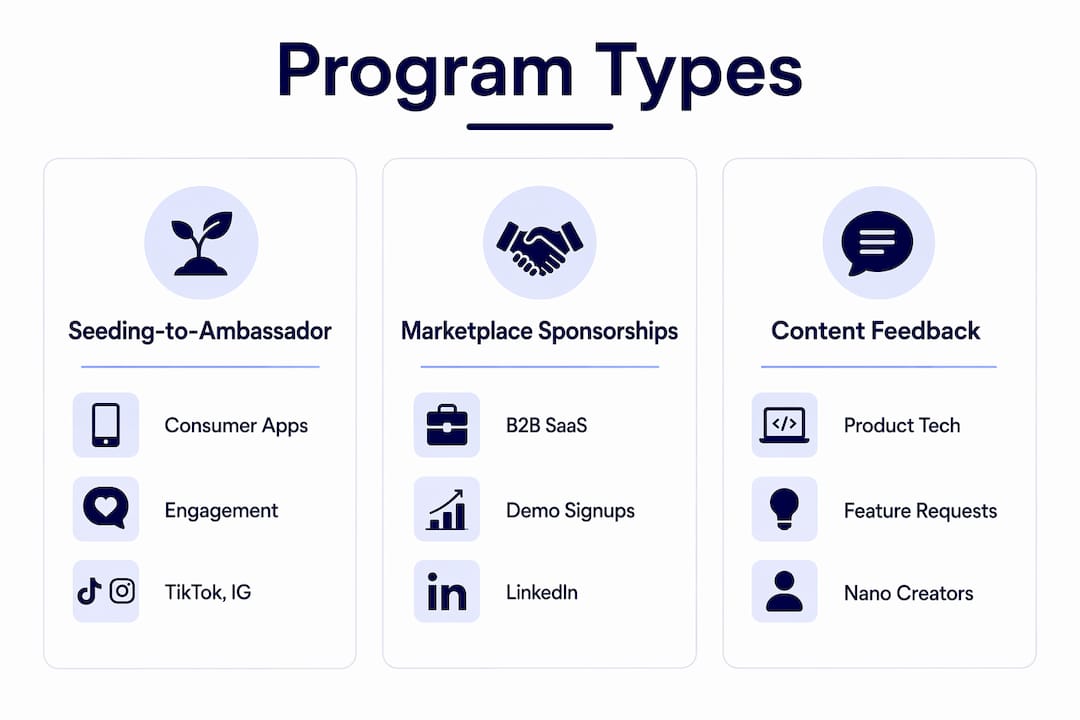
| Program Type | Best For | Primary Metric | Platform Fit |
|---|---|---|---|
| Seeding-to-ambassador | Consumer apps, DTC, early-stage products needing authentic proof | Capture rate, organic CTR | TikTok, Instagram Reels |
| Flat-fee marketplace sponsorships | B2B SaaS, mid-funnel demo signups, LinkedIn audiences | CPL, CTR vs. paid benchmark | LinkedIn, YouTube |
| Commission-led / guaranteed-views network | Consumer tech apps needing predictable installs, performance-aligned CAC | Views delivered, install rate, blended CAC | TikTok, Instagram, YouTube Shorts |
Use case 1: Consumer app install spike. A mobile fitness app seeds 40 micro-creators on TikTok with free premium access. Creators post authentic walkthroughs with a unique tracked link. Top performers generate organic views that convert at a measurable install rate. The brand converts the top five creators to paid ambassadors on a commission-per-install structure.

Use case 2: B2B SaaS mid-funnel demo signups. A niche project-management tool sponsors LinkedIn micro-creators in the operations and HR verticals. Marketplace data shows micro-creator posts averaging 12% CTR versus 0.8% for LinkedIn Sponsored Content, with CPLs around €18 versus €55–90 for LinkedIn Ads. The brand captures demo-request leads directly from creator bio links.
Use case 3: Product feedback loop. A consumer tech app seeds 20 nano-creators and monitors organic content for feature requests, UX friction signals, and language patterns. That feedback feeds directly into the product roadmap and marketing copy, closing the loop between creator distribution and product iteration.
CLG underperforms when the product has no visual demonstration value, when the buyer journey is entirely offline, or when the ICP has no meaningful creator-platform presence. LinkedIn is the right platform for B2B CLG; TikTok and Instagram Reels dominate for consumer app installs and DTC.
How to choose creator tiers and design a roster that scales
Creator tier selection is a portfolio decision, not a one-size-fits-all call. Each tier serves a different function in the acquisition funnel.
- Nano-creators (1k–10k followers): Highest engagement rates, lowest cost per post, best for seeding and product feedback. Ideal for testing product-creator fit before committing paid budget.
- Micro-creators (1k–10k followers): The dominant tier for always-on programs. Strong trust signals, measurable CTR, and manageable per-post costs. Best for conversion-focused campaigns.
- Mid-tier creators (50k–500k followers): Broader reach with retained audience trust. Use for awareness campaigns and when you need content that can be repurposed as paid creative.
- Macro-creators (500k+ followers): High reach, high cost, lower engagement rates. Reserve for product launches or brand moments, not always-on acquisition.
Recommended roster allocation by objective:
- Awareness: 20% mid-tier, 30% micro, 50% nano (wide seeding for organic discovery)
- Conversion: 50% micro, 30% mid-tier, 20% nano (proven converters with tracked CTAs)
- Product seeding / feedback: 70% nano, 30% micro (authentic use, low cost, high signal)
Sourcing checklist before signing any creator:
- Audience-ICP overlap: does their follower demographic match your buyer profile?
- Vertical alignment: does their content category match your product category?
- Engagement quality: real comments and saves, not just likes (use tools like Modash or HypeAuditor for fraud detection)
- Posting cadence: minimum two posts per week to maintain algorithmic relevance
- Content reusability: do they produce content you can license for paid amplification?
Managing creators manually at scale is expensive. A program with 20+ active creators typically requires a dedicated creator-relations owner and a creator CRM. Marketplaces and managed networks reduce that overhead significantly by handling discovery, vetting, and relationship management.
Always-on programs vs. campaign flights: which model actually drives durable growth
Always-on creator programs are the default for any brand that wants compounding acquisition, not a one-time spike. Campaign flights have a place, but they are the exception, not the strategy.
The logic is straightforward: creator content compounds. A post published in month one continues generating views, clicks, and installs in months three and six. A campaign flight stops generating when the budget runs out. Industry leaders in 2026 have moved decisively toward always-on relationships, treating creator marketing as durable infrastructure rather than a campaign line item.
90-day pilot timeline:
- Week 1–2: Define KPIs (capture rate, install rate, blended CAC), build the tracked CTA landing page, and finalize creator briefs.
- Week 3–4: Recruit and onboard five creators (two micro, two nano, one mid-tier). Seed product and deliver creative assets.
- Week 5–6: First content goes live. Monitor views, CTR, and capture rate daily. Flag underperformers at day 14.
- Week 7–8: Decision gate at day 30. Creators hitting target capture rate advance; underperformers receive brief adjustments or are replaced.
- Week 9–10: Scale top performers to two posts per week. Begin testing content formats (walkthrough vs. testimonial vs. challenge).
- Week 11–12: Decision gate at day 60. Identify ambassador candidates based on engagement lift and capture rate consistency.
- End of week 13: Full 90-day review. Creators meeting ambassador criteria move to a base-plus-commission structure. Campaign-only creators are retired.
Budget framing: Always-on programs fund a steady roster, typically structured as a monthly per-creator fee plus performance bonuses. Campaign flights pay per post with no ongoing relationship cost but also no compounding content library. For consumer app teams, the per-creator monthly investment in an always-on program almost always produces better blended CAC over 90 days than an equivalent campaign flight budget.
Graduation signals from pilot to ambassador: post engagement lift of 20%+ over baseline, capture rate consistently above 5%, and content that performs well enough to repurpose as paid creative.
How to build a creator-led growth program from scratch
The minimum viable CLG program is five creators, a tracked CTA, a dedicated landing page with UTM parameters, and a 30-day run. Everything else is optimization.
Sequential implementation steps:
-
Strategy and KPI definition. Set three metrics before recruiting a single creator: primary (capture rate), secondary (install rate or CPL), and guardrail (blended CAC ceiling). Align these with your growth team's existing acquisition benchmarks.
-
Creator discovery. Use discovery tools (Modash, Creator.co, or a managed network) to identify candidates by vertical, follower range, and audience demographics. Filter for engagement rate above 3% for micro-creators and above 5% for nano-creators.
-
Outreach and seeding. Send a personalized outreach message with a clear value proposition: free product access, a brief, and a performance bonus structure. Seed the product before asking for content. Authentic use produces better-performing content than scripted ads.
-
Contract terms. Every creator agreement must include: content usage rights (minimum 12 months for paid amplification), unique attribution links or codes, posting windows (specific dates and times), FTC-compliant disclosure language ("ad" or "sponsored" per FTC guidelines), and performance bonus terms tied to verified metrics.
-
Launch and measurement cadence. Review per-creator performance weekly for the first 30 days. Track views, CTR, capture rate, and install rate in a shared dashboard. Flag any creator whose capture rate falls below 2% after two posts.
-
Conversion to ambassadorship. Creators who hit target metrics after 30 days move to a hybrid compensation structure: base fee plus commission per verified install or opt-in.
Compensation models:
- Flat-fee: Simple, predictable, but misaligns incentives. Best for brand awareness posts where conversion is not the primary goal.
- Base plus commission: The dominant 2026 model. Covers creator effort while tying upside to performance. Reduces downside risk for the brand.
- Guaranteed-views CPM: Pay per verified view delivered. Predictable cost structure, performance-aligned, and directly comparable to paid media CPMs. This is the model Cult Media operates on.
- Commission-only: Zero base, pure performance pay. Works for high-volume seeding programs where individual creator risk is low.
Recruiting and onboarding checklist:
- Brief template items: product overview, key messages (three maximum), content format guidance, posting schedule, CTA copy, and disclosure requirements
- Asset delivery: product access, brand kit, sample content references (not scripts)
- Creative guardrails: what to avoid (competitor mentions, unverified claims), not what to say
- Performance bonus terms: stated clearly in the brief, not buried in the contract
Pro Tip: Brief creators on the outcome you want (installs, opt-ins, demo requests), not the content you want. Creators who understand the business goal produce content that converts; creators following a script produce content that looks like an ad.
KPIs, attribution, and benchmarks for measuring creator-led growth
Treat creators as a measurable acquisition channel. The three-layer measurement stack covers everything from content performance to pipeline impact.
Layer 1 — Top-line content metrics: impressions, views, CTR. These tell you whether the content is reaching and engaging the right audience. Track per creator, per post, and per platform.
Layer 2 — Mid-funnel capture metrics: capture rate into owned channels (email, SMS, app install). This is the single most predictive metric for downstream LTV. Benchmark data shows good capture rates of 2–6% for large creators and 8–14% for nano/micro creators.
Layer 3 — Bottom-line pipeline metrics: qualified lead rate, cost per acquisition, Ambassador LTV (total revenue attributable to a creator over 12 months). Ambassador LTV is a higher-leverage metric than single-post CAC because it captures the compounding value of an always-on creator relationship.
| KPI | How to Measure | Reporting Cadence |
|---|---|---|
| Views / Impressions | Platform analytics + creator report | Weekly |
| CTR | Tracked link clicks / total views | Weekly |
| Capture rate | Owned-channel opt-ins / tracked clicks | Weekly |
| Qualified lead rate | CRM-qualified leads / total captures | Bi-weekly |
| Blended CAC | Total creator spend / total attributed installs | Monthly |
| Ambassador LTV | 12-month attributed revenue per creator | Quarterly |
Attribution approaches:
- Per-creator UTMs and unique codes: The baseline. Every creator gets a unique tracked link and promo code. Direct, accurate, and easy to implement. Use for all programs.
- Holdout and A/B tests: Run a geographic or audience holdout to measure incremental lift beyond organic. Use when you have enough volume to split cleanly.
- Lift modeling: Statistical approach for micro-creator pools where individual attribution is noisy. Requires a data team but produces the most defensible ROI numbers.
- Post-purchase surveys: Ask customers "How did you hear about us?" as a signal layer. Especially useful for capturing creator influence that UTMs miss (dark social, word of mouth).
The right combination, per attribution best practice, is per-creator UTMs for direct capture, lift modeling for large nano/micro pools, and post-purchase surveys to triangulate impact without disrupting creator authenticity.
Pro Tip: Optimize capture rate into owned channels before optimizing for installs or revenue. A creator who drives a 10% capture rate into your email list is building a compounding asset. A creator who drives installs with no owned-channel capture is generating one-time revenue with no retention upside.
High-converting content formats and platform recommendations by objective
Format selection is a function of where the buyer is in the funnel, not personal preference.
Awareness: Short-form video (TikTok, Instagram Reels, YouTube Shorts). The goal is reach and pattern interruption. Creators should demonstrate the product in the first three seconds. No long intros, no scripted reads.
Consideration: Long-form explainers, carousels, and tutorial content. YouTube and LinkedIn are the right platforms here. Buyers in consideration mode want depth: how does the product work, who is it for, what does it replace?
Conversion: Shoppable clips, demo snippets, and download walkthroughs with a direct CTA. TikTok Shop integration, Instagram link stickers, and YouTube end-screen CTAs all reduce friction between content and conversion.
Platform recommendations by objective:
- TikTok and Instagram Reels: Consumer app installs, DTC product discovery, high-volume seeding. Best for nano and micro-creator portfolios at scale.
- YouTube Shorts: Discovery and consideration for products with a learning curve. Content has longer shelf life than TikTok.
- LinkedIn: B2B CLG, mid-funnel demo signups, thought leadership. Micro-creator posts here outperform paid LinkedIn Ads on CPL by a significant margin.
Repurposing checklist:
- Secure usage rights in the creator contract before the content goes live (minimum 12 months, paid channels included)
- Edit for platform specs: aspect ratio, caption length, thumbnail optimization
- Test three thumbnail and caption variants before scaling paid spend behind a piece of UGC
- Run top-performing organic creator content as paid dark posts to extend reach without burning through creative
Distribution architecture: seeded organic posts drive traffic to a tracked landing page, which captures owned-channel opt-ins (email or SMS), which feeds CRM activation sequences. Brands that execute this full loop consistently scale past $60M with improving unit economics because the owned-channel asset compounds over time. For production support on creator content at scale, teams working with a content production partner can maintain quality without inflating headcount.
How to scale a CLG program from pilot to a governed, repeatable engine
Scale is an operational problem. The content strategy that works for five creators breaks at 50 without a governance layer.
Scaling checklist:
- Creator CRM: Track every creator relationship, post history, performance metrics, contract status, and communication log in a single system. Notion, Airtable, or a dedicated influencer CRM (Grin, Aspire) all work.
- Standardized briefs: One brief template per content format. Briefs should take a creator 10 minutes to read and act on. Anything longer signals a brand that does not understand creator workflows.
- Discovery and fraud detection tooling: AI-assisted discovery (Modash, HypeAuditor) is standard practice for programs running 20+ creators. Manual vetting at scale produces inconsistent results and misses fake-follower signals.
- Content library: Every piece of creator content that clears performance thresholds goes into a licensed content library for paid amplification. This library is a compounding asset.
- Weekly performance reviews: A 30-minute weekly review covering per-creator capture rate, CTR, and content quality score is sufficient for programs up to 50 creators. Above that, automate the data pull and review exceptions only.
Content quality scorecard (per post):
| Dimension | What to Assess |
|---|---|
| Engagement quality | Comments, saves, shares vs. passive likes |
| Authenticity | Does the content feel native to the creator's style? |
| Conversion signal | Does the CTA appear clearly and early? |
| Brief adherence | Are key messages present without sounding scripted? |
Governance rules: Review creator performance at 30, 60, and 90 days. Creators consistently above target metrics on capture rate and CTR move to ambassador tier with higher base compensation. Creators consistently below target after two brief iterations are retired from the program. At-scale seeding programs require a defined team: a seeding coordinator, a creator relationship manager, and a creative ops lead to maintain quality without operational collapse.
Common mistakes and red flags in creator-led growth programs
Most CLG programs fail for the same five reasons. Recognizing them early saves significant budget.
-
Spray-and-pray seeding with no tracked CTA. Sending product to 200 creators without a unique link or code is brand awareness spend disguised as performance marketing. Fix: every creator gets a unique UTM link before the first post goes live.
-
Paying on vanity metrics. Compensating creators based on views or likes without tying payment to capture rate or installs misaligns incentives. A creator can generate 500k views with zero installs. Fix: structure at least a portion of compensation as a performance bonus tied to verified downstream metrics.
-
No content usage rights in the contract. Creator content that performs organically is your best paid creative. If you do not own the rights, you cannot amplify it. Fix: include a 12-month usage rights clause covering paid channels in every creator agreement before content goes live.
-
Ignoring creator churn. Creators who post once and go quiet are a program management failure, not a creator failure. Fix: set posting cadence expectations in the brief and build a 30-day check-in into the onboarding flow.
-
Measuring CLG like a paid media campaign. CLG compounds over time; paid media stops when the budget stops. Evaluating a 30-day creator program against a 30-day paid media ROAS benchmark will always make CLG look underperforming. Fix: measure Ambassador LTV at 90 days and 12 months, not just first-post CAC.
-
Skipping the seeding-to-ambassador ladder. Paying mid-tier creators flat fees before proving product-creator fit is expensive. The more effective approach is wide seeding to nano and micro pools first, then converting organic top performers to paid ambassadors. This identifies genuine fit and lowers paid CAC.
Quick remediation checklist for underperforming creators:
- Test a brief change before retiring the creator (adjust CTA copy, format, or posting time)
- Check if the audience-ICP match was accurate at onboarding (re-audit follower demographics)
- Adjust compensation structure to include a performance bonus if the creator is on flat-fee only
- If capture rate remains below 2% after two brief iterations, retire and reallocate budget
A commission-only, guaranteed-views CLG campaign in practice
The outcome: A consumer tech app needed predictable installs without the risk of paying flat fees to creators who might underdeliver. The program delivered a guaranteed view count through a managed creator network, with payment tied entirely to verified views. The primary metric improvement was a measurable reduction in blended CAC compared to the brand's prior paid social spend.
Campaign flow:
- Seed: Creators in the managed network received product access and a brief focused on authentic use-case demonstration.
- Perform: Content went live across TikTok and Instagram Reels. Views were tracked in real time against the guaranteed threshold.
- Convert: Tracked CTAs drove traffic to a dedicated landing page capturing app installs and email opt-ins.
- Ambassadorship: Top-performing creators by capture rate and install rate were offered ongoing ambassador agreements with a base-plus-commission structure.
Sample campaign metrics (anonymized ranges):
| Metric | Range |
|---|---|
| Guaranteed views delivered | 500k–2M per campaign |
| CTR (views to tracked link clicks) | 2%–5% |
| Capture rate (clicks to installs/opt-ins) | 6%–12% |
| Blended CAC vs. prior paid social | 30%–50% lower |
| Ambassador LTV (12-month projection) | 3x–5x single-post CAC |
The commission-only structure removed the brand's downside risk entirely. No views delivered means no payment. That alignment between brand incentives and creator performance is what separates a guaranteed-views network from a traditional influencer agency retainer. Hybrid compensation models that tie pay to verified outcomes are increasingly the standard, and a pure commission-on-views structure is the most performance-aligned variant of that model.
Key Takeaways
Creator-led growth compounds when you feed creator reach into owned channels, measure capture rate as your primary KPI, and run always-on programs rather than isolated campaign flights.
| Point | Details |
|---|---|
| Capture rate is the lead metric | Optimize for owned-channel opt-ins before optimizing for installs. |
| Always-on beats campaign flights | Creator content compounds over time; always-on programs produce better blended CAC at 90 days than equivalent campaign budgets. |
| Seeding-to-ambassador reduces CAC | Seed widely to nano/micro pools first, then convert organic top performers to paid ambassadors to lower paid acquisition costs. |
| Usage rights are non-negotiable | Secure 12-month paid-channel usage rights in every creator contract to unlock creator UGC as paid creative. |
| Cult Media for consumer app pilots | Cult Media's commission-only, guaranteed-views network lets consumer tech teams run performance-aligned CLG pilots with no retainer risk. |
The part of creator-led growth most playbooks skip
Most CLG playbooks focus on the front end: how to find creators, how to brief them, how to track links. The harder problem, and the one that actually determines whether a program compounds, is the seeding-to-ambassador conversion.
Here is what typically happens: a brand seeds 30 creators, gets a handful of strong posts, and then... nothing. The creators move on. The brand runs another seeding round. The cycle repeats without ever building a durable creator asset.
The fix is operational, not strategic. When a creator posts organically and hits your capture rate threshold, the follow-up needs to happen within 48 hours. Not a week later, not after a team meeting. The creator is warm, the content is performing, and the window to convert them to an ambassador is short. Build a 48-hour response protocol into your creator CRM: when a creator's post crosses the capture rate threshold, an automated alert triggers a personal outreach from the creator-relations owner with a specific ambassador offer.
Two tactical tips that rarely appear in published playbooks:
Brief quickly, brief visually. A one-page brief with three bullet points and two reference videos outperforms a five-page PDF every time. Creators process visual references faster than written guidelines. Lead with a 60-second reference video of the content style you want, then add three written guardrails. That brief takes 20 minutes to produce and generates better content than a detailed script.
Structure the performance bonus as a threshold, not a percentage. Instead of "earn 5% of installs," say "earn a $200 bonus when you hit 500 installs this month." Thresholds are concrete, motivating, and easy for creators to track in real time. Percentage-based commissions require creators to do math they rarely do, which reduces the motivational effect of the bonus entirely.
Cult Media runs the CLG pilot so you can focus on what converts
For consumer tech app teams that need predictable, performance-aligned creator reach without a retainer, Cult Media's commission-only creator network is built for exactly this use case. You pay per guaranteed view delivered, not per creator signed. No flat fees for underperforming posts, no monthly retainer regardless of results.
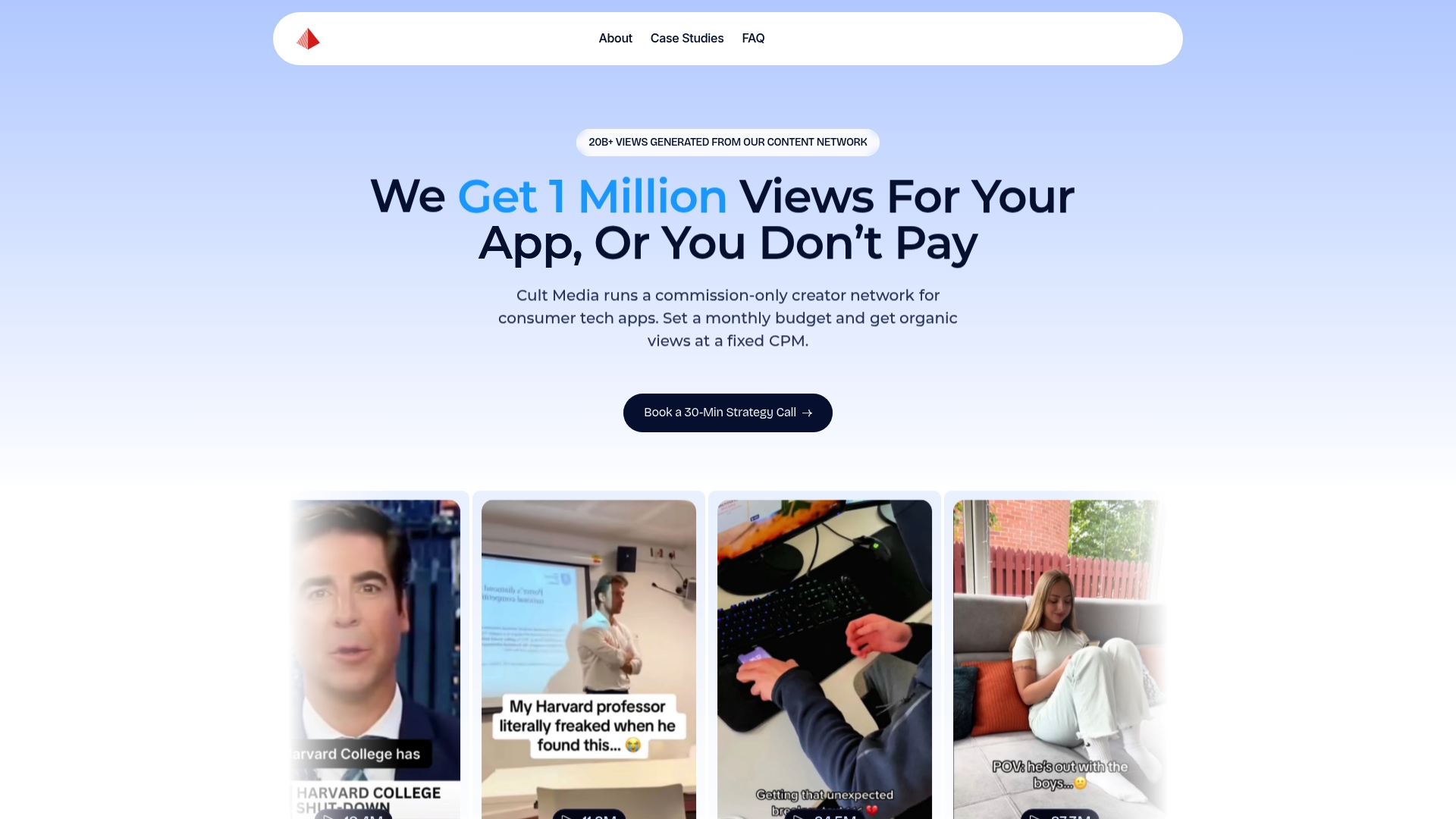
Cult Media handles creator discovery, vetting, briefing, and relationship management across TikTok and Instagram. Your team owns the landing page, the CTA, and the CRM activation. That division of labor means you get a fully managed creator program without the operational overhead of running one in-house. The 30/90/180-day pilot structure maps directly to Cult Media's campaign model: start with a guaranteed-views pilot, measure capture rate and install rate, then scale the creators and formats that perform.
The performance-based CPM model means your acquisition cost is predictable from day one. If you are currently spending on paid social and watching CAC climb, a guaranteed-views creator campaign is a direct, measurable alternative. Start your pilot and get a campaign proposal built around your app's ICP and growth targets.
Useful sources and tools for running CLG programs
-
Creator Marketing in 2026: Storika — Covers always-on program design, mid-tier and micro-creator tier definitions, AI-assisted discovery, and hybrid compensation models. Best used for benchmarking creator tier selection and program structure.
-
Creator-Led Growth B2B Guide: Naano — Detailed B2B CLG playbook with LinkedIn micro-creator CTR and CPL benchmarks, seeding-to-ambassador ladder mechanics, and attribution frameworks. Best for B2B growth teams and attribution methodology.
-
DTC Influencer-to-Owned Audience Engine: D2C Times — Practical guide on converting creator reach into owned CRM and SMS subscribers. Includes capture-rate benchmarks by creator size. Best for teams focused on retention and LTV.
-
DTC Influencer Seeding Engine: D2C Times — Operational guide to running seeding programs at scale, including team structure, P&L management, and content licensing. Best for brands scaling past 20 active creators.
-
Social Commerce and the Creator Economy: Deloitte — Research-backed analysis of creator influence across the full marketing funnel, including data on Gen Z purchase behavior and social-first brand performance. Best for executive-level CLG business cases.
-
Does Influencer Marketing Really Pay Off: HBR — Academic and practitioner analysis of influencer ROI measurement. Best for teams building internal business cases or responding to CFO scrutiny on creator spend.
-
The Rise of Influencer-Driven Growth: Webfluential — Practitioner perspective on budget allocation, authentic engagement, and trackable ROI in influencer programs. Best for teams making the case for shifting budget from traditional channels.
-
Creator-Led Growth: Definition, Types, Examples — Foundational reference covering CLG definition, program types (founder-led, employee-led, partnership-based), and real-world examples. Best for onboarding new team members to CLG concepts.
-
Naomi Lennon: Creator Economy Operator — Independent creator-economy strategist with practitioner-level perspective on creator relationships, program governance, and operator workflows. Best for teams building their first creator-relations function.
-
Modash and HypeAuditor — Discovery and fraud-detection platforms for creator vetting. Use for audience demographic verification, engagement quality scoring, and fake-follower detection before onboarding any creator.
This article is general marketing and growth information, not legal or financial advice. Verify FTC disclosure requirements, contract terms, and platform-specific advertising policies with qualified legal counsel for your specific situation.