
For consumer app founders seeking guaranteed, scalable visibility, the answer is clear: creator-driven organic views are the foundation, with paid used selectively to amplify what's already working. Paid reach is rented. Organic reach compounds. The most effective growth programs treat them as complementary tools, not competing budgets.
TL;DR:
- TikTok and Instagram algorithms reward native creator content with organic discovery that paid ads alone cannot replicate
- Creator networks deliver guaranteed organic views through performance-based pricing tied to verified results
- Organic visitors convert at ~2.4% compared to ~1.3% for paid visitors, making organic views more valuable per impression
- Cult Media's commission-only model aligns creator incentives with app growth outcomes, charging only for verified views delivered
Table of Contents
- How do organic views and paid views compare across key dimensions?
- How do organic and paid views actually work on TikTok and Instagram?
- When should you use organic, paid, or both?
- How do you measure view quality, attribution, and incrementality?
- A tactical playbook for turning creator content into scalable organic reach
- What are the risks and red flags when guaranteeing views?
- What should consumer app founders actually do?
- Key Takeaways
- The part most growth teams get wrong about organic vs paid
- Cult Media delivers guaranteed organic views for consumer apps
- Sources and further reading
How do organic views and paid views compare across key dimensions?
| Dimension | Organic views | Paid views | Creator-driven guaranteed organic |
|---|---|---|---|
| Speed to result | Weeks to months | Immediate | Faster than solo organic; no paid dependency |
| Short-term cost | Low (time-intensive) | High (ongoing spend) | Performance CPM, pay per verified view |
| Long-term cost | Compounds, cost decreases | Rises with competition | Predictable; tied to delivered results |
| Targeting specificity | Algorithm-driven | Precise demographic control | Creator audience alignment + platform signals |
| Scalability | Gradual | Budget-limited ceiling | Network-scale, multi-creator deployment |
| Sustainability | High; content earns long-term | Stops when budget stops | High; organic signals persist post-campaign |
| Attribution clarity | Harder to isolate | Clear CPC/CPA tracking | Verified view reports with impression source data |
| Risk | Low fraud risk; algorithm shifts | Ad fatigue, policy exposure, fraud | Vetted creators, auditable delivery |
Match your goal to the right channel:
- App launch: Paid for immediate visibility, creator organic to build authentic discovery signals
- Scale phase: Hybrid strategies that test organically, then amplify top-performing content with paid
- Evergreen growth: Creator-driven organic as the primary engine; paid reserved for seasonal pushes
Creator-driven guaranteed-organic campaigns shift the usual trade-offs significantly. You get organic's sustainability and algorithm favorability without waiting months for a solo content strategy to gain traction.
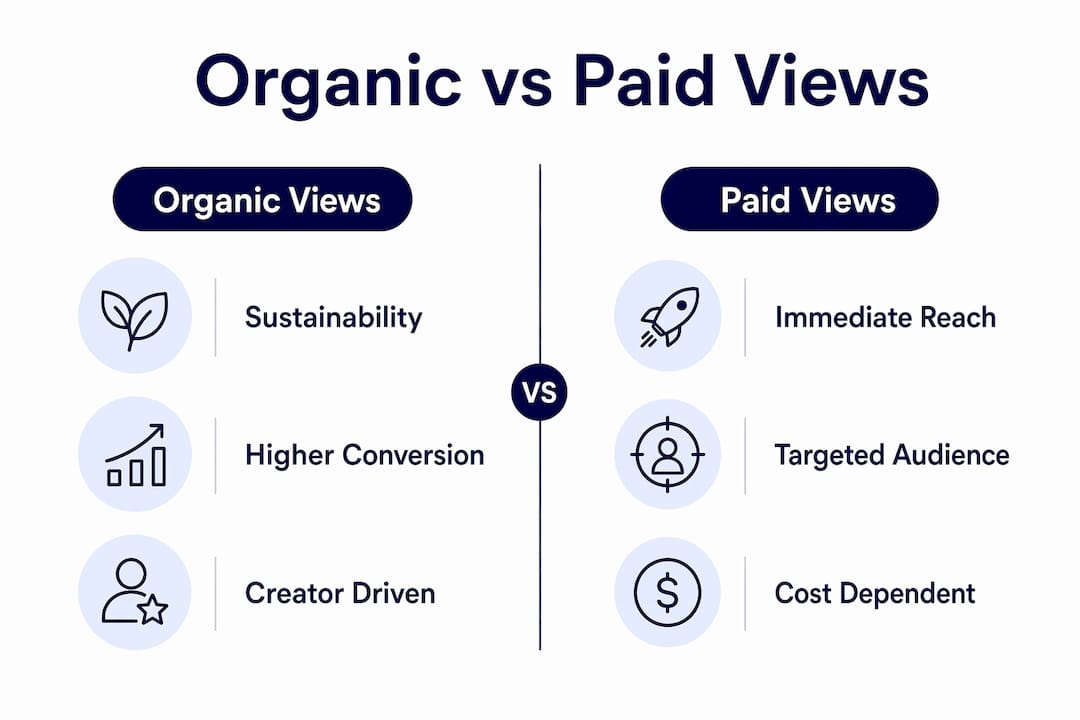
How do organic and paid views actually work on TikTok and Instagram?
Organic social content earns distribution through algorithmic discovery, follower engagement, and platform signals. Paid content buys placement directly, bypassing the algorithm's quality filter. The distinction matters operationally because TikTok and Instagram treat these view sources differently in their ranking systems.
What the platforms actually measure:
- Watch time and completion rate (the strongest organic ranking signals on TikTok)
- Saves, shares, and comments (Instagram's engagement weighting)
- Swipe-away rate and replays (both platforms use these to calibrate further distribution)
- Profile visits and follows generated from a single piece of content
Creator-native content consistently outperforms brand-produced ads on these signals because it matches the format, tone, and pacing users expect. A polished ad reads as an ad. A creator's authentic review of your app reads as a recommendation.
How a creator-driven guaranteed-organic campaign runs:
- Discovery and brief: Define the app's core value proposition, target user behavior, and hook requirements for the platform
- Creator selection: Vet creators by audience demographics, engagement rate, and content quality against the app's user profile
- Native content production: Creators produce content in their own voice, optimized for organic discovery (hook timing, caption strategy, sound selection)
- Organic seeding: Content publishes without paid amplification, allowing the algorithm to register genuine engagement signals
- View verification: Platform-native analytics, creator reporting, and third-party validation confirm view counts, watch time, and impression sources
- Performance billing: Client pays only for verified views delivered, per the agreed CPM rate
Pro Tip: Wait for organic indexing to establish baseline signals before adding paid amplification. Videos without early paid mixing have shown 3x more search views and 5x higher watch time than those amplified too soon. A 2–4 month organic window before paid is a common practitioner standard.

When should you use organic, paid, or both?
Choose organic-first when:
- Product-market fit is still being validated and you need real engagement data
- Budget is constrained and CAC efficiency matters more than speed
- You're building long-term channel authority on TikTok or Instagram
Choose paid-first when:
- You have a time-sensitive launch window and need immediate reach
- You've already validated creative and need to scale a proven message
- You're entering a new geographic market with no existing organic presence
Decision checklist:
- Do you need results within two weeks? → Paid or hybrid
- Is your conversion tracking fully configured? → Required before any paid spend; without it, paid is money spent blind
- Do you have validated creative? → If no, test organically first
- Is your app in active launch week? → Layer paid over organic creator content
- Are you optimizing for 90-day CAC? → Prioritize creator-driven organic with performance pricing
Timeline expectations:
- Meaningful organic signals: 4–8 weeks with consistent creator output
- Paid reach: Immediate, but engagement quality typically lags organic
- Creator-driven guaranteed organic: Faster than solo organic; view delivery begins within the campaign window
How do you measure view quality, attribution, and incrementality?
| Metric | Purpose | Where it matters |
|---|---|---|
| Views | Volume baseline | Both channels |
| Watch time / completion rate | Quality signal; algorithm weight | Organic, creator campaigns |
| Retention curve | Content effectiveness | Creator content review |
| CTR to app store | Discovery-to-intent conversion | Both channels |
| Installs (CPI) | Acquisition efficiency | Paid, creator campaigns |
| ROAS | Revenue return on ad spend | Paid campaigns |
| Incremental lift | True causal impact | Holdout testing |
| Impression source breakdown | Organic vs paid attribution | Creator campaign audits |
Attribution guidance: Last-touch attribution undercounts organic's contribution because creator content often influences a user days before they install. Multi-touch models or experiment-driven incrementality testing give a more accurate picture. For creator-driven campaigns, a 7–14 day attribution window captures the delayed conversion behavior common in app discovery.
Verified organic views should be tied to measurable engagement thresholds, including minimum average view duration and percent watched, and delivered with an auditable report showing impression source breakdowns and creator IDs. This is the standard that separates accountable creator programs from vanity metric delivery.
Organic visitors convert at roughly 2.4% compared to 1.3% for paid visitors. That gap means an organic view is worth nearly twice as much per impression when modeling true CAC, and it should directly influence how you value guaranteed organic view delivery in your media mix.
Pro Tip: Set up holdout groups before launching any creator campaign. Withhold the campaign from 10–20% of your target audience and measure install rates against the exposed group. That delta is your incremental lift, the only metric that proves the campaign caused growth rather than captured it.
A tactical playbook for turning creator content into scalable organic reach
- Brief and align: Write a creator brief specifying hook timing (first 2–3 seconds), CTA placement, caption keywords, and the one behavior the app solves
- Select and vet: Choose creators whose audience demographics match your app's target user; review recent content for engagement authenticity
- Publish organically: Release content without paid amplification; let the algorithm index and distribute based on genuine signals
- Measure the window: Track watch time, completion rate, and CTR over 4–6 weeks before making amplification decisions
- Amplify selectively: Use paid to scale only the top-performing organic content to lookalike audiences; avoid amplifying underperformers
- Iterate the brief: Feed engagement data back into the next creator brief cycle; winning hooks and CTAs compound across the network
A consumer app running a creator-network campaign across 40 creators on TikTok and Instagram, with organic-first publishing and verified view delivery, can generate meaningful install volume within the first campaign window while building a library of native content that continues earning views after the campaign closes. The performance-based billing model means the client pays only for what was delivered, not what was promised.
Pro Tip: The highest-converting creator briefs specify the emotional hook, not just the product feature. "Show the moment before you needed this app" outperforms "explain the app's features" in watch time and CTR on both TikTok and Instagram.
What are the risks and red flags when guaranteeing views?
Red flags to watch for:
- Sudden view spikes with no corresponding engagement (likes, comments, shares)
- Watch time below 20% of video length across the campaign
- Creator audience demographics that don't match your app's user profile
- Opaque reporting with no impression source breakdown
- No recourse or refund terms if view guarantees aren't met
Due diligence checklist before signing:
- Request sample creator content and review engagement authenticity
- Confirm verification methodology: platform-native analytics plus third-party validation
- Establish reporting cadence (weekly minimum for active campaigns)
- Define recourse terms: what happens if guaranteed views aren't delivered
- Audit creator IDs and confirm they are real accounts with organic history
Limitations to plan around: Introducing paid amplification too early on a piece of content can suppress organic indexing by signaling to the algorithm that the content needs artificial support. Platform policy exposure is also real: paid campaigns on TikTok and Instagram are subject to content review, targeting restrictions, and policy changes that can pause delivery mid-campaign. Creator-driven organic content carries lower policy risk because it distributes through native discovery rather than the ad auction.
What should consumer app founders actually do?
Prioritize creator-driven organic views as your primary acquisition channel, use performance-based pricing tied to verified delivery, and reserve paid for amplifying what's already proven to work organically.
Immediate next steps:
- Audit your current view sources: what percentage are organic vs paid, and what is the watch time on each?
- Define your guaranteed-view threshold and the engagement minimums you'll accept as proof of quality
- Run a creator pilot with 5–10 vetted creators, organic-first, with a 4–6 week measurement window before any paid amplification
- Build incrementality testing into the pilot from day one using holdout groups
The measurement framework matters as much as the campaign itself. Tie every creator contract to verified view delivery with auditable reporting, set attribution windows that capture delayed installs, and model organic view value at the higher conversion rate it earns. That combination of performance pricing and rigorous attribution is what separates scalable creator programs from one-off experiments.
Key Takeaways
Creator-driven organic views, verified through performance-based pricing and auditable reporting, deliver higher conversion rates and longer-lasting impact than paid views alone for consumer app growth.
| Point | Details |
|---|---|
| Organic converts higher | Organic visitors convert at ~2.4% vs ~1.3% for paid, making each organic view more valuable per impression. |
| Sequence matters | Allow 2–4 months of organic indexing before paid amplification to avoid suppressing algorithm signals. |
| Verification is non-negotiable | Guaranteed views must include impression source breakdowns, watch time thresholds, and auditable creator IDs. |
| Hybrid beats either alone | Test creative organically, then scale top performers with paid to maximize ROI without burning through creative. |
| Cult Media's model | Cult Media's commission-only creator network delivers guaranteed organic views on TikTok and Instagram, charging only for verified results. |
The part most growth teams get wrong about organic vs paid
The conventional framing treats organic and paid as a budget allocation problem. Spend more on paid when you need speed; invest in organic when you have time. That framing misses the more important question: what kind of view are you actually buying?
Paid views on TikTok and Instagram are impressions delivered to a targeted audience. They can generate installs, but they don't build the algorithm's understanding of your content. Organic views, especially those generated by creator-native content, teach the platform what your app is for and who responds to it. That behavioral data compounds. It informs future distribution, improves targeting for any paid you do run, and creates a content library that keeps earning views after the campaign closes.
The commission-only model matters here because it forces alignment. When a creator network only earns on verified organic views, the incentive is to produce content that actually performs, not content that looks good in a deck. Cult Media's approach to creator vetting and content quality controls reflects this: the network's economics depend on delivery, not promises. That's a fundamentally different relationship than a retainer-based agency where the invoice arrives regardless of results.
Cult Media delivers guaranteed organic views for consumer apps
Paid ads stop the moment the budget does. Creator-driven organic views keep earning. Cult Media's commission-only creator network is built specifically for consumer tech apps that need verifiable, scalable organic reach on TikTok and Instagram, without paying for impressions that don't convert.
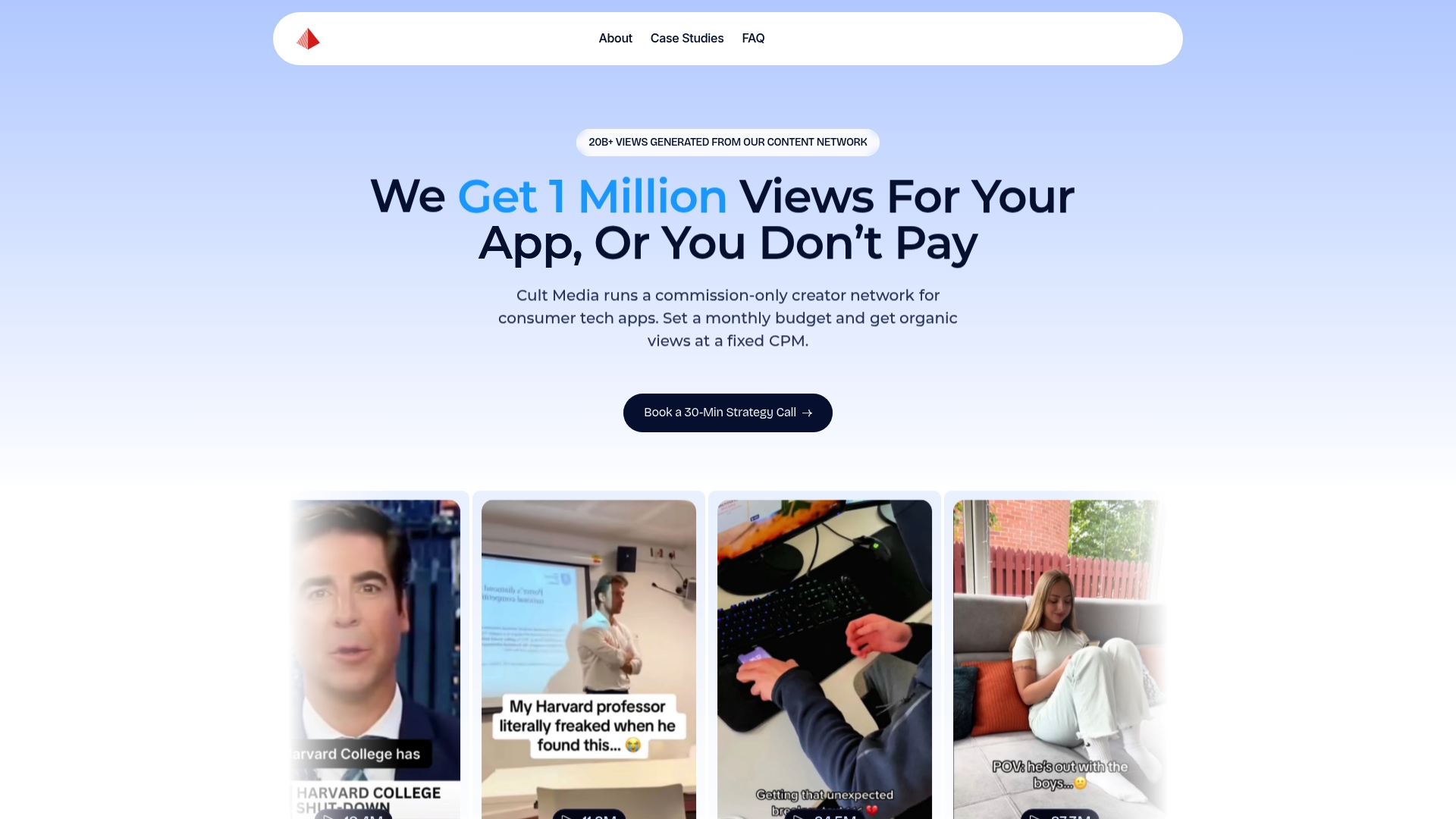
Cult Media handles creator sourcing, brief development, content quality review, and end-to-end campaign management. Clients pay a fixed CPM only for verified organic views delivered, with full reporting on impression sources, watch time, and creator IDs. No retainer. No guesswork on delivery.
What you get:
- Vetted creator network aligned to your app's user profile
- Guaranteed view campaigns with performance-based billing
- Platform expertise across TikTok and Instagram
- Auditable reporting tied to engagement thresholds, not vanity metrics
Consumer app founders ready to move from paid dependency to guaranteed organic growth can get started by requesting a campaign brief from Cult Media's team.
Sources and further reading
- Organic vs. Paid Social Media: Everything You Need to Know — Hootsuite
- Organic Search vs. Paid Search: What Delivers the Best ROI? — Fractl
- Organic vs. Paid Traffic — ContentPen (conversion rate data)
- Organic vs. Paid Video Traffic: How to Get the Best of Both Worlds — Tubics (sequencing data)
- The Difference Between Organic and Paid Traffic and When to Use Each — Digital Marketing Explained
- Cult Media: Creator-Driven Campaigns for Consumer Apps — Cult Media (guaranteed view delivery and platform strategy)
- Long-Form Content Strategy for B2B SEO — TheWebTeam.co (organic content authority building)
- On-Page SEO Elements for B2B Sites — TheWebTeam.co (organic discovery and search-driven acquisition)