
Creator whitelisting is the highest-leverage paid channel most consumer app growth teams are underusing. A benchmark study of many accounts found whitelisted Partnership Ads and Spark Ads deliver significantly lower CPA compared to standard brand-page UGC ads. Two conditions determine whether it's worth the operational overhead: you need a monthly paid social budget large enough to generate statistically meaningful test data (typically $5,000+ per creator per month), and every whitelisted ad must carry the FTC-required paid partnership disclosure tag throughout the campaign.
Benchmark: A 2026 benchmark study across 90 ad accounts found whitelisted/Partnership Ads and Spark Ads deliver 20–35% lower CPA compared to standard brand-page UGC ads — a reliable performance signal for consumer app growth teams evaluating this channel.
Table of Contents
- What is creator whitelisting and how does it differ from organic posts?
- Why the performance math favors whitelisting for app growth
- How to set up creator access before you spend a dollar
- Creative approval that protects compliance without killing creator voice
- Campaign setup and optimization for the first 90 days
- What creators charge and what your contracts must cover
- Compliance and brand-safety risks that collapse programs mid-flight
- Should you run whitelisting in-house or hire a managed partner?
- What a Cult Media pilot looks like in practice
- Key Takeaways
- The case for treating whitelisting as a core paid channel
- Cult Media's guaranteed-view pilot for consumer apps
- Sources and further reading
What is creator whitelisting and how does it differ from organic posts?
Creator whitelisting, now formally called Partnership Ads on Meta and Spark Ads on TikTok, is a permission arrangement where a creator grants a brand the right to run paid ads from the creator's own handle. The audience sees what looks like an organic post from someone they follow. The brand controls targeting, budget, and conversion tracking behind the scenes.
This is categorically different from two adjacent tactics. Organic influencer posts reach only the creator's existing followers with no paid amplification. Brand-run UGC ads use creator-produced assets but publish from the brand's own page, losing the trust signal of the creator's identity. Whitelisting combines creator authenticity with paid media precision.
Three permission models are in active use:
- Partnership tag (Meta): Creator grants account-level or post-level access via Meta's Partnership Ads Hub. Brand runs ads from the creator's handle in Ads Manager. Broadest control, fastest iteration.
- Authorization code (TikTok Spark Ads): Creator generates a per-post code in TikTok Ads Manager. Brand pastes the code to run that specific video as a Spark Ad. Granular, but limited to one video at a time.
- Full handle access: Creator shares advertiser-level access to their account. Maximum flexibility, highest trust requirement, rarely used at scale.
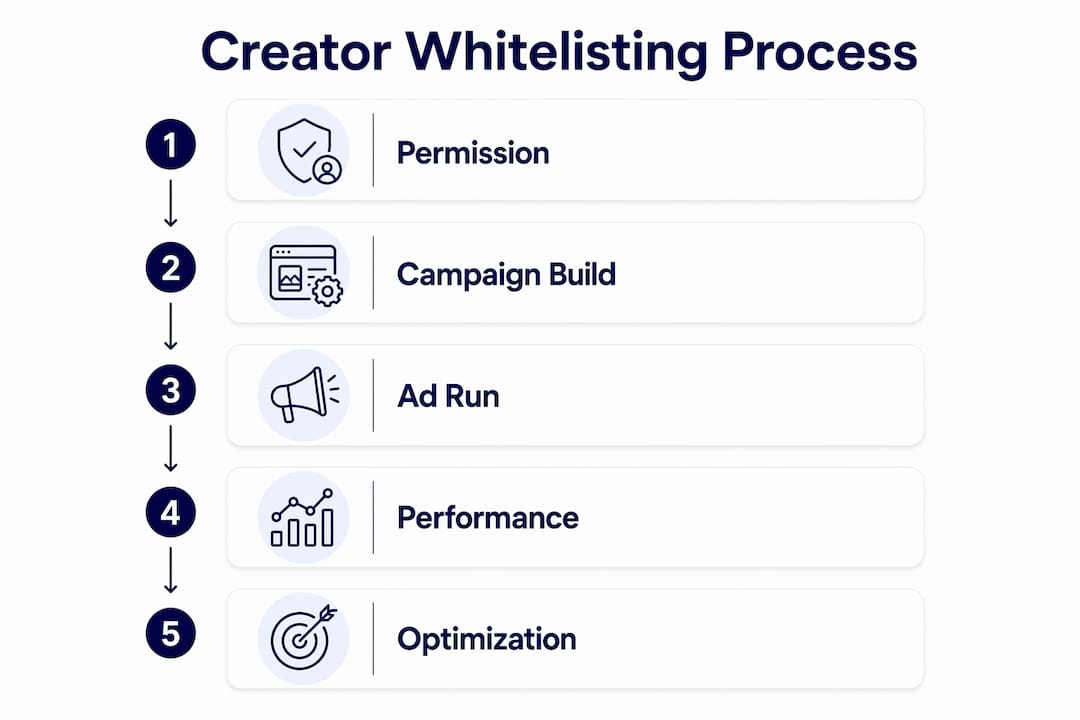
The operational flow: creator grants permission → brand builds the campaign in its own ad account → ad runs with the creator's handle as publisher → reporting splits between creator-side engagement and brand-side conversion data.
Why the performance math favors whitelisting for app growth
The significant CPA improvement documented in the benchmark is not uniform across all app categories. Verticals where social proof and personal recommendation carry high purchase weight — wellness, productivity, finance, and lifestyle apps — tend to see the largest delta. Mass-market utility apps with commodity positioning see smaller yet still meaningful gains.

The economics favor whitelisting once the CPA improvement exceeds the amortized whitelisting fee per conversion. At scale, this math compounds quickly.
| App Category | Typical Brand-Page CPA | Estimated Whitelisted CPA | Whitelisting Fee (6-month, micro creator) |
|---|---|---|---|
| Wellness / lifestyle | ranges in a typical range | lower ranges correspondingly | typical fee range |
| Productivity / utility | ranges in a typical range | lower ranges correspondingly | typical fee range |
| Finance / fintech | ranges in a typical range | lower ranges correspondingly | typical fee range |
These are illustrative ranges based on the benchmark and published fee data, not guaranteed outcomes for any specific app.
Statistic: Whitelisted ads outperform brand-page UGC by 20–35% in CPA according to a 2026 benchmark of 90 accounts — a strong published benchmark for this channel.
Pro Tip: Set a minimum engagement threshold before whitelisting any creator. An account with 5% engagement on organic posts will outperform a larger account at 0.8% every time. Follower count is a secondary signal.
How to set up creator access before you spend a dollar
Technical setup failures are the most common reason whitelisting programs stall at launch. Work through this checklist before any campaign goes live.
Meta Partnership Ads:
- Creator must have a Creator or Business account linked to an active Facebook Page
- Creator grants your Business Manager partner or advertiser access via the Partnership Ads Hub
- Brand selects the creator's Page and Instagram account as the ad identity in Ads Manager
- Audit log access should be assigned to a dedicated ad ops role, not a shared login
TikTok Spark Ads:
- Creator posts the video organically first
- Creator generates an authorization code in TikTok Ads Manager (note: as of April 2026, default code duration in many regions is 60 days, down from 365)
- Brand pastes the code into a Spark Ads campaign and sets targeting, budget, and CTA
YouTube / BrandConnect: Less standardized. Permissions are negotiated per asset via BrandConnect or direct licensing agreements. Not recommended as a primary whitelisting channel for app UA at this stage.
Realistic timeline: Allow 3–5 business days to onboard one creator and launch the first ad. The most common blocker on Meta is an Instagram account not linked to a Facebook Page. Flag this in the creator brief before any permission request goes out.
Creative approval that protects compliance without killing creator voice
Over-reviewing creative is one of the fastest ways to burn creator relationships and slow campaign velocity. The four mandatory approval pillars cover everything that actually matters from a compliance and brand-safety standpoint.
Four mandatory checks on every asset:
- FTC disclosure: Paid partnership label must be visible and remain in place for the full campaign duration
- Brand safety: No competing products, prohibited topics, or content that conflicts with platform policy
- Factual accuracy: All product claims must be verifiable; no superlatives that can't be substantiated
- Prohibited claims: Category-specific restrictions (health claims, financial guarantees, etc.) must be absent
What does not belong in the mandatory review: caption tone, creative style, hook phrasing, or any element that reflects the creator's native voice. Editing those elements reduces the authenticity that makes whitelisting outperform brand-page UGC in the first place.
Consolidated feedback from a single approver per review type moves faster than sequential sign-offs. Assign one person to compliance review and one to brand-fit review. Keep them separate.
Pro Tip: Provide two creative versions in the brief: a low-risk, brand-safe version and a creator-native version with more latitude. Approve the creator-native version unless it fails a mandatory pillar. You'll get better-performing ads and faster turnaround.
Campaign setup and optimization for the first 90 days
Treat whitelisted creative as a separate optimization pool from brand-page UGC. Mixing them in the same ad set obscures which creative type is driving performance.
A/B test matrix for the first 30 days:
- Hook variation: test three opening frames per creator (problem-led, result-led, curiosity-led)
- Ad format: in-feed video vs. Reels vs. Shorts, matched to platform
- Publisher vs. new asset: run the creator's existing organic post against a purpose-built whitelisting asset
KPIs and cadence:
- CTR and install rate: review weekly
- CPA: evaluate at 14-day and 30-day windows
- LTV lookback: 60–90 days minimum for subscription apps
Targeting guidance: Start with creator lookalike audiences built from the creator's engaged followers. Once CPA is validated, layer in first-party audiences (existing users excluded) and broad interest targeting. Scale budget 20–30% per week on winning ad sets to avoid auction disruption.
Pro Tip: Never consolidate whitelisted creative into the same campaign as brand-page UGC. The algorithm will optimize toward whichever format has more historical data, which is almost always the brand page. Separate campaigns give each format a fair test.
What creators charge and what your contracts must cover
Whitelisting fees are additive to the base content fee. Published 2026 pricing by creator tier for a 6-month Meta-only window:
- Micro (5K–50K followers): $200–$500
- Mid-tier (50K–250K): $500–$1,000
- Macro (250K+): $1,000–$3,000+
A 6-month amplification window is the industry standard. Twelve months is justifiable for evergreen content with sustained conversion data. Perpetual rights are rarely necessary and carry disproportionate cost and legal complexity.
Contract red flags to negotiate out before signing:
- Perpetual usage rights with no fee cap
- Exclusivity clauses that prevent the creator from working in adjacent categories
- No explicit authorization code renewal obligation (critical for TikTok Spark Ads)
- Missing response windows for code regeneration (contracts should require renewal within 24–72 hours of request)
Compliance and brand-safety risks that collapse programs mid-flight
Warning: Three failures account for the majority of mid-campaign performance collapses in whitelisting programs: expired authorization codes that silently drop creator-handle attribution while ads keep spending, revoked permissions with no alert in Ads Manager, and FTC disclosure tags removed or altered after launch.
Authorization lapses are particularly dangerous because Meta and TikTok Ads Manager do not always surface a clear alert when creator-handle attribution is lost. Ads continue spending. Performance drops. The cause is invisible without a dedicated monitoring step.
Mitigation checklist:
- Set calendar reminders for authorization code expiration dates (60-day default on TikTok as of April 2026)
- Require creators to renew codes within 24–72 hours of request, written into the contract
- Audit active whitelisted ads weekly to confirm creator-handle attribution is intact
- Never rely on a single creator for more than 40% of whitelisted spend in any given month
Should you run whitelisting in-house or hire a managed partner?
The build-vs-buy decision comes down to four variables: monthly spend scale, internal ad ops maturity, existing creator relationships, and compliance capacity.
Build in-house when: You have a dedicated paid social team with Meta and TikTok Ads Manager expertise, existing creator contracts that include whitelisting rights, and monthly spend above $50,000 where the economics of internal ops are justified.
Hire a managed partner when: You're testing the channel for the first time, your team lacks ad ops bandwidth, or you want guaranteed view delivery without building a creator roster from scratch. A commission-only partner with verified view guarantees removes the fixed cost risk of an internal program that may not scale.
When evaluating a whitelisting partner, ask these questions:
- Do they guarantee a minimum number of verified views, or only best-effort delivery?
- What is their authorization code renewal SLA?
- Who owns the ad account and the campaign data?
- How do they handle creator permission revocations mid-campaign?
- What reporting do they provide on CPA, install rate, and LTV?
What a Cult Media pilot looks like in practice
A consumer wellness app in the $10–$20 monthly subscription range ran a Cult Media pilot targeting a 30-day install window. The campaign used a managed creator network across TikTok and Instagram Reels, with guaranteed view delivery tied to a fixed CPM performance model. Verified organic views were tracked against a pre-agreed threshold, and the brand paid only for views delivered.
Result: The pilot delivered CPA within the 20–35% improvement range documented in the 2026 benchmark, with no upfront retainer and full campaign data ownership retained by the app team.
Growth teams interested in a similar pilot can request a conversion audit through Cult Media's creator network to assess fit before committing to a full campaign.
Key Takeaways
Creator whitelisting consistently delivers 20–35% lower CPA than brand-page UGC when paired with proper permissions, compliance controls, and a dedicated optimization cadence.
| Point | Details |
|---|---|
| CPA benchmark | Whitelisted ads cut CPA by 20–35% vs. brand-page UGC across a 90-account 2026 study. |
| Authorization code risk | TikTok codes default to 60 days as of April 2026; contracts must mandate 24–72 hour renewal windows. |
| Approval discipline | Review only four mandatory pillars: FTC disclosure, brand safety, factual accuracy, prohibited claims. |
| Pricing baseline | Micro creator whitelisting fees run $200–$500 for a 6-month window; macro creators reach $1,000–$3,000+. |
| Cult Media pilot | Cult Media's commission-only model delivers guaranteed verified views with no upfront retainer for consumer apps. |
The case for treating whitelisting as a core paid channel
Most growth teams still treat creator whitelisting as a one-off experiment rather than a persistent paid channel. That framing is the mistake. The 20–35% CPA advantage documented in the 2026 benchmark doesn't come from a single boosted post. It compounds when you run continuous A/B tests, maintain clean permission governance, and treat creator-handle creative as its own optimization pool separate from brand-page spend.
At Cult Media, the view is that whitelisting works best when it's managed with the same rigor as any other paid media channel: dedicated ad ops ownership, weekly performance reviews, and contracts that protect both the brand and the creator. The commission-only, guaranteed-view model exists precisely because growth teams shouldn't carry fixed costs on a channel they're still validating.
Cult Media's guaranteed-view pilot for consumer apps
Consumer app teams that want the CPA advantage of creator whitelisting without building an internal creator roster can run a pilot through Cult Media's commission-only network. The model is straightforward: guaranteed verified views delivered across TikTok and Instagram by a managed creator network, with performance pricing tied to actual results, not projected reach.
No upfront retainer. No long-term commitment before the data is in. Cult Media handles creator selection, permission setup, content approval, and campaign reporting, so your growth team stays focused on optimization rather than operational overhead. Apps that have run pilots through the network have seen CPA results consistent with the 20–35% CPA improvement documented in the 2026 benchmark. To assess fit and scope a pilot for your app, visit cultmedia.io and request a performance review.
Sources and further reading
The claims and benchmarks in this guide draw from the following sources. Platform documentation changes frequently; always verify current permission flows in Meta Business Suite and TikTok Ads Manager before launching.
- Creator Whitelisting on Meta Ads in 2026: The Complete Setup, Pricing & Performance Guide | AdRiseLab — primary source for the 90-account CPA benchmark, pricing tiers, and authorization code renewal guidance
- Whitelisted Creator Ads in 2026: The Complete Guide to Spark Ads, Partnership Ads, and Creator Ad Permissions | Storika — permission model breakdowns, TikTok April 2026 code duration change, and silent permission drop risks
- Influencer Content Approval Process: How to Review Creator Content Without Killing Authenticity | InfluencerFee — four mandatory approval pillars and authenticity-preserving review frameworks
- Influencer Content Approval: How Agencies Balance Brand Control and Creativity at Scale | Influencity — consolidated feedback models and single-approver best practices
- Creator Whitelisting: How Brands Scale Paid Social Performance | Nine.am — paid-channel treatment, A/B testing discipline, and ad-ops rigor recommendations
- The New Rules of Influencer Whitelisting in 2026 | Flinque — terminology clarification, rights trap explanation, and 2026 platform changes
- Build Brand Awareness Pre-Launch: Startup Guide 2026 | Marvin Growth Partners — creator-driven acquisition in early-stage and pre-launch cycles