A content moderation workflow is the step-by-step process a growth or product team uses to review, approve, reject, and remediate creator-produced content for policy, brand safety, and quality before distribution. The recommended approach: embed pre-flight automated gates plus a human compliance checkpoint plus continuous live monitoring with pre-authorized pause rules. FTC disclosure compliance, whitelisting controls, and a documented audit trail are non-negotiable at every stage.
One-line checklist:
- Intake brief ✓
- Automated pre-flight checks ✓
- Human compliance review ✓
- Whitelisting/permissions ✓
- Live monitoring and escalation ✓
Key Takeaways
A content moderation workflow for creator campaigns requires automated pre-flight gates, a human compliance checkpoint, and continuous live monitoring with pre-authorized pause rules to protect brand safety and FTC compliance at every stage.
| Point | Details |
|---|---|
| Automate pre-flight gates | Run disclosure detectors, keyword filters, and link validators before any asset reaches a human reviewer. |
| Set SLA targets by task | Human review targets 24–48 hours; high-severity incident triage targets 60 minutes from detection. |
| Log every whitelisting permission | Record creator handle, post URL, access type, date granted, and expiration to prevent downstream errors. |
| Scale with risk-based sampling | Review 100% of high-reach or flagged assets; apply a 20% random sample rate to lower-risk creators. |
| Cult Media manages it end to end | Commission-only model ties compliance and monitoring to verified view delivery, with no retainer required. |
Table of Contents
- What does a content moderation workflow look like step by step?
- Who owns what, and how fast must decisions happen?
- Which tools and signals should you monitor during a live campaign?
- How do brand safety and FTC compliance fit into the workflow?
- How do you scale moderation without losing quality?
- Ready-to-use templates: checklist, approval sign-off, and incident playbook
- How Cult Media runs this workflow for consumer app campaigns
- The part most teams get wrong about moderation speed
- Cult Media runs the entire workflow so your team can focus on growth
- Sources
- FAQ
What does a content moderation workflow look like step by step?
A repeatable content moderation process runs eight sequential steps. Each step has a defined owner, a binary gate, and a required output artifact.
- Intake and brief. Campaign manager issues a signed creative brief that includes brand-safety minimums, approved commerce pathways, and disclosure mandates. Output: countersigned brief on file.
- Creator vetting. Brand safety reviewer scores the creator against a 0–100 brand safety score covering authenticity, bot detection, and community behavior. Creators below the campaign threshold are rejected before any content is produced.
- Content submission. Creator submits a draft via the designated intake channel (shared folder, platform DM, or campaign tool). Timestamp is recorded.
- Automated pre-flight checks. Disclosure detectors, banned-keyword filters, and commerce-link validators run within five minutes. A binary pass/fail pre-flight checklist verifies platform-specific disclosure placement, approved links, and product-claim accuracy. Failures route to the remediation queue; passes advance.
- Human compliance review. Brand safety reviewer checks claim accuracy, contextual brand fit, and any edge cases the automated layer flagged. Decision window: 24–48 hours. Output: timestamped approval or rejection with evidence links in the audit log.
- Whitelisting and permissions handoff. Ad ops records the creator handle, post URL, access type, date granted, and expiration in the whitelisting permission log. Spark Ad Codes or Business Center access is activated same day once credentials are confirmed.
- Distribution and live monitoring. Content goes live. Social listening tools track sentiment, disclosure consistency, and engagement anomalies on a daily cadence. Alerts fire on knockout signals.
- Remediation and post-campaign audit. Any post-publication failure triggers: pause the ad, request creator removal, apply compensation clawback per contract, and escalate to Legal or PR. Post-campaign audit reviews disclosure compliance rate, time-to-publish, and rework rate across all assets.
Remediation checklist for failed post-publication content:
- Pause paid amplification immediately
- Request organic removal from creator within two hours
- Document the violation with screenshots and timestamps
- Apply clawback clause per signed agreement
- Escalate to Legal if the violation involves a regulatory risk
Pro Tip: Wire automated pre-flight failures directly into your Jira or Zendesk queue with the evidence screenshot attached. Reviewers spend zero time hunting for context, and the audit log is complete from day one.
Who owns what, and how fast must decisions happen?
Clear role ownership and SLA targets prevent the moderation queue from stalling between handoffs.
| Role | Primary Responsibility | SLA Target |
|---|---|---|
| Creator/Agent | Submit draft, acknowledge brief, apply disclosures | Per campaign brief deadline |
| Campaign Manager | Issue brief, coordinate submissions, track SLA compliance | Ongoing |
| Brand Safety Reviewer | Human pre-flight review, approve/reject decisions | 24–48 hours per asset |
| Legal | Review knockout flags, sign off on regulatory escalations | 4 hours for high-severity |
| Ad Ops/Performance | Activate whitelisting, manage Spark Codes, track spend | Same day if credentials provided |
| Community Manager | Monitor comments, flag sentiment spikes, execute pause | 60 minutes for high-severity incidents |
Escalation triggers that move an item from frontline moderation to Legal or specialist review:
- Hate speech or discriminatory content in any frame
- Identified health or safety misinformation
- Undisclosed paid promotion detected post-publication
- Rapid follower spike tied to a controversy or coordinated attack
- Cross-platform disclosure inconsistency on the same asset
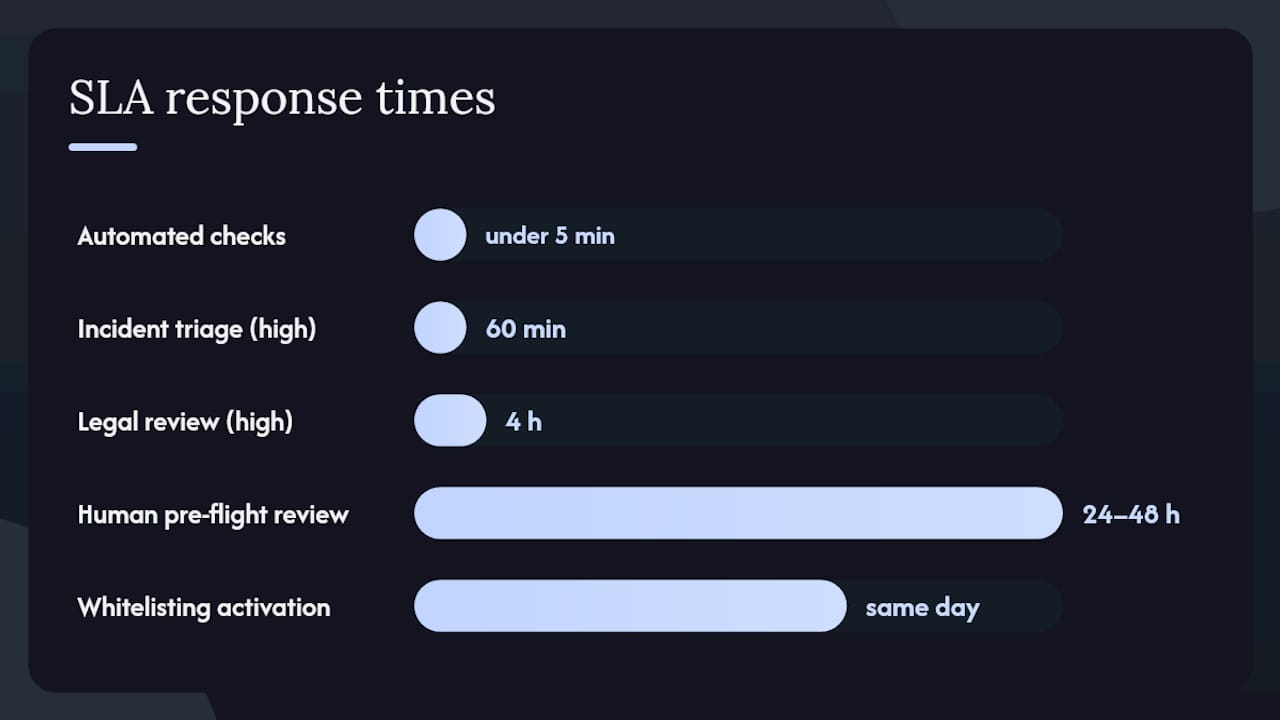
Automated checks resolve in under five minutes. Human pre-flight review targets 24–48 hours. Incident triage for high-severity flags targets 60 minutes from detection to containment decision. Whitelisting activation completes same day when creator credentials are already on file.
Which tools and signals should you monitor during a live campaign?
Effective online content control requires a layered stack: automation handles volume, humans handle judgment.
Tool categories to wire into your workflow:
- Disclosure detectors: scan captions and audio for FTC-required language and flag missing or buried placements
- Image/video NSFW detectors: flag banned-adjacent imagery before human review
- Comment triage filters: surface high-risk comments (threats, misinformation, competitor mentions) for community manager action
- Social listening platforms: track sentiment trends, share of voice, and brand-mention spikes across TikTok, Instagram, and YouTube
- Whitelisting/access management tools: log permissions, expiration dates, and access types in a single auditable record
- Campaign audit logs: timestamp every decision, reviewer, and evidence link for post-campaign review
Signal catalog — what to watch and how to route it:
Signals that should auto-pause amplification: missing disclosure on a live ad, banned-adjacent imagery confirmed by detector, commerce link pointing to an unapproved destination.
Signals that should queue for human review: sudden negative sentiment spike above baseline, removal requests from the creator, cross-platform disclosure inconsistency, affiliate link mismatch.
Integrate automated flags into Slack alerts with a direct link to the audit record. Every alert should carry the creator handle, asset URL, signal type, and detection timestamp so the reviewer can act without switching tools.
Pro Tip: Set a daily sync between your social listening platform and your campaign audit log. Brand safety programs that combine quantitative vetting with qualitative audits of creator behavior catch risks that either method alone misses.
How do brand safety and FTC compliance fit into the workflow?
Compliance is not a one-time gate. FTC disclosure compliance requires continuous monitoring throughout a campaign, not just at approval, because repurposed posts and platform edits can strip or bury required language after the initial review.
Contract clauses every creator agreement must include:
- Morality clause with defined triggers and termination rights
- Disclosure obligations with platform-specific language and placement requirements
- Approved commerce pathways (no unapproved affiliate links or storefronts)
- Content ownership, licensing, and usage-rights terms
- Compensation clawback on material violations
FTC disclosure checklist by format:
- Video: disclosure in the first three seconds, audible if audio-only, visible overlay if text-based
- Caption: above-the-fold placement, not buried in hashtags
- Story/short-form: on-screen text in the first frame, not a swipe-away slide
- Repurposed assets: re-check disclosure placement on every new distribution format
Map each contract clause to a corresponding checkbox in the pre-flight checklist. When the contractual language mirrors the operational gate criteria, reviewers apply the same standard every time without interpreting legal text mid-review.
How do you scale moderation without losing quality?
Quality degrades when programs grow faster than the review process. The fix is a sampling matrix and a scoring threshold that routes effort to the highest-risk assets.
Sampling rules:
- Random sampling: apply to all creators below 50,000 daily views, at a 20% sample rate
- Risk-based sampling: apply to creators above 50,000 daily views, any creator with a knockout flag in the prior 30 days, or any asset with spend above the campaign's top-decile threshold — review 100% of these
KPIs to measure moderation effectiveness:
Moderator onboarding checklist:
- Complete the brand safety rulebook and platform policy modules
- Review 20 calibration examples (10 approved, 10 rejected) with annotated reasoning
- Pass a decision rubric test before handling live assets
- Join a weekly calibration session for the first 30 days
- Retraining triggered when false-positive or rework rate exceeds threshold
Centralizing creator inventory with a comparable 0–100 score enables fast threshold-based decisions at scale. Pre-authorized pause workflows mean Legal reviews after containment, not before, so incidents are contained in minutes rather than hours.
Ready-to-use templates: checklist, approval sign-off, and incident playbook
Moderation checklist fields (copy into your tool of choice):
- Creator handle and campaign ID
- Brief version and countersignature date
- Automated pre-flight result (pass/fail) and timestamp
- Disclosure placement verified (platform-specific field)
- Commerce links audited (approved destination confirmed)
- Human reviewer name and decision timestamp
- Whitelisting credentials logged (handle, post URL, access type, expiration)
- Evidence links attached to audit record
Approval sign-off flow:
- Automated pre-flight: pass required
- Brand safety reviewer: approve with evidence link
- Ad ops: whitelisting activated, credentials logged
- Campaign manager: final sign-off, asset cleared for distribution
Incident playbook:
- Triage (0–60 min): detect signal, classify severity, assign owner
- Contain (0–2 hours): pause paid amplification, notify creator to remove organic post
- Investigate: pull audit log, identify root cause (missed gate, repurposed asset, creator action)
- Remediate: apply clawback if applicable, update checklist to close the gap, brief Legal if regulatory
- Post-incident audit: document findings, update SOP, debrief team within 48 hours
Provide the checklist in CSV for automated ingestion, Google Sheets for manual teams, and JSON for platform integration.
How Cult Media runs this workflow for consumer app campaigns
Cult Media integrates pre-flight checks, whitelisting, live monitoring, and pause authority into a single managed workflow for consumer tech apps. The commission-only model means Cult Media's incentives are tied directly to verified view delivery, which makes compliance a performance requirement, not an overhead cost.
Implementation steps Cult Media executes at each stage:
- Signed creative brief with compliance section acknowledged by creator
- Automated pre-flight gate run before any asset advances to human review
- Whitelisting log maintained with handle, post URL, access type, date, and expiration
- Daily monitoring cadence with pre-authorized pause rules active from day one
- Full audit trail of approvals, rejections, and incident responses delivered to the client
Sample operational KPIs (illustrative targets):
- Disclosure compliance rate: 100% of live assets verified before amplification
- Time-to-publish after approval: same business day for whitelisted assets
- Campaigns paused for incidents: tracked per period and reviewed in post-campaign audit
Because Cult Media charges only for verified views, the team has a direct incentive to keep every asset compliant and performing. A paused campaign costs Cult Media as much as it costs the client, which aligns operational rigor with commercial outcomes. Creator whitelisting paired with proper permission controls also lowers CPA for consumer apps, adding a measurable performance benefit to the compliance infrastructure.
The part most teams get wrong about moderation speed
Fast decisions and auditable decisions are not in conflict. Teams that treat moderation as a compliance tax slow everything down by routing every asset through Legal before containment. The better model: pre-authorize pause rules so the community manager can act in 60 minutes, and Legal reviews the evidence after the asset is already contained.
The other underrated priority is treating your moderation SOP as a living document. Every incident that clears the post-campaign audit should feed back into the checklist. If a disclosure was missed because a creator repurposed a Story as a Reel, that gap becomes a new gate. The teams that scale without quality loss are the ones that close loops systematically rather than waiting for the next incident to surface the same failure.
Cult Media runs the entire workflow so your team can focus on growth
Growth teams running creator-driven user-acquisition campaigns face a real tradeoff: the more creators you activate, the more moderation overhead you absorb. Cult Media eliminates that tradeoff. As a commission-only creator network built for consumer tech apps, Cult Media manages whitelisting, compliance checks, live monitoring, and audit trails end to end, so your team pays only for verified views delivered, not for the operational infrastructure behind them.

The performance model is the differentiator. Because Cult Media charges per verified view, every compliance decision is tied to a commercial outcome. A paused asset is a paused payment, which means the moderation team is motivated to get it right the first time. No retainer, no fixed overhead, no compliance gaps left to your internal team to catch. Start a campaign with Cult Media and get a managed moderation workflow built into the engagement from day one.
Sources
The recommendations in this article draw on the following industry references and Cult Media operational resources:
- Influencer marketing brand safety
- Brand safety & comment moderation for paid influencer ads
- Creator campaign pre-flight compliance checklist
- Influencer brand safety at scale: The 2026 guide | CreatorScore
Sources were selected for jurisdiction relevance (United States market), operational specificity, and direct applicability to creator-driven user-acquisition campaigns.
This article is general information, not a substitute for advice from a qualified lawyer. Consult a qualified legal professional about your own circumstances before acting on anything here.
FAQ
What is a content moderation workflow for creator campaigns?
A content moderation workflow is the step-by-step process a growth or product team uses to review, approve, reject, and remediate creator-produced content for policy, brand safety, and quality before distribution. It runs from intake brief through post-campaign audit.
How long does a typical content moderation review take?
Automated pre-flight checks complete in under five minutes. Human compliance review targets 24–48 hours per asset, and high-severity incident triage targets 60 minutes from detection to containment decision.
What FTC disclosure rules apply to creator campaigns?
Brands bear primary FTC liability for disclosure failures, so disclosures must appear in the first three seconds of video, above the fold in captions, and on the first frame of Stories. Repurposed assets require a fresh disclosure check on every new distribution format.
How does Cult Media handle moderation for consumer app campaigns?
Cult Media manages pre-flight checks, whitelisting logs, live monitoring, and audit trails as part of its commission-only creator network. Clients pay only for verified views, which ties the moderation team's incentives directly to compliance and performance outcomes.
What KPIs measure moderation effectiveness?
Track the percentage of campaigns paused for incidents as a trend metric over time.
Recommended
- Creator Whitelisting: Lower CPA for Consumer Apps
- Creator Audience Quality: Audit Checklist for Guaranteed Views - Scale Your Consumer App By Unlocking The TikTok & Instagram Systems Behind +20 Billion Views
- Creator-Led Growth: The 2026 Playbook for Growth Teams - Scale Your Consumer App By Unlocking The TikTok & Instagram Systems Behind +20 Billion Views