The fastest, most predictable path to quality installs at launch pairs guaranteed-view creator content with whitelisted ad amplification. Run a soft launch to validate creative and onboarding, then scale the winning creators through paid channels. Your next step is simple: build a creator brief now, or contact a performance-based network to pilot a guaranteed-view campaign before your hard launch date.
TL;DR:
- Running a soft launch for about 30 days helps validate creative and onboarding processes before scaling into a hard launch to avoid overspending on fixable issues.
- Prioritize vetting creators based on engagement, view retention, and tone fit rather than follower count alone, with contracts locking in content rights and performance clauses.
- Combining creative videos with paid amplification, such as whitelisted ads, can increase conversions by around 27 percent compared to using ads alone.
- Measurement should include activation rates, retention, and lifetime value, with attribution linking specific creator content to post-install user actions.
- Using a performance-based creator network with guaranteed views reduces risk, offers predictable costs, and accelerates launch timing when managed with verified reporting and sample creatives.
Table of Contents
- Which App Launch Creator Campaigns Deliver Results?
- How Do You Structure a 90-Day App Launch Roadmap?
- How Do You Find and Vet Creators for an App Launch?
- What KPIs Actually Matter After Launch?
- How Does Whitelisting and Paid Amplification Work?
- What Proof Points Support This Approach?
- How Do You Handle Creator Disputes and Relationship Problems?
- How Do You Keep Creator Content on Brand?
- How Do You Target the Right Audience Through Creators?
- What Are the Core Building Blocks of Campaign Management?
- When Should You Use a Managed Creator Network Instead of DIY?
- How to Start a Pilot Campaign with Cult Media
- Sources
- FAQ
Which App Launch Creator Campaigns Deliver Results?
Not every creator campaign format serves the same goal, and matching the format to the launch stage is what separates a controlled rollout from a budget bonfire. App launch creator campaigns generally fall into three buckets, each with a distinct job.
UGC creator campaigns build authenticity and social proof. They work best pre-launch and at soft launch, when you need believable footage for App Store listings and organic word-of-mouth. Word of mouth remains the top way people discover new apps, with video advertising accounting for 22% of discovery touchpoints and brand websites another 11%.
Influencer partnerships trade authenticity for reach and category trust. A well-matched creator in your app's niche shortens the discovery path for users who already trust that voice.
Creator whitelisting converts organic-style content into paid ads run through your own ad accounts, which typically lowers cost per acquisition while keeping the creator's tone intact.
- UGC: awareness, ASO lift, early social proof
- Influencer: targeted discovery, category credibility
- Whitelisting: scaled installs at lower CPA
- Format mapping: TikTok and Reels for virality, YouTube Shorts for discoverability, feed ads for retargeting
Pro Tip: Brief creators to contribute to their communities rather than interrupt them. Recent creator-platform launches, like Divine's rollout with Taco Bell, show that community-native content consistently outperforms interruptive ad formats for early engagement.
How Do You Structure a 90-Day App Launch Roadmap?
A launch that skips validation almost always overspends fixing problems it could have caught for free. Structure the 90 days around three phases, each gated by a decision rule before you unlock the next budget tranche.
- Days 1 to 30, soft launch. Recruit a small beta cohort, run store listing and ASO A/B tests, and brief several creators for validation content. This phase exists to catch onboarding friction and weak creative hooks before real money scales them, a principle Adjust's launch guidance treats as non-negotiable.
- Days 31 to 60, hard launch. Scale the top-performing creatives from soft launch, activate whitelisting on the winners, and open paid amplification across your primary channels.
- Days 61 to 90, scale. Reallocate budget toward the creators and creatives with the best post-install retention, run win-back experiments, and rotate new creative batches to fight fatigue.
Set a measurement gate at the end of each phase. If soft-launch retention or activation rates miss your target, do not proceed to hard launch on schedule. Fix onboarding first. Store listing experiments should already be running in parallel since ASO is a durable channel worth optimizing before you buy a single paid install.
How Do You Find and Vet Creators for an App Launch?
Sourcing options break into three tiers, and most launch teams end up using a blend of all three depending on volume needs. Managed performance networks give you scale and guaranteed outcomes without building a sourcing function from scratch. Direct community outreach works when you already have relationships in a niche. Micro-creator pools fill gaps for hyper-targeted audience segments.
Vetting matters more than volume. A creator with 50,000 followers and strong view retention often outperforms one with 500,000 followers and disengaged viewers.
- Check real engagement rate against follower count, not just follower count alone
- Review view-retention curves on recent posts, not just view totals
- Look for prior creative examples that resemble your actual user-acquisition hooks
- Confirm the creator's tone matches your app category before you brief them
Contracts should lock down three things: content usage rights, whitelisting permissions for paid amplification, and performance clauses that tie a portion of payment to delivered views or verified engagement. When negotiating guarantees, ask for a fixed CPM tied to verified organic views rather than a flat flat fee. That structure keeps your cost predictable and keeps the creator incentivized to produce content that actually performs, not just content that gets posted.
What KPIs Actually Matter After Launch?
Cost per install is the wrong metric to optimize alone, and teams that chase it exclusively tend to buy cheap, low-quality users who churn in a week. Track cost per install alongside activation rate, 7-day and 30-day retention, and either lifetime value or first-purchase rate for apps with in-app purchases.
Attribution should happen at the creative level, not just the campaign level. Deep links and event-level attribution let you see which specific creator video or hook drove installs that actually activated, not just installs that registered.
- CPI and CPA, tracked per creative variant
- Activation rate within the first session
- 7-day and 30-day retention curves
- LTV or first-purchase rate for monetized apps
Combining creator video with paid App campaigns can materially change the outcome. One cited case saw a 27% lift in conversion when YouTube video ads ran alongside App campaign install ads, compared with install ads running alone.
Test creative variants on a two-week cadence at minimum. Scale a winner only after it clears your retention gate, not just your CPI target. Raw view counts without post-install quality checks are a vanity metric dressed up as a KPI.
How Does Whitelisting and Paid Amplification Work?
Whitelisting hands your ad account permission to run a creator's content directly from their handle, which preserves the authentic feel while giving you full targeting and measurement control. That combination is why whitelisting tends to lower CPA compared to running the same budget through generic ad creative.
Channel choice depends on the job. TikTok and Instagram Reels drive virality and top-of-funnel discovery. YouTube Shorts adds discoverability with a slightly older audience skew, following the format rules laid out in the Shorts growth playbook: front-load the hook in the first three seconds, show the product in action, and close with an immediate call to action. UAC and Meta handle scaled installs once your creative is proven.
- Batch 4 to 6 creative variants per winning hook for rapid testing
- Keep captions and CTAs consistent across variants to isolate what's actually working
- A rough starting split: 60% of budget to guaranteed-view creator campaigns, 40% to paid amplification of whitelisted winners, adjusted once data comes in
What Proof Points Support This Approach?
Cult Media runs on a commission-only, performance-based model: clients pay a fixed CPM only for verified organic views, not for a retainer regardless of outcome. That structure only works if the underlying playbooks are documented and repeatable, not improvised per client.
- The 90-Day Roadmap maps directly onto the launch timeline described above
- The creator-whitelisting guide details how ad-account permissions and CPA reduction actually work in practice
- The YouTube Shorts playbook covers format-specific creative rules growth teams can apply immediately
- The TikTok performance playbook breaks down creator tactics specific to that platform
This article was compiled under Jax's editorial direction. If you're evaluating a creator partner, ask for verified view reporting and sample creatives before signing anything. Any legitimate performance-based network should hand those over without hesitation.
How Do You Handle Creator Disputes and Relationship Problems?
Disputes usually trace back to one of three causes: unclear deliverables, late payment, or a creator feeling their voice got overridden by brand notes. Fixing the root cause up front prevents most of the friction before it starts.
Put deliverables in writing before content gets made, not after. That means exact post count, platform, posting window, required disclosures, and what "approved" actually means on your end. Vague briefs are the single biggest source of creator complaints because both sides walk away with different expectations of what was promised.
When a creator delivers content that misses the brief, resist the instinct to reject it outright. Request one revision round with specific, written feedback, not a vague "this doesn't feel right." Creators who get concrete direction usually fix the issue fast, since most want the relationship to continue past a single campaign.
Payment timing matters more to creator retention than payment amount. Pay on the schedule you promised, especially for performance-based deals where a creator is waiting on a view threshold to clear. Late payment on a performance clause is the fastest way to lose access to a creator's best future work, and word travels fast in creator circles about brands who are slow to pay.
For recurring campaigns, build a simple escalation path: first contact goes to whoever manages the relationship day to day, unresolved issues go to a senior marketer within 48 hours, and payment disputes get resolved before the next campaign brief goes out. A managed creator network absorbs most of this friction directly, since vetting and contract terms are standardized before a creator ever gets matched to your brief.
How Do You Keep Creator Content on Brand?
Creator content that ignores your brand voice usually converts poorly, because the mismatch reads as inauthentic to viewers who follow that creator for a reason. The fix isn't a rigid script. It's a clear brief with room for the creator's own delivery.
Give creators three things every time: the one problem your app solves, the specific action you want viewers to take, and two or three phrases or moments that must appear somewhere in the content. Everything else, including tone, pacing, and personal anecdotes, stays in the creator's hands.
- Share real user pain points, not marketing copy, so creators can speak to them naturally
- Provide a short do's-and-don'ts list instead of a full script
- Approve concepts before filming, not finished cuts, so revisions stay cheap
- Reference one or two past posts from that creator as tone examples, not competitor ads
Test messaging on a small creator batch before rolling it out wide. If three different creators independently interpret your key message the same way, the brief is clear. If interpretations scatter, the brief needs tightening, not the creators.
How Do You Target the Right Audience Through Creators?
Creator audiences are already segmented for you. The work is matching the right creator's audience to the right app-feature message, rather than treating every creator as a generic install funnel.
Start by segmenting your target users by the specific reason they'd install your app: a productivity app might have segments for freelancers, students, and small-business owners, each with different pain points. Then find creators whose existing audience skews toward that exact segment, rather than picking creators by follower count alone.
Layer creator selection with platform behavior. TikTok and Reels audiences respond to fast, entertainment-first hooks, while a longer-form YouTube Shorts audience tolerates a slightly more explanatory pitch. Match your segment's expected attention span to the creator's typical format length.
Run separate creative variants per segment rather than one message for everyone. A freelancer-focused video and a small-business-focused video, even from the same creator, will convert differently because the pain point framing changes. Track conversion by segment, not just by creator, so you know which audience slice is actually driving quality installs.
What Are the Core Building Blocks of Campaign Management?
Every creator campaign, regardless of scale, runs on four operational primitives: briefs, approvals, payouts, and publishing. Getting these right is what separates a campaign that runs smoothly from one that generates weekly fire drills.
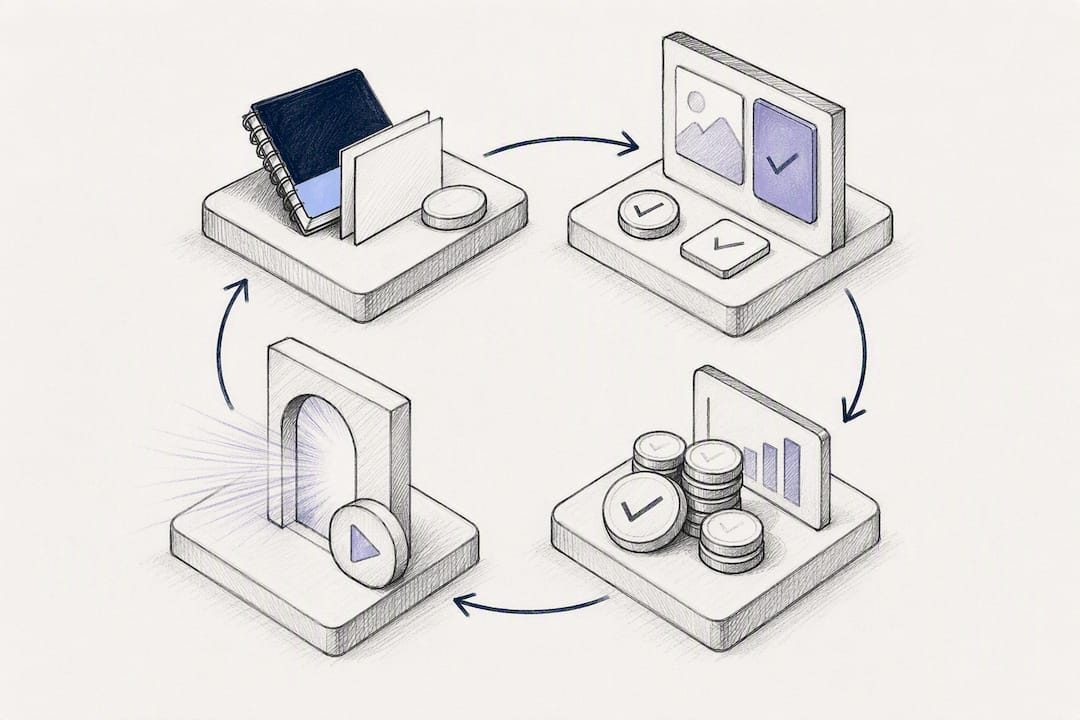
The brief is the foundation. It should specify the app's core value proposition, required disclosures, deliverable format, posting window, and any brand-safety restrictions, all in one document the creator can reference without follow-up questions.
Approvals work best as a two-stage checkpoint: concept approval before filming, then final-cut approval before posting. Skipping the concept stage is the most common cause of expensive reshoots.
Payouts should be structured around the performance terms negotiated in the contract, whether that's a flat fee, a CPM tied to verified views, or a hybrid. Automating payout tracking against a verified-view dashboard removes the manual reconciliation that eats up account-management time on larger campaigns.
Publishing needs a clear owner. Decide up front whether the creator posts natively on their own handle, whether the content gets whitelisted into your ad account, or both. That decision affects timing, since whitelisted content needs to be live organically before it can run as an ad in most platform policies.
When Should You Use a Managed Creator Network Instead of DIY?
A DIY creator program makes sense when you already have creator relationships and internal capacity to manage briefs, approvals, and payouts without a dedicated team. If you're launching on a tight timeline with no existing creator pipeline, building that infrastructure from scratch usually costs more in delay than it saves in fees.
Speed-to-scale and guaranteed outcomes are what tip the decision toward a managed performance partner. You trade some control over exact creator selection for cost predictability and a faster path from brief to live campaign. Neither choice is wrong. It depends on whether your team's time is better spent building creator infrastructure or running the product.
— Jax
How to Start a Pilot Campaign with Cult Media
A commission-only creator network built specifically for consumer tech apps means clients pay a fixed CPM only for verified organic views, not a retainer regardless of results. That structure aligns incentives: guaranteed views, conversion-focused UGC, and creators matched to your launch stage instead of a generic influencer list.
Starting a pilot is straightforward. Request a 90-day roadmap tailored to your launch timeline, or brief a smaller pilot campaign to test creative fit before committing to a full rollout. Before signing anything, ask for view verification methodology, sample creatives from creators in your app category, and the reporting cadence you'll get once the campaign is live. Those three things tell you whether a network can actually deliver on a guarantee or is just promising one.
If you're planning a launch in the next 90 days, the fastest next step is to scale your app launch with a performance-based creator campaign built around guaranteed views instead of a flat retainer.
Sources
- Mobile app marketing strategy best practices - Think with Google APAC
- How to promote your app for lasting success | Adjust
- Mobile app marketing guide: Cracking the code to success
- Divine App Opens to Public and Announces First Brand Collaboration With Taco Bell
FAQ
What Is a Performance-Based Creator Campaign?
It's a creator marketing model where you pay for verified outcomes, typically views or engagement, instead of a flat fee regardless of results. Cult Media structures its network around this model with guaranteed view counts tied to a fixed CPM.
How Long Should an App Launch Creator Campaign Run Before Scaling?
Run a soft launch phase for roughly 30 days to validate creative and onboarding before scaling budget into a hard launch, following the staged-rollout approach Adjust recommends.
What's the Difference Between UGC Creator Campaigns and Whitelisting?
UGC campaigns focus on organic-feeling content for awareness and social proof, while whitelisting takes that same creator content and runs it as a targeted paid ad through your own ad account, which usually lowers CPA.
How Do You Measure Creator Campaign Success Beyond Views?
Track activation rate, 7-day and 30-day retention, and LTV or first-purchase rate alongside cost per install, since raw view counts alone don't confirm the users you acquired stick around.
What Should I Ask a Creator Network Before Signing a Contract?
Ask for view verification methodology, sample creatives from your app category, and reporting cadence. Any legitimate performance-based network, including Cult Media's guaranteed-view model, should provide all three before you commit budget.
Recommended
- B2C App Marketing Plan: Your Ready 90-Day Roadmap
- Price Creator Deals to Break Even: Creator Campaign Forecasting for Marketers
- TikTok App Marketing: Performance-Based Creator Playbook - Scale Your Consumer App By Unlocking The TikTok & Instagram Systems Behind +20 Billion Views
- Creator Audience Quality: Audit Checklist for Guaranteed Views