
Creator audience quality is the composite of seven measurable signals you must verify before signing any guaranteed-view contract. Before committing budget, run one check immediately: pull a native analytics screenshot from the creator and cross-reference it against two independent third-party tools. If the numbers diverge significantly, that gap is your first red flag.
TL;DR — three fastest checks:
- Audience match: Confirm that more than 50% of the audience is in your target geography for geographically targeted campaigns
- Bot estimate: Flag and disqualify any creator where estimated fake followers exceed 15% of the total audience
- Comment quality: Read 5–10 recent posts for real sentences, questions, and back-and-forth conversation
Table of Contents
- What does creator audience quality actually measure?
- Why audience quality predicts installs better than reach
- What metrics and signals should you request from creators?
- How do you audit creators before and during a campaign?
- How does audience quality affect pricing and contract terms?
- What questions should you ask a managed creator partner?
- How Cultmedia operationalizes guaranteed views and audience quality
- What KPI dashboard should you require from a guaranteed-view partner?
- Key Takeaways
- The case for verification rigor over automated scores alone
- Guaranteed views, verified: what Cultmedia offers growth teams
- Useful sources
What does creator audience quality actually measure?
CreatorScore defines creator quality across seven AI-scored dimensions, each weighted to produce a single 1–100 score. For guaranteed-view buys, understanding each dimension helps you write better RFPs and set clearer contract terms.
- Content risk: Probability that a creator's content triggers platform moderation or brand-safety violations
- Authenticity: Whether follower growth and engagement patterns reflect organic behavior
- Brand safety: Alignment between a creator's historical content and your app's category
- Audience quality: Community health (real, active followers) and engagement quality, each weighted equally within this dimension, contributing 15% to the final score
- Sentiment: Net emotional tone across comments and reactions
- Community trust: Whether the audience treats the creator as a credible source in the relevant category
- ROI prediction: Estimated downstream conversion probability based on the above signals combined
For consumer app campaigns, audience quality, community trust, and ROI prediction carry the most weight operationally. Cultmedia treats verified audience quality and community trust as non-negotiable before onboarding any creator into a guaranteed-view campaign.
Why audience quality predicts installs better than reach
Follower count is the least predictive metric for driving app installs or retention. A creator with 2 million followers concentrated in the wrong geography, or inflated by bot accounts, will deliver views that never convert. Audience quality, specifically the degree to which followers are real, engaged, and relevant, is what drives business outcomes.
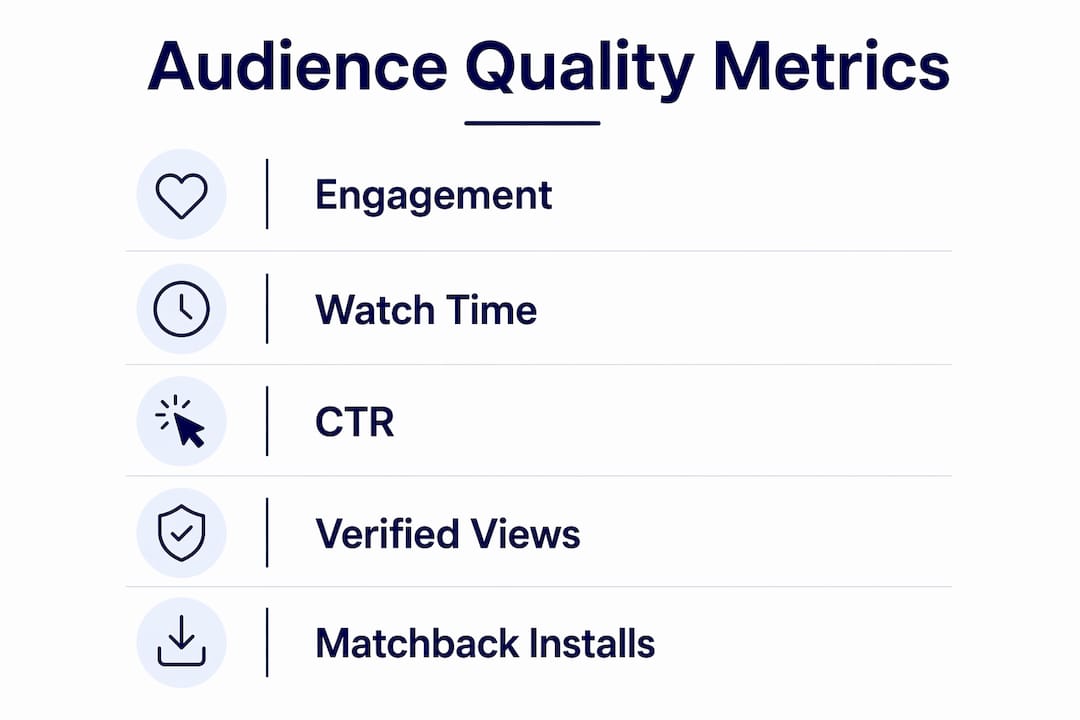
The conversion data supports this directly. Returning visitors convert at 2.9% versus 1.7% for new visitors in engagement research, a gap that maps cleanly onto the difference between a creator whose audience actively trusts their recommendations and one whose reach is passive or artificial. Engagement has shifted from a soft metric to a core operating signal for growth teams.
Three immediate campaign risks from low audience quality:
- Bad installs: High install volume from disengaged or mismatched audiences drives up D1 churn and distorts LTV models
- High fraud exposure: Bot-inflated view counts consume CPM budget without generating real user actions
- Wasted makegood cycles: When views don't convert, refund or re-run clauses get triggered, delaying campaign timelines and burning team bandwidth
What metrics and signals should you request from creators?
Engagement signals should be weighted by business value: surface interactions (likes) matter least; deep signals (CTR, repeat views, time-on-content) and business impact signals (installs, D1/D7 retention) matter most.

| Metric | Why it matters | What to request |
|---|---|---|
| Verified view count | Confirms delivery against guarantee | Native analytics screenshot + third-party verification |
| View duration / watch time | Indicates real attention, not bot traffic | Average watch time per post, last 30 days |
| Repeat views | Signals community trust and content pull | Repeat view rate from native analytics |
| CTR to app store | Measures intent to act | Link click data or swipe-up rate |
| Installs (matchback) | Ties views to actual user acquisition | Pixel or UTM-matched install report |
| D1 / D7 retention | Validates audience relevance | Post-campaign matchback from MMP |
| Audience geography | Confirms primary-market concentration | Location export: top 5 countries/cities |
| Age brackets | Validates demographic match | Age distribution from native analytics |
| Bot / fake follower estimate | Flags fraud risk | Two independent third-party tool outputs |
| Comment quality | Assesses community health | Manual review of 5–10 recent posts |
| Audience overlap | Prevents wasted reach | Cross-campaign overlap report |
Pro Tip: Cross-check outputs from two different third-party tools, since methodologies differ and a single tool can miss growth spikes. If both tools flag an anomaly in the same two-week window, treat it as a disqualifying signal.
How do you audit creators before and during a campaign?
Pre-run vetting:
- Read comments on the creator's last 10 posts. Look for full sentences, product questions, and genuine back-and-forth, not emoji chains or generic praise.
- Run two independent bot-check tools and compare estimates. Flag any creator above 15% estimated fake followers.
- Request a native analytics screenshot covering the last 30 days: views, watch time, audience location, and age breakdown.
- Ask for an audience location export. Confirm primary-market share exceeds 50% for US-targeted campaigns.
- Spot-check follower growth charts for sudden spikes, which often indicate purchased followers or viral anomalies that inflate baseline numbers.
At contract signing:
- Specify the verification provider(s) by name in the contract
- Define the makegood threshold (e.g., re-run or refund if delivered views fall below an agreed minimum delivery level)
- Include sampling rights: the right to audit any 10% of delivered views at any point during the campaign
- Set reporting cadence in writing: daily delivery summary, weekly matchback, post-campaign retention report
During live delivery:
- Run daily sample audits on a rotating subset of creator posts
- Compare promised view duration against delivered watch time weekly
- Check pixel or UTM matchback data against install reports from your mobile measurement partner (MMP)
- Define escalation triggers: if bot estimate rises mid-campaign or watch time drops below threshold, pause delivery and review
Pro Tip: Sample at least 10% of posts per creator per week during live delivery. For campaigns with more than five creators, rotate which accounts you audit daily so every creator gets checked within a seven-day window.
How does audience quality affect pricing and contract terms?
Higher audience quality commands a higher CPM, and that premium is justified. A creator with verified low bot rates, strong primary-market concentration, and documented engagement quality carries lower fraud risk and higher conversion probability, which means fewer wasted impressions and fewer makegood triggers.
Key contract clauses to negotiate:
- Verification standard: Name the tools and methodology used to confirm view authenticity
- Makegood threshold: Define the minimum delivery percentage (typically 90%) that triggers a re-run or partial refund
- Proof-of-audience exports: Require location and demographic exports before campaign launch, not after
- Retention-linked bonuses: Structure a performance bonus tied to D7 retention rate exceeding a defined benchmark
- Holdback: Withhold 10–15% of payment until post-campaign matchback data is delivered and verified
Pro Tip: Start with a smaller initial tranche — one to three creators, capped at 20% of total budget — before scaling. Escalating guarantees let you validate audience quality signals against real install and retention data before committing full spend.
What questions should you ask a managed creator partner?
Must-ask RFP questions:
- Which third-party verification tools do you use, and can you share sample audit reports?
- What is your sampling methodology during live campaigns?
- What is your onboarding timeline from contract signing to first content delivery?
- What is your reporting cadence, and which metrics appear in each report?
- What is your makegood or refund policy if guaranteed views are not delivered?
- Who owns the campaign data, UTM parameters, and pixel configurations?
- Do you support MMP integration for matchback attribution?
Decision checklist:
- Documented case studies with install and retention outcomes, not just view counts
- Two named third-party verification tools in the contract
- Willingness to provide native analytics exports before payment
- Clear data ownership language
- Transparent pricing tied to verified CPM, not estimated reach
Scoring rubric (weight in order): audience match and verification rigor first, reporting transparency second, pricing structure third.
How Cultmedia operationalizes guaranteed views and audience quality
Cultmedia's commission-only model ties every payment to verified organic views. Clients pay an agreed CPM only after views are confirmed through native analytics and independent third-party checks. Daily sample audits, pixel and UTM matchback, and view-duration verification run throughout every campaign. Makegood clauses are written into every contract, with re-run or refund triggers defined before launch.
Cultmedia's verified approach reflects the operational standard that performance-based guaranteed-view campaigns require: no payment without verification, no verification without a documented audit trail.
Pro Tip: When reviewing any managed partner's contract, ask specifically where the holdback clause sits and what data triggers its release. If the answer is vague, that is a signal the verification process is not operationally mature.
What KPI dashboard should you require from a guaranteed-view partner?
| KPI | Source | Reporting cadence |
|---|---|---|
| Delivered views | Native analytics + third-party | Daily |
| View duration | Native analytics | Daily |
| Repeat view rate | Native analytics | Weekly |
| CTR to app store | Link tracking / native | Weekly |
| Landing page visits | UTM / pixel | Weekly |
| Installs | MMP matchback | Weekly |
| D1 retention | MMP | Post-campaign |
| D7 retention | MMP | Post-campaign |
| Cost per verified view | Partner report | Weekly |
| Matched-install rate | MMP matchback | Post-campaign |
Daily reports should cover delivered views and watch time. Weekly reports add matchback installs, CTR, and cost per verified view. The post-campaign report must include D1 and D7 retention tied to matched installs.
To integrate these outputs with your existing analytics stack, pass UTM parameters through every creator link, connect your MMP (AppsFlyer, Adjust, or similar) to receive matched install feeds, and pipe weekly matchback data into your attribution dashboard for LTV modeling.
Key Takeaways
Creator audience quality, verified through native analytics, third-party tools, and matchback attribution, is the single most reliable predictor of install quality and retention in guaranteed-view campaigns.
| Point | Details |
|---|---|
| Verify before you pay | Pull native analytics and cross-check with two third-party tools before signing any guaranteed-view contract. |
| Bot threshold is 15% | Flag and disqualify creators where estimated fake followers exceed 15% of the total audience. |
| Primary-market concentration | Require more than 50% of audience in your target geography for US-focused campaigns. |
| Makegood clause is non-negotiable | Define re-run or refund triggers at 90% delivery threshold in every contract before launch. |
| Cultmedia as verified partner | Cultmedia's commission-only model ties payment to verified CPM with daily audits and contractual makegood terms built in. |
The case for verification rigor over automated scores alone
Automated scoring tools, including CreatorScore-style frameworks, are genuinely useful for initial screening. They surface patterns across thousands of creators faster than any manual process. But a score alone does not tell you whether an audience trusts a creator's product recommendations in your specific app category. That judgment requires human review: reading comments, assessing the quality of questions asked, and evaluating whether the community engages with the creator as an authority or simply as entertainment.
The most reliable campaigns combine both. Use automated scores to filter the field, then apply human vetting to the shortlist. When incentives are aligned, as they are in a commission-only model where the partner only earns when verified views are delivered, the verification process tends to be more rigorous by design. That alignment is what separates a managed partner worth trusting from one that optimizes for the appearance of delivery.
Guaranteed views, verified: what Cultmedia offers growth teams
Cultmedia delivers guaranteed-view campaigns for consumer tech apps on a commission-only basis: you pay only for verified organic views, confirmed through native analytics and independent third-party checks. No monthly retainers, no payment before verification.
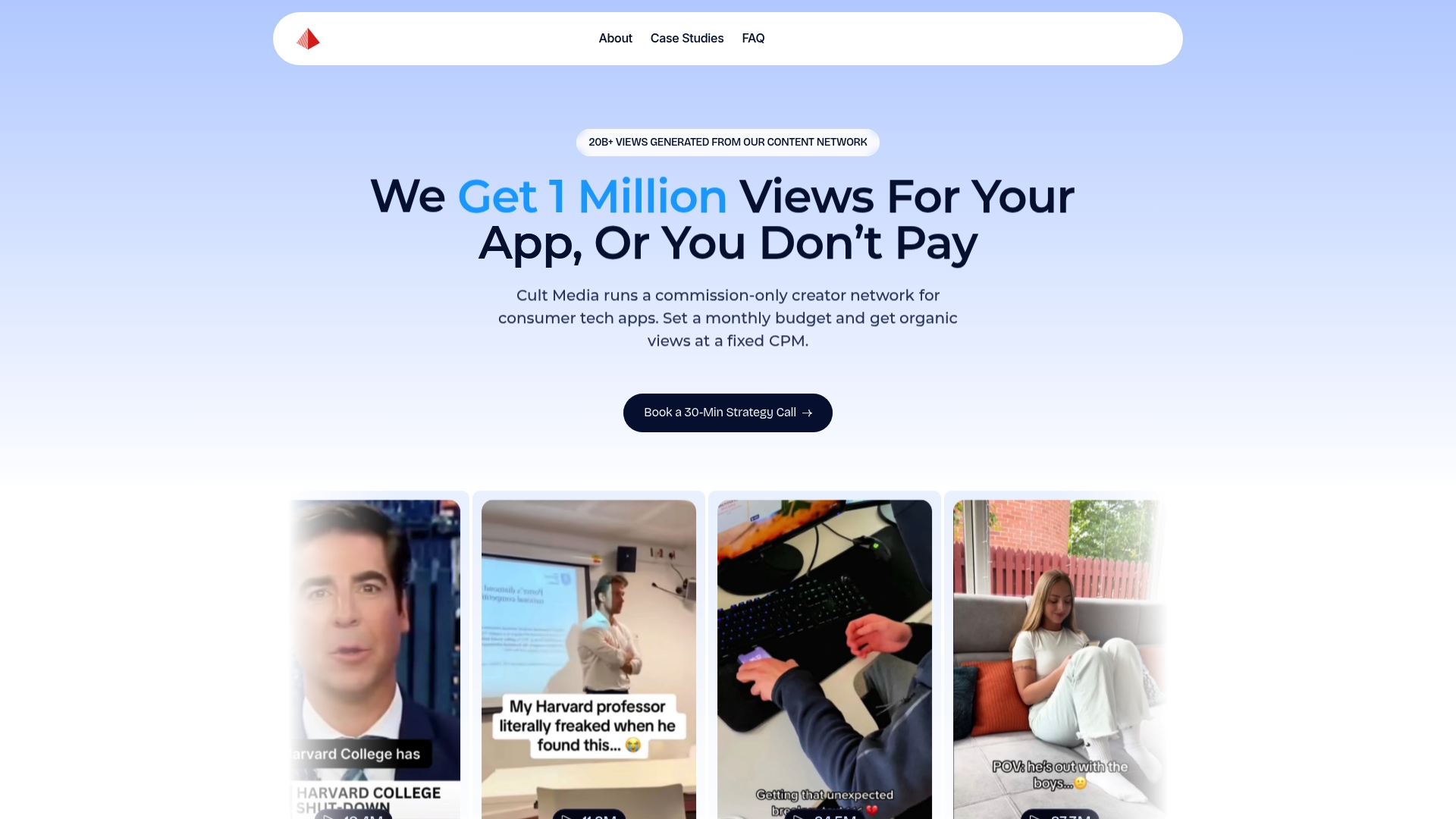
Every campaign includes daily sample audits, pixel and UTM matchback attribution, and contractual makegood terms. Growth teams get a weekly KPI report covering delivered views, CTR, matched installs, and cost per verified view, plus a post-campaign retention report tied to D1 and D7 data from your MMP.
- Commission-only pricing tied to verified CPM
- End-to-end creator management across TikTok and Instagram
- Native analytics exports and two-tool verification standard
- Makegood clauses written into every contract
Submit a campaign brief to see how Cultmedia's verified creator network fits your next user acquisition campaign.
Useful sources
- CreatorScore: 7 Dimensions of Creator Quality — the source framework for the seven-dimension model and audience quality weighting used throughout this guide
- InfluencerFee: Influencer Audience Quality Guide — practical benchmarks for bot thresholds, comment quality review, and two-point verification methodology
- PostSyncer: Audience Engagement Strategies — documents the shift from reach-based to engagement-based performance measurement
- Zoom: What Is Audience Engagement? — conversion data linking engagement depth to business outcomes
- Sprout Social: Audience Engagement Strategies — the engagement-level framework (surface, active, deep, business impact) used in the KPI hierarchy
- Cultmedia — campaign brief templates, RFP guidance, and the commission-only guaranteed-view model described in this guide