Run creator campaigns as outcome-driven programs, not one-off content buys. That means defining a KPI before outreach, locking down UTMs and pixel events before the first post goes live, and treating creator selection, briefing, tracking, and scaling as five connected pillars rather than five separate tasks. Skip the tracking setup and even a viral post becomes unattributable data you can't defend in a budget meeting.
TL;DR:
- Campaigns should be outcome-driven with clear KPIs and proper tracking infrastructure in place before outreach begins, to ensure attribution accuracy.
- Selecting creators relies on audience fit and engagement quality, not follower count, with thorough vetting of recent posts, comment activity, and fraud signals.
- Well-structured briefs and approvals are essential, with specific deliverables, messaging points, and rights defined upfront, maintaining flexibility for authentic content.
- Contracts must specify verification-based payouts, clear deliverables, and usage rights, with performance tracking integrated into the operational setup.
- Using guaranteed-view models aligns incentives, as payments are based on verified outcomes like views and installs, simplifying measurement and reducing disputes.
Table of Contents
- What Is Creator Campaign Management, and Which Outcomes Should You Design For?
- How Do You Plan a Campaign Before Reaching Out to Creators?
- How Do You Find and Vet the Right Creators?
- What Belongs in a Creator Brief, and How Should Approvals Work?
- What Goes Into Contracts, Compensation, and Payments?
- How Do You Track and Measure Campaign Performance?
- How Do You Scale Operations Without Losing Quality Control?
- How Do Guaranteed-View Partnerships Change the Operational Model?
- Your One-Page Launch Checklist
- Why "Guaranteed Views" Beats Guessing on Creator Spend
- Sources
- FAQ
What Is Creator Campaign Management, and Which Outcomes Should You Design For?
Creator campaign management is the operational discipline of planning, executing, and measuring paid or gifted creator partnerships against a specific business outcome, not likes or reach alone. The job-to-be-done is conversions, installs, or revenue, and the campaign structure should reflect that from day one.
Different campaign types optimize for different single metrics. An awareness campaign using broad-reach creators should optimize for cost per thousand impressions. A conversion-focused campaign using niche micro-creators should optimize for cost per install or cost per acquisition. A brand ambassador program spanning months should optimize for retention and repeat engagement rate, not one-time reach.
Choosing the right type comes down to budget and timeline. Tight budgets and short windows favor performance-based models with a handful of vetted creators. Larger budgets with longer runways support broader creator mixes and layered KPIs, working backward from the business outcome to set targets rather than picking a metric because it's easy to report.
How Do You Plan a Campaign Before Reaching Out to Creators?
Planning starts with the outcome, not the creative idea. Work backward from the business result and pick one or two KPIs that map directly to it, whether that's app installs, trial signups, or revenue per creator, a sequencing results-driven playbooks recommend over vanity-metric planning.
Budget determines creator tier and compensation model simultaneously. A moderate budget typically buys access to micro-creators on flat fees or CPM deals; a significantly larger budget can support mid-tier creators plus a commission layer for top performers.
Before any outreach message goes out, tracking infrastructure needs to exist:
- A standardized UTM taxonomy covering campaign ID, creator handle, and content format
- Pixel events mapped to your chosen KPI, not a generic "page view"
- Deep links or affiliate codes tested end-to-end in a staging environment
- An approvals calendar with named owners and dated gates for brief sign-off, draft review, and go-live
Pro Tip: Build your UTM structure in a shared spreadsheet before the campaign kicks off. Retrofitting tracking after fifteen creators have already posted is often not fixable.
Attribution gaps created before launch are frequently permanent. Governance around campaign URLs has to happen before creators post, not after someone asks why the numbers don't add up.
How Do You Find and Vet the Right Creators?
Follower count is a weak predictor of performance. What matters is what one influencer marketing guide calls "product truth": whether a creator's storytelling style and audience actually match your product, prioritizing fit over raw reach.
Run every candidate through this sequence before an offer goes out:
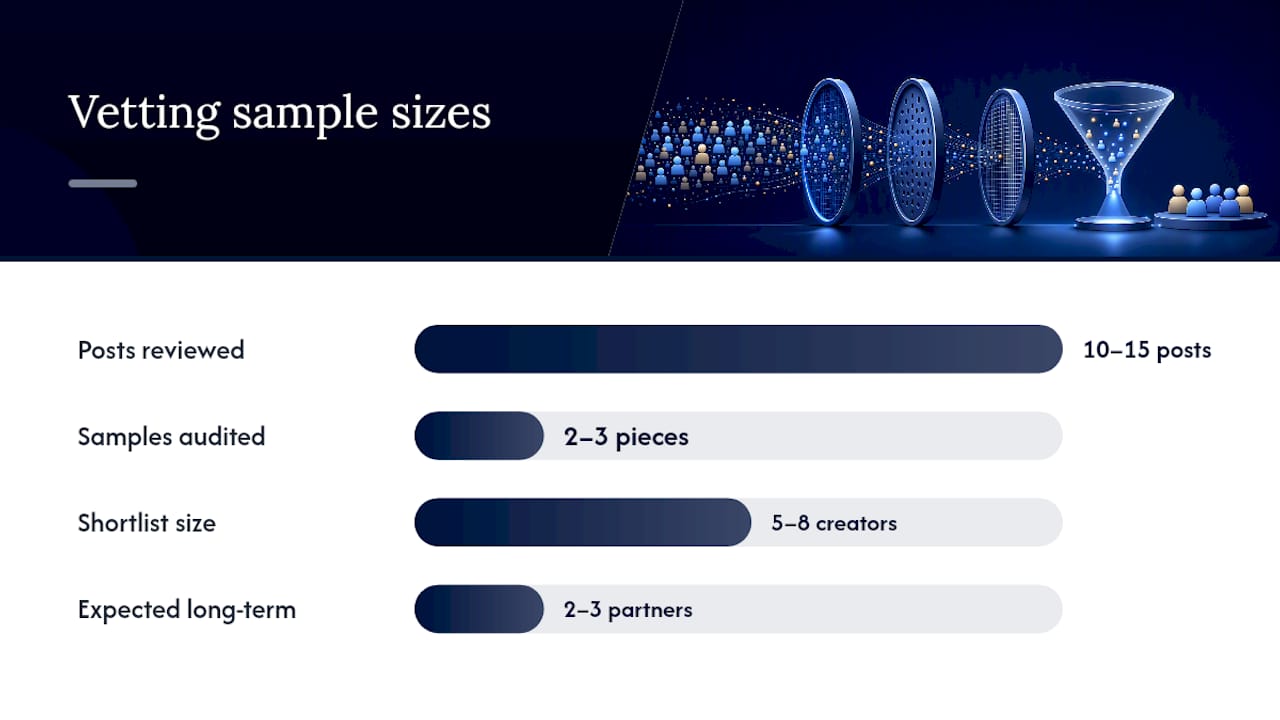
- Pull the creator's last 10 to 15 posts and check engagement rate against their category average, not a generic benchmark.
- Audit two or three pieces of sample content for tone, pacing, and whether the audience actually comments or just scrolls past.
- Screen for engagement fraud signals like sudden follower spikes or comment sections dominated by bot-like generic replies.
- Confirm operational fit: response time to your first message, willingness to follow a brief, and availability within your posting window.
- Shortlist five to eight creators for a first wave, expecting two or three to become long-term partners.
A first wave that's too small tells you nothing about repeatability. A first wave that's too large burns budget on creators you'll never rehire.
Pro Tip: Treat the first message as part of the vetting process. A creator who takes four days to reply to outreach will take four days to reply to a revision request during a live campaign.
What Belongs in a Creator Brief, and How Should Approvals Work?
A brief that's too vague produces content that misses the point; a brief that's too rigid kills the authenticity that made the creator worth hiring in the first place. Industry guidance consistently names unclear deliverables as the biggest cause of campaign rework.
Every brief needs:
- The campaign goal and the single KPI it's optimizing for
- Audience description, not just demographics but the problem the audience is trying to solve
- Mandatory messaging points, kept to three or fewer
- Visual and tonal references, ideally two or three examples of content you like
- Exact deliverables: format, length, platform, and posting window
- Usage rights terms, spelled out before production starts
| Element | Get it wrong | Fix |
|---|---|---|
| Mandatory messages | Ten bullet points of requirements | Cap at three non-negotiables |
| Tone guidance | No references given | Attach two example posts |
| Deliverables | Vague "a video about the app" | Specify format, length, platform |
| Usage rights | Left undefined until after posting | Define term and scope in the brief |
Two rounds of approval, one on the initial draft and one on the final cut, keeps quality high without micromanaging. Prescriptive scripts belong only in regulated categories; open, collaborative briefs tend to outperform because creators bring their own storytelling instincts when given room to. Reusable templates help; brief examples that actually get used beat a blank document every time.
What Goes Into Contracts, Compensation, and Payments?
Every creator agreement needs the same core clauses regardless of market: deliverables and deadlines, payment amount and schedule, cancellation terms, disclosure requirements under FTC guidelines, and content licensing scope. Standardized contract templates covering usage rights and duration cut down on post-publish disputes significantly.
Compensation models each carry tradeoffs:
- Flat fee is simple to budget and predictable for creators, but it decouples pay from performance.
- CPM or guaranteed-views pricing ties spend to actual delivered exposure, aligning incentives with the brand's growth goal.
- Commission or affiliate pricing rewards conversions directly but can undervalue top-funnel awareness content.
- Hybrid models combine a smaller flat fee with a performance bonus, balancing creator cash flow needs against brand risk.
Payment flows should account for tax documentation across jurisdictions before a campaign spans multiple countries. Licensing terms matter beyond the organic post too: content cleared for paid amplification needs its own line in the contract, since rights management gaps are one of the fastest ways a strong-performing asset gets stuck in limbo.
How Do You Track and Measure Campaign Performance?
Attribution has to be built before launch, not reconstructed afterward. UTMs, pixel events, deep links, and affiliate codes each need to be live and tested against your chosen KPI before a single creator posts, matching event names to your analytics platform's own conventions.
Different metrics deserve different monitoring cadences:
| Metric | Check frequency | Why |
|---|---|---|
| Reach and engagement | Daily during flight | Catches underperforming creative early |
| Clicks and link taps | Daily | Signals whether the hook is working |
| Installs or signups | Daily to weekly | Direct tie to campaign KPI |
| CPA and ROAS | Weekly | Needs volume to be statistically meaningful |
Creator-reported view and engagement numbers should be reconciled against your own analytics weekly. Discrepancies over 15 to 20 percent usually mean a tracking link broke, not that the creator inflated numbers. Dashboards that aggregate creator posts and engagement in one view cut manual reporting time and surface top performers faster, which matters because the real payoff of tracking is knowing which assets to push into paid amplification once organic performance proves out.
How Do You Scale Operations Without Losing Quality Control?
Scaling a creator program from five partners to fifty requires the same rigor at higher volume, not looser standards. A documented onboarding SOP keeps new creators moving through vetting, contracting, and briefing on a predictable timeline instead of stalling in someone's inbox.
- Send the vetting checklist and contract within 48 hours of creator confirmation.
- Deliver the brief and reference assets within 3 business days of contract signature.
- Require a pre-publish proof, a draft file or private link submitted 48 hours before posting, so the brand can validate compliance and tracking parameters ahead of go-live.
- Route final approval through a named reviewer with a 24-hour turnaround SLA.
- Archive final assets using a consistent naming convention: campaign ID, creator handle, format, date.
Assign clear roles: a campaign manager owns timelines, a legal reviewer clears disclosure and rights language, a performance analyst reconciles metrics, and a payments lead handles disbursement. Pro Tip: Keep a simple spreadsheet ranking creators by CPA after every campaign. The top 20 percent typically deserve a standing retainer offer before a competitor locks them in. Long-term partnerships with proven creators save meaningful time and cost versus onboarding new talent for every single campaign.
How Do Guaranteed-View Partnerships Change the Operational Model?
Buying verified outcomes instead of flat-fee deliverables changes what a contract has to specify. Payout terms shift from "on delivery" to "on verification," which means tracking infrastructure isn't optional infrastructure, it's the mechanism that triggers payment itself.
A brand submits a brief with mandatory messaging and a tracking link. The creator posts within the agreed window. Views are verified against the platform's own analytics before any commission is released. Nobody argues about numbers because the numbers are the contract.
That verification step is what an operational model built around guaranteed outcomes entails: rights and disclosure terms get locked at onboarding, not renegotiated after a video underperforms or overperforms expectations.
Your One-Page Launch Checklist
Define your KPI, then build tracking, then shortlist creators, then brief, approve, publish, monitor, and finally pay or scale, in that order. Skipping tracking before launch usually results in substantial time spent later reconciling broken attribution.
Three red flags worth watching: engagement that looks high but comment quality is generic (fraud risk), a creator who negotiates hard on price but goes quiet on brief questions (fit risk), and reported views that don't match your own pixel data by more than 20 percent (tracking risk). Target a 48 hour SLA for onboarding and a 24 hour SLA for approvals.
Why "Guaranteed Views" Beats Guessing on Creator Spend
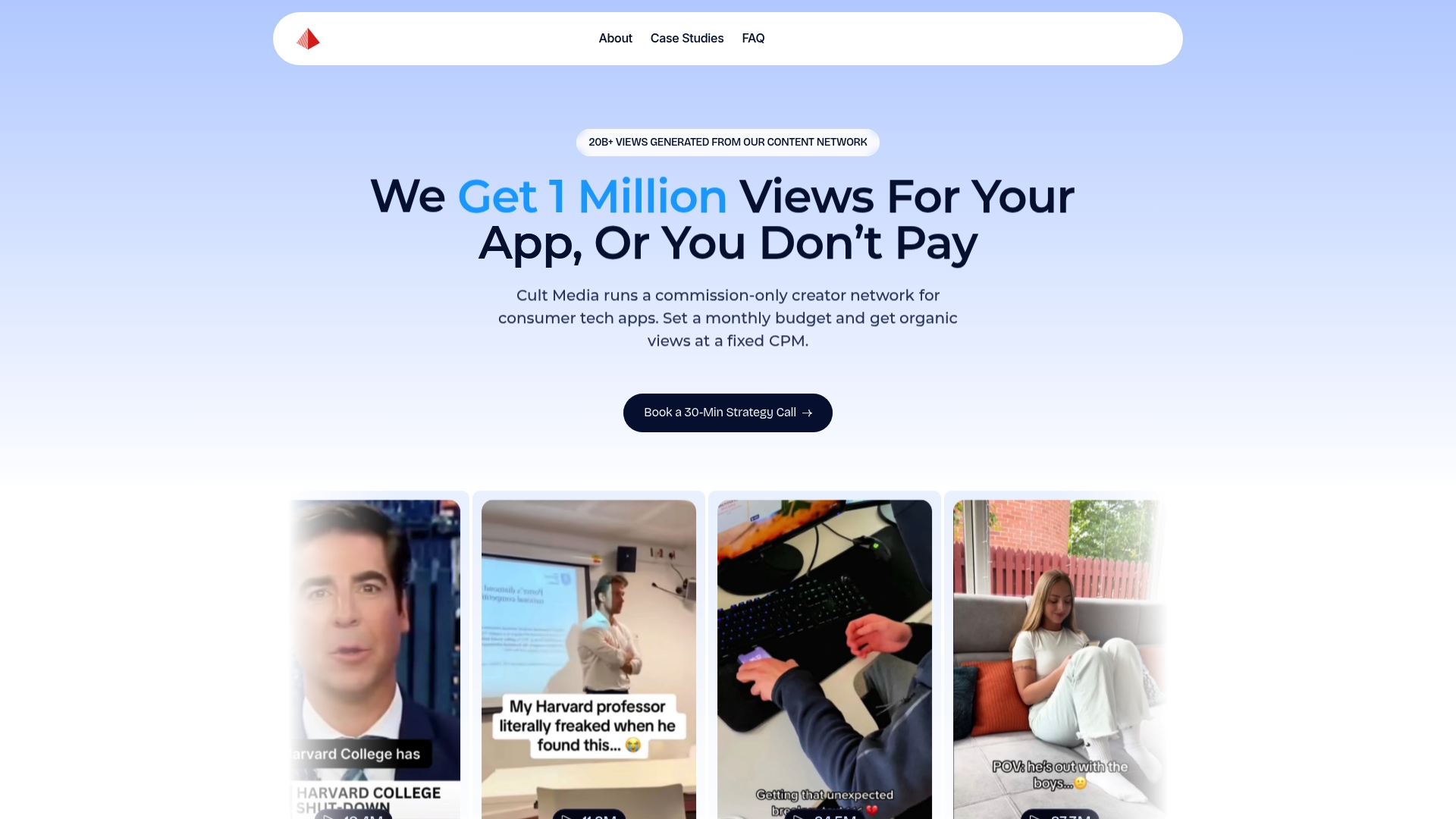
Consumer app teams comparing agency retainers, in-house influencer hires, and self-serve platforms are usually solving for the same problem: paying for effort instead of results. This model often uses a commission-only approach built specifically for consumer tech apps, where clients pay a fixed CPM only for verified organic views a creator campaign actually delivers.
That structure removes the reconciliation fights this article just walked through. Views get verified before payout, rights and disclosure terms are locked at onboarding, and the incentive on both sides points at the same number: downloads. For a growth team weighing whether to hire another in-house creator manager or find a network that already has vetted creators making high-conversion content, that alignment is the operational difference. If your team is planning a creator push this quarter, see how the guaranteed-views model works and what a measurement setup for your app would look like.
Sources
Build your own reporting stack with campaign reporting templates and ROI examples, track offline activations with QR-based campaign tracking, and compare influencer analytics tools for your dashboard build.
- Influencer marketing strategy (Shopify enterprise blog)
- Influencer marketing strategy: the results-driven playbook for 2026 (Later)
- Influencer marketing (Sprout Social)
- CampaignTrackly — campaign URL builder and UTM governance
FAQ
Is Cult Media a Legitimate Creator Campaign Partner?
Cult Media operates a commission-only creator network for consumer tech apps, charging a CPM fee only for verified organic views, which ties payment directly to delivered outcomes rather than promised deliverables.
How Much Do Influencer Managers Get Paid?
Influencer manager compensation varies widely by market, company size, and whether the role is in-house or agency-based, and no single figure applies universally across regions or seniority levels.
What Does Campaign Management Actually Involve?
Campaign management covers goal-setting, creator vetting, briefing, tracking setup, approvals, payment, and performance reporting, treating each stage as connected rather than as separate one-off tasks.
How Much Do Influencers Get Paid for a Single Campaign?
Influencer pay depends heavily on the compensation model. Flat fees, CPM or guaranteed-view rates, and commission-based structures each produce different payouts depending on audience size, engagement, and verified results.
What's the Biggest Mistake Marketing Teams Make in Creator Campaigns?
Skipping tracking governance before launch is the most common and costly mistake, since UTM and pixel setup done after creators post often can't be fixed retroactively.
Recommended
- B2C App Marketing Plan: Your Ready 90-Day Roadmap
- TikTok App Marketing: Performance-Based Creator Playbook - Scale Your Consumer App By Unlocking The TikTok & Instagram Systems Behind +20 Billion Views
- Creator Whitelisting: Lower CPA for Consumer Apps
- Modash vs HypeAuditor: Performance Creator Campaigns for App Growth