For consumer app founders and growth teams, a commission-only, guaranteed-view creator network is the right model when your goal is verified installs at a predictable CAC. Pay-for-verified-views aligns creator incentives with your revenue outcomes in a way that SaaS discovery tools simply cannot. If you have MMP attribution in place and a product with a visible social hook, this model is worth testing with $10k before committing to a larger budget. If you need raw audience data or long-term creator relationship ownership, a discovery-first platform may serve you better.
Table of Contents
- How does a guaranteed-view network differ from discovery SaaS?
- How does MMP attribution actually work for app campaigns?
- What formats and pricing mechanics should you expect?
- How do you decide between a managed network and a SaaS tool?
- A $10k test campaign playbook you can run this month
- Why Cult Media delivers on performance guarantees
- Key Takeaways
- The gap between cheap CPMs and real growth
- Cult Media's pilot offer for app growth teams
- Useful sources
- FAQ
How does a guaranteed-view network differ from discovery SaaS?
The core difference is financial risk. With a managed creator network, you define a CPM and a minimum view threshold, and you pay only after those views are verified. With a SaaS discovery platform, you pay for database access and audience audits regardless of campaign performance.
A managed network delivers more than a creator list. It provides:
- Content inventory: Posts continue accumulating views after the paid window, creating ongoing organic discovery if quality control is enforced.
Discovery-first platforms and in-house programs make sense when you need data ownership, want to build direct creator relationships over time, or have a dedicated influencer manager who can run outreach and negotiation internally. The trade-off is execution bandwidth and the absence of a performance guarantee.
Pro Tip: Start with a managed network for your first creator channel test. Once you know which formats and creator profiles convert, you can bring that intelligence in-house or into a SaaS tool.
How does MMP attribution actually work for app campaigns?
Measurement is where most app creator programs fail. Weak attribution — missing unique tracking links per creator, no downstream event mapping — is the most common reason campaigns look flat even when content performs.
The attribution flow runs in four stages:
| Stage | What happens | Tool involved |
|---|---|---|
| Creator post goes live | View count begins; unique link embedded in bio or caption | Creator tracking link |
| View verification | Views checked against threshold and bot-filter rules | Network verification layer |
| Install attribution | User clicks link, app opens, MMP records install source | AppsFlyer, Adjust, or Branch |
| Downstream events | Onboarding completion, day-7 and day-30 retention mapped to creator | MMP event mapping |
Deferred deep linking matters because a user who sees a creator post, downloads the app from the App Store, and opens it later still needs to be attributed to that creator. OneLink-style solutions handle this by preserving the attribution parameter through the install gap. Without it, retention data is incomplete and you cannot calculate true CAC per creator.
Cross-network attribution discrepancies are also worth flagging. View-through conversion reporting varies by platform, so a view counted on TikTok may not match what your MMP records as a VTC. Agree on a single attribution window in the contract before the campaign launches.
Pro Tip: Map every creator to a unique tracking link in your MMP before the campaign brief goes out. Without that mapping, you are scaling on vanity metrics, not verified installs.
What formats and pricing mechanics should you expect?
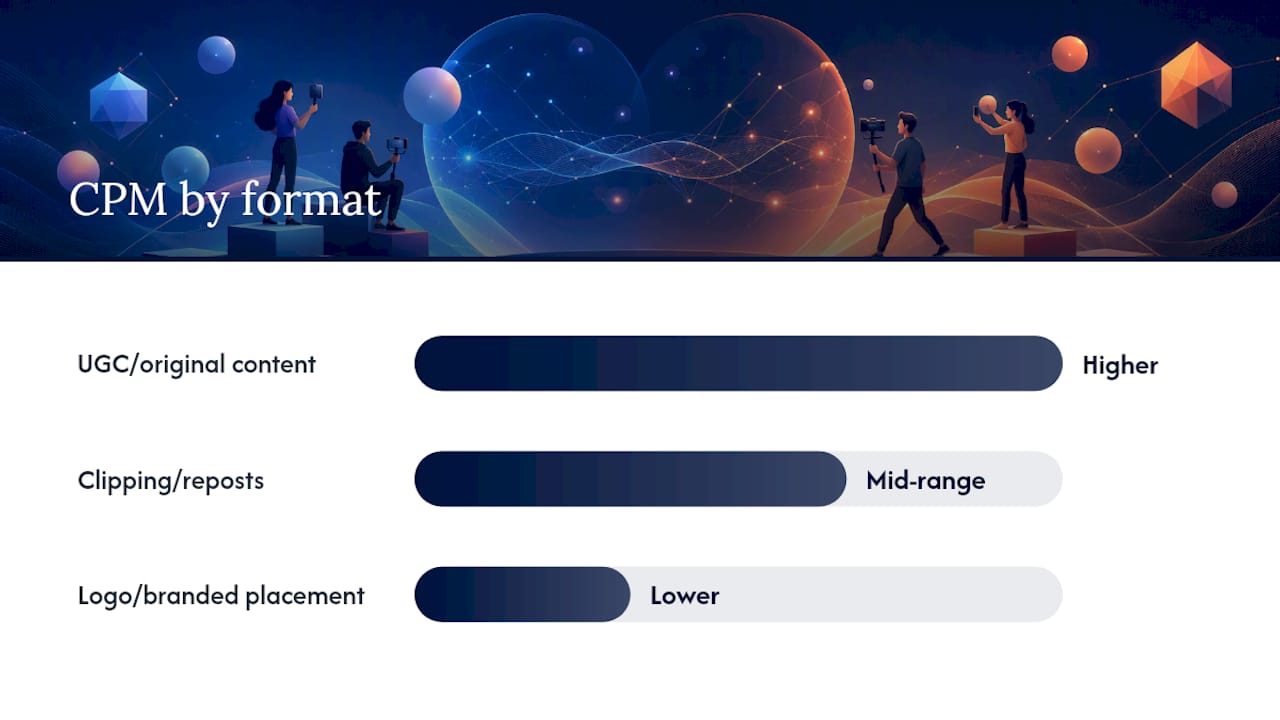
Three formats drive most app growth campaigns, and each sits at a different CPM tier.
| Format | Best for | CPM position |
|---|---|---|
| UGC/original content | New user acquisition, onboarding hook | Higher CPM |
| Clipping/reposts | Retargeting, social proof amplification | Mid-range CPM |
| Logo/branded placement | Brand recall, top-of-funnel awareness | Lower CPM |
The strategic rule is straightforward: prioritize formats where your RPM (revenue per 1,000 views) exceeds your CPM. If a UGC post costs $25 CPM and your app generates $40 RPM from creator-driven installs, the math works. If RPM drops below CPM, the format or the creative is underperforming.
Performance-based deals are typically structured with a defined performance window of 7–30 days and a minimum view clause (MVC) that triggers payout only after the threshold is met. Caps protect the brand from runaway payouts on viral posts.
Watch for hidden costs: creative review fees, platform commission on top of creator payouts, and unclear MVC triggers. Require every fee to be itemized in the contract before signing.
Pro Tip: Creator fund agreements explain how RPM and CPM interact in practice — read one before negotiating your first CPM rate.
How do you decide between a managed network and a SaaS tool?
Run through this checklist before your next vendor call.
- Does your product have a visible social hook? If the app's core value is hard to show in 15–30 seconds, creator content will underperform regardless of the network.
- Is MMP attribution already in place? Without it, you cannot verify outcomes or calculate CAC.
- Do you have $10k+ available for a test? Managed networks require a minimum budget to seed enough creator posts for statistically meaningful data.
- Does your team have bandwidth to manage creators? If not, a managed network's end-to-end execution is worth the CPM premium.
When you talk to a managed network's sales team, ask:
- What counts as a verified view, and what is the dispute process?
- Which MMPs do you integrate with natively?
- What is the MVC trigger and the payout window?
- What is the creative approval SLA?
Red flags to walk away from:
- No MMP integration or vague language about "tracking."
- Unlimited payout caps with no MVC floor.
- No written creative approval workflow.
- Verification described as "platform analytics" with no independent check.
A $10k test campaign playbook you can run this month
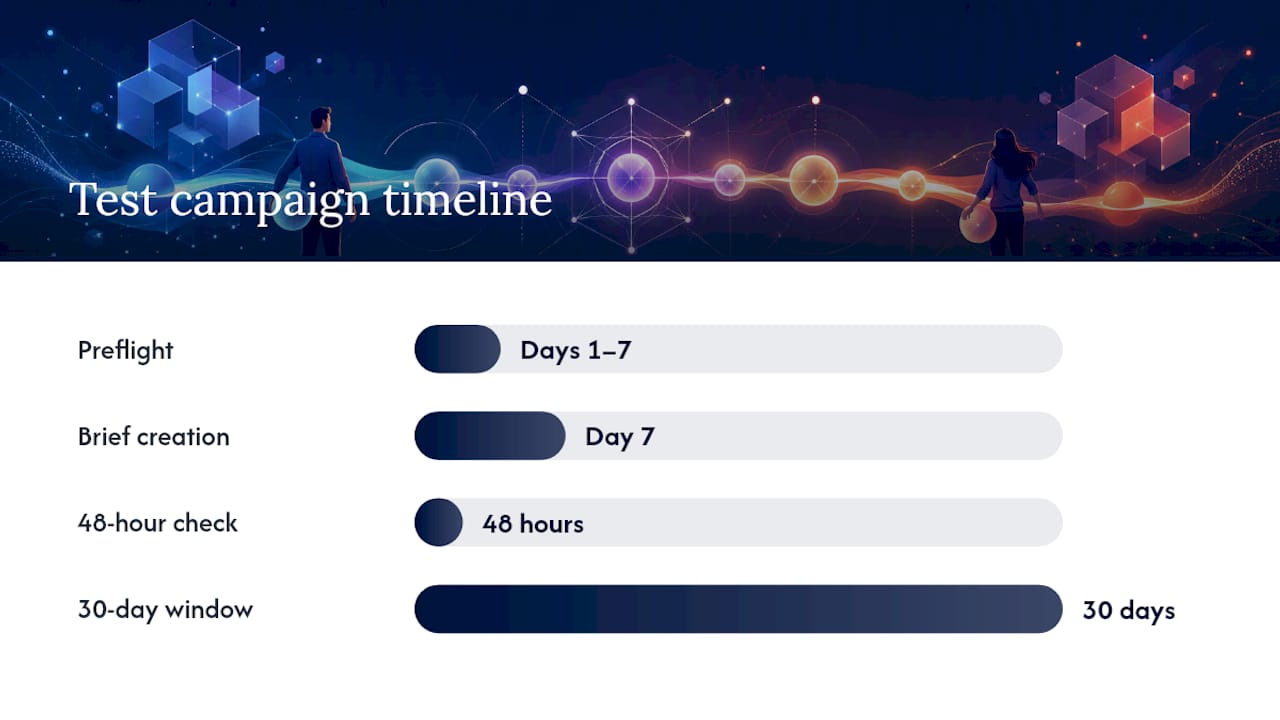
A tight preflight is what separates a useful test from a wasted budget.
| Phase | Action | Timeline |
|---|---|---|
| Preflight | Audit 10 reference videos; confirm product has a social hook; set up MMP tracking links | Days 1–7 |
| Brief creation | Define creative requirements, disclosure language, CTA, and one reference video | Day 7 |
| Creator onboarding | Approve submissions; enforce brief compliance before posts go live | — |
| 48-hour check | Review early view velocity; flag underperforming posts for replacement | Day 30 |
| 30-day window | Measure installs, onboarding completion, and day-30 retention per creator | — |
| Scale/kill decision | Scale creators where RPM > CPM; pause formats where it does not | — |
Short-form creator content generates measurable install and revenue lifts when paired with product-native hooks and correct tracking. The preflight reference video is the single highest-leverage input: creators follow visual examples faster than long brand books.
Keep the brief to one page. Specify the CTA, the disclosure format, the hook style, and the one thing the creator must not say. Everything else is creative latitude.
Why Cult Media delivers on performance guarantees
Cult Media operates on a commission-only model: clients pay a fixed CPM only for verified views delivered by the creator network. No retainer, no payment for underperforming posts.
The integration stack covers the MMPs growth teams already use, including deferred deep-linking support so retention data flows back to the correct creator. Every campaign includes a written verification process, an MVC trigger defined in the contract, and a creative approval workflow with a defined SLA.
Onboarding runs in under two weeks for most consumer app clients. The team handles brief creation, creator sourcing, submission review, and MMP handoff. Clients receive a campaign dashboard showing view verification status, install attribution, and downstream retention events per creator.
Key Takeaways
A commission-only, guaranteed-view creator network is the highest-ROI model for consumer apps with MMP attribution in place and a product that shows well in short-form content.
| Point | Details |
|---|---|
| Pay only for verified views | Managed networks charge CPM only after views clear threshold and bot-filter checks. |
| MMP attribution is non-negotiable | Unique tracking links per creator and downstream event mapping are required to calculate real CAC. |
| RPM must exceed CPM | Prioritize formats where revenue per 1,000 views beats your CPM; cut formats where it does not. |
| Run a $10k test first | A pilot with preflight, brief, and 30-day measurement window validates creator-native demand before scaling. |
| Cult Media | Commission-only model with MMP integration, written MVC triggers, and end-to-end creator management. |
The gap between cheap CPMs and real growth
The most common mistake founders make is optimizing for the lowest CPM without first confirming that the product converts from creator traffic. A $3 CPM on a product with a weak onboarding funnel will burn budget faster than a $15 CPM on a product with a 40% day-7 retention rate. Cult Media structures pilots to surface that signal in the first 48 hours, not after 90 days of spend.
One caution worth stating plainly: no creator network, regardless of the guarantee, can manufacture product-market fit. If organic users churn in the first session, the problem is the product, not the CPM.
Cult Media's pilot offer for app growth teams

Cult Media delivers guaranteed-view creator campaigns for consumer tech apps on a commission-only basis. A $10k pilot includes brief creation, creator sourcing and onboarding, MMP tracking setup, and a 30-day measurement window with a full attribution dashboard. You pay only for verified views that clear the campaign threshold. No retainer, no upfront creative fees.
The pilot is designed to answer one question: does creator-native content convert your users at a CAC that justifies scale? If it does, Cult Media scales the creator pool and content volume. If it does not, you have clean data to inform the next test.
Book a pilot call to get a campaign brief and CPM estimate for your app within five business days.
Useful sources
| Source | What it covers |
|---|---|
| Creator performance network model | CPM mechanics, pay-for-verified-views structure, and content inventory behavior |
| AppsFlyer influencer measurement guide | MMP integration, OneLink deep-linking, and creator attribution dashboards |
| Performance-based deal structures | CPM, MVC, bonus deals, and performance windows |
| Short-form content install benchmarks | View-to-install metrics and RPM/CPM framing for app campaigns |
| Mobile creator partnership measurement | Attribution failure modes and operational measurement checklist |
| Influencer software and billing-event models | How lifecycle-aligned payout tools differ from discovery platforms |
| VTC reporting and cross-network attribution | View-through conversion discrepancies in multi-channel creator campaigns |
FAQ
What is a guaranteed-view creator network?
A guaranteed-view creator network pays creators only after their content reaches a verified view threshold, so the brand's CPM spend is tied to confirmed delivery rather than potential reach.
How does MMP integration work in a creator campaign?
Each creator receives a unique tracking link generated in your MMP. Installs, onboarding completions, and retention events are mapped back to that creator, giving you CAC and LTV data per post.
When does a managed network outperform a SaaS discovery tool?
When your team lacks the bandwidth to run outreach, negotiation, and attribution setup internally, a managed network's end-to-end execution and performance guarantee justify the CPM premium over a self-serve platform.
What should a $10k test campaign measure?
Track view verification rate, install volume, onboarding completion, and day-30 retention per creator. The 30-day window is the minimum needed to distinguish high-retention creators from low-retention ones.
Does Cult Media integrate with major MMPs?
Yes. Cult Media supports MMP integration and deferred deep-linking so retention data flows back to the correct creator, giving clients a full attribution picture from view to day-30 event.