
For consumer app teams running creator-driven video campaigns, the best ASO tools follow a layered stack pattern: one primary platform for keyword intelligence and metadata management, plus one or two specialists for creative testing and automation. No single product excels at all three. The table below maps each tool to its strongest use case so you can build your stack immediately.
| Tool | Best For | Key Features | Platforms | API / Integrations | Pricing Shape | Trial / Demo |
|---|---|---|---|---|---|---|
| Cult Media | Performance UA via creator campaigns | Guaranteed views, UGC strategy, creator management | iOS & Android | MMP handoff, analytics integration | Commission-only CPM | Yes |
| AppTweak | Mid-to-large keyword research + market intelligence | AI keyword suggestions, Apple Ads integration, market insights | iOS & Android | API, Apple Ads | Mid-market to enterprise | Free trial |
| App Radar | Bulk localization + listing management | Store listing editor, bulk translation, AI keyword suggestions | iOS & Android | Store APIs, bulk edit | $39/mo starter | Free plan |
| Sensor Tower / data.ai | Enterprise market intelligence | Download/revenue estimates, ad creative library, historical trends | iOS & Android | Enterprise API | — | Demo |
| MobileAction | Growth teams needing ASO + competitive signals | Keyword research, creative insights, competitor tracking | iOS & Android | API | Mid-market | Free trial |
| StoreMaven / SplitMetrics | Rigorous creative A/B testing | Store page experiments, CVR measurement, statistical testing | iOS & Android | Integrations with analytics | Custom / enterprise | Demo |
| Gummicube | Enterprise metadata engineering | Service-led ASO, metadata optimization, managed services | iOS & Android | Managed | Custom | Demo |
| TheTool | Small teams, rank tracking | Keyword tracking, ranking dashboards, basic analytics | iOS & Android | Limited | SMB-friendly | Free trial |
| Apple App Store Connect | iOS-native A/B testing | Product Page Optimization, release management, analytics | iOS | Native Apple APIs | Free | N/A |
| Google Play Console | Android-native experiments | Store experiments, variant testing, install analytics | Android | Native Google APIs | Free | N/A |
Quick picks by team size:
- Enterprise: Sensor Tower or data.ai for market intelligence; AppTweak as primary ASO platform
- Mid-market growth team: AppTweak or MobileAction as primary; StoreMaven/SplitMetrics for creative testing
- Lean or indie: App Radar ($39/mo starter) or TheTool; native consoles for A/B testing at zero cost
Table of Contents
- How these ASO picks were selected
- What does a creator-driven ASO stack actually look like?
- How to automate metadata and creative updates at scale
- Your 30/60/90-day ASO implementation timeline
- What to expect from ASO tool support and training
- How ASO tools connect to your analytics and UA stack
- What US app teams say about these tools
- Cult Media complements your ASO stack with guaranteed creator-driven views
- Key Takeaways
How these ASO picks were selected
These tools were evaluated on six weighted criteria: data freshness and scale, API access and automation capability, creative testing depth, localization and bulk editing, integration with paid UA tooling, and pricing transparency. For teams running creator-driven video campaigns, API access and creative testing carry the heaviest weight because ASO scales with automation and programmatic metadata updates, not manual dashboard edits.
Third-party review platforms (G2, Capterra) and published case studies informed support and onboarding scores. Enterprise customer references from AppTweak (Amazon, Zynga, Adobe) and Sensor Tower's investor-grade data reputation confirmed their placement. Tools without verifiable pricing or documented API access were ranked lower regardless of feature breadth.
When evaluating any ASO vendor, ask three questions before signing: What are the API rate limits per app and per locale? Does the plan include bulk metadata push, or is that an add-on? What is the rank-check frequency SLA at your tier? Many platforms impose keyword limits and query caps that only surface after you scale past a handful of apps.
Pro Tip: Request a sandbox API call during the demo. A vendor that cannot show live metadata push in 20 minutes is telling you something about their automation maturity.
What does a creator-driven ASO stack actually look like?
The dominant 2026 practice is one primary ASO platform plus one or two specialists. For creator-driven UA specifically, the stack has three layers.

Primary platform handles keyword research, rank tracking, and metadata management. AppTweak fits mid-to-large teams; App Radar suits teams prioritizing bulk localization across multiple markets.
Creative testing layer validates which UGC video thumbnails, screenshots, and short-form previews convert best before global rollout. Apple App Store Connect and Google Play Console provide native A/B testing at no cost. StoreMaven and SplitMetrics add statistical rigor and dedicated experimental frameworks when CVR precision matters.
Market intelligence layer is optional for smaller teams but critical at scale. Sensor Tower and data.ai surface competitor download trends and ad creative libraries, letting UA managers align creator content briefs with what is already converting in the market.
How to automate metadata and creative updates at scale
Automation cuts repetitive ASO work on metadata, screenshots, and review replies, freeing growth teams to focus on creative strategy. The practical workflow: connect your primary ASO platform's API to your CI/CD pipeline, push metadata updates programmatically after each creative test cycle, and trigger localized listing updates via bulk edit endpoints rather than store-by-store manual edits.
App Radar's bulk localization feature and store listing editor reduce multi-locale workload significantly. For AI-native workflows, API-first tools with REST endpoints and MCP server integrations let teams pipe keyword data directly into LLM-based metadata generation, producing production-ready copy without manual reformatting.
Integrating ASO data with UA workflows closes the loop between creator content performance and store listing updates. When a creator video drives a spike in branded search, your ASO platform should flag the keyword movement so metadata can be updated within the same sprint.
Your 30/60/90-day ASO implementation timeline
Days 1–30: Baseline and tool setup
- Audit current keyword rankings and store listing CVR in Apple App Store Connect and Google Play Console
- Select and onboard primary ASO platform; configure API credentials and rank-check frequency
- Map top 20 keywords by volume and relevance; identify gaps versus top three competitors
- KPIs: keyword coverage score, baseline CVR per store listing, rank positions for target terms
Days 31–60: Creative testing and localization
- Launch first Product Page Optimization test (iOS) and store experiment (Android) using UGC video thumbnails from creator campaigns
- Enable bulk localization for top three markets via App Radar or equivalent
- Connect ASO platform to your MMP (Adjust, AppsFlyer, or similar) for install attribution by listing variant
- KPIs: CVR lift per variant, localized listing impressions, MMP-attributed installs by creative
Days 61–90: Automation and scaling
- Automate metadata push via API; schedule weekly rank-check exports into your analytics dashboard
- Feed winning creative variants from store experiments back into creator campaign briefs
- Review competitor keyword movements monthly via Sensor Tower or AppTweak market intelligence
- KPIs: time-to-publish for metadata updates, CAC by creative variant, organic install share versus paid
What to expect from ASO tool support and training
Support quality varies sharply by pricing tier. AppTweak provides dedicated account managers for enterprise plans and a well-documented knowledge base accessible to all tiers. App Radar offers chat support and onboarding sessions at mid-market price points. Sensor Tower and data.ai assign customer success managers to enterprise contracts, with SLA-backed response times.
For self-serve teams, TheTool and MobileAction provide documentation and community resources, though live support response times are slower. Native consoles (Apple App Store Connect, Google Play Console) rely on developer documentation and community forums rather than direct support. Gummicube's service-led model includes managed onboarding as part of the engagement, which suits large publishers that want ASO handled rather than learned.
How ASO tools connect to your analytics and UA stack
Connecting ASO data with UA workflows is the step most teams delay and most regret. AppTweak integrates with Apple Search Ads, letting keyword bid data inform organic metadata decisions. MobileAction covers Apple Search Ads management alongside ASO, making it a natural fit for teams running both channels from one dashboard.
For MMP integration, most primary ASO platforms accept webhook or API feeds from Adjust, AppsFlyer, and Singular, mapping install events back to specific listing variants. This is the data handoff that lets creator campaign results inform store listing updates: when a UGC video drives installs, the MMP data confirms which listing variant captured them, and the ASO platform flags which keywords spiked.
Understanding reach versus engagement metrics matters here. Creator campaigns optimize for watch-time and click-through; ASO optimizes for search visibility and CVR. Aligning both sets of KPIs in a shared dashboard prevents the common failure mode where UA and ASO teams optimize against each other.
What US app teams say about these tools
AppTweak is consistently cited by mid-to-large US publishers for keyword accuracy and Apple Ads integration depth. Teams at companies like Amazon and Adobe have used it as their primary ASO platform, per AppTweak's published customer references. App Radar's bulk localization capability draws positive feedback from multi-locale teams managing ten or more store listings simultaneously, with practitioners noting meaningful reductions in manual localization effort.
Sensor Tower's enterprise customer base includes major mobile publishers and investment firms using it for market sizing rather than day-to-day ASO. StoreMaven and SplitMetrics are referenced in growth marketing communities for bringing statistical discipline to store page experiments, a gap that native consoles do not fully close. TheTool earns consistent mentions from smaller US teams for its clean dashboards and accessible pricing, though teams that scale past a handful of apps typically migrate to a more API-capable platform.
For creator marketing agency context and how managed creator services fit alongside these tools, the role of the agency layer is increasingly to feed winning creative signals back into the ASO stack rather than operate independently of it.
Cult Media complements your ASO stack with guaranteed creator-driven views
Every ASO platform on this list optimizes what happens after a user searches. Cult Media addresses what happens before: getting your app in front of high-intent audiences on TikTok and Instagram through a commission-only creator network that charges per verified view, not per month.
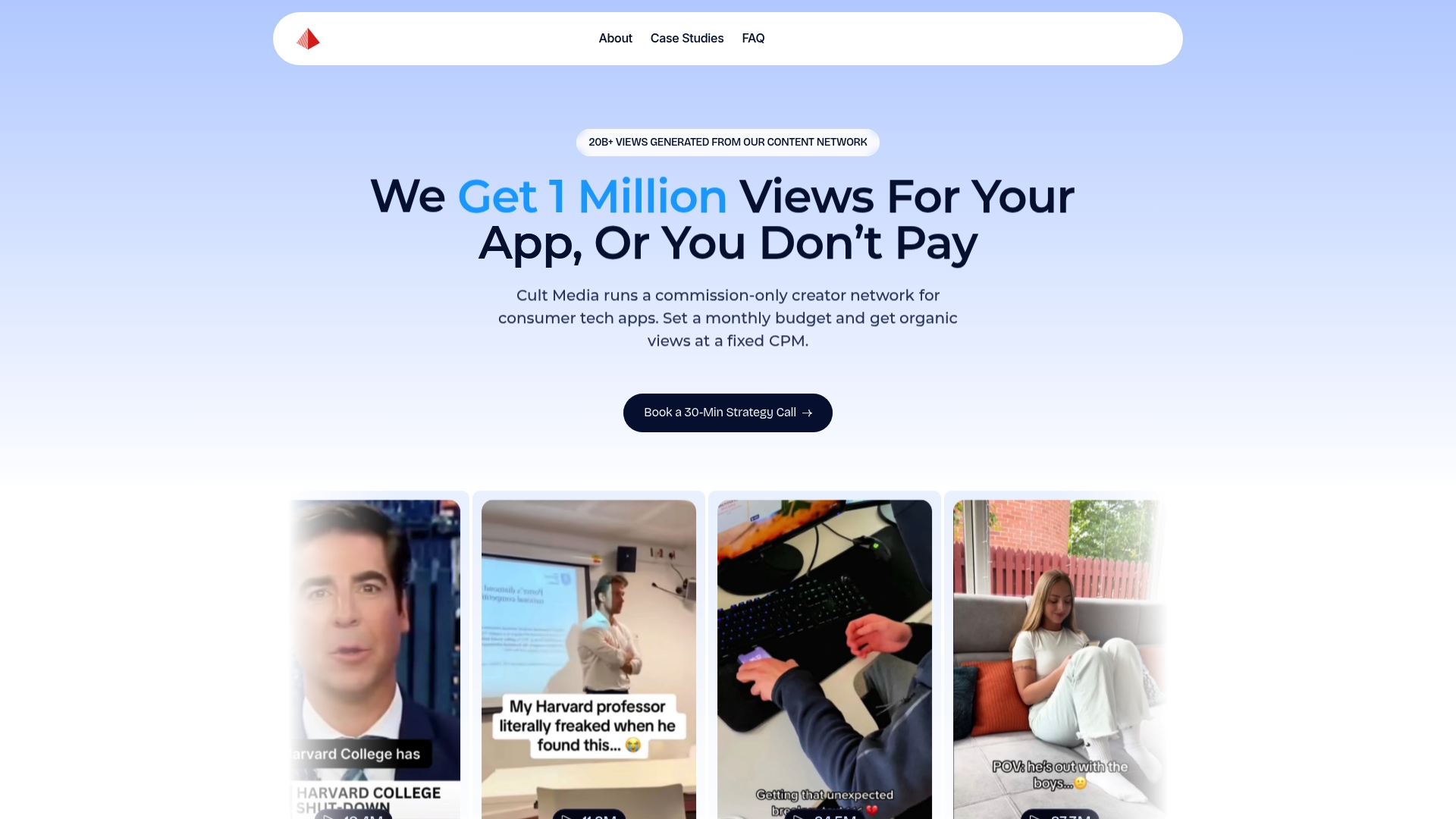
For consumer app teams, the practical combination is a primary ASO platform handling keyword and metadata work, with Cult Media running guaranteed-view creator campaigns that drive branded search volume and install intent. Winning creative variants from Cult Media campaigns feed directly into your store listing A/B tests, closing the loop between creator content and CVR. There are no retainers and no spend commitments disconnected from results. You pay for views delivered.
If your current ASO stack is generating visibility but CAC remains high, the missing layer is usually creator-driven demand at the top of the funnel. See how Cult Media's performance model works and request a campaign brief to get started.
Key Takeaways
A layered ASO stack built around one primary platform, one creative testing tool, and API-driven automation is the most effective approach for consumer app teams running creator-driven video campaigns in 2026.
| Point | Details |
|---|---|
| Stack pattern beats single tools | Pair one primary ASO platform with one or two specialists for keyword, creative testing, and market intelligence. |
| API access is a gating criterion | Ask vendors about rate limits and metadata push before signing; caps block automation at scale. |
| Native consoles are free and essential | Apple App Store Connect and Google Play Console provide A/B testing at zero cost for every iOS and Android team. |
| Creator campaigns feed ASO | Winning UGC creative variants should inform store listing updates and keyword targeting via MMP data handoff. |
| Cult Media as performance UA layer | Cult Media's commission-only creator network drives guaranteed views and branded search volume that amplifies ASO results. |