Content rights management means securing releases, tracking ownership, and licensing UGC across every platform your creator-driven campaigns touch. The single action that eliminates most legal exposure: centralize each asset's clearance record and require explicit paid-ad rights before any dollar of paid spend goes behind it. Skip that step, and you're one whitelisting request away from a paused campaign or a takedown notice, exactly the kind of disruption Cult Media's guaranteed-view model is built to avoid.
TL;DR:
- Securing explicit, time-limited paid-ad rights for creator content prevents campaign pauses or takedowns, especially for assets used in TikTok and Meta ads.
- Proper documentation must include clear license scope, platform authorization proof, and recorded approval wording to reduce usage-rights disputes by up to 70%.
- Auditable rights trackers should systematically capture creator replies, license details, expiration dates, and proof evidence, with manual tracking replaced at scale.
- Avoid using organic post assets for paid ads without separate licenses, model releases, and confirmed platform authorization to prevent most common takedown triggers.
- Using a performance-oriented creator network that handles rights capture and whitelisting reduces legal overhead and protects ad scale, saving costs over manual contract management.
Table of Contents
- What Rights Do You Actually Own When You Pay for Content?
- How Does Ad Whitelisting Actually Work on TikTok and Meta?
- What Data Fields Belong in a Rights Tracker?
- What Are the Most Common Rights Traps in UGC Campaigns?
- How Should You Structure Creator Pay and Licensing Fees?
- How Do You Roll This Out Across a Campaign?
- Why Rights-Aware Creator Operations Actually Protect Your CAC
- Run Rights-Aware Campaigns Without Building the Legal Layer Yourself
- Sources
- FAQ
What Rights Do You Actually Own When You Pay for Content?
Paying a creator for content does not transfer ownership. Creators own the copyright in their work from the moment they hit record, and that ownership stays with them unless a written agreement explicitly assigns it to you. Most brands don't need full assignment. A well-scoped license, one that defines platforms, duration, and edit permissions, gets you everything required for an app UA campaign without the higher fee and friction that full IP transfer usually demands.
Paid advertising rights are the clause growth teams miss most often. Organic posting permission does not include the right to run that same asset as a paid ad; treat that as a separate license with its own fee and its own expiry date. When negotiating, build the contract around these elements:
- Scope: exactly which platforms, formats, and edits are allowed.
- Duration: a defined license window, not an open-ended grant.
- Model releases: covering the creator and anyone else identifiable in the frame.
- Kill fees and deposits: protecting both sides if production falls through.
- Exclusivity limits: how long the creator can't work with a direct competitor.
- Termination effects: what happens to already-posted content when the contract ends.
Push for time-limited paid licenses over perpetual ones, and build FTC disclosure language into the agreement itself rather than hoping the creator remembers to tag it.
How Does Ad Whitelisting Actually Work on TikTok and Meta?
Whitelisting fails when teams treat it as a single checkbox instead of three separate layers that each need their own proof. Skipping any one of them is how campaigns get flagged mid-flight.
- Content license. The written agreement granting paid-ad usage, already covered in your contract.
- Platform ad authorization. On TikTok, the creator generates a Spark Ads code inside the app; you enter it in Ads Manager to run their organic post as a branded ad. On Instagram and Facebook, the creator grants partner approval through Meta's branded content tool, which preserves their attribution tag on the ad.
- Written commercial terms. Duration, geography, and payment, spelled out separately from the platform mechanics.
TikTok's ad authorization codes typically expire within about 90 days, which means a campaign that runs longer than a quarter needs a renewal step built in before launch, not after the code lapses. Hootsuite has reported that whitelisted creator content in Spark Ads can drive meaningfully higher conversion than standard brand-run ads, which is exactly why skipping the authorization step costs more than the delay of doing it right. Capture the code or partner approval before spend allocation, log its expiry date, and set a reminder well ahead of it, not the week it lapses.
What Data Fields Belong in a Rights Tracker?
An auditable rights registry is not complicated. It needs specific fields, captured consistently, every time.
- Creator name and asset unique ID
- Exact request text sent to the creator
- Affirmative reply, in the creator's own wording
- Timestamp of that reply
- Linked contract or attachment
- License scope: which platforms and formats are covered
- Start and expiry dates
- Platform authorization evidence (TikTok code, Meta approval screenshot)
- Payment status
The standard operating procedure is simple: require this capture before an asset gets published or boosted, automate renewal reminders ahead of expiry, and attach the proof directly to the asset file rather than leaving it in a scattered email thread. Agencies running structured licensing tracking report roughly 70% fewer usage-rights disputes than teams relying on ad hoc DMs and memory.
Pro Tip: Move off a spreadsheet the moment you're running 5 or more active creators or 3 or more concurrent campaigns. Past that threshold, manual tracking misses renewal dates, and a missed renewal is what actually triggers a paused ad account.

If it isn't documented with a timestamp and exact wording, it effectively didn't happen. That documentation is your entire defense if a creator disputes usage months later.
What Are the Most Common Rights Traps in UGC Campaigns?
Three failure points account for most takedowns and campaign pauses, and none of them show up until you're already spending against the asset.
- Music. A track playing in a creator's original post does not give you the right to run that audio in a paid ad. Default to cleared or royalty-free music, or secure a separate license for the specific track before boosting.
- Bystanders and locations. Anyone identifiable in the frame who isn't the creator needs a model release; filming inside a business or private venue may need separate location permission.
- Deleted originals. Don't rely on a live link to the creator's post as your proof of rights. Download and store your own verified copy of the asset, with the permission record attached, the moment clearance comes through.
Run a pre-launch check against all three before scaling paid spend, not after a platform flags the ad.
How Should You Structure Creator Pay and Licensing Fees?
Most rights disputes trace back to pricing that was never broken into line items. Structure compensation as a base fee for organic rights, then stack add-ons for anything beyond that.
- Base fee: covers organic posting and basic usage rights.
- Whitelisting and paid-ad fees: commonly add 20% to 100% on top of the base, depending on duration and how much exclusivity you're asking for.
- Exclusivity and territorial expansion: priced separately, since they restrict what else the creator can do.
- Kill fees and deposits: a 50% upfront deposit is standard practice with new creators to cover production risk.
Treat whitelisting as its own line item rather than folding it into a flat rate. This keeps your CPA and CPI math clean, since you know exactly what portion of spend is content cost versus media cost, and it makes performance-linked pricing models far easier to justify to finance.
How Do You Roll This Out Across a Campaign?
Securing rights at scale comes down to five steps, repeated for every creator and every asset.
- Brief and request. Send a clear message covering deliverables and usage options, with template language the creator can reply to affirmatively.
- Capture and attach. Log the exact affirmative wording and timestamp directly to the asset entry in your tracker.
- Confirm platform authorization. Get the TikTok code or Meta partner approval in hand before allocating a cent of ad spend.
- Tag and schedule renewals. Set automated reminders ahead of code expiries and license end dates so nothing lapses mid-campaign.
- Run a pre-scale compliance check. Verify music clearance, model releases, and FTC disclosure language before expanding paid budget on any asset.
Pro Tip: Build step 3 as a hard gate in your ad platform workflow, not a manual reminder. A code check that blocks spend automatically catches the lapses a calendar reminder won't.
Why Rights-Aware Creator Operations Actually Protect Your CAC
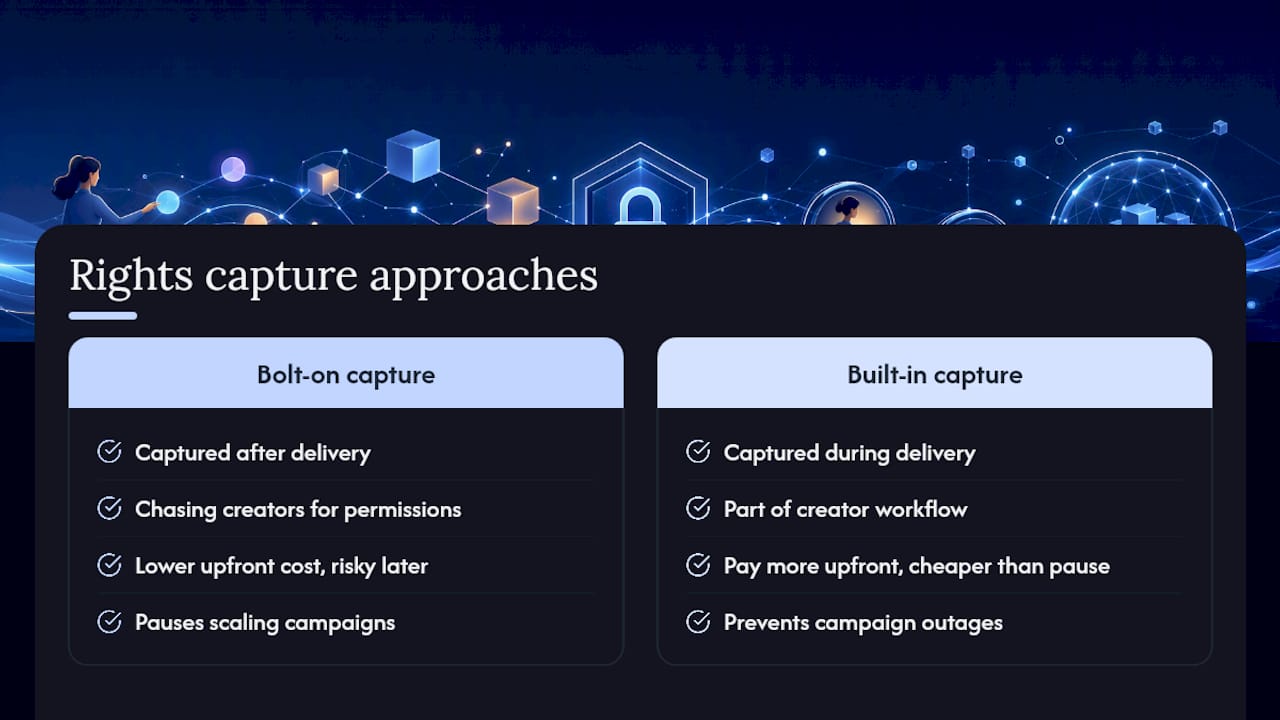
Most growth teams treat rights capture as legal overhead until a campaign gets paused mid-scale and the real cost shows up in lost momentum, not legal fees. Building the capture step into the creator workflow itself, rather than bolting it on after content is delivered, is what actually prevents that outage.
A performance-aligned creator network simplifies this because whitelisting and rights capture become part of the delivery process rather than an afterthought chasing creators for permissions after the fact. The trade-off is straightforward: paying more for whitelisting rights up front is cheaper than pausing a scaling campaign to renegotiate mid-flight, every time.
— Jax
Run Rights-Aware Campaigns Without Building the Legal Layer Yourself
Cult Media is the alternative to piecing together contracts, whitelisting codes, and rights trackers on your own. As a commission-only creator network built for consumer apps, Cult Media handles end-to-end rights capture and platform whitelisting as part of every guaranteed-view campaign, so you pay only for verified performance, not for legal cleanup after the fact.
That means your team isn't chasing affirmative replies or tracking TikTok code expiries manually; the creator network handles clearance, paid-ad authorization, and renewal tracking as a built-in part of the campaign, backed by a performance-based pricing model that keeps your incentives and the creators' aligned. If you're scaling app UA through creator content and want the rights layer handled for you, explore how Cult Media structures guaranteed-view campaigns and request a rights capture template for your next launch.
Sources
- Copyright assignment guide — Freeman Harris Solicitors
- Brand deal contract guide for creators — Starguard Law
- How to whitelist UGC for paid ads — Conbersa
- UGC rights and permissions guide — Idukki
FAQ
What Is Content Rights Management for UGC Campaigns?
It's the process of securing releases, tracking ownership, and licensing creator-generated content for use across organic and paid app marketing channels.
Do I Own a Creator's Content Once I Pay for It?
No. Creators retain copyright by default, and ownership only transfers through a signed written assignment agreement; a license is usually sufficient and cheaper.
Does Organic Posting Permission Cover Paid Ads Too?
No. Paid advertising rights must be negotiated as a separate, explicit license, since organic and paid usage are distinct permission categories.
How Long Do TikTok Spark Ads Authorization Codes Last?
TikTok ad authorization codes typically expire around 90 days, so campaigns running longer need a renewal step scheduled in advance.
Can Cult Media Handle Rights Capture and Whitelisting for Me?
Yes. Cult Media's creator network builds rights capture and platform whitelisting into every guaranteed-view campaign, so clients pay for verified performance rather than managing contracts and codes themselves.