A creator brief for apps must name one measurable conversion event, hand creators three to six testable hooks, spell out exact CTAs with tracking links, specify formats built for paid reuse, and set clear licensing terms. Skip any of those five and you get pretty content that can't be measured, optimized, or legally repurposed as an ad.
TL;DR:
- Clear, measurable conversion events like app installs or specific in-app actions are essential, with vague goals disqualifying measurement and optimization.
- Creator briefs must include target persona, three to six testable hooks, exact CTAs with tracking, and a single revision round to ensure effective and legally compliant content.
- Native, portrait-first videos that showcase real UI and avoid fabricated screens perform best, with hooks designed as problems to solve not scripted lines.
- Disclosures must be visibly overlaid and spoken early in videos, with exact wording specified in briefs to meet FTC requirements.
- Paid usage rights should be explicitly limited to 30 to 90 days, with standardized deliverables and tracked links to accurately measure campaign performance.
Table of Contents
- What Are the Essential Components of a Creator Brief for Apps?
- A Copy-and-Use Creator Brief Template for Apps
- What Creative Specs Make App Content Ad-Usable?
- What Legal Disclosures Belong in Every Creator Brief?
- How Should Usage Rights and Delivery Work?
- How Do You Map Creator Content to App Conversion Data?
- An Agency Perspective on Turning Briefs Into Guaranteed Views
- How Cult Media Runs Briefs Into Guaranteed-View Campaigns
- Primary Sources for Creator Brief Compliance and Specs
- Sources
- FAQ
What Are the Essential Components of a Creator Brief for Apps?
A creator brief for apps fails or succeeds on six components. Miss one, and you either can't measure results or can't legally run the content as a paid ad.
Start with a single primary objective and the exact conversion event tied to it, whether that's app installs, account registrations, or a specific in-app action like completing onboarding. Vague goals like "brand awareness" give creators nothing to aim at and give your analytics team nothing to optimize.
- Target persona and use case: describe the exact person and moment your app solves for, so the creator's hook matches a real pain point instead of generic app-store copy.
- Testable hooks, not scripts: offer three to six hook directions creators adapt in their own words. Over-scripting kills authenticity and performance alike.
- Shot list and raw footage: specify vertical video, real UI capture, and unedited raw clips for later repurposing.
- CTA, deep link, and tracking parameters: every piece of content needs a trackable link or promo code baked in before filming starts.
- Delivery specs and revision policy: file formats, deadlines, and exactly one structured round of feedback.
Pro Tip: Write hooks as problems to solve, not lines to read. "Show why you almost missed rent this month" outperforms a scripted line every time, because the creator fills it with their own voice.
Practitioner experience across agency and in-house teams supports keeping the creator brief examples to one or two pages focused on what a creator needs before they hit record, not a full marketing deck.
A Copy-and-Use Creator Brief Template for Apps
Paste this structure into a doc or briefing tool. Fill each block before sending it to a creator.
Header block:
- Campaign name and app name
- Brand contact and creator contact
- Content deadline and paid-use window (e.g., organic post by March 3, paid usage rights through May 3)
- One-sentence campaign summary
Body blocks:
- Objective/KPI: name the one conversion event you're optimizing for
- Target user: age range, context, and the specific pain point
- Key message: the single benefit the video must communicate
- Hooks: three to six hook directions, not scripts
- Deliverables: number of videos, raw footage requirement, caption copy
- Shots: required UI moments, app screens, or real-use footage
- CTA/tracking: exact link, deep link, or promo code
- Disclosures: required wording and placement
- Licensing: organic rights vs. paid usage window
- Revisions: one structured round, defined turnaround
Mini filled example:
Objective: App installs via tracked link. Target user: college students juggling part-time work and classes. Key message: "See your whole week's schedule in one glance." Hook: "Show the moment you almost missed a shift because you forgot to check three different apps." CTA: Link in bio, code STUDY20. Licensing: Organic post plus 60-day paid usage.

What Creative Specs Make App Content Ad-Usable?
Portrait-first footage wins for app campaigns because that's how nearly every install ad gets consumed, on a phone held vertically. Require creators to shoot native 9:16 video from the start rather than cropping horizontal footage after the fact.
Google's own guidance for App campaigns recommends getting to the actual app experience fast and building in multiple cut changes within the first few seconds to hold attention before a swipe. Pair that with the platform's recommendation to supply a genuinely diverse mix of text, image, and video assets rather than one video stretched across every placement.
- Aim for hooks landing in the first one to three seconds, not after a slow intro.
- Request unedited RAW footage separately from the final cut, so your team can re-edit for testing without going back to the creator.
- Never show simulated or fabricated app screens. App Store and Google Play rules restrict marketing that depicts features the app doesn't actually have.
- Native creator formats built for TikTok's Spark Ads structure typically follow hook, body, CTA, in that order.
One number worth remembering: Google explicitly recommends supplying multiple early cut changes within short videos because attention drops fast in feed environments, per its App campaign creative guidance.
What Legal Disclosures Belong in Every Creator Brief?
Every paid or sponsored app promotion needs disclosure that's impossible to miss, not buried in a hashtag string at the bottom of a caption. The FTC's guidance for social media influencers recommends a dual-disclosure approach for video: a visible on-screen overlay plus a spoken disclosure within the first 30 seconds.
Write the exact disclosure language into the brief rather than leaving it to interpretation. The FTC's Endorsement Guides are specific that platform tags alone don't satisfy the requirement.
- Require "#ad" or "Paid partnership" as the first words of the caption, not buried after hashtags.
- Require an oral disclosure like "this video is sponsored by [app name]" spoken within the first 30 seconds.
- Get creator sign-off on the disclosure language in writing, and keep the record.
Review FTC disclosure rules with every new creator before their first deliverable, not after a video is already live.
How Should Usage Rights and Delivery Work?
Organic posting rights and paid advertising rights are two different things, and your contract needs to say so explicitly. A time-boxed paid usage license, typically 30 to 90 days, protects both sides better than an open-ended buyout that overpays for content you might stop running after two weeks.
- Require raw vertical footage, a 30-second cut, a 15-second cut, and caption copy as standard deliverables.
- Standardize file naming (creator name, date, hook version) so your team can assemble ads without a scavenger hunt.
- Set one structured round of feedback with a clear acceptance checklist, not open-ended revisions.
- State the paid usage window explicitly in days, not "ongoing."
Pro Tip: A 60-day paid license with an option to renew costs less and creates less friction than negotiating a lifetime buyout for content you'll likely retire after creative fatigue sets in any way.
How Do You Map Creator Content to App Conversion Data?
A vague call to action is the single fastest way to lose attribution on otherwise strong content. Every video needs a specific tracked link, deep link, or promo code arranged before the creator ever hits record, not added after the fact.
Define one primary KPI (installs, registrations, or a specific in-app event) and track secondary engagement metrics alongside it. Where your attribution setup allows, report D1 and D7 retention against each creative, not just top-line views, since a video that drives cheap installs but poor retention isn't actually working.
- Test every tracking link and promo code before filming, not after delivery.
- Log each asset in a creative registry so you can spot fatigue by creative ID, not just by campaign.
- Tag every ad in-platform with the source creator and hook version for fast performance review.
Pipeline volume matters as much as any single asset. Growth teams generally need dozens of distinct creative variations moving through testing weekly to stay ahead of ad fatigue, which is exactly why a repeatable brief format matters more than a perfect one-off video.
An Agency Perspective on Turning Briefs Into Guaranteed Views
Standardized briefs are what let an agency produce dozens of testable assets a week instead of a handful. When every creator gets the same objective, hook menu, and format spec, review time drops and output multiplies.
Leaving phrasing to the creator, while enforcing hooks and shot lists, keeps content native to each platform's feel. Usage licensing and a single feedback round are what prevent scope creep from quietly eating your 90-day launch plan budget.
— Jax
How Cult Media Runs Briefs Into Guaranteed-View Campaigns
A commission-only creator network charges only for verified views delivered through managed creator partnerships, which means the guesswork of vetting, briefing, and chasing revisions sits with the agency, not your internal team.
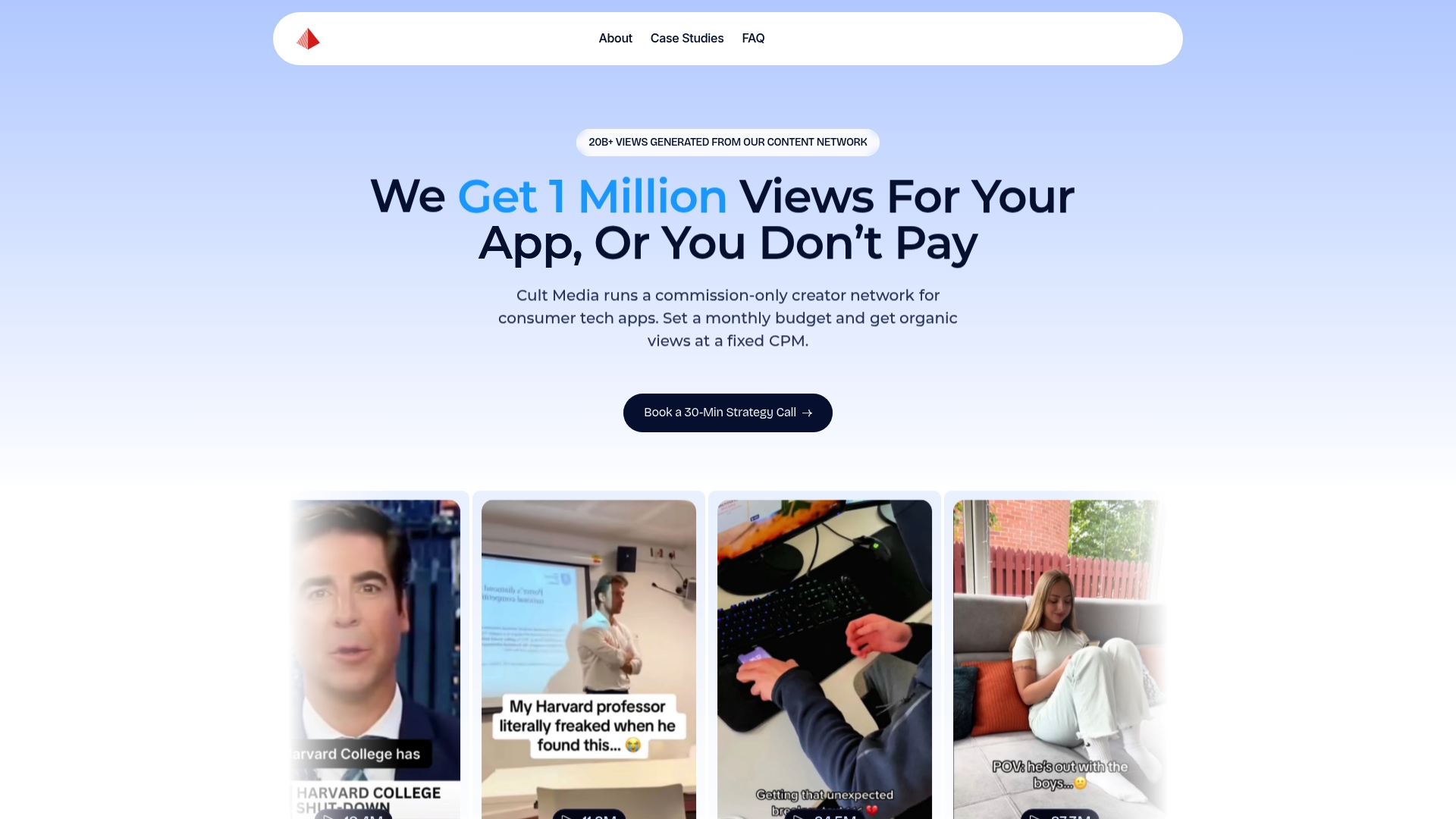
DIY briefing works when you're testing one or two creators a month. It stops working once you need consistent weekly volume, cross-platform distribution, and performance data feeding back into what gets made next. That's the gap a commission-only creator network is built to close: guaranteed view campaigns tied to a fixed CPM, custom UGC strategy, and end-to-end creator management so your growth team spends time on strategy instead of chasing deliverables.
One consumer finance app generated 42,500 signups at $0.28 each using organic UGC built on exactly this kind of structured brief process. Review Cult Media's case studies and start a conversation about a guaranteed-view campaign for your app.
Primary Sources for Creator Brief Compliance and Specs
For disclosure wording, consult the FTC's Disclosures 101 guidance and its Endorsement Guides. For asset specs, Google's App campaign best practices and creative asset specs cover exact counts and formats. For native creative structure, see TikTok's Spark Ads guidance.
Sources
- Disclosures 101 for Social Media Influencers | Federal Trade Commission
- Best practices guide: Setting up your App campaigns - Google Ads Help
- Make better creative assets for App campaigns - Google Ads Help
- TikTok Ads for Mobile Apps | Tenjin
FAQ
What Should a Creator Brief for Apps Include First?
The primary objective and the exact conversion event come first, before hooks or shot lists. Every other section of the brief exists to serve that one measurable outcome.
How Many Hooks Should You Give a Creator?
Three to six hook directions is the practical range, offered as problems to solve rather than lines to read. This lets creators keep their native voice while still hitting the angles you need tested.
Do I Need Separate Rights for Organic Posts and Paid Ads?
Yes. Organic posting rights and paid advertising rights are different, and a time-boxed paid license of 30 to 90 days protects both the brand and the creator better than an open-ended buyout.
What Disclosure Wording Does the FTC Require?
The FTC recommends a dual-disclosure approach for video: a clear on-screen overlay plus a spoken disclosure within the first 30 seconds, per its Disclosures 101 guidance. Platform hashtags alone don't meet the standard.
How Much Does Cult Media Charge for Creator Campaigns?
Cult Media runs on a commission-only model, charging per verified view delivered through its creator network rather than a flat retainer. Current pricing details are available directly on the Cult Media site.