The best content cadence for apps is a hybrid model: a predictable baseline of scheduled posts, LiveOps bursts tied to product moments, and a share of the calendar left open for trends. Pre-PMF apps should favor rapid, high-volume testing over polish. Post-PMF apps should shift toward steady, higher-quality output that protects trust and retention. The right model for your team depends on where your app sits in that lifecycle.
TL;DR:
- Pre-product-market-fit apps should prioritize high-volume, low-polish testing with quick iteration to find message-market fit within 3 to 5 days per creative test.
- Content triggers like user milestones, feature launches, and analytics signals should guide publishing, with ownership assigned to one person for a unified editorial calendar.
- Short-form social channels require daily to multiple weekly posts, while in-app LiveOps and blog content benefit from weekly or monthly pacing, respectively.
- A short, structured plan with 30-day sprints, regular weekly reviews, and reserve slots for trend-reactive content support sustained growth and responsiveness.
- Using a performance-based creator network can help scale content volume without increasing headcount, focusing on verified views and flexible production.
Table of Contents
- Which Content Cadence Model Fits Your App?
- What Are the Core Elements of an App Content Cadence?
- How Often Should Apps Publish on Each Platform?
- How Do You Plan and Batch Content Without Losing Flexibility?
- What KPIs Should Drive Your Testing Cadence?
- What Should Your Content Calendar Checklist Look Like?
- How Creator-Driven Content Sustains a Steady Cadence
- What Actually Matters More: Speed or Polish?
- Scale Your Cadence With a Managed Creator Network
- Primary Sources and Further Reading
- Sources
- FAQ
Which Content Cadence Model Fits Your App?
Cadence is not one setting. It is a choice you make based on team capacity, growth goals, and how far along your app is. Four models cover most consumer apps:
- Pre-PMF rapid-test: High-frequency, low-polish posting across short-form social to find message-market fit fast. Assumes a lean team (one to two people) prioritizing speed over production value.
- Steady-state growth: A consistent baseline (three to five weekly social posts, one monthly blog pillar, quarterly store refreshes) once the product has proven retention. Requires a small dedicated content function.
- LiveOps-first: Cadence is driven by in-app events and seasonal moments rather than a fixed publishing schedule. Common in gaming and gamified utility apps with a live-ops or product marketing hybrid role.
- Enterprise/pillar-driven: Long lead times, formal approval chains, and content built around quarterly campaigns. Fits larger teams with legal or brand review requirements.
Match the model to your primary goal. Acquisition-focused teams lean pre-PMF or steady-state. Retention-focused teams lean LiveOps. Monetization pushes often borrow from the enterprise model's structured campaign cadence.
What Are the Core Elements of an App Content Cadence?
A working cadence is built from four components, not a posting frequency alone.
- Triggers. The events that generate content: user milestones, feature launches, analytics signals (a spike in a specific search term, a churn cliff at day 7), and organic community posts worth amplifying.
- Pillars and formats. The recurring content types mapped to channels, such as in-app events, short-form video, blog pillars, and lifecycle email sequences.
- Segmentation and timing. New users, lapsed users, and power users respond to different messages at different moments. A win-back email lands differently than a feature announcement to an active cohort.
- Ownership and governance. One person owns the calendar, one team approves brand-sensitive content, and publishing responsibility is clear per channel.
Apps that treat product activity as a content source, not just a feature log, cut ideation time significantly. Subscription and community apps in particular can turn user milestones into a steady content engine, because the product itself keeps generating material worth sharing.
Pro Tip: Assign a single owner to the calendar even if five people contribute content. A shared calendar with no owner turns into a graveyard of half-finished drafts within a month.
Governance does not need to be heavy. A weekly 15-minute sync between product, marketing, and community is usually enough to keep triggers flowing into the calendar without a formal approval bottleneck.
How Often Should Apps Publish on Each Platform?
Cadence varies sharply by surface, and treating every channel the same is the fastest way to burn out a small team.
- Short-form social: TikTok performs best around daily posts; Instagram Reels and YouTube Shorts sit closer to multiple weekly, with long-form YouTube at about weekly. These ranges come from aggregated platform frequency guidance, and consistency within a range matters more than hitting the top of it.
- App Store creatives and metadata: Treat major screenshot and video refreshes as periodic events, with more frequent micro-tests on icons, titles, or short descriptions in between. This split between quality-driven major updates and lighter monthly iteration keeps discoverability fresh without exhausting design resources.
- In-app LiveOps: Frequent, modest events sustain retention better than rare, large campaigns. A weekly or biweekly mini-event beats a quarterly blowout that spikes engagement for three days and then flattens.
- Blog/SEO: One strong pillar post monthly, paired with a rolling refresh schedule for older posts, compounds organic traffic more reliably than sporadic bursts of five posts followed by silence.
Platform-level design choices matter too. If your content calendar includes themed events or UI-driven promotions, following Android's guidance on system theming and accessible contrast keeps those assets usable across light and dark mode instead of breaking on half your user base.
How Do You Plan and Batch Content Without Losing Flexibility?
Work on a 30-day horizon with weekly checkpoints, and produce content in 7 to 14 day batching sprints. This structure, drawn from common operational planning guidance for content teams, gives you enough runway to plan thoughtfully while staying short enough to adjust when something underperforms.
- Set the 30-day skeleton first. Block out known events, product launches, and seasonal moments before filling in routine posts.
- Batch by channel and role. Video creators batch shoot days once every two weeks; copywriters batch captions and blog drafts weekly; designers batch store assets monthly.
- Reserve 15% to 25% of the calendar. Keep this share open for trend-reactive content and LiveOps amplification, rather than filling every slot in advance.
- Review weekly, not monthly. Check which posts and events outperformed, then double down on the winning pillar in the next sprint.
Teams that run this kind of short weekly review ritual grow faster than teams that publish and move on without checking results. For teams still building their first structured plan, a 90-day roadmap gives a useful frame for stacking three of these 30-day cycles into a quarter.
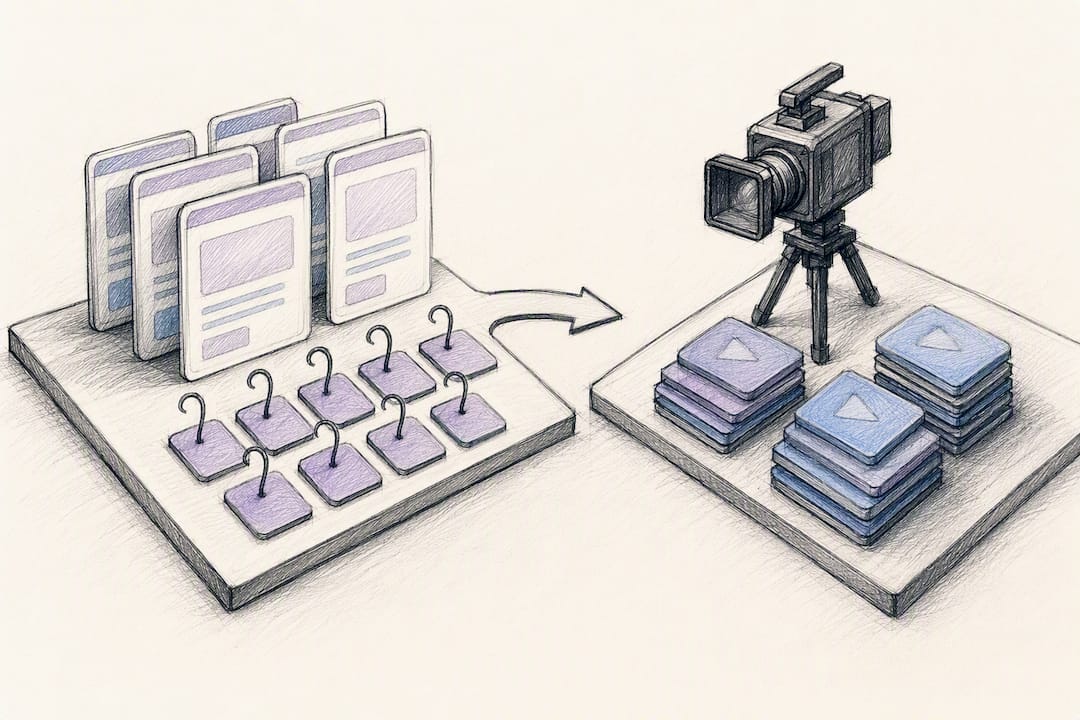
Pro Tip: Batch scripts and hooks separately from filming. Writing ten hooks in one sitting is faster and sharper than writing one hook per shoot day.
What KPIs Should Drive Your Testing Cadence?
Match the metric to the surface, not to a single company-wide dashboard. Acquisition content lives or dies on installs and click-through conversion rate. LiveOps events live or die on daily active users and 7-day retention. Social content lives or die on engagement rate and click-through to the store listing.
- Acquisition posts: Track install conversion rate as the primary signal; a conversion benchmark reference helps you know whether a creative variant is actually underperforming or just average.
- LiveOps events: Track DAU lift during the event window and 7-day retention afterward, since a spike that evaporates in a day is not a win.
- Social content: Track engagement rate and click-through to your store listing, not just views.
Set a short experiment window, typically 3 to 5 days for a creative variant test, then apply a clear decision rule: scale winners that clear your baseline engagement threshold, and kill or rework variants that underperform for two consecutive test cycles. Your sources of truth should be in-app event data, App Store or Play Store analytics, and, where creators are involved, verified view counts rather than self-reported numbers.
What Should Your Content Calendar Checklist Look Like?
Turn all of the above into a checklist your team actually runs, not a strategy document that sits in a drive folder.
- Weekly: Publish 3 to 5 social posts, run at least one creative variant test, and sync with product on any in-app events scheduled that week.
- Monthly: Publish one pillar blog post or long-form resource, refresh at least one store creative element, and audit analytics for emerging trends worth chasing.
- Quarterly: Run a major App Store creative refresh, launch a bigger LiveOps campaign, and align the next quarter's content calendar with the product roadmap.
Keep the checklist visible somewhere the whole team checks weekly, whether that is a shared board or a calendar tool synced to your sprint cycle.
How Creator-Driven Content Sustains a Steady Cadence
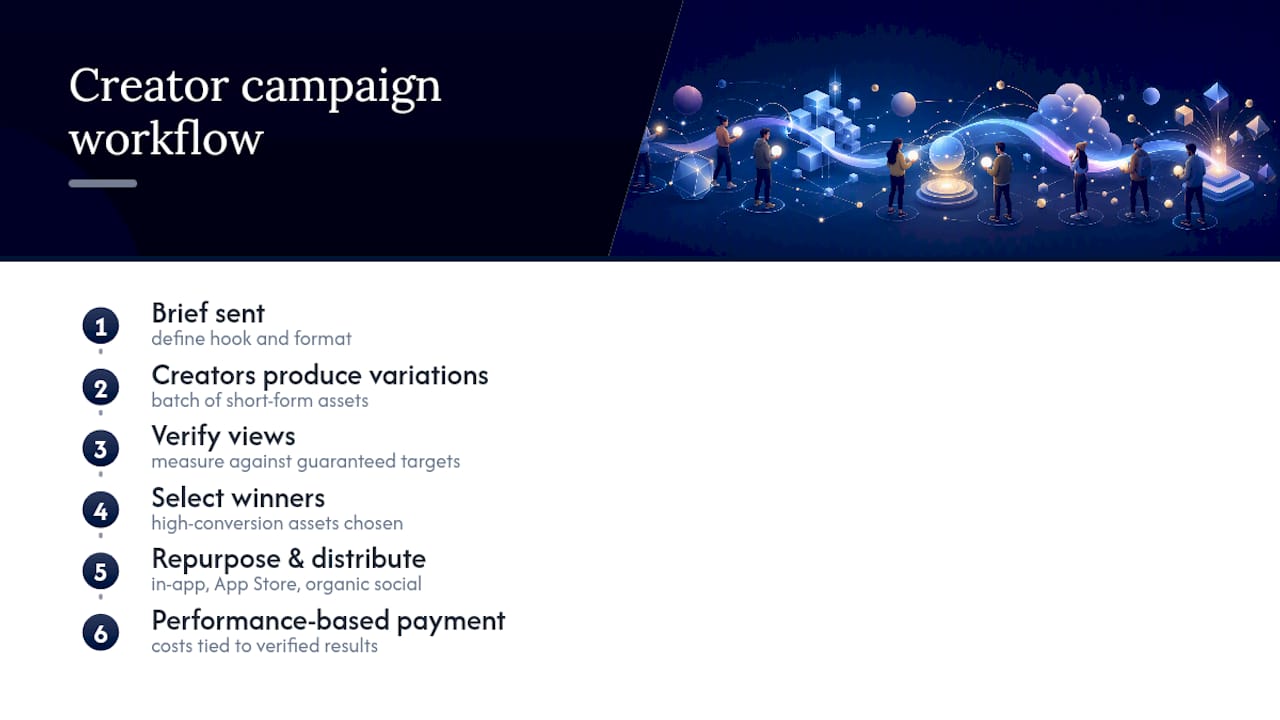
Managed creator campaigns solve the hardest part of cadence: consistent volume without a full-time production team. A managed creator network commissions creators against guaranteed view targets, verifies delivery before payment, and provides clients with high-conversion short-form assets they can repurpose into in-app promotions, App Store preview videos, and organic social posts.
The workflow is straightforward: a brief goes out defining the hook and format, creators produce a batch of variations, views are verified against the guarantee, and the winning assets get repurposed across owned channels instead of living and dying on one creator's page.
A performance-based creator network turns content production from a fixed cost into a variable one tied directly to verified results, which is the structural shift that makes sustained cadence affordable for teams without a large in-house content staff.
What Actually Matters More: Speed or Polish?
Speed wins early. Before you have product-market fit, a rough post that tests a hook beats a polished one that takes a week to produce. Once retention is proven, the trade flips. Sloppy, inconsistent content erodes trust faster than it builds reach.
Two moves to make this week: block a 30-day calendar with weekly checkpoints, and schedule one small LiveOps event to test the model, before committing to a bigger campaign.
— Jax
Scale Your Cadence With a Managed Creator Network
A managed creator network can be an alternative to hiring an in-house content team when a calendar needs more volume than headcount supports. Instead of a retainer that costs the same whether content performs or not, such networks run commission-only creator partnerships where clients pay only for verified views delivered against a guarantee.
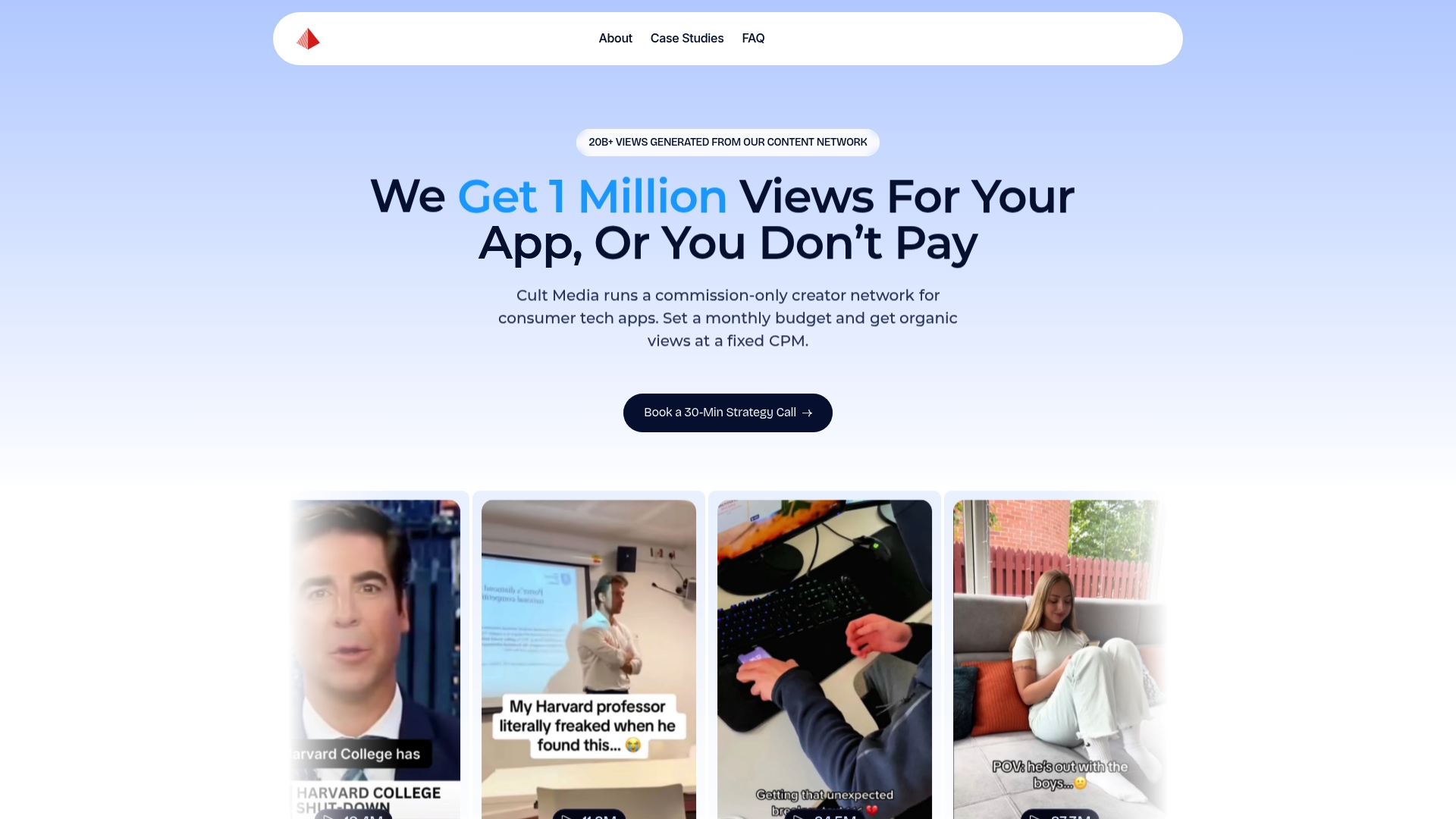
If your team has the bandwidth to batch, shoot, and publish weekly, DIY production works fine at steady-state cadence. If you need to fill LiveOps windows or sustain a daily short-form presence without adding headcount, a managed creator network closes that gap faster than hiring can. Cult Media's creator campaigns behind more than 20 billion views give consumer apps a repeatable source of high-conversion content tied directly to performance. Check current campaign availability and guaranteed view tiers to see what a managed sprint would look like for your app this quarter.
Primary Sources and Further Reading
The cadence models and batching rules above draw on how apps turn product activity into content, quality versus quantity guidance for store updates, and 30-day planning and batching frameworks. For a broader view of building a content engine rather than isolated posts, see Plexo's breakdown of the modern content engine and Moor Marketing's ecommerce content structuring guide.
Sources
- How your app becomes your content calendar | Built by Foundry
- Quality vs Quantity in App Content & Updates (2026) | ASOhack
- Free Content Calendar Generator — AI-Powered (2026) | Clypse
- Material theming and styles | Android Developers
FAQ
What Does "Content Cadence" Mean?
Content cadence is the rhythm and structure behind how often, and in what pattern, an app or creator publishes content across channels. It covers frequency, timing, and the mix of content types, not just a raw posting count.
Is Cadence the Same as Posting Frequency?
No. Frequency is just how often you post; cadence includes frequency plus the structure behind it, meaning which content types run on which channels for which audience segments.
What Is the 5-3-1 Rule for Social Media?
The 5-3-1 rule suggests a weekly content mix of roughly 5 curated or repurposed posts, 3 original posts, and 1 promotional post, though exact ratios vary by team and platform.
What Is the 5-5-5 Rule for Social Media?
Definitions vary across sources, but a common version calls for 5 pieces of content across 5 formats distributed over 5 platforms to test what resonates before scaling a format.