Run a content distribution engine: create one master asset, adapt it natively for each platform, publish through direct APIs, and close the loop with a measurement system that tells you what to make next. Teams that follow this model see cross-platform adaptation lift total reach well beyond single-platform posting, and it's the same operational logic behind Cult Media's guaranteed-view creator campaigns for consumer tech apps.
TL;DR:
- Prioritize testing content on TikTok first because its fast discovery cycle helps confirm winners that can then be scaled to Instagram and Shorts within 24 to 72 hours.
- Ensure your content supply chain can produce at least 15 master assets weekly, as falling short of this scale limits platform distribution regardless of variation quality.
- Use platform-specific format specifications, such as caption length and autoplay behaviors, to adapt content effectively rather than relying on generic cuts or templates.
- Automate publishing through direct API connections with a defined asset library, export presets, and a human review checkpoint before posting, to avoid mechanical failures.
- Focus on measurements like watch time, engagement rate, click-through, and conversion rather than raw views, and implement proper attribution, including cross-platform touchpoints, for accurate performance assessment.
Table of Contents
- What Is a Multi-Platform Content Distribution Engine?
- Which Platforms Deserve Your Time and Budget?
- How Do You Repurpose One Asset Across Platforms?
- What Tools Keep a Distribution Engine Running Reliably?
- Which Metrics Actually Tell You What's Working?
- Your Week-0 Setup and Scaling Checklist
- How Cult Media Runs This Engine at Scale
- What Legal Risks Come With Multi-Platform Distribution?
- How Should You Segment Audiences Across Platforms?
- How Do You Handle a Content Crisis Across Platforms?
- Where Does AI Actually Help in Multi-Platform Scheduling?
- What Most Teams Get Wrong About This Model
- Get a Guaranteed-View Creator Campaign Instead of Building From Scratch
- Sources
- FAQ
What Is a Multi-Platform Content Distribution Engine?
Multi-platform content distribution means publishing adapted versions of a single content asset across owned, earned, and paid channels instead of treating each platform as a separate content project. Most teams get this backward. They ask "what should we post on TikTok this week?" instead of "what did we produce this week, and where does it belong?"
The distribution engine framework fixes that by breaking the work into five stages, each with a clear owner and a clear handoff to the next stage.
- Sourcing — creators, in-house teams, or licensed footage generate raw material tied to a campaign brief.
- Production — raw material becomes a clean master asset: highest resolution, no burned-in captions, no platform logos.
- Variation — the master gets cut, captioned, and re-timed for each destination platform.
- Native posting — variations publish directly to each platform through its own interface conventions, not as a copy-paste of the same file.
- Monitoring — performance data feeds back into the next sourcing brief.
A continuous distribution engine treats UGC as an ongoing pipeline rather than a batch of quarterly campaigns, which matters because algorithmic feeds reward accounts that post consistently, not accounts that post well once a month.
Lead-platform testing is the piece most teams skip. Instead of adapting a master asset to six platforms simultaneously, publish it first on the platform that gives you the fastest performance signal. Publishers running cross-platform UGC programs typically lead with TikTok because its discovery algorithm surfaces winners or losers within hours, then adapt confirmed winners to Instagram Reels and YouTube Shorts within a 24 to 72-hour window. That cadence keeps your production team from wasting adaptation hours on content that never had a chance.
Content supply is the constraint that kills most programs before the strategy does. If your engine needs 15 master assets a week to keep every platform fed and you're producing four, no amount of clever variation will fix the shortfall. Plan minimum throughput before you plan platform mix.
Which Platforms Deserve Your Time and Budget?
Not every platform earns the same role. Mapping platforms by function, before you map them by format, keeps your team from spreading effort across channels that don't move the funnel.
- Owned channels (your app's blog, email list, in-app feed) — best for long-form context and retention messaging, low reach ceiling but full control.
- Earned/organic social (TikTok, Instagram, YouTube Shorts, X) — best for top-of-funnel discovery and short-form hooks, highest reach variance.
- Paid amplification (boosted posts, in-feed ads) — best for scaling proven organic winners, not for testing unproven concepts.
- Long-form and audio (YouTube long-form, podcasts) — best for consideration-stage trust building, slower velocity but longer content lifespan.
For account portfolio, most consumer app brands do best running one flagship account per major short-form platform (TikTok, Instagram, YouTube Shorts) plus one owned hub, rather than spinning up regional or sub-brand accounts before the flagship proves consistent performance. A beginner-to-intermediate distribution framework backs this sequencing: pick a core format, map channels to it, then tailor messaging per destination only once the core format is validated.
Platform norms change what "adaptation" actually means. A hook that works at second three on TikTok needs to work at second one on Reels, where autoplay behavior is less forgiving. Caption length tolerance on X is nothing like caption length tolerance on a YouTube Shorts description. Treat each platform's format quirks as a specification sheet, not a suggestion.
How Do You Repurpose One Asset Across Platforms?
A single 10-minute UGC video or a single long-form blog post can generate eight to twelve distinct platform outputs if you build a repurposing matrix instead of improvising each time.
| Master Asset | Platform Output | Length | Format Notes |
|---|---|---|---|
| Long-form video (webinar, demo) | TikTok/Reels/Shorts | 15 seconds | Cold open, no logo, native captions |
| Long-form video | YouTube long-form | Full length | Chaptered, SEO-optimized description |
| Long-form video | 90 seconds | Subtitled, professional framing | |
| Blog post | X thread | 5–8 posts | One idea per post, no walls of text |
| Blog post | Email newsletter | 200 words | Single CTA, plain-text feel |
| Blog post | Instagram carousel | 6–10 slides | One takeaway per slide |
Watermark policy deserves its own rule: never publish a clip carrying another platform's watermark. A TikTok-watermarked video posted to Instagram Reels gets suppressed by that platform's own recommendation system, which treats it as recycled third-party content rather than native material.
Here's the repurpose sequence for a long-form webinar recording:
- Pull the three strongest 20 to 40 second moments (a surprising stat, a demo reveal, an objection handled).
- Re-export each clip from the clean master, not from a downloaded copy, to avoid compression artifacts and watermarks.
- Write platform-native captions: question hooks for TikTok, statement hooks for LinkedIn.
- Add burned-in captions sized for sound-off viewing, since most short-form consumption happens muted.
- Schedule the TikTok version first, hold the Reels and Shorts versions 24 to 48 hours to see if it performs.
- Cut a 90-second highlight reel for the YouTube channel and a full transcript for the blog.
What Tools Keep a Distribution Engine Running Reliably?
The single biggest reliability failure in multi-platform distribution isn't creative fatigue, it's publishing mechanics. Tools that merely remind a team member to manually post at 9am are operationally weaker than tools that publish directly through official platform APIs, because reminder-based workflows depend on a human remembering, copying, and pasting correctly every single time, and every missed reminder is a dead slot in your cadence.
Your asset library needs three non-negotiable rules: store the clean, unwatermarked master as the source of truth, maintain export presets per platform so every editor produces consistent aspect ratios and caption sizing, and version every asset so you can trace which cut performed and which didn't.
A workable stack blueprint looks like this:
- Composer — where masters get cut and captioned per platform spec.
- Scheduler/publisher — pushes variations live via direct API connections rather than browser automation.
- Monitor — flags comments, flags policy strikes, flags underperformance early.
- Analytics — rolls performance data back into the next sourcing brief.
Centralized platforms that export to over 150 destination endpoints matter most once you're distributing beyond the five major social networks, since manually re-rendering the same clip for a dozen long-tail platforms eats hours that should go toward sourcing new content. A prompt-management layer, like PromptChief, can also cut the time your team spends writing platform-specific captions and hooks from scratch for every variation.
Pro Tip: Insert a human review checkpoint right before native posting, not after. Catching a captioning error post-publish means damage control; catching it pre-publish means a two-minute fix.
Which Metrics Actually Tell You What's Working?
Views are the least reliable metric across platforms because a "view" means something different on every platform. Compare watch time, engagement rate, click-through rate, and conversion (installs or leads) instead of raw view counts, since those metrics correlate more consistently with actual funnel movement.
- Views/impressions — top-of-funnel volume signal, weak on its own.
- Watch time and engagement rate — quality signal, tells you whether the hook and pacing worked.
- Click-through rate — intent signal, tells you whether the CTA landed.
- Conversion (installs, sign-ups, leads) — the metric that actually pays the bills.
Normalize before you compare. A clip with 500,000 views and 2% engagement is weaker than a clip with 50,000 views and 9% engagement; measure per-1,000-views to make platforms and creators comparable. Watch for a specific trap: watermarked reposts inflate raw view counts on secondary platforms while quietly suppressing actual algorithmic distribution, which distorts your read on which platform is truly working.
Attribution requires a UTM discipline that survives multiple touchpoints, since a user might see a TikTok clip, later see a Reels repost, then convert from an email link a week later. Set attribution windows wide enough to catch multi-touch behavior instead of crediting only the last click. First-party analytics tools such as Matomo are increasingly relevant here as third-party tracking reliability declines, and platforms that unify PESO-channel measurement in one dashboard save you from stitching together five separate native analytics tabs. For a deeper breakdown of why raw view counts mislead, see how views differ from impressions.
Your Week-0 Setup and Scaling Checklist
- Week 0 setup: connect API access for every target platform, build export presets in your composer tool, lock a clean-master storage policy, and assign one owner per engine stage.
- Daily operations: queue the next 48 hours of variations, run the pre-publish QA checkpoint, and log performance on yesterday's posts.
- Weekly operations: review lead-platform winners, greenlight adaptations to secondary platforms, and refresh the sourcing brief based on what converted.
- Scale triggers: once you see consistent uplift across two consecutive weeks, add staffing to the production stage before adding more platforms, and only automate a workflow step once its manual version has run error-free for a month.
How Cult Media Runs This Engine at Scale
Cult Media operates on a commission-only model: clients pay for verified, guaranteed views rather than a flat retainer, which keeps incentives aligned between the creator network and the app teams footing the bill. That structure maps directly onto the engine stages above.
Cult Media's creator network handles sourcing at scale, its production workflows produce the clean-master content needed for cross-platform variation, and its distribution approach applies the same native-posting discipline (no cross-platform watermarks, no reminder-based scheduling) that this guide recommends. Every campaign ties back to a performance guarantee rather than a hope that content "does well," which is the same accountability standard the measurement section above pushes teams to adopt for their own programs.
What Legal Risks Come With Multi-Platform Distribution?
Copyright and content rights get more complicated with every platform you add, not less. A UGC creator's contract needs to explicitly grant repurposing rights across every destination platform you plan to use, not just the platform where the content was originally filmed. A creator who agrees to a TikTok post doesn't automatically clear you to run that same clip as a paid ad on Instagram.
Music licensing is the most common trip wire. A sound cleared for use inside TikTok's platform may trigger a copyright claim the instant the same clip is uploaded natively to YouTube or Instagram, since each platform's licensing agreements with music rights holders are separate. Re-check music clearance every time content crosses platforms, don't assume clearance travels with the file.
Platform-specific content policies also diverge on claims, especially for consumer tech and health-adjacent apps. What passes moderation on X may violate Instagram's branded content disclosure rules, and app-store-linked promotional content faces additional scrutiny on some platforms during sensitive periods. Build a lightweight compliance checklist per platform rather than assuming one approval covers every destination.
Disclosure requirements for paid or sponsored UGC vary by platform and by jurisdiction, and creators need clear guidance on how to flag sponsored content correctly for each destination. A documented content moderation workflow that checks rights clearance, music licensing, and disclosure compliance before anything goes live protects your program from takedowns that stall momentum right when a piece of content starts performing.
How Should You Segment Audiences Across Platforms?
The same app can attract meaningfully different audience segments depending on the platform, and treating every channel's audience as one undifferentiated group wastes targeting precision you already have access to.
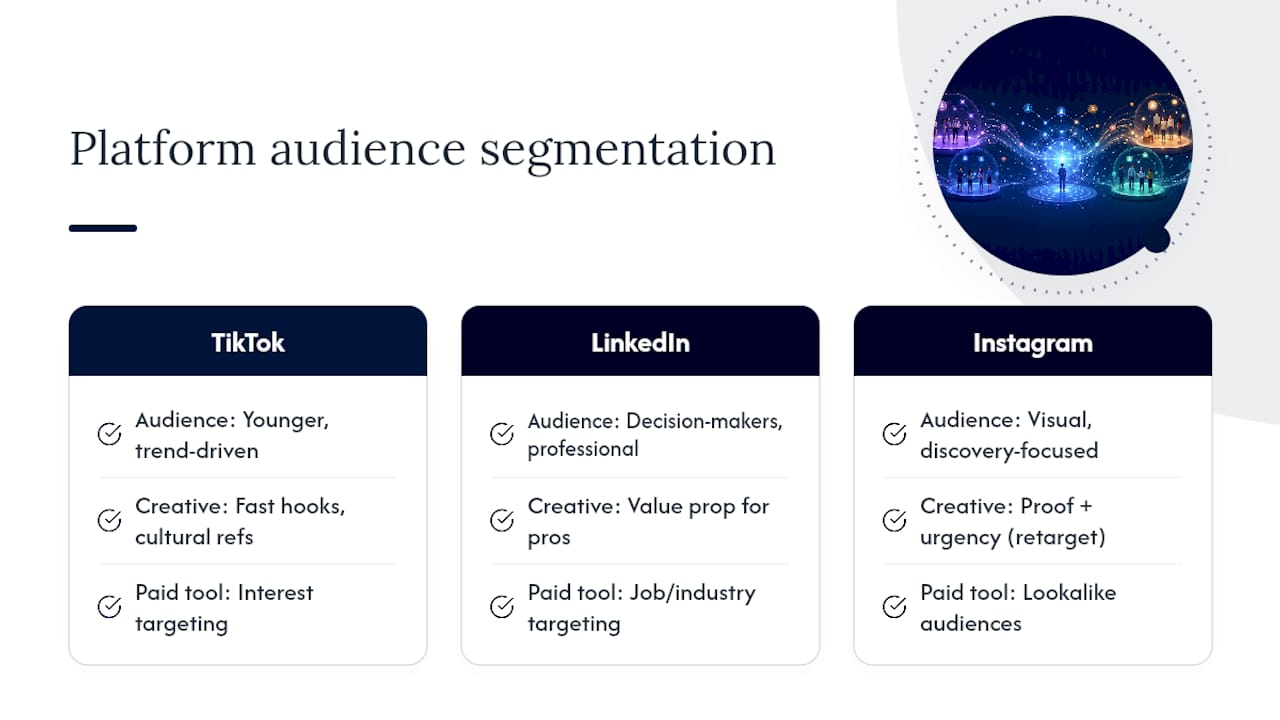
TikTok's discovery algorithm tends to surface younger, trend-driven users who respond to fast hooks and cultural references. LinkedIn audiences skew toward decision-makers evaluating a tool for professional use, which calls for a completely different value proposition in the opening three seconds. Segment your messaging by platform-native audience behavior, not just by demographic data pulled from a single source.
Layer platform segmentation with lifecycle stage. A first-touch TikTok viewer needs a hook that creates curiosity; a retargeted paid audience on Instagram who already visited your app-store page needs proof points and urgency instead. Running the same creative to both groups on the same platform undersells your data.
Use native platform targeting tools for paid amplification rather than assuming your organic segmentation automatically carries over into ad delivery. Instagram's lookalike audiences, TikTok's interest-based targeting, and YouTube's in-market audiences each require their own setup, and skipping that setup means your paid spend rides on default broad targeting instead of the segmentation work you already did organically.
Cross-reference performance by segment, not just by platform. A conversion-focused targeting approach that ties creative variants to specific audience segments, rather than one-size-fits-all messaging, consistently outperforms broad targeting because the content actually speaks to what that segment cares about.
How Do You Handle a Content Crisis Across Platforms?
A piece of content that goes wrong on one platform rarely stays contained to that platform, since screenshots, reposts, and cross-linking spread the problem faster than your team can react on the original channel alone.
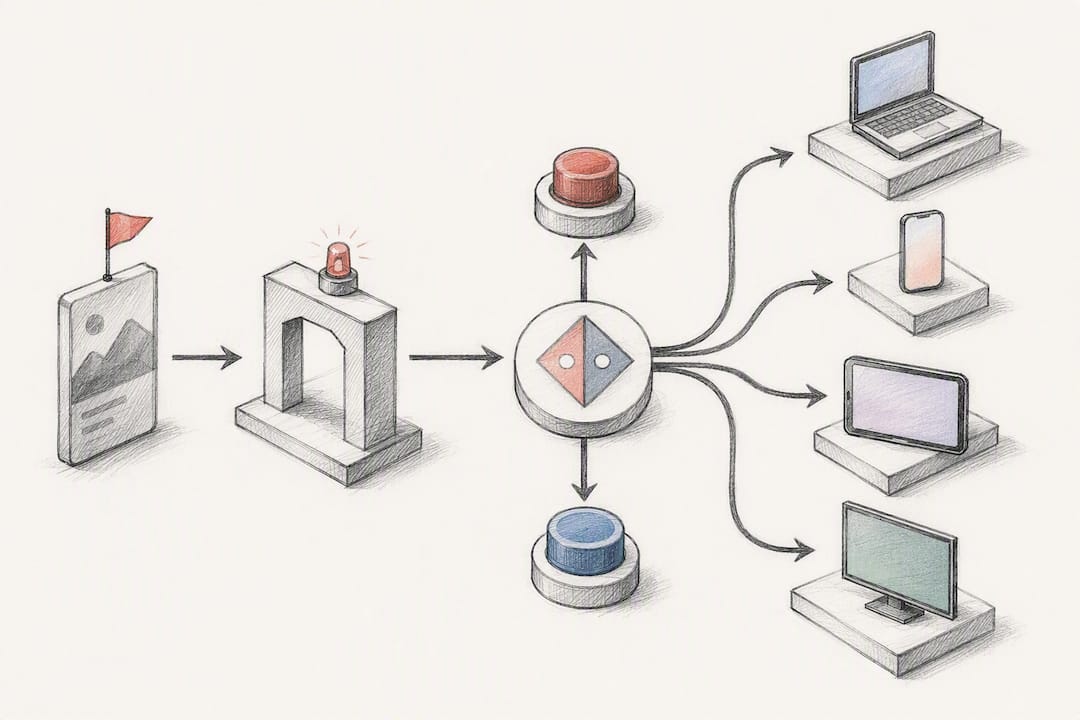
Build a correction workflow before you need one. The moment flagged content surfaces (a factual error, a compliance issue, a tone-deaf comment section), your monitoring stage should route it to a single decision-maker empowered to pull the post across every platform where it's live, not just the platform where the complaint originated.
Speed matters more than perfection in the first hour. A quick, honest correction posted within hours outperforms a polished statement that takes two days to clear legal and marketing review, because the conversation has usually moved on by the time a delayed response arrives. Draft a lightweight response template in advance for common issues (factual correction, accidental policy violation, creator conduct concern) so your team isn't writing from scratch under pressure.
Document every correction. If a video gets pulled from TikTok for a music licensing issue, check whether the same clip is still live on Reels, Shorts, or a paid campaign before considering the incident closed. Cross-platform distribution means a single piece of flagged content can have five or six live instances across channels, and missing even one undermines the whole correction.
Assign crisis ownership to the same role that owns your monitoring stage day-to-day. A person already watching performance data and comment sentiment across platforms will catch an emerging issue faster than someone brought in only after it escalates.
Where Does AI Actually Help in Multi-Platform Scheduling?
AI tools genuinely help with two parts of the engine: generating caption and hook variations at speed, and predicting optimal posting windows based on historical engagement patterns per platform. Both are legitimate time savers, not gimmicks.
Caption generation is where teams see the fastest return. Instead of a human writer drafting six platform-specific captions from scratch for every master asset, an AI-assisted workflow can draft first-pass variants that a human then edits for voice and accuracy. Tools built specifically for marketing prompt management, like PromptChief, help standardize that process so caption quality doesn't degrade as volume scales.
Scheduling optimization works similarly. AI-driven scheduling tools analyze when your specific audience engages most on each platform and adjust posting windows accordingly, which matters because the "best time to post" varies by platform, audience, and even by content type, not just by generic industry benchmarks.
Where AI falls short is judgment calls: whether a hook actually lands, whether a caption tone fits a sensitive moment, whether a clip needs a compliance review before it goes live. Automation should compress the mechanical work (formatting, scheduling, first-draft variation) so your human team spends its time on judgment work instead of retyping the same caption six different ways. Treat AI as a production accelerant inside the variation stage, not as a replacement for the human review checkpoint described earlier in the tooling section.
What Most Teams Get Wrong About This Model
Most teams treat distribution as an afterthought bolted onto content creation, when it should be the thing you design around from the first brief. Clean masters, lead-platform testing, and honest attribution are the three priorities that separate programs that compound from programs that plateau.
The most common failure isn't lack of ideas, it's inconsistent throughput: teams burst-produce for two weeks, then go quiet for a month. A close second is measuring vanity views instead of watch time and conversion, which rewards the wrong content. Third is skipping the API-first publishing setup because reminder-based tools feel "good enough" until an account gets flagged.
Invest in people before automation. A skilled editor who understands platform-native pacing will outperform any scheduling tool running on mediocre source material.
— Jax
Get a Guaranteed-View Creator Campaign Instead of Building From Scratch
Everything in this guide—the sourcing, the native adaptation, the API-first posting, and the conversion-focused measurement—is what Cult Media already runs for consumer tech apps, minus the months it takes to build that engine in-house. Instead of hiring a production team, negotiating creator contracts one by one, and learning platform posting hygiene through account strikes, you get a commission-only campaign where you pay for verified views your app actually receives, not for a retainer regardless of outcome.
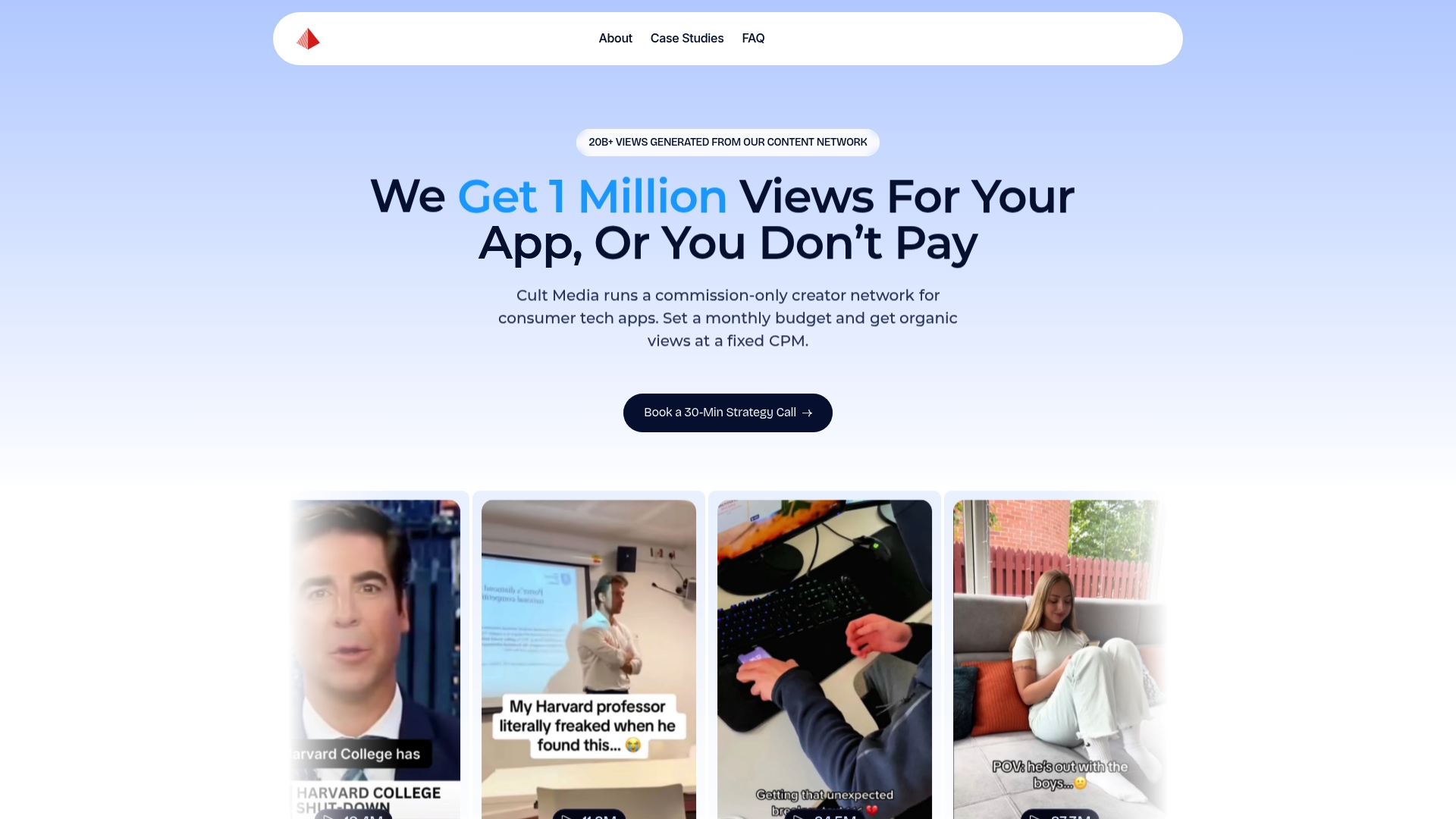
That performance-based structure means Cult Media's creator network only gets paid when the distribution engine actually delivers, which is the same accountability this guide argues every program should hold itself to. If your app needs a multi-platform launch or a sustained growth push without building the entire operation internally, see how Cult Media's guaranteed-view model works and get a campaign scoped to your app's growth targets.
Sources
- How Do You Turn UGC Production Into a Continuous Distribution Engine?
- 150+ Platforms · Mato
- Multi-Platform Social Media Publishing — Post Once, Everywhere
FAQ
What Are the Best Content Distribution Platforms?
The best platforms depend on your funnel stage: TikTok and Reels for top-of-funnel discovery, YouTube for consideration-stage trust building, and centralized publishing platforms like the ones covered in Workato's roundup for managing PESO-channel publishing from one place. Cult Media's creator network is built specifically to source and distribute short-form content across the platforms that drive app installs.
What Is the 5-5-5 Rule for Social Media?
The 5-5-5 rule is a content-engagement discipline: spend time engaging with five posts, leaving five thoughtful comments, and following five relevant accounts each day to build platform visibility organically. It's a manual growth tactic best suited to individual creators rather than a substitute for a structured distribution engine at brand scale.
What Are the 5 Pillars of Content Strategy?
Common frameworks converge on five pillars: format selection, channel mapping, message tailoring per platform, consistent publishing cadence, and performance measurement. This mirrors the beginner-to-intermediate distribution framework that underlies the engine model in this guide.
What Are the 8 Types of Distribution Channels?
Common categorizations include owned media, earned media, paid media, social platforms, email, direct/organic search, syndication partners, and influencer or creator networks. Most multi-platform programs combine at least four of these, with creator networks and paid amplification working together to scale proven organic content.
How Do I Optimize Content Reach Across Platforms?
Reach improves most when you adapt a single master asset natively per platform instead of cross-posting identical files, and when you publish through direct APIs rather than manual reminders. Pairing that with a lead-platform testing cadence, publishing to TikTok first and adapting winners within 24 to 72 hours, consistently outperforms simultaneous multi-platform posting.