
For consumer tech apps focused on installs and CPI efficiency, commission-only performance-driven creator networks are the strongest fit among all available UGC platform types. Review-syndication tools and social aggregators serve e-commerce well, but they don't move the needle on app downloads. The right choice here is a managed, performance-guaranteed creator network that delivers verified views, perpetual usage rights, and transparent reporting tied to real conversion outcomes.
The short-list criteria for app-growth teams:
- Commission-only or CPM-based pricing tied to verified view delivery
- Managed creator coordination (briefing, QA, scheduling owned by the provider)
- Guaranteed view commitments with third-party or platform-verified tracking
- Perpetual usage rights included in the base contract
- Campaign reporting that connects views to installs and CPI
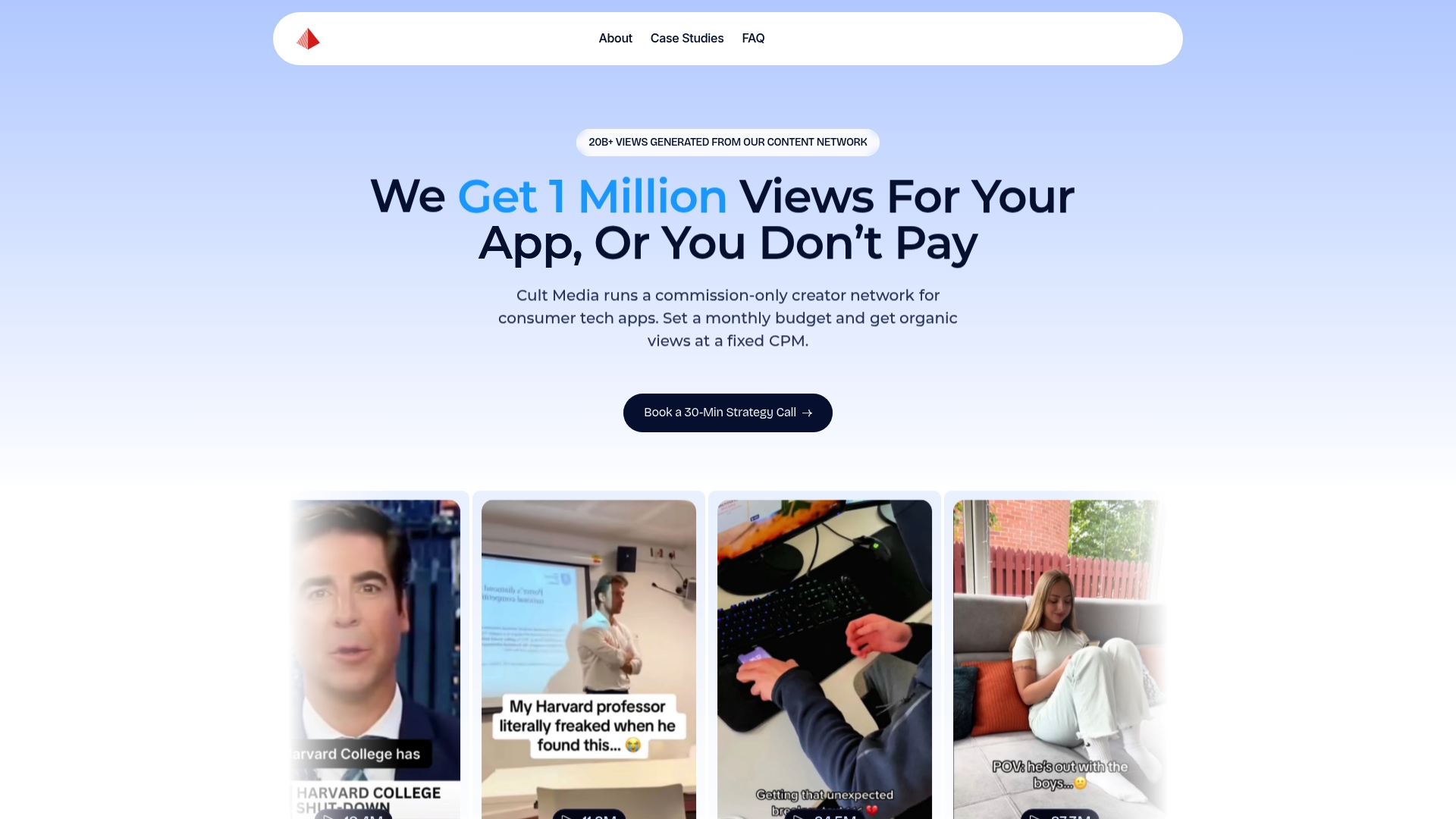
Cult Media is a purpose-built example of this model, operating a commission-only creator network specifically for consumer tech apps with guaranteed-view campaigns on TikTok and Instagram.
Table of Contents
- Which UGC platform type should your team pick?
- How performance-driven creator networks deliver measurable app-growth outcomes
- How to evaluate UGC platforms for commission-only campaigns
- Pricing models and KPIs to expect from performance-based UGC
- Why scaled consumer apps switch to managed, commission-only partnerships
- How Cult Media's commission-only creator network solves the app-growth use case
- Quick-launch checklist for your first commission-only UGC campaign
- What support and training do UGC platforms actually provide?
- Key Takeaways
- The metric that actually predicts whether a UGC campaign will scale
- Pilot a guaranteed-views campaign with Cult Media
- Useful sources and further reading
Which UGC platform type should your team pick?
The UGC platform landscape divides cleanly into three categories, and the right one depends entirely on your marketing objective.

| Platform Type | Best For | Pricing Model | Guaranteed Deliverables | Creator Management | Choose When |
|---|---|---|---|---|---|
| Review-syndication | E-commerce, retail | Subscription / per-seat | Reviews, star ratings | Self-serve | You need product pages and retail syndication |
| Creator marketplaces | Brand awareness, content volume | Per-project or flat fee | Content files only | Self-serve (you manage) | You have an in-house team to vet and brief creators |
| Performance-driven managed networks | App growth, CPI campaigns | Commission / CPM on verified views | Guaranteed views, installs | Fully managed | You need verified reach tied to install outcomes |
Review-syndication and visual UGC platforms are most valuable to e-commerce because they power product pages and retail syndication. App growth teams need something different: creator networks built around short-form social advertising.
For CPI-focused campaigns, the decision is straightforward:
- Self-serve marketplaces put briefing, scheduling, and QA on your team, which adds internal coordination costs and creates creative drift.
- Performance-driven managed networks shift that operational burden to the provider and tie payment to verified reach, not just content delivery.
How performance-driven creator networks deliver measurable app-growth outcomes
These networks align creator incentives to verified reach and conversion goals, not just impressions. The operational flow is tighter than most teams expect.
- Campaign brief — You define the objective, target audience, key message, required CTAs, and view guarantee.
- Creator selection and vetting — The network screens creators for audience fit, engagement quality, and content track record in your app category.
- Content production — Creators produce higher-converting content when they receive structured, tech-specific briefs and when compensation ties to verified organic view goals.
- Whitelisting and placement — Content is distributed across TikTok, Instagram Reels, and Stories via whitelisted creator accounts or paid dark posts.
- Verified view delivery — Views are tracked through platform SDKs, whitelisting dashboards, and third-party attribution events (e.g., AppsFlyer, Adjust).
- Post-campaign reporting — You receive a verified breakdown of views delivered, view-to-install conversion rate, CPI, and creative-level performance.
Typical phase timelines for a pilot campaign run two to six weeks: one week for briefing and creator selection, one to two weeks for production and approvals, and the remainder for live delivery and reporting.
Deliverables to expect from a well-run managed campaign:
- Verified view count against the guaranteed threshold
- Creative assets with perpetual usage rights
- Attribution data linking views to installs
- Creative performance breakdown by format (Reels vs. Stories vs. TikTok feed)
How to evaluate UGC platforms for commission-only campaigns
Evaluation checklist:
- Performance guarantees: does the provider commit to a specific view or install number in writing?
- Verification method: platform SDK, whitelisting dashboard, or third-party pixel?
- Usage rights: are perpetual rights for paid ad use included in the contract price?
- Creator vetting: what is the screening process for audience quality and category fit?
- Campaign management SLAs: who owns briefing, scheduling, and delivery timelines?
- Reporting detail: can you access raw data, not just a summary PDF?
- Ad account integrations: does the platform connect with your MMP (AppsFlyer, Adjust, Singular)?
- Geographic targeting: can creators be filtered by U.S. audience demographics?
- Scalability: can the provider increase view guarantees or creator count mid-campaign?
Vendor questions to ask on a discovery call:
- What exactly is guaranteed — views, installs, or both?
- How are views verified, and which third-party tools confirm delivery?
- Are perpetual usage rights for paid social included, or licensed separately?
- How do you vet creators for consumer tech app audiences?
- Who writes the brief, and what approval steps does the client control?
- What is the typical turnaround from signed contract to first content live?
- How do you handle underperformance against the view guarantee?
- What reporting cadence and data format do you provide?
- Can you target creators with U.S.-based audiences in a specific age or interest segment?
- What is the minimum campaign size to access managed services?
- How do you handle content revisions or brand-safety issues?
- What integrations do you support for MMP attribution?
Pro Tip: Watch for two red flags: providers that retain content ownership or charge extra licensing fees for paid ad use, and those that cannot explain their view-verification methodology. Ownership traps are common — low entry costs often hide restrictive usage rights or additional licensing fees downstream. Require 100% perpetual usage rights as part of the campaign price before signing.
Pricing models and KPIs to expect from performance-based UGC
Performance-driven creator networks can price around guaranteed views or pay-for-verified-reach, which aligns creator incentives with campaign outcomes.
| Pricing Model | How It Works | Best For | Key Risk |
|---|---|---|---|
| CPM on guaranteed views | Fixed fee per verified views delivered | App teams with clear CPI targets | Verify what counts as a "view" |
| Pay-for-installs (CPI) | Fee per attributed install | Performance-only budgets | Attribution window disputes |
| Hybrid (minimum + performance) | Base fee covers production; performance fee covers views | Campaigns needing creative volume | Minimum can inflate effective CPI |
KPIs to track on every commission-only campaign:
- Verified views (against the guaranteed threshold)
- View-to-install conversion rate
- Organic vs. attributed installs
- CPI (cost per install, blended)
- D1 and D7 retention rates
- Creative-level performance by format
The most useful benchmark is view-to-install conversion rate by creative format. Short-form video on TikTok and Instagram Reels consistently outperforms Stories for install-intent audiences, which is why managed networks that specialize in these formats tend to deliver lower effective CPI than broad creator marketplaces.
Why scaled consumer apps switch to managed, commission-only partnerships
Managed partnerships reduce creative drift and shift delivery risk to the provider. That single shift changes the economics of a UGC program significantly.
Top consumer tech brands often shift from discovery tools to full-service managed partnerships as they scale because managed partners own briefing, scheduling, and delivery timelines. When your team is managing creators directly, you absorb every coordination cost: revision cycles, missed deadlines, inconsistent brand voice, and underperforming content that still gets paid for.
The operational case for managed partnerships: Practitioners report the most value from partnerships that combine vetted creators, performance guarantees, and agency-style project management. Self-serve marketplaces produce content volume; managed networks produce verified reach tied to install outcomes. The difference shows up in CPI, not just in creative quality.
Practitioners report the most value comes from partnerships that combine vetted creators, performance guarantees, and agency-style project management rather than purely self-serve marketplaces. For a growth team running multiple campaigns simultaneously, that operational ownership is worth more than a lower per-creator rate.
How Cult Media's commission-only creator network solves the app-growth use case
Cult Media delivers guaranteed views and performance-based pricing built specifically for consumer tech apps. The campaign model is direct: you agree on a view guarantee and CPM rate, Cult Media manages creator selection, briefing, production, and delivery, and you receive verified reporting against the committed threshold.
Campaign framework:
- Brief — Cult Media builds a tech-specific brief aligned to your install objective and audience targeting.
- Guaranteed view commitment — A specific view number is contractually committed before the campaign launches.
- Creator management — Cult Media handles vetting, scheduling, content QA, and whitelisting across TikTok and Instagram.
- Verified reporting — Post-campaign data includes views delivered, view-to-install conversion, and creative-level breakdown.
On content rights and U.S. ad compliance: Every Cult Media campaign includes perpetual usage rights for paid social, and campaigns are structured to meet U.S. Federal Trade Commission disclosure requirements for sponsored creator content. You own the assets; no separate licensing fee applies.
Cult Media's creator network has driven over 20 billion views across TikTok and Instagram for consumer app clients, with a focus on high-conversion short-form formats that move users from view to download.
Quick-launch checklist for your first commission-only UGC campaign
A tight brief and measurable view targets are what align creators to install outcomes. Without both, even a managed network will underdeliver.
- Define your install objective — Set a target CPI and a minimum install volume for the pilot.
- Set your view guarantee — Work backward from expected view-to-install conversion rate to determine the view threshold you need.
- Complete the campaign brief — Include: objective, target audience demographics, key message, required CTAs, placement specs (TikTok feed, Reels, Stories), view guarantee, usage rights confirmation, approval process, and verification tags.
- Confirm MMP integration — Connect AppsFlyer, Adjust, or Singular before launch so attribution is tracked from day one.
- Approve creative before go-live — Gate final approval on brand safety and CTA accuracy.
- Launch and monitor daily — Track verified views and install attribution daily for the first week.
- Post-campaign review — Analyze creative-level performance and identify the top-performing format for the next iteration.
Pilot timeline: Two to six weeks is the standard range. Week one covers briefing and creator selection; weeks two and three cover production and approvals; weeks four through six cover live delivery and reporting.
Pro Tip: To set view goals tied to install lifts, use this rule of thumb: if your category average view-to-install rate is 1–2%, a guarantee of 500,000 verified views should produce 5,000–10,000 attributed installs. Adjust the view guarantee up or down based on your historical conversion data. Creators who receive structured, tech-specific briefs with compensation tied to verified view goals consistently produce higher-converting content.
What support and training do UGC platforms actually provide?
Support quality varies sharply across platform types, and it matters more than most teams realize during onboarding.
Self-serve creator marketplaces typically offer documentation, a help center, and email support. You get platform access and creator search tools; the operational knowledge stays with your team. For app-growth teams without dedicated creator ops staff, that gap shows up quickly in brief quality and campaign consistency.
Managed networks operate differently. Onboarding usually includes a dedicated account manager, a structured campaign intake process, and creative strategy support. Cult Media, for example, provides end-to-end campaign management, which means the briefing, creator coordination, and reporting workflows are handled by the provider's team, not yours. That structure functions as built-in training for your first campaign and reduces the learning curve on creator compensation, content approvals, and attribution setup.
For teams scaling beyond a pilot, look for platforms that offer creative performance reviews, regular reporting calls, and guidance on iterating briefs based on what the data shows. The best creator economy operators treat campaign reporting as a feedback loop, not a final deliverable.
Key Takeaways
Commission-only, performance-guaranteed creator networks are the most effective UGC platform type for consumer tech apps focused on installs and CPI efficiency.
| Point | Details |
|---|---|
| Match platform type to objective | Review-syndication fits e-commerce; performance-driven managed networks fit app-growth CPI campaigns. |
| Require perpetual usage rights | Demand 100% perpetual rights for paid social in the contract to avoid downstream licensing costs. |
| Insist on verified view reporting | Confirmed views via platform SDK or MMP integration are the only reliable basis for CPI benchmarking. |
| Pilot with a 2–6 week campaign | A short pilot with a guaranteed view threshold lets you validate view-to-install conversion before scaling. |
| Cult Media for app-growth campaigns | Cult Media's commission-only creator network delivers guaranteed views and end-to-end campaign management for consumer tech apps. |
The metric that actually predicts whether a UGC campaign will scale
Most app-growth teams optimize for CPI first. That's the right instinct, but the metric that actually predicts whether a UGC campaign will scale is view-to-install conversion rate at the creative level.
Here's what gets missed: a campaign can hit its guaranteed view threshold and still produce a poor CPI if the creative format is wrong for the audience. Short-form video on TikTok and Instagram Reels drives install intent in ways that Stories and static posts don't, particularly for consumer tech apps where the product demo is the hook. The brief is where that gets decided, not the platform.
The conventional wisdom says to test many creators and let the data decide. That's partially right. But the more reliable lever is brief specificity. Creators who receive a structured, tech-specific brief with a clear CTA and compensation tied to verified views produce content that converts at a measurably higher rate than those given open-ended prompts. The platform is the distribution mechanism; the brief is the performance driver.
One caution worth stating plainly: content ownership is where teams get burned most often. A low-cost marketplace entry price that excludes paid ad usage rights will cost more in licensing fees than a managed network with perpetual rights built in. Read the usage rights clause before anything else.
Pilot a guaranteed-views campaign with Cult Media
Cult Media gives consumer tech app teams a direct path to verified, install-driven views without the overhead of managing creators in-house. You pay only for views delivered, perpetual usage rights are included, and the entire campaign workflow — briefing, creator selection, production, and reporting — is managed end-to-end.
The pilot process starts with a discovery call where Cult Media reviews your install objective, target audience, and current CPI benchmarks. From there, the team builds a performance proposal with a specific view guarantee and CPM rate. To move fast, come prepared with your MMP setup, target audience demographics, and a clear install goal.
Start your pilot campaign with Cult Media and get a performance proposal built around your app's growth targets.
Useful sources and further reading
For platform overviews and category comparisons, the sources below cover review-syndication tools, creator marketplaces, and performance-driven networks in detail.
- The 12 Best UGC Platforms in 2026 — soona — Best for understanding platform categories and e-commerce vs. app-growth fit.
- Best UGC Platform for Brands — Twirl — Covers managed vs. self-serve workflows, pricing models, and creator compensation structures.
- UGC Platform and Content Creator Network — Trend — Practitioner guidance on usage rights, ownership traps, and licensing best practices.
- 7 Best UGC Platforms for Creators — Yotpo — Detailed breakdown of review-syndication and visual UGC tools for e-commerce teams.
- Bazaarvoice — UGC Platform for Authentic Shopper Experiences — Enterprise-grade review syndication and creator marketing for retail brands.
- Skeepers — UGC Platform Suite — European-market UGC suite covering influencer campaigns, verified reviews, and AI-assisted content activation.
- Cult Media — Commission-Only Creator Network — Practitioner content on performance-based UGC, TikTok and Instagram campaign workflows, and app-growth creative strategy.
- MINIM Content Production — Production workflow context for teams building large-scale UGC programs with agency support.