High-converting UGC is engineered direct-response creative, not spontaneous customer footage. It leads with a specific problem, delivers concrete proof in a believable setting, and ships in modular variations built for testing. The single best focus for most teams is short-form problem-to-solution video paired with shoppable placements on the product page. Networks like Cult Media apply this performance logic directly to consumer app growth, treating creator content as a measurable acquisition channel rather than a branding exercise.
TL;DR:
- Focus on modular, testable UGC content with specific hooks, environments, and calls-to-action to maximize conversion lift and reduce production costs.
- Prioritize testing multiple hooks and formats quickly to identify top performers, improving success rates within two testing cycles.
- Use a rights workflow upfront and accurately measure impact through metrics like thumbstop, hold rate, click-through, and conversion rates; last-click attribution undercounts UGC effects.
- Automate discovery, rights capture, and tagging to scale volume without sacrificing quality, ensuring assets are properly organized and tested across placement channels.
- Adopt performance-based UGC models, such as guaranteed views, to pay only for verified results like app downloads, avoiding inefficient spending on unproven creative.
Table of Contents
- Why High Converting UGC Outperforms Polished Ads
- High-Converting UGC Formats Worth Replicating
- Nine Tactics for Briefing, Sourcing, and Producing UGC That Converts
- Measuring UGC: KPIs That Actually Prove Impact
- How to Scale a UGC Pipeline Without Losing Conversion Quality
- What Marketers Consistently Get Wrong About UGC
- How Cult Media Turns UGC Into Downloads
- Sources
- FAQ
Why High Converting UGC Outperforms Polished Ads
Pages carrying UGC drove 6.73 times higher conversions than pages without it in Q1 2026, up from 4.27 times just one quarter earlier. Pages with UGC also pulled 4.11 times more visits than pages without it, meaning the lift compounds across both traffic and close rate. Shopper behavior backs this up: engaging with UGC reviews correlates with a 144% jump in conversion and a 162% rise in revenue per visitor, according to Shopify's analysis of Power Reviews and Bazaarvoice data.
Statistic Callout: UGC-driven conversion lift jumped from 4.27x to 6.73x quarter over quarter in early 2026, a 57% increase in a single reporting period.
The mechanics are simple. Buyers trust peer content far more than brand advertising, and UGC borrows the visual grammar of the platform itself, a phone camera, a real bathroom, a real kitchen, so it reads as evidence rather than a pitch. It performs best in paid social feeds, on product detail pages, and inside shoppable video units. The caveat: generic testimonial footage with no hook or specificity underperforms static product photography almost as often as it beats it.
High-Converting UGC Formats Worth Replicating
Not every format earns its production cost. These six consistently outperform generic testimonial clips, based on patterns across top-ranking creative in 2026:
- Problem→solution testimonial. Opens on a relatable frustration, ends on the fix. Hook types: "I almost returned this until…" or a flat statement of the problem. Needs a lived-in environment, 15 to 30 seconds, caption that names the specific pain point.
- Before/after. Visual proof beats verbal claims. Works best with a hard cut or split-screen, minimal narration, and a timestamp overlay so the transformation feels documented, not staged.
- Demo-in-context. Shows the product doing its job in a real setting rather than a studio. Deliverable requirements: at least one close-up of the interaction that matters (a swipe, a tap, an unboxing detail).
- Day-in-life. Embeds the product inside a routine. Hook is the routine itself, not the product. Best for brand awareness and top-of-funnel paid social rather than direct conversion.
- Unboxing. Still converts on impulse categories. Needs authentic reaction audio, not a scripted voiceover, and a clear shot of packaging and first use.
- Shoppable video. The activation layer, not a standalone format, any of the above can be repurposed here. Idukki's 2026 data shows shoppable video pulling significantly higher engagement than static galleries.
Platform notes matter. TikTok rewards raw pacing and a hook inside the first second. Instagram Reels tolerates slightly more polish. PDP shoppable video should run silent-first with captions burned in, since most product-page traffic scrolls with sound off.
Nine Tactics for Briefing, Sourcing, and Producing UGC That Converts
Most UGC underperforms because teams skip the engineering step and go straight to filming. Here's the sequence that fixes that.
- Write the hypothesis first. Define Who (the exact customer segment), Belief (the objection you need to overcome), and Proof (the evidence that overcomes it) before you contact a single creator, a structure Ads4scale calls the Who + Belief + Proof thesis.
- Hire for delivery, not followers. Acting ability and comfort on camera predicts performance far better than audience size; a creator with 2,000 followers who can sell a product in eight seconds beats one with 200,000 who can't.
- Build a roster, not a one-off list. Repeat creators cut briefing time and improve consistency once you know who performs.
- Request modular deliverables per shoot. Ask for five hooks, three body variations, and two CTAs from every session, per the Ads4scale operational framework. One shoot day should produce dozens of testable combinations.
- Set environment standards. The setting has to match where the buyer actually uses the product, not a staged backdrop.
- Lock audio and framing rules. Vertical, phone-native audio, minimal background noise. Polish reads as an ad; a slightly imperfect take reads as real.
- Build the rights workflow before filming, not after. A signed usage agreement covering paid media, not just organic posting, has to exist before the shoot starts.
- Run a 72-hour test window. Small spend, tight timeline, measure thumbstop and hold rate before committing budget.
- Perform a creative autopsy and Frankenstein the winners. Take the top-performing hook and pair it with a different body and CTA. This is where the unit economics of scalable UGC actually show up: one shoot day can yield 30 testable permutations instead of one static ad.
Pro Tip: Never brief a single "final" video. Brief the raw components, hooks, bodies, CTAs, and let the testing data decide the combination. The editing room, not the shoot, is where conversion rate gets built.
Measuring UGC: KPIs That Actually Prove Impact
Thumbstop rate (the percentage of viewers who stop scrolling in the first three seconds) and hold rate (how far they watch past that point) are the earliest signals a hook is working. Calculate thumbstop as 3-second views divided by impressions, and hold rate as average watch time divided by total video length.
- Click-through rate from the ad or gallery unit into the product page.
- Add-to-cart rate from UGC galleries, which Idukki measured at 6.4% versus 1.8% for static image galleries.
- Conversion rate on sessions exposed to UGC versus sessions that weren't.
- Blended CAC, tracked weekly, since UGC's cost advantage shows up in acquisition cost, not just conversion percentage.
Last-click attribution consistently undercounts UGC, because a viewer often sees a clip, closes the app, and converts later through a branded search or direct visit. Holdout tests, holding back UGC exposure from a control group, and GA4's data-driven attribution model both surface the fuller picture. Reporting on last-click alone will make a working UGC program look like it's failing. A reliable ROI measurement framework treats attribution modeling as a prerequisite, not an afterthought.
How to Scale a UGC Pipeline Without Losing Conversion Quality
Volume kills quality unless the operations layer is built first. Here's the checklist that keeps output high while output volume increases.
- Automate discovery and rights capture. Use an API feed, webhook, or a standing consent form so usage rights get logged the moment content is submitted, not chased down weeks later.
- Centralize everything in one tagged library. Product-tag every asset and pull from at least three distinct creator sources; multi-source galleries show roughly 1.6 times the conversion impact of single-source ones.
- Map activation by placement. PDP above the fold, shoppable video units, email strips for post-purchase upsell, and paid retargeting for warm audiences who didn't convert the first time.
- Run quality control on every batch. Standardize file naming, metadata, and a minimum deliverable count per creator before anything enters the library.
- Keep the testing loop running. New winning hooks feed back into the next round of briefs, the same cycle described in the tactical playbook above.
AI tools handle the low-judgment work well, tagging, moderation, sorting by product category, but the creative decisions still need a human call. Creators are matched to consumer apps, content gets tested, and clients pay only for verified views delivered.
Pro Tip: A high tagging rate on your gallery content correlates directly with conversion lift. Improving product tagging before investing in new creator shoots is advisable.
What Marketers Consistently Get Wrong About UGC
The biggest failure mode is treating follower count as a proxy for performance. It isn't. A second is under-testing: brands run one video, call it a loss, and abandon the format instead of testing five hooks against the same body. Third, and most costly, is skipping the rights conversation until after a video performs, then discovering it can't run as a paid ad.
A team that fixes the rights workflow first and tests hooks in modular batches typically sees its winning-asset rate climb within the first two testing cycles. This week's action: pull your last five UGC briefs and check whether any of them specified more than one hook option. If not, that's the gap to close first.
— Jax
How Cult Media Turns UGC Into Downloads
A commission-only, guaranteed-view model built specifically for consumer tech apps means you pay a fixed fee per verified view a creator delivers, not a retainer for effort regardless of outcome. That structure is the direct contrast to agency models that bill monthly whether or not the content performs.
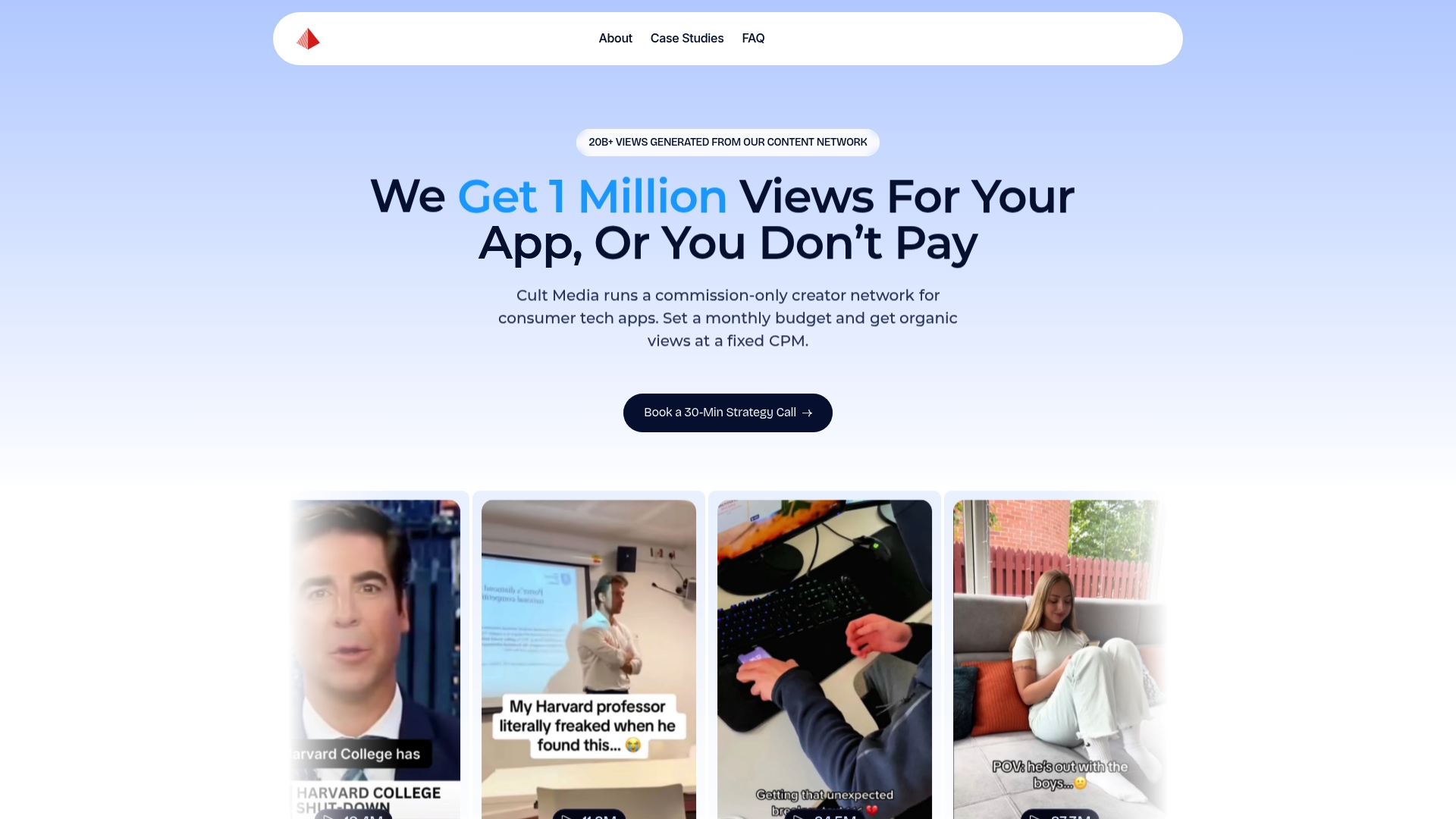
The ideal fit is a consumer app team that needs downloads at scale without gambling a fixed budget on unproven creative. A creator network is built around the same performance-first UGC logic covered above, hook-driven, testable, modular, applied specifically to app install campaigns rather than generic brand content. The goal is straightforward: more downloads, lower blended cost per install, and payment tied to results that can be verified. If your current UGC pipeline produces content but not installs, that's usually a briefing and testing problem, not a talent problem, and it's exactly what a guaranteed-view creator network built for app installs is designed to fix.
See how the guaranteed-view system works for your app category and get a sense of what a commission-only campaign would look like for your install targets.
Sources
- Emplifi Q1 2026 social media marketing benchmarks
- User-generated content examples — Shopify Enterprise
- UGC Impact Report 2026 — Idukki
- How to Engineer a High-Converting UGC Pipeline — Ads4scale
FAQ
Is UGC still relevant in 2026?
Yes. Q1 2026 benchmarks show UGC-driven conversion lift climbing to 6.73 times versus non-UGC pages, up from 4.27 times the prior quarter, which points to growing, not fading, effectiveness.
Is UGC actually profitable for brands?
It is, when treated as engineered creative rather than casual content. Shopper data shows conversion increases of 144% and revenue-per-visitor gains of 162% tied directly to UGC engagement, and Cult Media's guaranteed-view pricing means clients pay only for verified results.
What is a good UGC rate to pay creators?
Rates vary widely by platform, follower size, and deliverable count, and there's no single industry-standard figure. Pricing based on modular deliverables (multiple hooks, bodies, and CTAs per shoot) tends to produce better cost efficiency than paying per finished video.
Is UGC content legal to use in paid ads?
Only with explicit written usage rights covering paid media, not just organic posting; a like or comment from a creator is not a usage license. Build the rights agreement into the briefing process before filming, since retroactively securing ad rights on a viral clip is often difficult or impossible.
What's the difference between UGC and influencer marketing?
UGC is typically produced for direct-response testing and paid amplification, while influencer marketing leans on an individual's existing audience and reach. Many performance teams now blend both, sourcing UGC-style content from creators regardless of their follower count, a distinction covered in more detail in this performance playbook comparing the two approaches.