Yes, influencer campaigns can reliably drive app installs and high-value users when you set measurable KPIs and track creator-level performance. The core requirements are straightforward: clear goals, creator-level tracking through deep links or QR codes, platform fit, and native creative. Start by setting a KPI, assigning tracking links to every creator, and briefing each one on the exact call to action you need.
TL;DR:
- Connect each creator’s unique link or QR code to app events, then compare cohort retention and lifetime value rather than judging performance by installs alone.
- Brief creators to hook viewers within the first three seconds, demonstrate one core feature, name the app, and direct viewers to its store page.
- Match creators to the app category: finance apps benefit from education and trust, while gaming campaigns can use live streams and gameplay highlights.
- Set creator fees against lifetime value and target acquisition costs; guaranteed views suit predictable launch reach, while performance pay limits risk when testing partnerships.
- Require content reuse rights in contracts and verify clear sponsorship disclosures in spoken and written content before posts go live or become paid ads.
Table of Contents
- Why influencer marketing works for mobile apps
- Plan a campaign: set goals, choose platforms, and assign tracking
- Creative formats and content that convert for apps
- Measurement and attribution: deep links, MMPs, and cohort analysis
- Budgeting and pricing: CPMs, guaranteed views, and negotiation
- Compliance and platform rules: FTC disclosure and Apple's constraints
- Short examples by app vertical
- Cult Media's practitioner playbook for app creator campaigns
- Audience targeting and segmentation strategies for app users
- Integrating influencer campaigns with app store optimization
- Driving engagement and in-app actions after install
- Handling influencer fraud and ensuring authentic engagement
- Cross-platform promotion tactics to maximize visibility
- One priority and one tactic worth adopting
- Get a managed creator program built around guaranteed views
- FAQ
- Sources
Why influencer marketing works for mobile apps
Creator content performs well in app marketing because it shows up in a feed the same way a friend's post would, which lowers the resistance that polished ads tend to trigger. A viewer watching a creator demonstrate an app is closer to a referral than an advertisement, and that framing moves people through the top of the funnel faster than a banner or a static ad unit.
The category has also matured. Industry data shows a shift toward ROI-first strategies, with brands favoring micro and mid-tier creators for their engagement-to-cost ratios over reach alone. That same data points to short-form video as the dominant discovery format, which matters for apps because a 15-second demo often does more to prove value than a feature list ever could.
Creator-shot UGC tends to outperform studio creative in these native formats, mainly because it matches what the platform's own users are already producing. A phone-shot walkthrough with a casual voiceover reads as a recommendation, not a pitch, and that distinction shapes everything else in this guide.
Plan a campaign: set goals, choose platforms, and assign tracking
A campaign plan that skips measurement is a campaign you cannot optimize. Before you brief a single creator, lock down the mechanics that let you judge results later.
- Define your KPIs. Decide what matters most, whether that is installs, day-7 retention, lifetime value, or return on ad spend, and set an acceptable cost-per-install or cost-per-lead range before you negotiate with anyone.
- Map your audience to a platform and creator tier. A finance app education series fits a mid-tier creator with a trust-building audience, while a gaming app launch might justify a macro creator's reach for a short burst of visibility, with nano and micro creators filling in sustained, lower-cost coverage.
- Build a deliverables bundle and timeline. Specify the number of posts, the launch window, the posting cadence, and whether creators grant rights for you to repurpose their content as paid ads later.
- Assign unique deep links or QR codes to every creator before they post. Adjust recommends giving each influencer a distinct tracking link so installs and in-app events can be attributed at the creator level, not lumped into a generic social bucket.
Skipping that last step is the single most common mistake in app influencer campaigns. Without creator-level links, you end up with vanity metrics and no way to tell which partnerships are actually worth renewing. Our guide on tracking influencer installs for apps walks through how to map these links to post-install events so the data is usable within days, not months.
Creative formats and content that convert for apps
The formats that move app installs share a common trait: they show the product in motion rather than describing it. A creator opening the app, narrating a real use case, and landing on a specific in-app moment tends to beat a cutaway montage.
- Short-form native video that mirrors the platform's own content style, not a repurposed TV spot.
- Demonstration clips that show one clear problem being solved inside the app within the first few seconds.
- Creator-hosted walk-throughs that feel like a tutorial a friend sent you, not a scripted ad read.
- Series and bundled deliverables, such as a three-part arc that stretches across a launch week and gets repurposed later as paid creative.
- Live commerce or affiliate formats when the app supports in-app purchases or a storefront, letting viewers act on impulse during the stream itself.
A workable brief usually breaks into four beats: a hook in the first three seconds, a demonstration of the core feature, a direct call to action naming the app, and a quick cut to the store page or a specific rating or review as social proof. Our breakdown of UGC for app installs includes sample scripts that follow this structure and tend to lower cost-per-install compared with studio-produced spots.
Pro Tip: Ask creators to film a second, unscripted take after the brief; it often outperforms the on-brief version because it reads as more authentic.
Measurement and attribution: deep links, MMPs, and cohort analysis
Attribution is where most app influencer campaigns succeed or fail quietly. Without creator-level tracking, you cannot tell a high-LTV partnership from a low-quality traffic spike, and you will keep paying for the wrong thing.
- Assign a unique tracking link, deep link, or QR code to each creator and campaign so every install can be traced to its source.
- Connect those links to a mobile measurement partner (MMP) or your existing analytics pipeline, and define which in-app events (signup, purchase, subscription) you are mapping to install data.
- Run cohort analysis to compare retention and lifetime value across creators and platforms rather than judging a campaign on day-one installs alone.
- Track cost-per-install, cost per valuable user, and view-to-install ratios so you can compare creators on efficiency, not just volume.
- Report by creator, not by channel. Lumping all influencer traffic into a generic "social" line item erases the differences between your best and worst partnerships.
Adjust's guidance on influencer marketing for mobile apps makes this point directly: the practice is shifting from brand awareness toward measurable performance, and assigning unique deep links per influencer is the baseline for getting there. Apple's App Tracking Transparency framework adds a layer of complexity here, since cross-app tracking is now limited by default. Apple's developer guidance outlines privacy-preserving attribution methods, which means your measurement stack should lean on deep links and server-side event reporting rather than device-level tracking you can no longer count on.
Budgeting and pricing: CPMs, guaranteed views, and negotiation
Pricing in this space ranges widely by platform and creator tier, and the right model depends on what you are optimizing for.
- CPM or guaranteed-view deals pay for a fixed amount of exposure, which suits campaigns that need predictable scale.
- Flat fees work for one-off placements where reach is secondary to a specific creator's audience fit.
- Commission or affiliate structures tie payment to verified outcomes, shifting risk away from the brand.
- Hybrid models blend a smaller flat fee with a performance bonus, which tends to keep creators motivated past the initial post.
To find your ceiling, work backward from your target return on ad spend: if your average user's lifetime value supports a $4 cost-per-install, your acceptable CPM or guaranteed-view price should be calculated against that number, not against what a creator's media kit asks for. Statista's benchmark data on influencer marketing ROI and cost gives a useful reference point when you are setting these expectations for the first time.
Guaranteed views make sense when you need predictable scale for a launch window. Performance payouts make more sense when you are testing a new creator relationship and want to limit downside risk.
Pro Tip: Always negotiate content reuse rights into the contract; a single creator asset can become three paid ad variations if you own the rights upfront.
Compliance and platform rules: FTC disclosure and Apple's constraints
Compliance here is not optional, and the rules are specific. FTC guidance requires that any material connection between a brand and a creator be disclosed clearly and conspicuously, in both audio or video and text, and the agency places that disclosure burden on both the brand and the influencer. Our own breakdown of FTC disclosure rules for 2026 covers platform-specific placement language if you need a starting template.
Apple adds a second layer. Its App Store privacy guidance requires privacy-preserving attribution under ATT, and Apple's advertising policies set rules for ad content if you plan to run creator footage as paid placements.
A short checklist covers most of the risk:
- Confirm disclosure placement before a post goes live, not after.
- Train creators on required language rather than assuming they know it.
- Audit live posts periodically for compliance drift.
- Route all ad copy derived from creator content through approval before it runs as a paid unit.
Short examples by app vertical
Strategy shifts meaningfully by category, and the creative brief should reflect that.
- Gaming. Live streams and gameplay highlights work well here, often paired with early access keys and referral deep links that reward both the creator's audience and the creator.
- E-commerce and social shopping. Live commerce, affiliate codes, and product seeding tend to convert fastest, since the purchase decision happens inside the same session as the content.
- Finance and utilities. Education-first creators and trust-building content matter more than reach, since these apps carry a longer, more deliberate decision funnel.
- Lifestyle. Relatable, fast-hook short-form content drives initial discovery, while Pinterest tends to extend the content's lifespan well past a single platform's news cycle.
Our platform-specific guides on TikTok app marketing and Snapchat influencer app marketing break down vertical nuances in more depth for teams building out a multi-platform plan.
Cult Media's practitioner playbook for app creator campaigns
We run a commission-only creator network structured around guaranteed-view campaigns and performance-based pricing tied to verified organic views. Our process ties creative strategy, creator management, multi-platform distribution, and paid amplification into one loop, so a single piece of creator content can be measured, optimized, and reused as a paid asset. Our case studies show how that loop plays out across real campaigns.
Audience targeting and segmentation strategies for app users
Targeting an app audience is different from targeting a general consumer audience because the action you need is binary: install or do not install. That narrows the job but raises the stakes on creator fit.
Start by segmenting your existing users by behavior, not just demographics. A high-retention cohort that uses a specific feature heavily tells you more about who to target next than age or location data alone. Match that profile to a creator whose audience already discusses adjacent problems, whether that is productivity, personal finance, or fitness tracking, rather than picking a creator purely on follower count.
Platform-native targeting tools add a second layer. TikTok and Instagram both allow you to boost organic creator posts to lookalike audiences built from your own install data, which effectively turns a single piece of UGC into a paid acquisition asset aimed at the exact segment most likely to convert. Retargeting also matters here: audiences who watched a creator's video but did not install can be served a follow-up ad featuring the same creator, which tends to close more efficiently than a cold creative.
Segment by funnel stage too. A nano creator's highly engaged niche audience might be ideal for a free-trial push, while a broader mid-tier creator audience may be better suited to a general awareness push that feeds your retargeting pool later.

Integrating influencer campaigns with app store optimization
Influencer content and app store optimization reinforce each other, but only when you plan for it. A creator driving a spike in searches for your app's name without a store listing optimized to convert that traffic wastes most of the attention generated.
Before a campaign launches, review your store listing's screenshots, preview video, and description to make sure they echo the language and visuals the creator is using. If a creator demonstrates a specific feature in their video, that same feature should appear prominently in your first screenshot, since users who click through from a creator's content are primed to look for exactly what they just watched.
Keyword strategy matters too. A surge in branded searches following a creator post can lift your ranking for adjacent, non-branded keywords, so it helps to track your store listing's keyword rankings during and after a campaign rather than only watching install counts. Reviews and ratings generated in the days following a campaign also feed directly into your store ranking algorithm, so briefing creators to encourage a rating prompt, without violating platform rules on incentivized reviews, adds a compounding benefit beyond the initial install spike.
Driving engagement and in-app actions after install
An install is a cost, not a result. The real return comes from what a user does after opening the app for the first time, which means your creator brief should point toward a specific in-app action, not just a download.
Design the first session around the same hook the creator used. If a creator's video demonstrated a specific feature, your onboarding flow should surface that feature within the first interaction, closing the gap between what someone expected and what they experience. A mismatch there is one of the fastest ways to lose a user who arrived with genuine intent.
Push notifications and in-app messaging timed to a campaign's launch window can reinforce the behavior a creator demonstrated, reminding users of the specific action that originally caught their attention. Referral mechanics also extend a creator campaign's value: a user who installs through a creator link and then shares their own referral code effectively becomes an unpaid extension of that creator's reach.
Cohort analysis, covered earlier for attribution, serves a second purpose here: it tells you whether users from a given creator engage with the feature that creator demonstrated, which is a more honest signal of campaign quality than install volume alone.
Handling influencer fraud and ensuring authentic engagement
Fraud in this space usually shows up as inflated follower counts, bot-driven engagement, or view counts that do not match install volume. The fix starts before you sign a contract, not after a campaign underperforms.
Review engagement rate relative to follower count rather than follower count alone, since a sudden mismatch, like a creator with a large following but minimal comments or shares, is one of the more reliable signs of purchased followers. Ask for screen-recorded analytics rather than screenshots, which are easier to alter, and cross-check a creator's stated audience demographics against the platform's own creator marketplace tools where available.
Your tracking setup doubles as a fraud check. A creator whose unique deep link generates installs that never complete onboarding, or whose cohort shows near-zero retention compared with other creators in the same campaign, is a strong signal of low-quality or fraudulent traffic, even if the raw view count looked healthy. Building that comparison into your reporting, rather than evaluating creators in isolation, makes fraud easier to spot early and cheaper to walk away from.

Cross-platform promotion tactics to maximize visibility
A single-platform campaign limits your reach to that platform's existing habits. Spreading creator content across TikTok, Instagram Reels, and YouTube Shorts, with light edits for each platform's native format, extends a single production budget across multiple discovery surfaces.
Repurposing is the practical lever here. A long-form YouTube Short can be cut into three TikTok-native clips, each leading with a different hook, which multiplies your testing surface without multiplying your production cost. Cross-posting the same raw clip without adaptation tends to underperform, since each platform's audience expects slightly different pacing and framing.
Coordinating timing matters too. Staggering a creator's content across platforms over a week, rather than posting everywhere at once, keeps your app visible in discovery feeds for longer and gives you more opportunities to test which platform is actually converting before committing further budget.
One priority and one tactic worth adopting
If you take one thing from this guide, prioritize measurable creative over reach. A smaller creator with trackable, retained users beats a large one with vanity installs every time.
The tactical fix is contractual: require deep links and reuse rights in every agreement before a single piece of content goes live.
— Jax
Get a managed creator program built around guaranteed views
We run app creator campaigns on a commission-only model, with guaranteed-view pricing tied to verified organic views instead of vague reach promises. 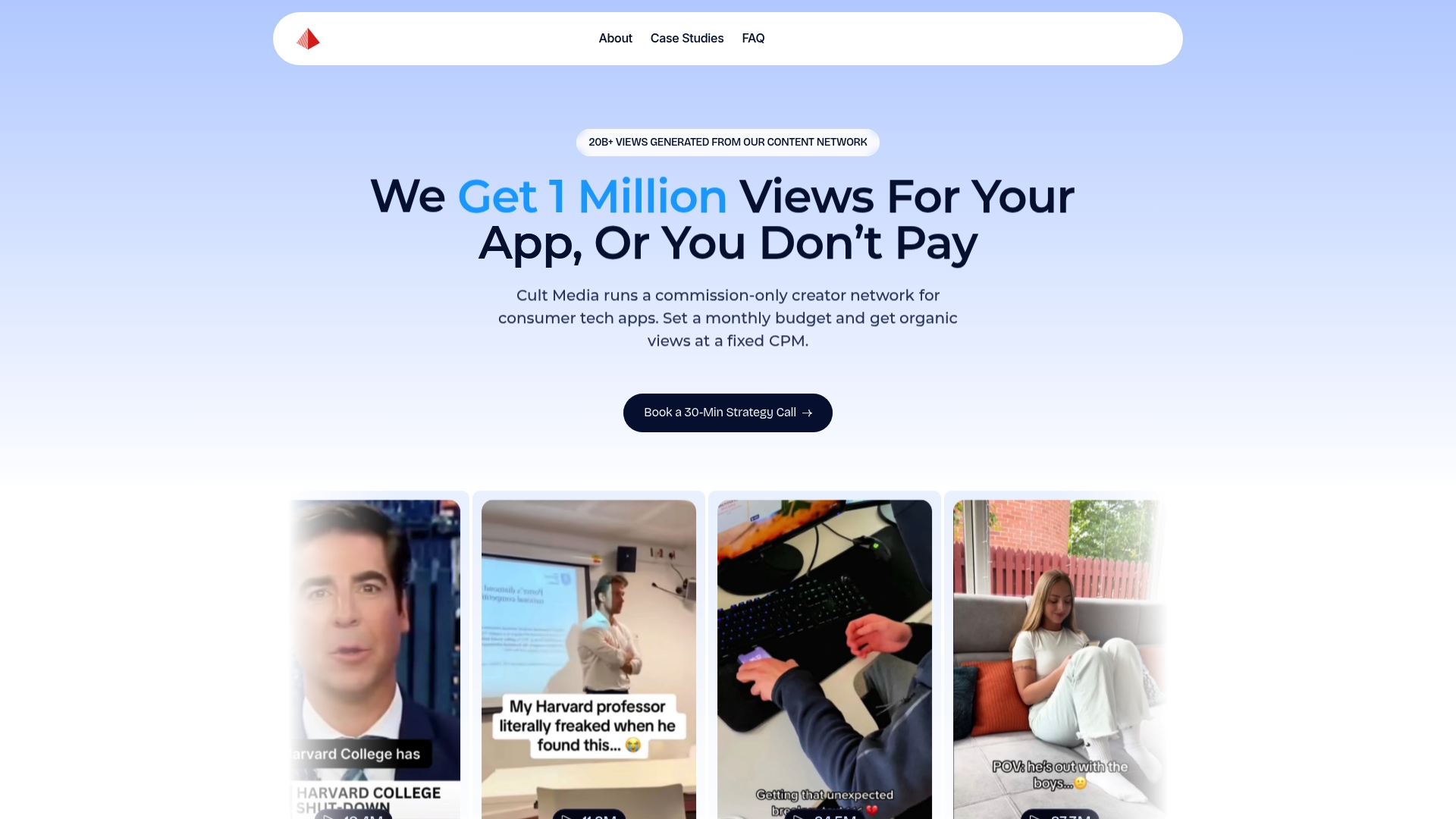
If you want a managed program handling creative, creator relationships, and distribution in one loop, start with our commission-only creator network or review our case studies for examples of how the model performs in practice.
FAQ
How many followers do you need to make $100,000?
There is no fixed follower count tied to that income figure, since earnings depend on niche, engagement rate, pricing model, and brand deal volume far more than raw follower count. A mid-tier creator with strong engagement and consistent brand partnerships can out-earn a larger account with weak engagement.
What are some good apps for influencer marketing?
Short-form video platforms like TikTok, Instagram Reels, and YouTube Shorts tend to perform best for app discovery because their native formats favor demonstration-style content. The right choice depends on where your target audience already spends time and which format best shows your app's core feature in action.
Does Apple use influencer marketing?
Apple relies primarily on its own App Store advertising tools and policies rather than public influencer partnerships for app promotion. Its developer guidance on privacy and attribution is more relevant to third-party marketers, since it governs how any app can measure and advertise within Apple's ecosystem.
What is the best way to promote my app?
A combined approach tends to outperform any single channel: creator-led content for native discovery, paid distribution to scale what performs, and app store optimization to convert the traffic a campaign generates. Pairing these with creator-level tracking lets you see which combination is actually driving valuable users rather than just downloads.
How do I measure if an app influencer campaign is working?
Track creator-level deep links through a mobile measurement partner, then run cohort analysis on retention and lifetime value rather than judging success by install count alone. Adjust's guidance on mobile app influencer marketing recommends this setup specifically because it separates high-quality users from one-time installs.
Sources
- App Store user privacy and data use - Apple Developer
- Disclosures 101 for Social Media Influencers (FTC staff brochure)
- Influencer marketing for mobile apps | Adjust
- Influencer marketing in 2025: New data reveals what works, what costs, and what's next - PR Newswire
- Influencer marketing ROI statistics - Statista