Effective influencer campaign budgeting starts with a target CAC or ROAS, not a round number pulled from last year's plan. Build the budget from that target, then split spend across three buckets: creator fees, operational overhead, and paid amplification. Usage rights and whitelisting can add 25% to 100% on top of base fees, so budget for them before you negotiate, not after.
TL;DR:
- Most influencer campaigns should be budgeted based on a target CAC or ROAS, with clear allocations for creator fees, operations, amplification, and usage rights.
- Influencer rates vary widely by tier, from $25 to $250 per post for nano creators up to tens of thousands for macro influencers, with CPM comparisons helping evaluate cost efficiency.
- Incorporating a 10% to 15% contingency and reserving funds for re-booking proven creators improves campaign ROI and reduces long-term costs.
- Budgeting should include detailed tracking templates, weekly metrics, and a structured process to validate performance before scaling spend or increasing content volume.
- Using a guaranteed-view creator network can ensure predictable CPA and payback timelines, especially for brands seeking fixed results within tight timeframes.
Table of Contents
- What Goes Into an All-In Influencer Marketing Budget
- What Do Influencer Rates Look Like in 2026?
- How Do You Turn a KPI Into an Actual Budget?
- Three-Bucket Allocation: Starter, Growth, and Scale Budgets
- What Hidden Costs Blow Up Influencer Budgets?
- What to Check Before You Scale Your Budget
- Templates and Calculators for Tracking Real Numbers
- A Note on Defending Your Numbers
- When It Makes Sense to Bring in a Managed Creator Network
- Sources
- FAQ
What Goes Into an All-In Influencer Marketing Budget
Most marketers underestimate influencer campaign cost analysis because they only price the content itself. An all-in budget accounts for five categories, and skipping any one of them is how a $15,000 campaign becomes a $22,000 one.
- Creator fees. Gifting works for nano-tier product seeding, but anything beyond that needs flat fees, hybrid fee-plus-commission deals, or performance-based retainers. The creator pay model you choose changes both cost and risk exposure.
- Operational overhead. Discovery, vetting, contracting, legal review, payment processing, and reporting eat real hours. Agencies typically price this in; in-house teams often forget to.
- Creative production. Even UGC-style content needs editing, captioning, and sometimes paid post-production if you plan to repurpose it into ads.
- Paid amplification. Whitelisting spend and boosted posts belong in a separate line item, never folded into "creator fees," because the two scale independently.
- Contingency and re-booking reserve. Set aside 10% to 15% for underperformers, reshoots, or last-minute swaps, plus a reserve to re-book creators who convert well.
Budgeting for influencer partnerships this way turns a vague "creator budget" into a document finance can actually approve.
What Do Influencer Rates Look Like in 2026?
Setting influencer rates without a reference point is how brands overpay for reach and underpay for performance. Rate ranges vary widely by platform and tier, and treating them as fixed prices rather than starting points is the single biggest mistake in influencer campaign cost analysis.
Directional 2026 ranges, before usage rights or amplification:
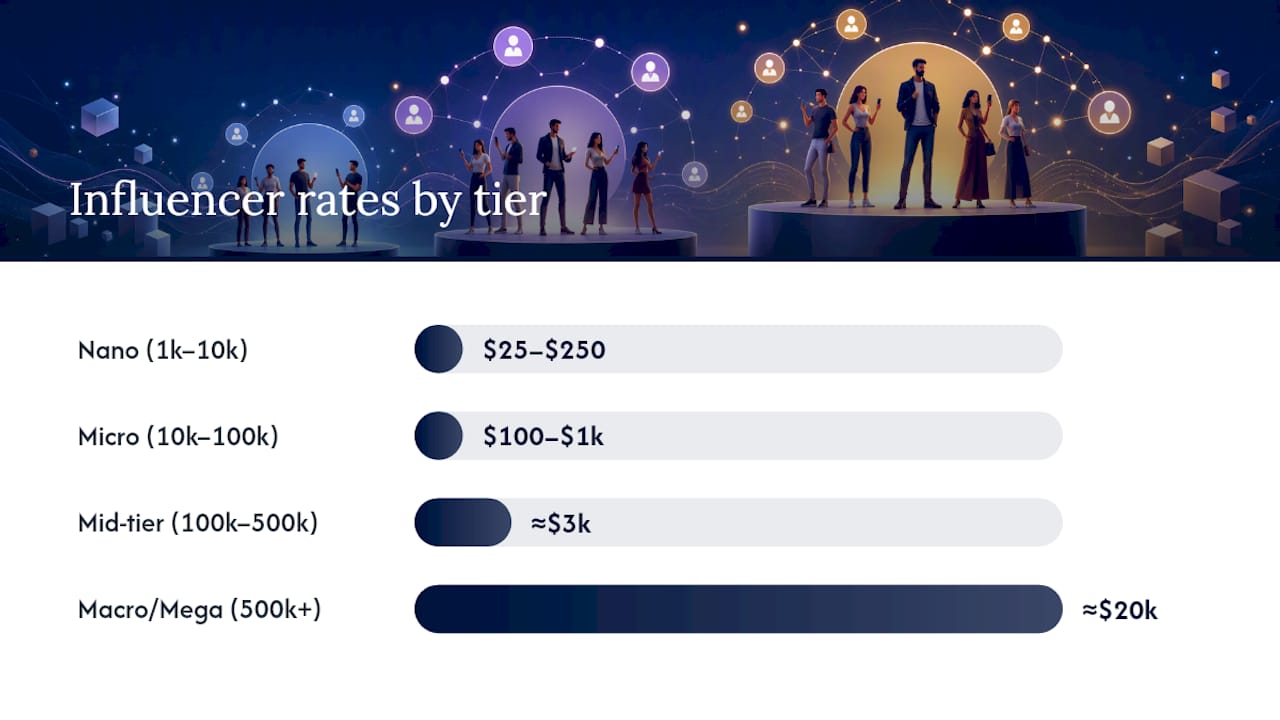
- Nano creators (1,000 to 10,000 followers): often $25 to $250 per post; TikTok clips can run as low as $25.
- Micro creators (10,000 to 100,000): commonly $100 to $1,000 per post depending on platform and format.
- Mid-tier creators (100,000 to 500,000): frequently land in the low thousands per integration.
- Macro and mega creators (500,000-plus): can reach tens of thousands per post, especially for exclusive or first-look content.
Rate Benchmark: Agency-tracked datasets put mid-tier integration medians around a few thousand dollars per post, with wide spreads driven by niche, platform, and exclusivity demands.
Several factors push rates above the median: video production complexity (a 60-second TikTok costs more to produce than a static Instagram post), niche premiums in finance or health verticals, above-average engagement rates, and any exclusivity clause that blocks the creator from working with competitors.
The most useful exercise is converting influencer spend into a CPM-equivalent figure so you can compare it against paid social buys. If a $2,000 mid-tier post reliably delivers 150,000 views, that's a $13 CPM, which is often competitive with paid media once you factor in the trust premium influencer content carries.
How Do You Turn a KPI Into an Actual Budget?
Setting a budget backward from your goal, rather than forward from an arbitrary spend cap, is the difference between a plan that survives a board review and one that doesn't. Here's the sequence:
- Define your primary KPI and payback window. Is this installs, trial signups, or purchases? Are you underwriting a 30-day payback or a 90-day one?
- Set your target CAC or ROAS. If your app's target CAC is $8 and you need 2,000 installs, your ceiling is $16,000 before ops and amplification.
- Translate volume into required views. Estimate your click-through and install-conversion rates to back into total impressions needed, then divide by expected views per creator tier.
- Select a tier mix. A blend of micro and mid-tier creators usually outperforms a single mega influencer on cost-per-install, per the ROI comparisons between creator tiers.
- Layer in ops, amplification, usage rights, and contingency. Add 15% to 20% for operations and 10% to 20% for amplification on top of creator fees.
- Write a one-page investment memo. State the target CAC, total spend, expected views, break-even timeline, and the date you'll evaluate results.
Pro Tip: Build your memo using a break-even forecasting model before you approach a single creator. Walking into negotiations with a locked ceiling number keeps you from overpaying under deadline pressure.
Three-Bucket Allocation: Starter, Growth, and Scale Budgets
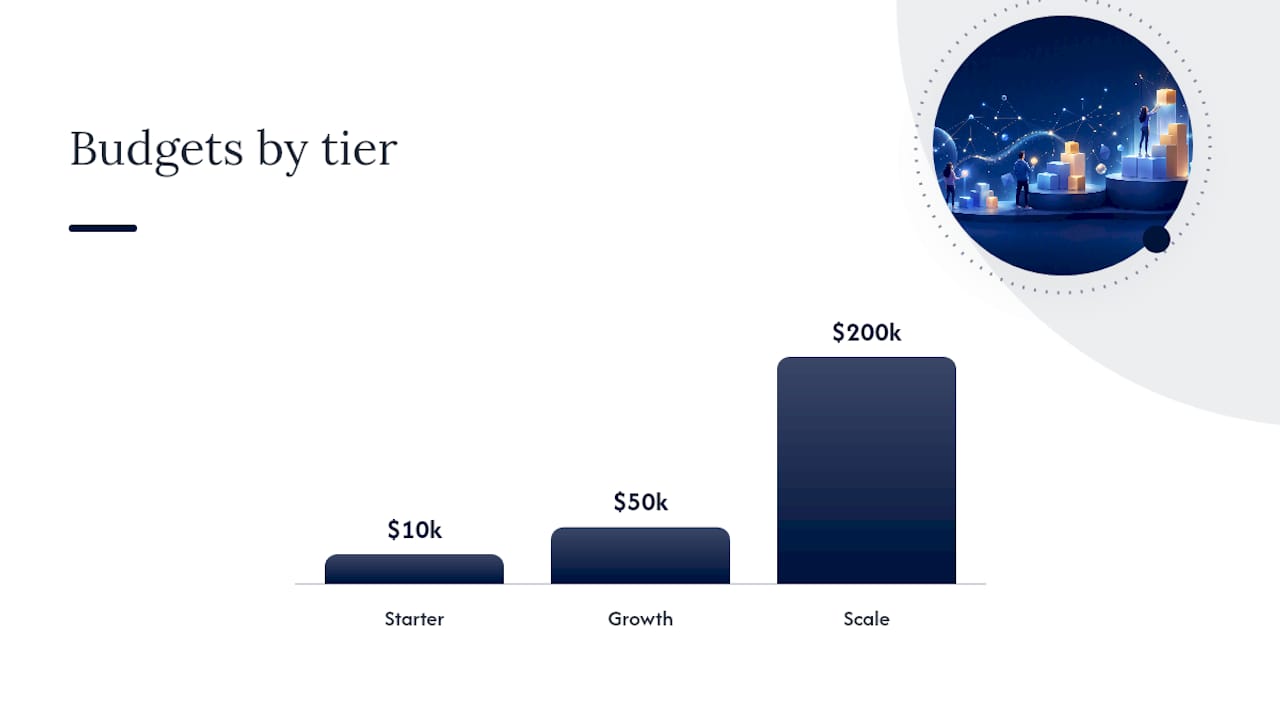
The three-bucket model that governs most 2026 influencer programs allocates 60% to 70% of total spend to creator fees, 15% to 20% to operations, and 10% to 20% to paid amplification. That ratio holds whether you're spending $10,000 or $250,000, though the amplification share tends to climb as programs mature and teams learn which content is worth boosting.
Here's how that split plays out at three common budget tiers:
| Tier | Total budget | Creator fees | Ops | Amplification | Typical creator mix |
|---|---|---|---|---|---|
| Starter | $10,000 | $7,000 | $1,750 | $1,750 | 8 to 10 nano/micro |
| Growth | $50,000 | $32,500 | $9,000 | $8,000 | 15 to 20 micro/mid-tier |
| Scale | $200,000 | $130,000 | $35,000 | $35,000 | 25 to 35 mixed tier, including macro |
Reserving that money to re-book proven performers lowers cost-per-result over time because returning creators skip onboarding and typically convert faster on the second or third campaign.
What Hidden Costs Blow Up Influencer Budgets?
Usage rights are the single most common budget-buster in influencer marketing, and they're also the most negotiable line item if you raise them early. A short paid-ads license, usually 30 days, typically adds 25% to 50% to a base fee. A perpetual buyout, granting indefinite content rights, can substantially increase the creator's original rate.
Other line items marketers routinely forget:
- Product seeding and shipping. Physical goods campaigns need a logistics line, especially for international creators where customs delays affect timelines.
- Kill criteria and test-and-learn losses. Budget for a 10% to 15% failure rate on new creator relationships that simply don't convert, and define upfront what "underperforming" means so you can cut fast.
- Whitelisting access fees. Some creators charge separately for granting ad-account access, distinct from the content fee itself.
Pro Tip: Negotiate usage rights and fee together in the same conversation, never sequentially. Creators who agree to a flat fee first often quote a much higher number once you circle back and ask for whitelisting access.
Multi-post commitments and retainer deals are your strongest lever. Brands that commit to three or more posts per creator can often cut per-post fees by 15% to 25% compared to one-off bookings, and pairing a modest flat fee with a performance bonus tied to conversions aligns incentives without inflating your fixed cost.
What to Check Before You Scale Your Budget
Payback windows have compressed industry-wide. Many brands now expect a return within a single month, which raises the bar for tracking hygiene before you commit more dollars to a program.
Run through this checklist before increasing spend:
- Lock KPI definitions and payback windows across every stakeholder before scaling, so nobody redefines success mid-quarter.
- Standardize UTMs, promo codes, and landing pages across every creator so attribution doesn't fall apart at higher volume.
- Reserve amplification and re-booking budget in the same planning cycle, not as an afterthought once results come in.
- Automate operations once you manage 10 to 15 active creators simultaneously, since manual contracting and payment tracking start leaking money past that threshold.
- Reduce cost per acquisition by pairing organic creator content with retargeting on paid channels rather than treating influencer and paid media as separate budgets.
Scaling without this groundwork is how teams end up with three months of spend and no clean way to attribute a single install.
Templates and Calculators for Tracking Real Numbers
A working campaign budget template needs specific fields, not a generic spreadsheet. At minimum, track: creator name, platform, deliverables, base rate, usage-rights fee, expected views, estimated CAC, ops cost allocation, amplification spend, and an all-in per-creator total.
- Use a calculator that converts tier mix and posts-per-creator into a recommended total budget as a sanity check against your own math.
- Pull weekly numbers on views, click-through rate, and cost-per-install; save deeper ROI and retention analysis for a quarterly review.
- Track which creator content gets repurposed into paid ads or landing pages, since that reuse rate often determines whether a campaign was actually cost-effective.
Your investment memo should show planned versus actual spend by bucket, plus the payback timeline you originally committed to.
A Note on Defending Your Numbers
Stakeholders push back on influencer budgets more than any other line item, mostly because the category still feels unpredictable to finance teams. The fix isn't a bigger contingency fund. It's showing your math: KPI, target CAC, tier mix, and the re-booking reserve that lowers cost over time. One tactic worth stealing from app growth teams is treating every piece of creator content as reusable inventory, feeding top performers into paid ads instead of letting them die after one organic post. A budget built from unit economics defends itself in the room.
— Jax
When It Makes Sense to Bring in a Managed Creator Network
Running influencer campaign budgeting entirely in-house works until you need guaranteed outcomes on a fixed timeline, and that's exactly where most growth teams hit a wall. A commission-only creator network built specifically for consumer tech apps lets clients pay only for verified views a campaign actually delivers, not a flat retainer regardless of results.
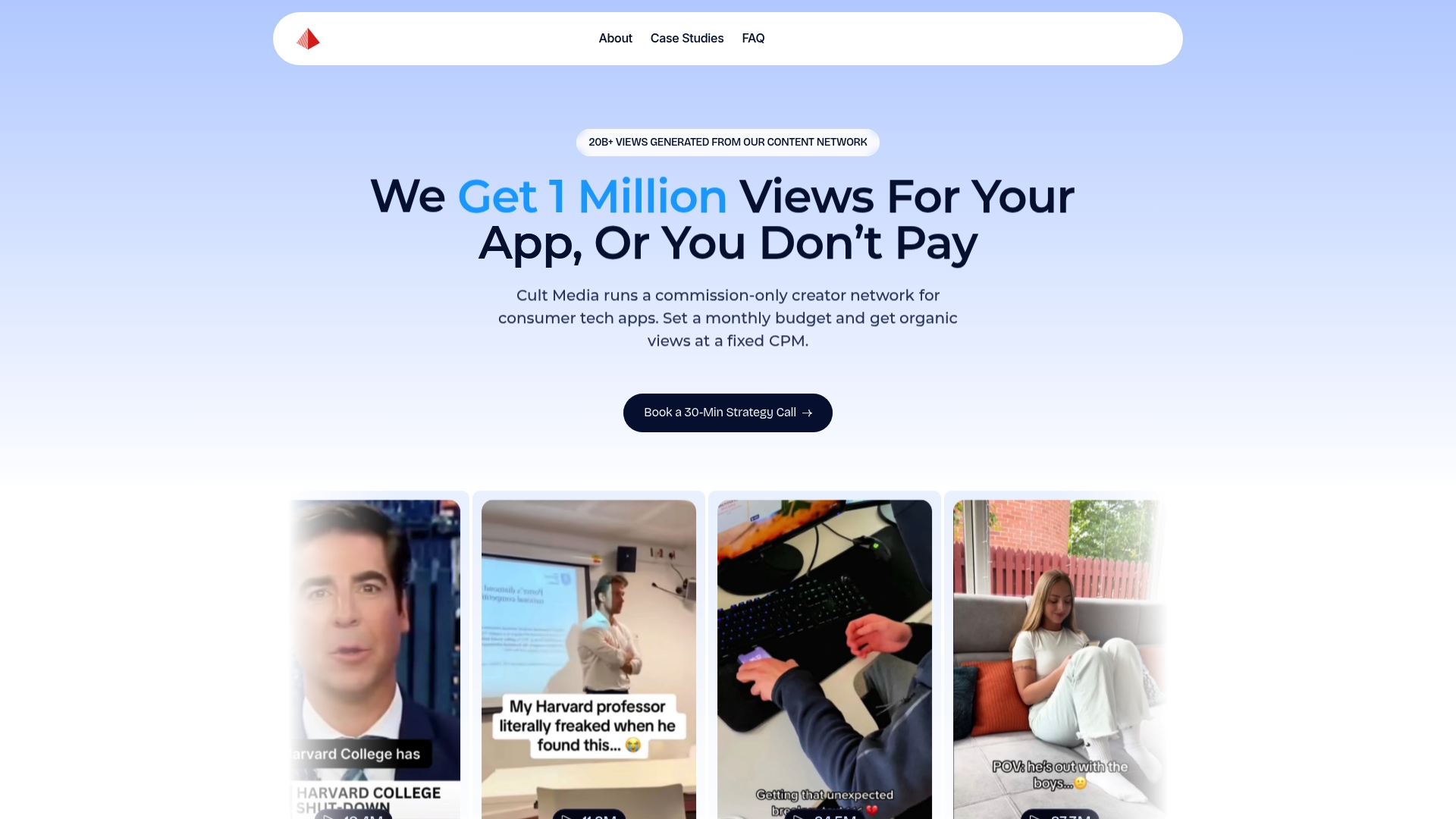
That structure matters most when your budget memo promises a CAC target and a payback window to leadership. Instead of estimating creator output and hoping the tier mix performs, you set a view guarantee upfront and build your unit economics around a number you know will land. The network specializes in high-conversion, UGC-led formats that turn views into installs, and manages sourcing, contracting, and content production so your team isn't absorbing that operational overhead internally. If your app needs predictable user acquisition without the guesswork of estimating creator performance, see how the guaranteed-view model works and what a campaign structured this way could look like for your next quarter.
Sources
- How to Build Influencer Marketing Budgets That Actually Scale | AMT Blog
- Influencer Marketing Budget Calculator for US Brands
- Influencer marketing pricing guidance (SocialNative)
- Influencer Marketing Budget in 2026, What to Spend
FAQ
What Is the Typical Budget for an Influencer Campaign?
There's no single fixed number.
What Is the 70/20/10 Rule for Marketing Budget?
That rule refers to allocating 70% of overall marketing spend to proven channels, 20% to emerging tactics, and 10% to experimental bets. It's a general marketing budgeting principle, not a formula specific to influencer campaigns; influencer marketing budgeting typically uses the separate three-bucket split of creator fees, ops, and amplification instead.
What Is the 5-3-2 Rule on Instagram Marketing?
Definitions of this rule vary across sources, and it isn't a standardized influencer budgeting framework. Treat any specific breakdown you encounter with caution unless it comes from a primary Instagram or Meta resource.
How Much Do Influencers Get Paid for a Campaign?
Pay varies sharply by tier and platform: nano creators may charge as little as $25 per post, mid-tier creators often land in the low thousands per integration, and macro or mega creators can charge tens of thousands, before usage rights or amplification fees are added.
Does Cult Media Guarantee Campaign Results?
Yes. Cult Media's commission-only model ties payment to verified views delivered by its creator network, which lets marketing teams set a CAC target with a known cost basis instead of estimating performance in advance.
Recommended
- Modash vs HypeAuditor: Performance Creator Campaigns for App Growth
- Snapchat Influencer App Marketing: Scale Installs Fast
- TikTok App Marketing: Performance-Based Creator Playbook - Scale Your Consumer App By Unlocking The TikTok & Instagram Systems Behind +20 Billion Views
- Best Influencer Analytics Tools for Founders & Growth Marketers