Flat fees work for one-off awareness plays, commission and affiliate models fit direct-response campaigns you can track to a sale, and hybrid base-plus-performance structures are the right call for ongoing UGC-for-ads production. That last point matters more than it used to: influencer compensation is shifting away from flat per-post fees toward hybrid and performance-tied structures precisely because brands want creators paid on outcomes, not just deliverables.
The main models breaking down that way:
- Flat fee — predictable cost, but you pay regardless of performance.
- Commission/affiliate — low risk, requires reliable tracking.
- Gifting — cheap test, weak guarantee of output.
- Retainer/ambassador — steady creative pipeline, higher commitment.
- Hybrid (base + performance) — aligned incentives, more setup work.
- Performance/revenue share — scalable, needs mature measurement.
Cult Media's commission-only model, which ties billing to verified view delivery, sits at the performance end of that spectrum.
Pro Tip: Start any new creator relationship on a hybrid or commission structure before committing to a retainer. It lets you validate content quality against real numbers before locking in a recurring spend.
Key Takeaways
Hybrid and performance-tied creator pay models outperform flat fees on incentive alignment, and brands should match model choice to measurement maturity before negotiating rate.
| Point | Details |
|---|---|
| Start with low-risk models | Test unproven creators with gifting or affiliate deals before committing to retainers. |
| Use hybrid for ongoing UGC | Base plus performance bonus aligns incentives better than flat fees for recurring content needs. |
| Separate usage fees from creation fees | Price paid-ad licensing and exclusivity as distinct line items, not bundled into the base rate. |
| Verify views before paying | Cross-check platform analytics against third-party tracking to avoid double-counted impressions. |
| Consider commission-only for app growth | Cult Media's guaranteed-view network ties CPM billing to verified performance, cutting upfront risk. |
Table of Contents
- Which Creator Pay Models Should You Use?
- How Do You Calculate Creator Rates?
- How Do You Choose the Right Pay Model?
- Pricing by Creator Tier and Content Format
- Setting Up Payment Operations and Compliance
- Contracts and Usage-Rights Checklist
- A Commission-Only Model for Consumer App Growth
- The Performance-First Shift Is Just Getting Started
- Get a Guaranteed-View Pilot Without the Retainer
- Sources
- FAQ
Which Creator Pay Models Should You Use?
Six structures cover nearly every brand deal you'll negotiate, and each one solves a different problem. Picking the wrong one is usually what turns a campaign into a budget leak.
Flat fee / pay-per-post
The creator delivers agreed content for a fixed price, paid whether the post performs or flops. It's the simplest model to administer and the easiest for creators to say yes to, which makes it the default for one-off awareness pushes where you need reach fast and don't have attribution infrastructure in place. The risk is obvious: you're paying for exposure, not results, and a creator with an inflated following can quietly underdeliver on actual engagement.
- Best for: launch buzz, event coverage, single-campaign awareness
- Watch out for: vanity metrics masking low watch time or weak audience overlap
Commission / affiliate
Payment is tied to tracked outcomes, usually a percentage of sales or a fixed amount per conversion, using affiliate links or promo codes. This is the model of choice for direct-response work because you only pay when something measurable happens. Attribution quality determines whether it works: without a reliable link or code, you can't verify what the creator actually drove versus what would have converted anyway.
- Best for: ecommerce, subscription signups, anything with a clean purchase funnel
- Watch out for: attribution windows that credit creators for sales they didn't influence
Performance / revenue share
A step further than commission, revenue share gives creators an ongoing cut of revenue generated from their content over time rather than a one-time payout per conversion. It scales well for creators who build durable, recurring traffic, but it demands mature measurement, because both sides need to trust the same dashboard.
Retainers and ambassador programs
A fixed recurring payment for a defined cadence of content, often paired with usage rights and exclusivity. Retainers deliver something flat fees and commissions can't: consistency. A creator who posts monthly under an ambassador agreement develops a voice for your product that one-off deals never build. The tradeoff is commitment. You're paying whether or not any single post overperforms, so retainers work best once you already know a creator converts.
Gifting / product-for-post
You send product in exchange for content, no cash changing hands. It's the cheapest way to test a creator relationship and works well in niches like beauty, food, and lifestyle where product experience is the content. It carries real limits: there's no enforceable guarantee of output quality or timing, and disclosure rules still apply even when no money changes hands.
Hybrid models (base + performance bonus)
A guaranteed minimum payment plus a bonus tied to views, clicks, or conversions. This is the structure industry pricing guides increasingly point to as the recommended default, because it splits risk instead of dumping it entirely on one side. Creators get downside protection; brands get upside alignment. For consumer app marketers specifically, this is the closest analog to a guaranteed-CPM structure with a performance kicker layered on top.

UGC-for-ads and content licensing
Separate from organic posting, this covers content brands license specifically to run as paid ads (comparable to TikTok's Spark Ads authorization). Usage rights and paid-promotion licensing are distinct line items from the creation fee itself, and they should be priced that way. A creator quoting $500 for a video isn't necessarily quoting $500 for the right to run that video as a paid ad for six months.
Pro Tip: Always separate the content-creation fee from the usage-license fee in your quote request. Bundling them makes it impossible to negotiate either one cleanly, and it hides the real cost of extending a license later.
How Do You Calculate Creator Rates?
Two formulas cover most rate validation work. The engagement-based formula estimates fair value from audience interaction: average views x engagement rate x a niche multiplier (commonly $0.01 to $0.05 per engaged view, adjusted by category). The CPM/CPV formula is simpler: total budget divided by projected views, giving you cost per thousand views or cost per view to compare against category benchmarks.
Worked example, micro-tier creator: 50,000 average views, 4% engagement rate, lifestyle niche. At a $0.03 per engaged-view multiplier, that's roughly 2,000 engaged views x $0.03 = $60 in engagement value, which combined with a base CPV of $0.01 to $0.02 per view puts a fair flat-fee quote in the $500 to $800 range for a single video, in line with published micro-tier benchmarks.
The same math scales toward $2,000 to $4,000 per video before add-ons.
Add-ons that shift the quote:
- Usage rights for paid ads: typically 50% to 100% on top of the base fee.
- Exclusivity windows (blocking competitor deals): often a 20% to 40% premium.
- Production complexity (multi-location, editing-heavy): priced per hour or per deliverable.
- Rush fees for turnaround under 48 hours: commonly 15% to 25%.
To convert a quote into cost-per-outcome, divide the total spend (fee plus add-ons) by expected downloads or conversions. A $1,000 video projected to drive 500 installs is a $2.00 cost-per-install, which you then compare against your existing CAC to judge whether the deal is worth signing.
| Creator tier | Typical rate range (single video) |
|---|---|
| Nano | $50–$300 |
| Micro | $300 |
| Mid-tier | $2,000 to $4,000 |
| Macro | $15,000 to $40,000 |
| Mega | $100,000+ |
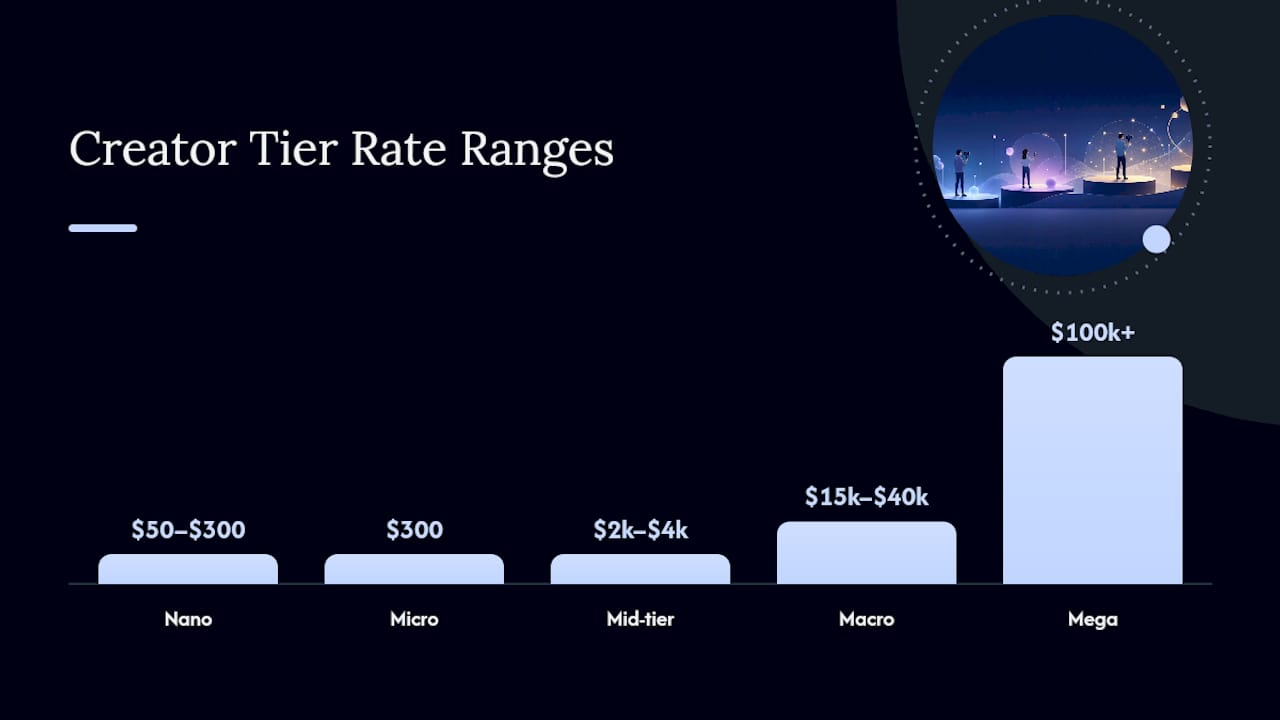
Rates vary by niche, audience geography, and format, so treat these as sanity checks, not fixed quotes.
How Do You Choose the Right Pay Model?
Match the model to what you actually know about your funnel. If you can't yet measure conversions cleanly, don't sign a commission deal. You'll fight about attribution for weeks.
- Define the campaign goal first. Awareness favors flat fee; direct response favors commission; ongoing creative supply favors retainer or hybrid.
- Check your measurement maturity. No tracking infrastructure means you should start with gifting or flat fee, not performance-based pay.
- Assess budget certainty. Fixed budgets pair naturally with flat fees; flexible budgets pair with commission or hybrid structures.
- Weigh creative control needs. Ambassador retainers give you more say over tone and cadence than one-off deals.
- Factor in speed to market. Gifting and affiliate deals close faster than negotiated retainers.
Negotiation tips that actually move deals forward: offer a guaranteed minimum plus a milestone bonus rather than a pure commission ask, and propose a short probation period (one to two pieces of content) before committing to a longer retainer.
Red flags worth walking away from:
- Deliverables described only in vague terms ("a few posts")
- No analytics dashboard access offered to verify performance
- Usage rights left undefined or open-ended with no time limit
Start with gifting or affiliate for unproven creators, and reserve flat fees or hybrid structures for creators with a track record.
Pricing by Creator Tier and Content Format
Format changes the math as much as tier does. A 15-second Reel and a 10-minute YouTube video are not priced on the same scale, even for the same creator.
TikTok and Instagram rates run close to parity across most tiers, but TikTok's distribution mechanics often deliver a lower cost-per-view for pure discovery campaigns, which matters when your goal is app installs rather than brand recall.
Sample budgets, illustrative structure:
- Small test: $2,000 to $5,000, covering three to five micro-creator posts plus basic tracking.
- Scale pilot: $15,000 to $40,000, mixing micro and mid-tier creators with paid amplification and usage licensing.
- Enterprise launch: $100,000+, spanning multiple tiers, exclusivity clauses, and dedicated attribution tooling.
The biggest swing factors are niche competitiveness, engagement rate, US audience percentage, and how much production support the brief demands. See more format-specific pricing breakdowns for platform-by-platform detail.
Setting Up Payment Operations and Compliance
A repeatable payment flow protects your budget and your timeline. The typical sequence runs: SOW signed, content delivered, performance verified, invoice submitted, payout released. Flat fee deals usually complete this cycle in one to two weeks; commission and hybrid deals stretch longer, since payout depends on a verification window (often 30 to 60 days) to confirm attributed conversions or delivered views.
- Collect a signed SOW with deliverables and deadlines before any payment moves.
- Require creator-provided analytics screenshots or platform-level access for verification.
- Set invoice terms up front (net 15, net 30) and put them in the contract, not just email.
- Reconcile delivered views or conversions against tracked data before releasing final payment.
- Keep a payment log by creator and campaign for tax reporting.
Tax and compliance basics vary by country, so this isn't a substitute for local advice, but a few things apply broadly: collect the appropriate tax form for the creator's jurisdiction (a W-9 or W-8 equivalent in the US, VAT registration checks for EU-based creators), and confirm invoicing currency matches the contract before payout.
Tools brands commonly use for this workflow include PayPal or Wise for direct payouts, affiliate platforms like Impact for commission tracking, and contract tools like PandaDoc or DocuSign for signed terms.

Pro Tip: For guaranteed-view campaigns, always cross-check platform-reported views against a third-party tracking link. Double-counted impressions between the platform's native analytics and your own pixel is one of the most common billing disputes in performance deals.
Contracts and Usage-Rights Checklist
Most disputes trace back to a contract that never specified who owns what, for how long. Before signing, confirm the agreement covers deliverables and format specs, timelines, payment triggers, usage and licensing scope, exclusivity windows, revision limits, reporting requirements, and termination conditions.
- Deliverables: exact format, length, and platform
- Usage rights: organic-only versus paid-ad licensing, with an explicit end date
- Exclusivity: which competitor categories are blocked, and for how long
- Payment schedule: base amount, bonus triggers, and invoicing cadence
For hybrid deals, spell out the payout cadence explicitly: base fee on delivery, bonus tranche on verified performance milestone, final reconciliation invoice within a set window after campaign close.
A Commission-Only Model for Consumer App Growth
A consumer app team running a user-acquisition campaign structured around guaranteed views illustrates how commission-only pricing works in practice. The objective: drive install volume through short-form creator content, with the brand paying strictly for verified organic views rather than a flat production fee.
- Creators are selected based on niche fit and historical engagement quality, not follower count alone.
- A CPM guarantee is set, with views tracked through platform analytics and cross-checked against third-party data.
- Content launches in staggered batches to test creative angles before scaling spend.
- Payout triggers once verified view counts hit the contracted threshold.
Metrics the brand tracks throughout: total verified views, install volume, conversion rate from view to install, cost-per-install, and fraud checks to rule out bot traffic. Commission and performance-based models lower upfront risk precisely because payment only follows verified delivery. Commission-only fits best for pure acquisition plays; once a brand has validated which creators convert, a hybrid base-plus-commission structure often becomes the better long-term arrangement for retaining that talent.
The Performance-First Shift Is Just Getting Started
Hybrid models will keep gaining ground because they solve a real problem: pure flat fees waste budget on underperforming content, and pure commission scares off creators who won't take on all the risk. Brand teams that invest early in clean attribution will negotiate better long-term ambassador deals, because they can prove which creators actually move numbers.
Pro Tip: When optimizing for performance, don't strip creative freedom from the brief. Creators who feel over-directed produce flatter content, and flatter content underperforms regardless of the pay structure behind it.
Get a Guaranteed-View Pilot Without the Retainer
Traditional agency retainers charge you whether or not the content performs. Cult Media flips that: it's a commission-only creator network built specifically for consumer tech apps, billing on a CPM basis tied to verified views instead of a fixed monthly fee.
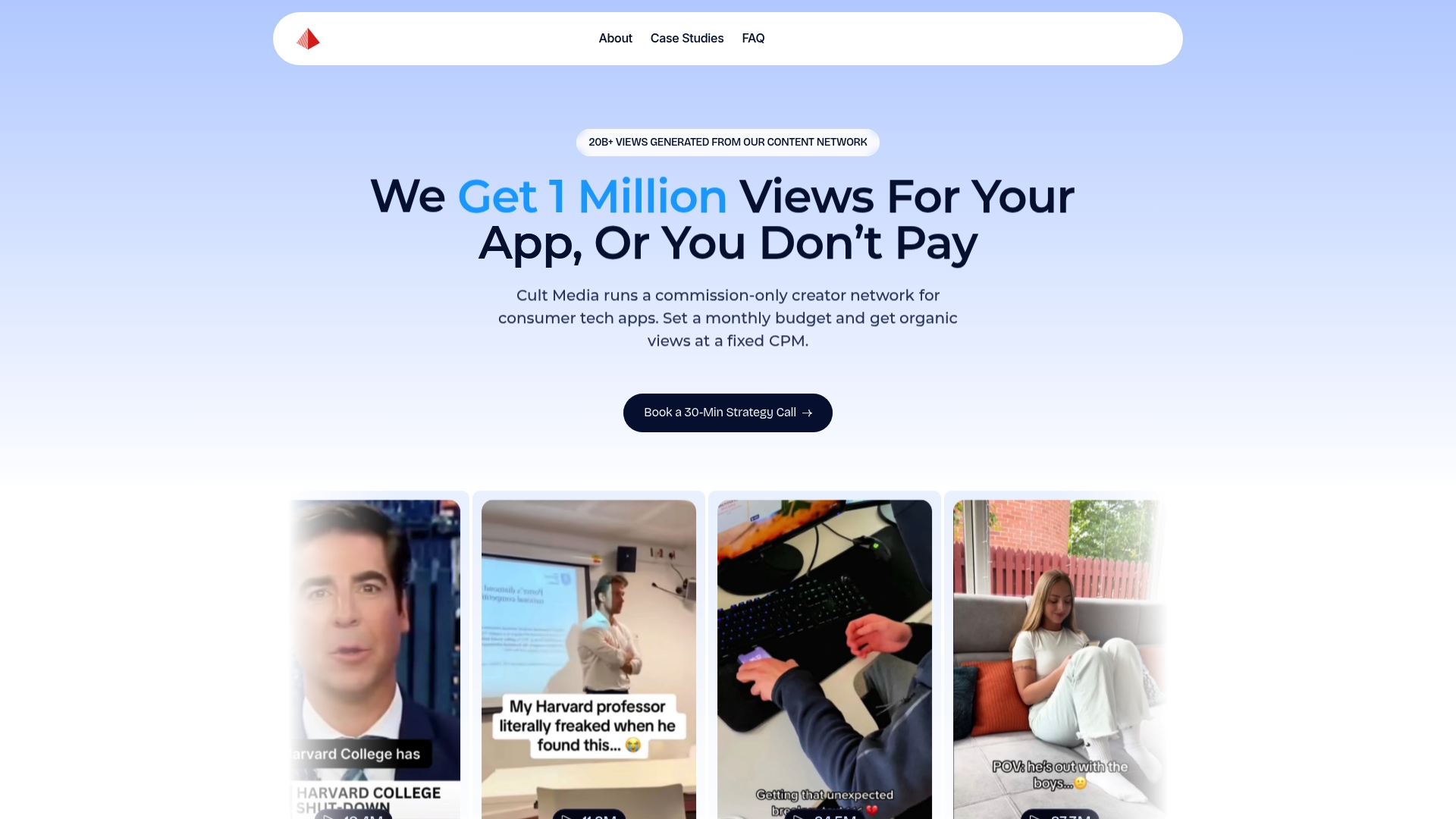
A pilot typically starts small: a defined view target, a set CPM rate, and a verification method agreed before launch, so you know exactly what you're paying for before spend goes out the door. If you're evaluating vendors for a guaranteed-view program, ask for three things in any proposal: fraud protection and third-party verification, a reporting cadence you can audit weekly, and clear licensing terms for any content used beyond organic posting. Cult Media's no-retainer approach was built around exactly that structure for app growth teams. Request a pilot campaign proposal to see what a guaranteed-view structure looks like against your current acquisition costs.
Sources
- Influencer Pricing: The Cost of Influencers in 2026 - Shopify
- TikTok Influencer Rates 2026: Complete Pricing Guide for Brands | InfluencerFee
- How to Pay Content Creators in 2025: 7 Proven Methods — Impact
- Creator Economy Earnings by Platform 2026: What Creators Actually Get Paid - Axis Intelligence
FAQ
How much do influencer models actually make?
Earnings vary widely by tier, from roughly $50 to $300 per post for nano creators to $200,000 or more for mega creators, depending on platform, niche, and engagement rate.
How much does 1,000 views on Instagram pay?
There's no fixed rate; brands typically negotiate cost-per-view directly in a quote, with benchmarks running from roughly $0.01 to $0.05 per view depending on niche and engagement quality.
How do creators get paid?
Common methods include flat fees, commission or affiliate payouts, gifting, retainers, and hybrid base-plus-bonus structures, with platform ad-revenue sharing as an additional income stream on top of brand deals.
What's the difference between commission and performance/revenue share?
Commission typically pays a set amount or percentage per tracked conversion, while revenue share gives creators an ongoing cut of revenue generated over a longer period.
Is a commission-only model risky for brands?
It shifts most of the risk to verification quality rather than to the brand's budget, since payment only follows confirmed delivery, which is why Cult Media's guaranteed-view structure ties billing directly to verified performance.