
No retainer marketing is a performance-driven model where payment is tied to verified outcomes — installs, views, leads, or revenue — rather than a fixed monthly fee regardless of results. For consumer app companies, commission-only creator campaigns tend to deliver the strongest risk alignment because every dollar spent maps to a measurable delivery. MarketerHire reports a 95% trial-to-hire conversion rate for no-commitment engagements, which reflects a straightforward dynamic: when clients can leave freely, they stay because the results justify it.
TL;DR:
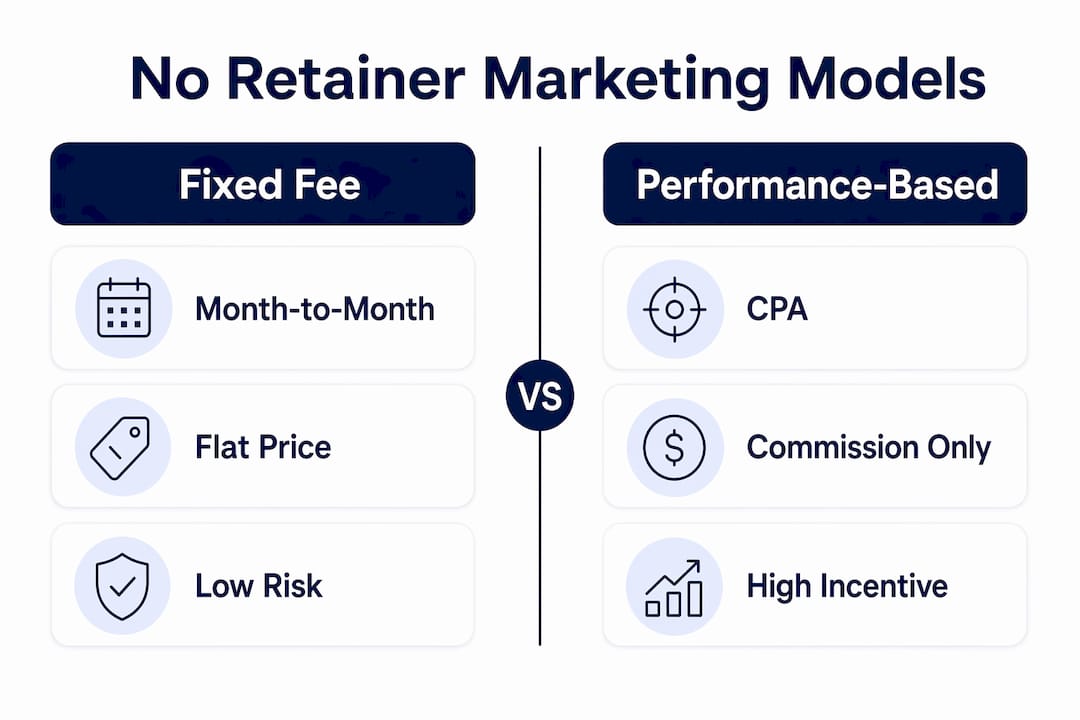
- No retainer marketing covers several models: month-to-month fixed fees, CPA, CPM with guaranteed views, revenue-share, and commission-only creator campaigns.
- Incentive alignment is the real advantage — agencies must earn each renewal, which drives faster experimentation and prioritization of high-impact channels.
- Cult Media's commission-only, guaranteed-view campaigns are a practical, operationally ready option for consumer app growth teams.
Table of Contents
- What does no retainer marketing actually look like?
- Why performance-based models can outperform retainers
- What should your contract actually say?
- How do you evaluate a provider before committing?
- Red flags and exact questions to ask on sales calls
- How Cult Media runs commission-only campaigns for consumer apps
- Key Takeaways
- When does no-retainer marketing actually make sense?
- Cult Media's commission-only pilot: what to expect
- Useful sources
What does no retainer marketing actually look like?
The phrase covers more commercial structures than most founders realize. Understanding the variants prevents you from signing something that looks flexible but functions like a retainer.
Common model types:
- Month-to-month fixed fee: A flat monthly rate with no long-term contract. Either party exits with reasonable notice, typically 30 days.
- CPA / CPL: You pay per verified install, lead, or subscription. Risk shifts to the provider.
- CPM with guaranteed views: A fixed cost per thousand verified views, often with a delivery guarantee. Cult Media operates on this structure.
- Revenue-share: The provider takes a percentage of revenue attributable to their campaigns.
- Commission-only creator campaigns: Creators produce and distribute content; the client pays only when agreed delivery thresholds are met.
Pricing under these models can be competitive with retainer pricing — the real difference is accountability, not necessarily cost savings. Month-to-month arrangements also tend to require more client involvement upfront, since there is less ongoing account management than in a traditional retainer.
Pro Tip: Watch the gap between a "no contract" headline and the fine print. Long notice windows, non-refundable setup fees, and restricted access to ad accounts are the three mechanisms agencies use to recreate retainer-style lock-in without calling it that.
| Model | Payment trigger | Risk bearer | Best for |
|---|---|---|---|
| Month-to-month fixed fee | Calendar month | Client | Ongoing SEO, content |
| CPA / CPL | Verified install or lead | Provider | Direct-response apps |
| CPM / guaranteed views | Verified view count | Provider | App awareness + installs |
| Revenue-share | Attributed revenue | Shared | High-LTV subscription apps |
| Commission-only creators | Delivered content + views | Provider | Consumer tech UGC growth |
Why performance-based models can outperform retainers
The incentive structure is the mechanism. Under a retainer, an agency's revenue is guaranteed regardless of your CAC or install volume. Under a pay-for-results model, the agency's continued engagement depends on delivering measurable outcomes — which forces faster experimentation and clearer prioritization of high-impact channels.
No-retainer structures shift the agency reward from activity to outcomes. That realignment matters most in fast-moving consumer tech categories, where a campaign that is not converting in week three needs to pivot, not wait for a quarterly review.
What the data and practitioner evidence shows:
- No-retainer models force agencies to show value quickly — the first 2–4 weeks often determine whether the engagement continues, which compresses the ramp time that retainer clients typically absorb.
- When clients can leave at any time, retention paradoxically increases because they choose to stay based on delivered value rather than contractual obligation.
- For consumer apps, creator-driven campaigns tied to verified conversion events — installs, subscriptions, view counts — scale distribution faster than slow retainer-driven programs in most growth-stage scenarios.
The agility argument is particularly strong for apps with clear conversion funnels. If your attribution is clean and your install-to-retention metrics are tracked, a commission-only or CPM model gives you a direct line between spend and outcome.
What should your contract actually say?
A true no-retainer relationship is clean: no hidden setup fees, a short and explicit notice period, and full client ownership of assets from day one. A genuine no-contract agency assigns ad accounts, tracking pixels, and creative assets to the client immediately — not at the end of the engagement.
Checklist: verify each item before signing
- Notice period: Is it 30 days or fewer? Anything beyond 60 days functions as a soft lock-in.
- Setup / onboarding fees: Are they itemized? Are they refundable if you cancel within a defined window?
- Ad account ownership: Does the contract state accounts are client-owned from day one?
- Pixel and tracking ownership: Who controls the data? Can you export it freely?
- Asset transfer timeline: If you exit, how quickly are files, accounts, and access transferred?
- SLA language: Are deliverables (views, installs, leads) defined with specific numbers and timeframes?
- Measurement methodology: What counts as a paid-for outcome? Define the attribution window and the third-party tool used.
- Dispute resolution: Is there a written process for contesting a delivery shortfall?
- Audit rights: Can you request raw data or third-party verification at any time?
"Some agencies advertise no contracts but replace retainers with significant upfront, non-refundable setup fees ranging commonly from $1,000 to $5,000+, which functionally operate as hidden retainers." — Spark Hive Agency
Pro Tip: For any guaranteed-delivery clause, insist on third-party measurement or viewership proofs. Define "qualified" explicitly: minimum view duration, attribution window, and the mobile measurement partner (MMP) used to verify installs.
How do you evaluate a provider before committing?
Measure what matters for apps: CAC, cost-per-install (CPI), qualified-user rate, LTV projection, and retention at day 7 and day 30. Vanity metrics — raw impressions, follower counts — tell you nothing about whether the model is working.
A practical test plan:
- Weeks 1–2 (onboarding): Confirm asset ownership in writing, set up third-party tracking (AppsFlyer, Adjust, or equivalent), and agree on the KPI baseline.
- Days 15–60 (active test): Run the campaign with predefined KPI gates. For CPM/guaranteed-view models, verify delivery against the contracted view count weekly.
- Day 60–90 (decision gate): Evaluate CPI, day-7 retention, and qualified-user rate against benchmarks. Scale, pivot, or exit based on data.
| Pricing model | Primary KPI | Verification method | Realistic timeline |
|---|---|---|---|
| CPA / CPL | Cost per install or lead | Server-side events + MMP | 30–60 days |
| CPM / guaranteed views | Verified view count | Third-party viewability proof | 2–4 weeks |
| Revenue-share | Attributed revenue | MMP + in-app event tracking | 60–90 days |
| Commission-only creators | Views + install lift | Creator analytics + MMP | 2–6 weeks |
The primary measurement risk is disagreement on what counts as a paid-for outcome — define the attribution window and the MMP before any payment triggers.

Pro Tip: For post-acquisition retention, pair your acquisition campaign with solid lead conversion workflows to maximize the value of every install your campaign delivers.
Red flags and exact questions to ask on sales calls
Stop the conversation if you see: hidden setup fees presented after the proposal, vague deliverable language ("we'll drive growth"), refusal to transfer accounts, notice periods longer than 60 days, or no third-party measurement offered.
Questions to ask verbatim:
- "Do you charge an onboarding or setup fee? Is it refundable if we cancel within 30 days?"
- "Who owns the ad accounts and tracking pixels from day one?"
- "What third-party tool verifies delivery, and can I access the raw data directly?"
- "Show me a sample verification report from a current client."
- "What is your notice period, and what happens to in-flight campaigns if we exit?"
A credible provider answers the asset-ownership question immediately and without hesitation. If the answer is "we'll discuss that at the end of the engagement," that is a platform-hostage setup in progress.
Watch for 30-day notice periods as the acceptable standard — they allow orderly offboarding without trapping you. Anything beyond that warrants a direct negotiation before signing.
How Cult Media runs commission-only campaigns for consumer apps
Cult Media delivers commission-only creator campaigns priced on guaranteed, verified views. Clients pay only for delivered performance — no monthly retainer, no setup fee that functions as a hidden commitment.
How the campaign structure works:
- Creator sourcing: Cult Media builds a custom creator roster matched to the app's category, audience, and conversion profile.
- Content production: UGC-led production with high-conversion formats optimized for TikTok and Instagram, where creator-driven content has scaled to +20 billion views across the network.
- Delivery guarantee: Campaigns are priced on a fixed CPM against a guaranteed view count. If the view threshold is not met, the shortfall is addressed before payment is finalized.
- Verification: Third-party viewability proofs and MMP-linked install attribution give clients an auditable record of every delivered outcome.
- Asset ownership: Ad accounts, creative assets, and tracking data remain client-owned throughout the engagement.
For re-engagement after initial acquisition, pairing Cult Media's install campaigns with re-engagement messaging automation can improve day-30 retention metrics without adding acquisition spend.
Pro Tip: To start a pilot, come prepared with your app's current CPI benchmark, your day-7 retention rate, and access to your MMP. Cult Media uses these to scope the campaign and set the guaranteed-view threshold against a realistic install-lift target.
Key Takeaways
No retainer marketing works for consumer apps when incentives are aligned, measurement is airtight, and asset ownership is secured in writing from day one.
| Point | Details |
|---|---|
| Model selection matters | Match the pricing model (CPA, CPM, commission-only) to your attribution maturity and risk tolerance. |
| Contract hygiene is non-negotiable | Verify notice period, setup fee refundability, and asset ownership before signing anything. |
| Test windows should be defined | Structure a 30–90 day pilot with predefined KPI gates and third-party verification before scaling. |
| Measurement drives payment | Define the attribution window and MMP upfront; disagreement on what counts as a result is the primary dispute risk. |
| Cult Media option | Cult Media's commission-only, guaranteed-view campaigns give consumer app teams a verified, no-retainer acquisition path. |
When does no-retainer marketing actually make sense?
The model fits best when your conversion funnel is measurable, your attribution stack is in place, and you can evaluate results within 30–90 days. Growth-stage consumer apps with clean install tracking and a defined retention benchmark are the ideal profile.
It fits less well for enterprise procurement cycles, multi-month brand buildouts, or situations where internal measurement is immature. If you cannot define what a "qualified install" means before the campaign launches, a performance-based model will create payment disputes rather than clarity. The fix is straightforward: build your measurement infrastructure first, then engage on a commission basis.
Start small. Demand third-party verification. Secure asset ownership in writing before the first creative goes live.
Cult Media's commission-only pilot: what to expect
Cult Media is the direct alternative to a retainer-based agency for consumer app growth teams that need verified installs, not activity reports. The model is simple: you pay for guaranteed views delivered by a managed creator network, with third-party verification and full asset ownership from the start. No monthly retainer, no non-refundable setup fee, no lock-in.
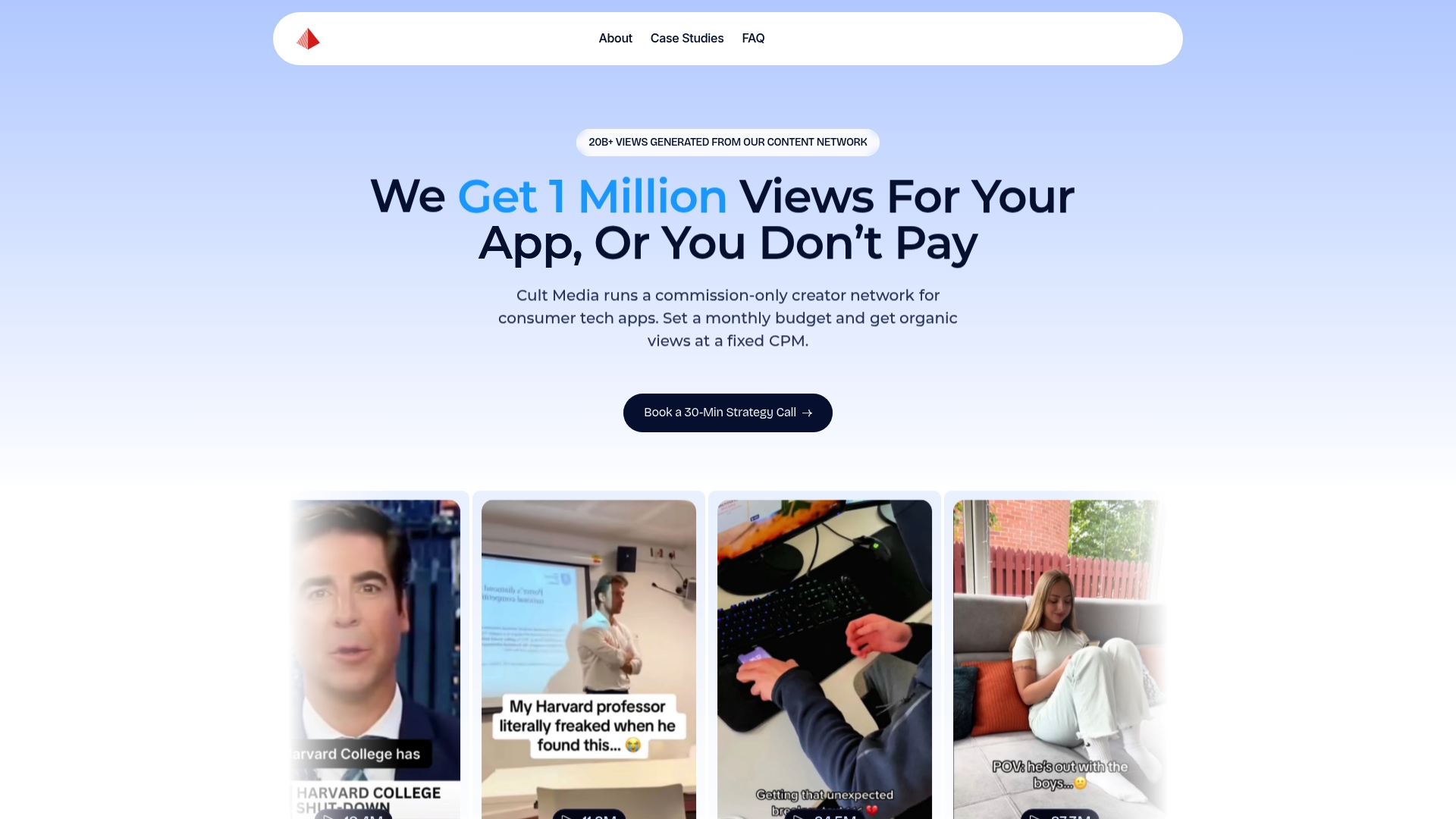
The pilot process is built for founders and growth leads who want results before scaling spend. Cult Media scopes the campaign against your current CPI and retention benchmarks, sources the right creators, produces high-conversion UGC, and delivers a verified view count against a fixed CPM. To start a pilot or request a campaign scope, visit Cult Media and submit your app details.
Useful sources
- No Commitment Marketing: How to Win Clients Without Locking Them In — covers trial-to-hire conversion data, notice period norms, and the retention paradox of no-commitment models.
- The Freedom of No Lock-In Marketing Contracts — explains asset ownership best practices and the agility advantages of performance-based engagements.
- Is a No Contract Marketing Agency Better? — documents how setup fees function as hidden retainers; use this when negotiating fee refundability.
- No Contract Marketing Agency: Why Month-to-Month Wins — addresses measurement risk and attribution window definitions; cite this when asking vendors for proof methodology.
- Digital Marketing Without Contracts: Results First — practical guide to evaluating no-contract providers and structuring a test-and-learn approach.
- Flat Fee vs. Retainer — clarifies client involvement expectations and resourcing differences between retainer and project-based models.
- Cult Media: Creator-Driven App Growth — documents the commission-only, guaranteed-view approach and creator network performance for consumer tech apps.