The most effective Snapchat influencer app marketing strategy combines performance-aligned creator partnerships with native, edutainment content and AR Lens experiences to reduce CPI and improve Day-7 retention for Gen Z audiences. Three tactics deliver the fastest results:
- Guaranteed-view CPM deals with Snap creators, where you pay per verified view rather than a flat retainer, directly aligning spend with delivery.
- Lens-enabled try-out experiences that let users interact with your app's core value proposition before hitting the App Store or Google Play link.
- Creator-led swipe-up deep links configured as deferred deep links so every store visit maps back to a tracked install and a clean onboarding funnel entry.
Before you brief a single creator, set one primary KPI: a target CPI or a minimum ROAS threshold. Then run a two-creator test. Everything else in this guide builds on that starting point.
Table of Contents
- Why Snapchat is the right platform for Gen Z app campaigns
- How to define your Snapchat influencer strategy around app goals
- How to find and evaluate Snapchat creators who move app KPIs
- Which Snapchat formats work best for app campaigns?
- How to set up tracking and attribution for Snapchat app campaigns
- What creator pricing and deal models work best for app UA?
- Legal and brand-safety rules for Snapchat influencer campaigns
- A step-by-step playbook to launch your Snapchat creator campaign
- Why guaranteed-view models outperform flat-fee retainers for app UA
- Key Takeaways
- The case for long-term creator programs over one-off activations
- Cult Media delivers guaranteed views for app teams on Snapchat
- Useful sources
- FAQ
Why Snapchat is the right platform for Gen Z app campaigns
Snapchat's daily active user base has grown consistently, with the platform reaching over 450 million DAUs globally, and its core demographic skews heavily toward 13–34-year-olds. For U.S. app marketers, that concentration matters: Gen Z users open Snapchat more than 30 times per day on average, driven by Snap Streaks and a friend-first feed that creates habitual, high-frequency engagement no other platform fully replicates.
That habit loop is structurally different from TikTok or Instagram. Snapchat's ephemeral format creates urgency. Users do not scroll passively; they respond, react, and swipe. For app marketers, that behavioral posture translates directly into higher swipe-up intent and faster install decisions when the creative is right.
Three platform strengths make Snapchat particularly effective for app user acquisition:
- AR Lenses — create interactive, try-before-you-install moments. A user who engages with a Lens tied to your app's core feature has already experienced your product's value proposition, which compresses the consideration phase.
- Snap's creator ecosystem (Public Stories, Spotlight, and the Snap Creator Network) distributes native content through trusted voices rather than interruptive ad placements. Snap's own research confirms that creator-led, edutainment-style content captures more attention and drives higher brand recall than polished brand ads.
Product momentum also creates campaign windows. Sensor Tower recorded a 55% week-over-week surge in first-time U.S. Snapchat installs following a platform redesign, demonstrating that Snap's install base is not static. Timing influencer campaigns around platform updates or seasonal spikes can amplify organic reach without additional media spend.
How to define your Snapchat influencer strategy around app goals
Vague objectives produce vague results. Before you contact a single creator, map each campaign goal to a measurable KPI and decide which audience segment you are targeting. The table below gives you that framework.
| Campaign Objective | Primary KPI | Secondary KPI | Creative Priority |
|---|---|---|---|
| Awareness | Story views, reach | Brand recall lift | Edutainment, Lens engagement |
| App installs | CPI, install volume | Swipe-up rate | Demo-first, deep link swipe-up |
| Re-engagement | Deep link opens, DAU lift | Session length | Feature reveal, urgency hook |
| Retention / LTV | Day-7 retention, in-app events | CPA for key actions | Onboarding tips, social proof |
Social Media Today's strategy guidance recommends building a distinct brand persona for Snapchat before activating creators, then using Snapchat's audience insights tool to validate that persona against real in-app behavior. That step prevents the common mistake of briefing creators whose audiences look right on paper but behave differently on Snap.
Audience segmentation checklist before creator selection:
- Define your core user profile (age band, interest cluster, device type).
- Build a Snap lookalike audience from your existing install base using Snap Ads Manager.
- Identify high-value cohorts (users who completed onboarding or hit a key in-app event) and use them as the seed for creator audience matching.
- Cross-reference creator audience demographics in Snap Creator Network before signing any deal.
One practical note: for retention-focused campaigns, the creative brief changes significantly. Awareness content can be broad and entertaining. Retention content needs to demonstrate a specific feature the user has not yet discovered, which requires creators who actually use the app and can speak to it authentically.
How to find and evaluate Snapchat creators who move app KPIs
Discovery on Snapchat requires a multi-channel approach. The Snap Creator Network is the most direct route: it gives brand managers access to vetted creators with verified audience data, making it the logical first stop for app campaigns. Beyond that, scout Public Stories and Spotlight for creators who are already producing content in your app's category, and use cross-platform signals (TikTok, Instagram Reels) to identify creators with proven swipe-up and conversion track records before bringing them onto Snap.
Follower count is the wrong primary filter. On Snapchat, story completion rate and swipe-up rate are far more predictive of install performance than raw audience size. A creator with 80,000 followers and a 70% story completion rate will outperform a creator with 500,000 followers and a 20% completion rate on every install KPI that matters.
Creator evaluation criteria (in priority order):
- Story completion rate (target: above 60%)
- Swipe-up or link-tap rate on previous sponsored content
- Screenshot rate (a proxy for save intent and high-interest engagement)
- Audience age and location match to your target install market
- Prior app or tech content (can they demo a product naturally?)
- Content cadence (active creators posting 4+ times per week retain audience attention)
Creator brief: required fields
- Campaign objective and single primary KPI (e.g., target CPI of $X)
- App store deep link and deferred deep link URL
- Required disclosure language (FTC-compliant "#ad" or "Paid partnership")
- Creative freedom parameters: what the creator must include vs. what they control
- Deliverables: number of Snaps, Stories, or Spotlight posts; posting window
- Measurement requirements: creator must share Story analytics screenshots within 48 hours of posting
- Content approval process and turnaround time
Give creators genuine latitude on tone and format. HubSpot's Snapchat marketing research confirms that raw, behind-the-scenes content consistently outperforms polished brand assets on the platform. A brief that over-scripts the creator produces content that feels like an ad, which kills completion rates. The creator audience quality audit checklist from Cult Media provides a structured framework for vetting creators before contracts are signed.
Which Snapchat formats work best for app campaigns?
Each format serves a distinct role in the app install funnel. Matching format to objective prevents wasted spend and keeps creative fatigue from setting in too early.
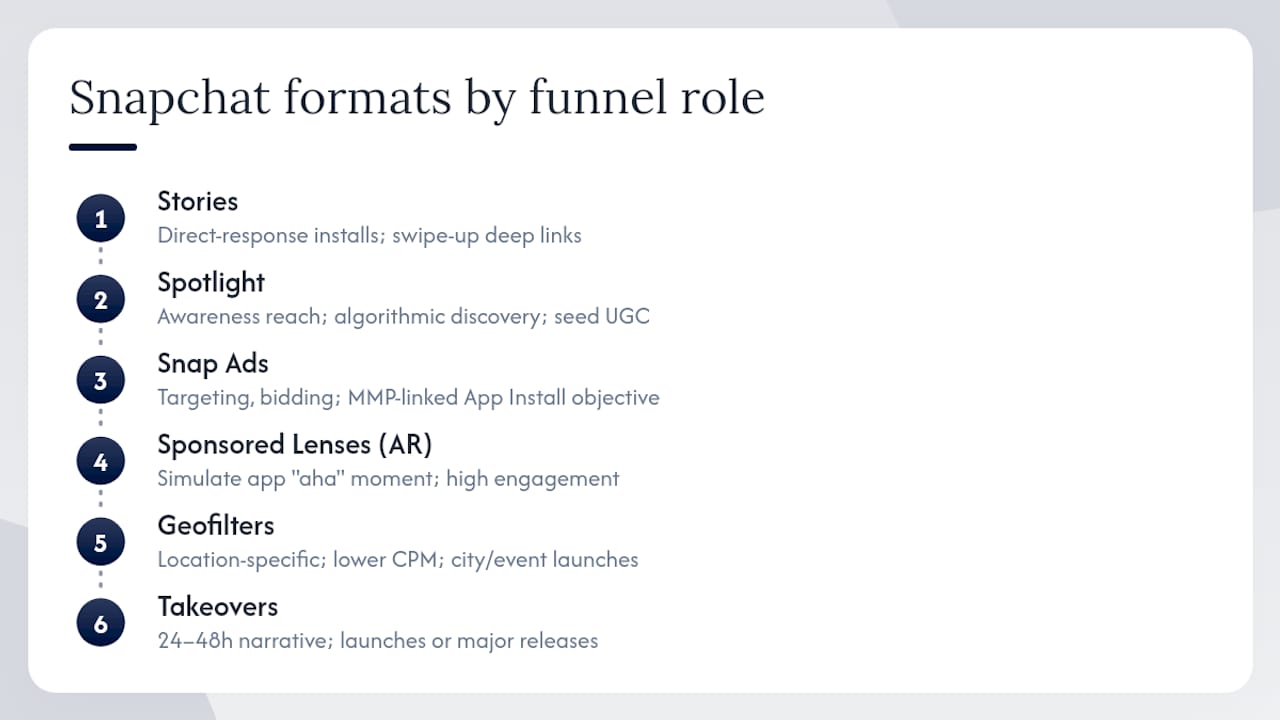
Stories are the workhorse for direct-response app campaigns. The ephemeral format creates urgency, and swipe-up links map cleanly to deferred deep links for tracked installs. Sprout Social's format guidance recommends Stories for time-sensitive offers and install pushes where you need a direct conversion path.
Spotlight functions more like TikTok's For You Page: algorithmic, discovery-driven, and rewarded by Snap for high-engagement content. Use Spotlight for awareness and top-of-funnel reach, particularly when you want to seed UGC broadly without a hard install CTA. Measurement is less precise here, so pair Spotlight posts with a branded hashtag or Lens to track downstream engagement.
Snap Ads (non-skippable 6-second or full-screen video) run through Snap Ads Manager and give you direct control over targeting, bidding, and attribution. For app campaigns, the App Install objective within Ads Manager connects directly to your MMP for clean CPI tracking. Use these to amplify creator content that has already proven organic engagement.
Sponsored Lenses and AR Filters are Snapchat's most differentiated format. An AR Lens that lets a user simulate your app's core feature, whether that is a fitness tracker overlay, a language learning prompt, or a financial calculator, converts curiosity into intent before the install decision. Udonis' analysis of Snap's ad products identifies AR as the platform's primary competitive differentiator, and the interactive nature of Lenses produces engagement metrics that static or video formats cannot match.
Geofilters work for location-specific campaigns: app launches in a target city, event activations, or geo-targeted re-engagement pushes. The CPM is typically lower than Lens campaigns, and they layer well on top of a broader creator activation.
Takeovers (creator account takeovers or brand account Story series) build sustained narrative over 24–48 hours. They work best for app launches or major feature releases where you need to hold audience attention across multiple content pieces.
Pro Tip: Build your Lens around the first "aha moment" in your app's onboarding flow. If a user can experience that moment through a Lens before installing, your swipe-up conversion rate from Lens engagement will be materially higher than from a standard video ad.
How to set up tracking and attribution for Snapchat app campaigns
Clean measurement is the difference between a campaign you can scale and one you run once and abandon. The tracking stack for Snapchat app campaigns has four required components.
- Snap Pixel — installed on your web properties (landing pages, app store redirect pages) to capture pre-install behavior and build retargeting audiences.
Measurement principle: Snap's in-platform reporting and your MMP will rarely show identical install counts. Snap uses view-through and click-through attribution windows that overlap with other channels. Set your MMP as the source of truth for CPI calculations, and use Snap's data for engagement metrics (story completion, swipe-up rate, Lens plays). Reconcile the two weekly, not daily, to avoid optimization decisions based on attribution lag.
Metrics by funnel stage:
One measurement caveat for Spotlight and organic creator posts: Snap does not pass organic Story view data to MMPs. For creator content that is not amplified through Ads Manager, you rely on creator-submitted analytics screenshots and MMP install spikes correlated to posting times. The view vs. impression distinction matters here: a Snap "view" requires the content to play, while an "impression" may count a thumbnail. Always specify which metric you are buying or measuring in creator contracts.
What creator pricing and deal models work best for app UA?
Four deal structures dominate Snapchat creator campaigns for apps, and each fits a different stage of your UA program.
| Deal Model | Best For | Risk Profile | Alignment with App KPIs |
|---|---|---|---|
| Fixed fee | Brand awareness, content testing | Brand bears all risk | Low |
| Cost-per-install (CPI) | Performance-only campaigns | Creator bears risk; hard to recruit | High |
| Guaranteed-view CPM | Install velocity, scalable UA | Shared; views verified | High |
| Revenue share | Long-term LTV optimization | Complex to track | Very high (long-term) |
Fixed-fee deals are the simplest to negotiate but the hardest to scale. You pay regardless of performance, which makes them appropriate for initial creative testing with one or two creators but unsustainable as a primary UA channel.
CPI deals align incentives perfectly on paper, but most quality creators refuse them because their income depends on factors outside their control (your app store page, your onboarding flow, your pricing). Expect limited creator supply at this model.
Guaranteed-view CPM deals are the most practical model for app UA at scale. You agree on a CPM rate and a minimum view guarantee. The creator delivers the views; you pay per verified view delivered. This model gives you predictable media costs, lets you calculate a projected CPI before the campaign launches, and gives creators a fair, achievable commitment. For benchmarking, CPM rates on Snapchat creator campaigns vary by creator tier and category, with micro-creators (50K–250K followers) typically commanding lower CPMs than Snap Stars, although engagement-adjusted CPMs often favor the micro tier.
Revenue share works for mature apps with strong LTV data and long-term creator relationships. It requires robust attribution and a creator who trusts your tracking, so it is rarely the right starting point.
For app teams new to Snapchat, the recommended sequence is: run a fixed-fee two-creator test to validate creative and swipe-up rates, then move to guaranteed-view CPM deals once you have a CPI benchmark to work against.
Legal and brand-safety rules for Snapchat influencer campaigns
FTC compliance is non-negotiable, and Snapchat's ephemeral format does not exempt creators from disclosure requirements. The FTC's endorsement guidelines require that any material connection between a brand and a creator be clearly disclosed in a way that consumers cannot miss. On Snapchat, that means:
- In Stories: "#ad" or "Paid partnership with [Brand]" must appear as on-screen text in the first frame, not buried at the end of a caption or hidden in a swipe-up link.
- In Spotlight posts: the same disclosure applies; Snap's platform labels help but do not replace the creator's own disclosure.
- In Lens activations: if a creator is paid to promote a Sponsored Lens, the promotional relationship must be disclosed in any accompanying Story or post.
Snap-specific compliance considerations for app campaigns:
- Age-gating: if your app is rated 17+ or contains mature content, your creator targeting and Snap Ads Manager audience settings must exclude users under 18. Snap's ad policies enforce this for paid placements; for organic creator content, the brand is responsible for briefing creators on audience restrictions.
- Lens policy: Sponsored Lenses must comply with Snap's AR content policies, which prohibit certain categories of content (alcohol, gambling, adult content) from using interactive AR formats targeting younger audiences.
- Data and privacy: if your app collects user data, ensure your App Store listing and any creator-linked landing pages include current privacy disclosures consistent with CCPA requirements for U.S. users.
Compliance checklist before launch:
- Creator contract includes FTC disclosure language as a deliverable requirement.
- All deep links point to an age-appropriate App Store listing.
- Snap Ads Manager audience settings exclude underage users if app content requires it.
- Creative QA review confirms disclosure appears in the first frame of every Story.
- Brand safety keywords and category exclusions are set in Ads Manager for any paid amplification.
A step-by-step playbook to launch your Snapchat creator campaign
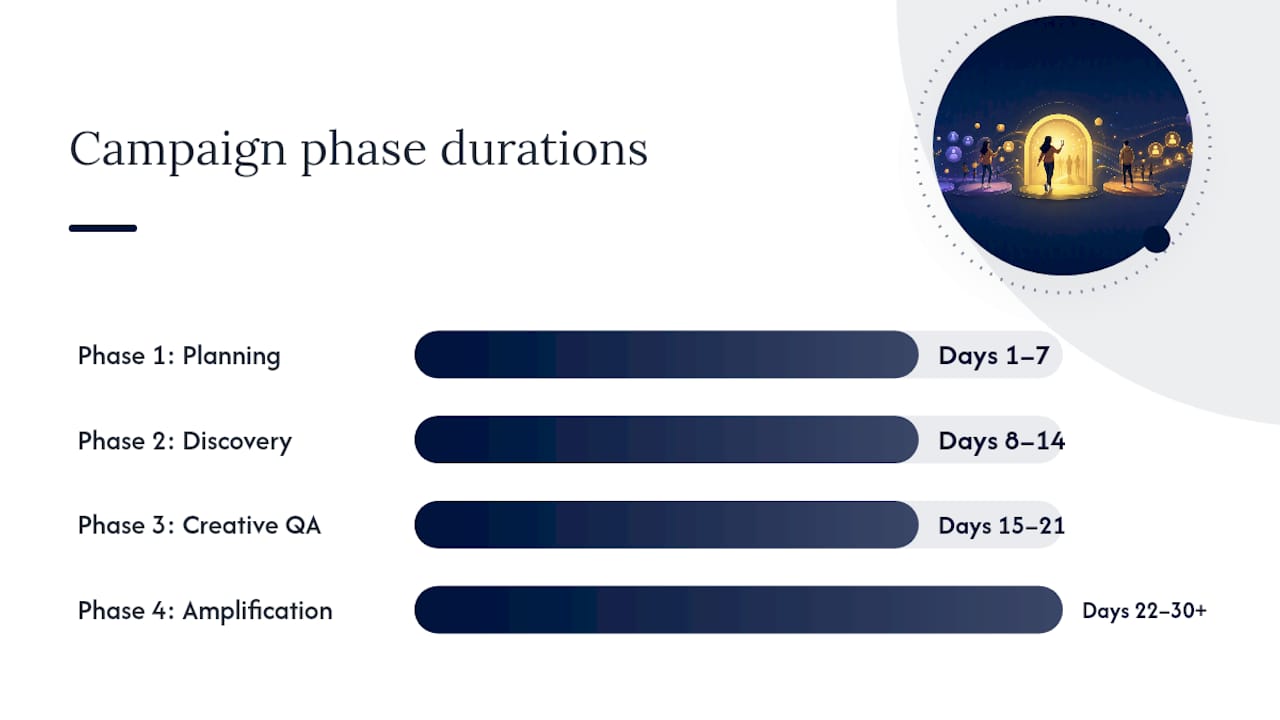
Phase 1: Planning (Days 1–7)
- Define campaign objective and single primary KPI (CPI target or ROAS floor).
- Build audience segments in Snap Ads Manager using your existing install data.
- Set campaign budget and deal model (recommended: guaranteed-view CPM for first scaled test).
- Draft creator brief with deliverables, deep link requirements, and disclosure language.
Phase 2: Discovery and contracting (Days 8–14)
- Search Snap Creator Network and Spotlight for creators in your app's category.
- Evaluate candidates against the engagement criteria (story completion rate, swipe-up history).
- Audit creator audience quality using a structured checklist before signing.
- Negotiate deliverables, view guarantees, posting windows, and analytics reporting requirements.
- Execute contracts with IP assignment clauses for any UGC you plan to repurpose.
Phase 3: Creative QA and launch (Days 15–21)
- Review creator content drafts: confirm deep link placement, disclosure in first frame, and demo-first creative structure.
- Configure deferred deep links and test the full install flow end-to-end.
- Verify Snap Pixel and MMP event tracking are firing correctly before launch.
- Approve and launch. Set up a daily reporting dashboard pulling from both Snap Ads Manager and your MMP.
Phase 4: Amplification and optimization (Days 22–30+)
- Identify the top-performing creator post by swipe-up rate within the first 72 hours.
- Amplify that post as a Snap Ad using the App Install objective to extend reach beyond the creator's organic audience.
- Run A/B tests on the deep link landing page (App Store screenshots, description copy) to improve store conversion rate.
- At Day 14, review Day-7 retention for the install cohort. If retention is below benchmark, adjust the creator brief to emphasize onboarding utility rather than pure install hooks.
- At Day 30, decide: pause underperforming creators, extend contracts with top performers, and set the CPM benchmark for the next campaign cycle.
Ongoing UGC strategy: repurpose creator content as paid Snap Ads creative, with creator permission per your contract. Native UGC consistently outperforms brand-produced assets in Snap's ad auction, and UGC-led production frameworks for app installs show that repurposed creator content can cut CPI further when deployed as amplified paid placements.
Why guaranteed-view models outperform flat-fee retainers for app UA
The core problem with flat-fee creator deals is misaligned incentives. A creator paid $3,000 regardless of performance has no structural reason to optimize for your CPI. A creator in a guaranteed-view CPM model only gets paid when verified views are delivered, which means their content quality and posting strategy directly affect their own revenue.
The Ulys case study on Snapchat illustrates what performance alignment produces in practice. Ulys partnered with a Snap Star creator and achieved a significantly higher swipe-up rate and a substantially lower cost per purchase compared to non-creator ad placements. Those results did not come from a bigger budget; they came from a creator who had genuine audience trust and a content format that felt native to the platform.
The mechanism behind the result: when a creator's compensation is tied to verified view delivery, they self-select for content quality. Low-quality content gets skipped, which reduces their verified view count and their payout. The incentive structure filters for performance before the brand has to intervene.
Guaranteed-view campaigns require a verification methodology to be credible. The process works as follows:
- Snap Ads Manager provides impression and view timestamps for any amplified placements.
- For organic creator Stories, creators submit analytics screenshots (views, completion rate, swipe-ups) within 48 hours of posting.
- An MMP matches install events to the creator's deep link source, reconciling view counts to actual installs and billable units.
- The brand pays the agreed CPM only for views that clear the verification threshold.
Why this model scales better than alternatives:
- Predictable media costs: you know your maximum spend before the campaign launches.
- Faster creative iteration: underperforming creative is identified within 72 hours, not at the end of a 30-day retainer cycle.
- Creator accountability: view guarantees create a shared performance standard that improves brief compliance and content quality over time.
- Cross-platform applicability: the same guaranteed-view framework that works on Snapchat applies to TikTok and Instagram app marketing campaigns, making it easier to build a unified UA model across platforms.
Key Takeaways
Performance-aligned creator partnerships built on guaranteed-view CPM deals, native edutainment content, and AR Lens activations consistently deliver lower CPI and stronger Day-7 retention for Gen Z app campaigns on Snapchat.
| Point | Details |
|---|---|
| Set one KPI first | Define a target CPI or ROAS floor before briefing any creator to keep optimization decisions grounded. |
| Engagement beats follower count | Prioritize story completion rate (above 60%) and swipe-up history over raw audience size when selecting creators. |
| Guaranteed-view CPM aligns incentives | Paying per verified view ties creator compensation to delivery, producing the 42% reduction in cost per purchase seen in the Ulys case study. |
| Four-step tracking stack | Snap Pixel, Snap Ads Manager, deferred deep links, and MMP integration are all required for clean CPI attribution. |
| Cult Media's model | Cult Media's commission-only, guaranteed-view creator network applies this framework end-to-end for consumer tech apps, with performance-based pricing tied to verified organic views. |
The case for long-term creator programs over one-off activations
One-off creator activations produce install spikes. Long-term creator programs produce retention cohorts. The distinction matters more than most app growth teams acknowledge when they are planning quarterly budgets.
A creator who posts about your app once is a media placement. A creator who posts about your app monthly, integrates it into their content routine, and references it across multiple Stories becomes a trust signal for their audience. Their followers do not just install; they install with a pre-formed expectation of the product, which compresses onboarding friction and improves Day-30 retention.
The signals that tell you a test is ready to scale into a program are specific: consistent CTR-to-install conversion across two or more posting cycles, Day-7 retention above your app's category benchmark for the install cohort from that creator, and a swipe-up rate that holds steady rather than declining with each post. Declining swipe-up rates on repeated posts from the same creator indicate creative fatigue, not audience saturation. The fix is a new content angle, not a new creator.
Multi-month relationships also reduce brief overhead. A creator who has run three campaigns for your app understands your onboarding flow, your key features, and your tone. That institutional knowledge produces better content faster, which lowers your effective cost per creative asset over time.
When to move from test to program: after two campaign cycles with consistent CPI at or below target and Day-7 retention above benchmark, extend the creator to a quarterly contract with a content calendar. Build in quarterly creative refreshes to prevent fatigue, and use Snap Ads Manager amplification to extend the reach of their best-performing posts without requiring new organic content every week.
Cult Media delivers guaranteed views for app teams on Snapchat
App teams that have burned through flat-fee creator budgets without a clear CPI outcome know the problem: you pay upfront, the content goes live, and the install numbers may or may not follow. Cult Media's commission-only creator network is built specifically to eliminate that risk for consumer tech apps.
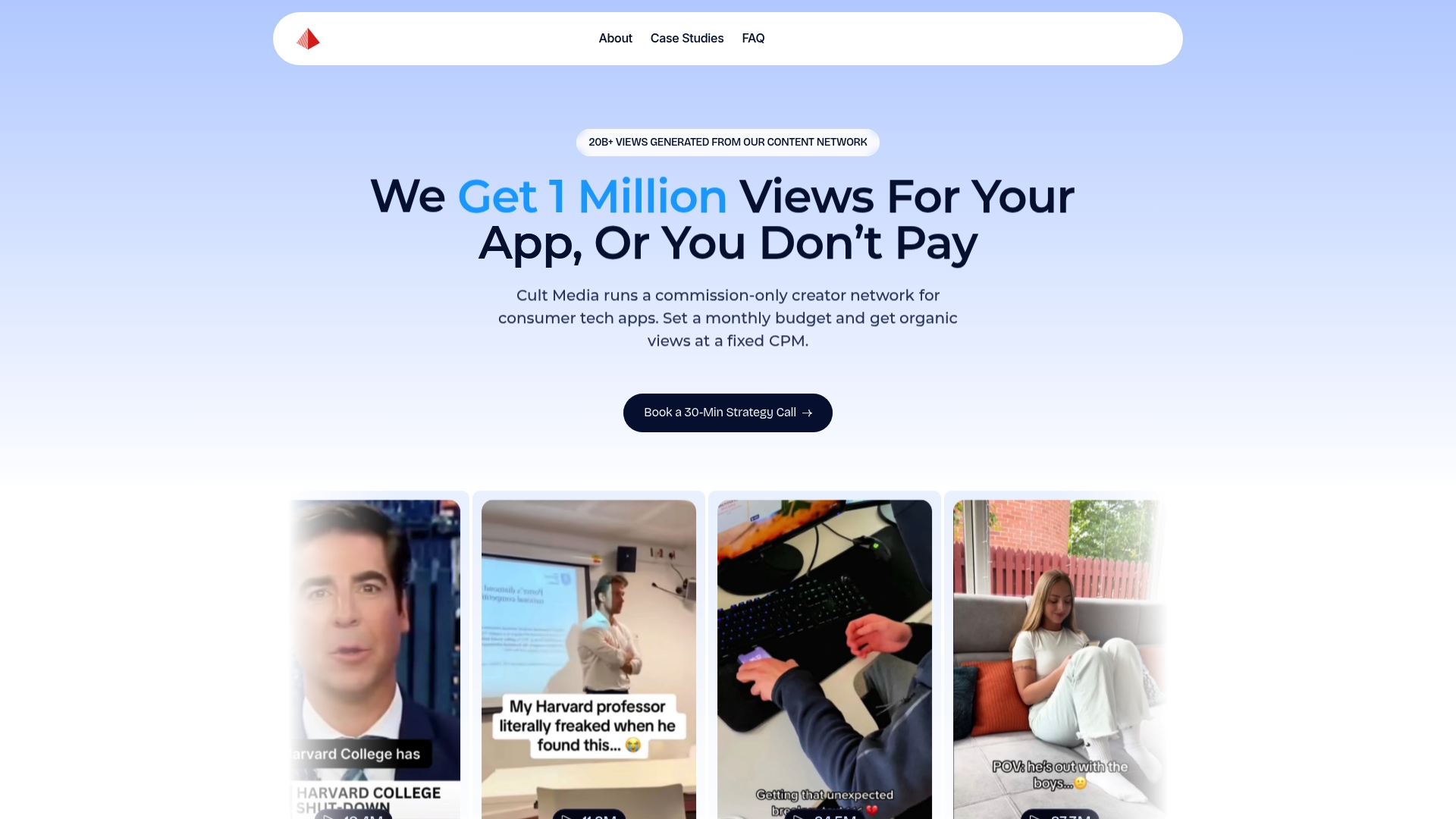
Cult Media guarantees a minimum view count for every campaign, charges on a fixed CPM tied to verified organic views, and manages the full creator workflow: discovery, briefing, content QA, deep link setup, and performance reporting. App teams pay only for views that are delivered and verified, with no retainer and no spend committed to unproven placements. The creator network spans Snapchat and other high-intent platforms, with UGC creative formats proven to convert views into installs at scale.
If your app needs a structured, performance-first path to Snapchat installs, get a campaign review from Cult Media to see what a guaranteed-view program looks like for your specific CPI target and audience.
Useful sources
- The Modern Brand Guide: Creating Scroll Stopping Content on Snapchat | Snapchat for Business
- Ulys Success Story | Snapchat For Business
- How to Use Snapchat for Business in 2026 | Sprout Social
- Snapchat app daily active users (DAU) — Statista
- Snapchat Statistics (2026): Users, Revenue, Downloads
- How to Use Snapchat for Business | HubSpot
- 4 tips to build a Snapchat marketing strategy | Social Media Today
- First-Time U.S. Snapchat Installs Increase 55% Following the App's Redesign | Sensor Tower
FAQ
How do you get influencers to promote your app on Snapchat?
Start with the Snap Creator Network to find vetted creators whose audiences match your app's core user profile, then offer a guaranteed-view CPM deal with a clear brief, a deferred deep link, and defined analytics reporting requirements. Giving creators genuine creative freedom within those parameters produces content that performs; over-scripted briefs produce content that gets skipped.
Why are influencers effective for Snapchat app marketing?
Creators on Snapchat reach Gen Z audiences through a friend-first feed where native content earns far higher completion and swipe-up rates than standard ad placements. The Ulys case study recorded a 58% higher swipe-up rate and a 42% reduction in cost per purchase when a Snap Star creator was central to the campaign versus non-creator ads.
How much does a Snapchat creator campaign typically cost?
Pricing varies by creator tier and deal model. Micro-creators (50K–250K followers) command lower CPMs than Snap Stars, and guaranteed-view CPM deals give app teams a predictable cost structure before the campaign launches. Fixed-fee deals for initial creative tests are common, with guaranteed-view CPM contracts used once a CPI benchmark is established.
How does Cult Media's guaranteed-view model work for Snapchat?
Cult Media charges a fixed CPM only for verified organic views delivered by its creator network, with no upfront retainer. Creators submit analytics screenshots within 48 hours of posting, and an MMP reconciles view counts to installs, so app teams pay only for confirmed delivery against their CPI target.
What metrics should you track for a Snapchat influencer app campaign?
Track story completion rate and swipe-up rate at the top of the funnel, installs and CPI at the conversion stage, and Day-7 retention for the install cohort as the primary retention signal. Use your MMP as the source of truth for CPI, and use Snap Ads Manager data for engagement metrics.