Creators do not convert free users to paid on their own. They decide who enters your free tier, what those users expect, and how cheaply you acquire them. Your product, onboarding and upgrade prompts decide how many of those users start paying. Teams that treat these as one system get better free-to-paid rates and a lower cost per paying customer. This guide covers the benchmarks, the creator-side levers, and a batching workflow for testing them.
TL;DR
- Free-to-paid conversion is a cohort metric: new accounts that start paying within a set window (often 6 months) divided by new accounts created in that window.
- A 3% to 5% self-serve freemium rate is commonly called good. Rates vary widely by product and motion, so benchmark against your own cohorts first.
- Creators influence conversion indirectly, through audience fit and expectation setting. Content that shows the paid feature in the demo attracts users more likely to upgrade.
- Batching creator content into hook, persona and format variants gives you a steady supply of tests, so you can scale winners before creative fatigue sets in.
- Pricing the acquisition side per verified view keeps CAC predictable while you work on the conversion side.
Table of Contents
- What freemium conversion means and how to calculate it
- What counts as a good free-to-paid rate
- Where creators fit in the freemium funnel
- Product-side changes that raise conversion
- How to measure creator-driven freemium conversion
- Creator content batching for conversion tests
- Fighting creative fatigue without losing the signal
- Perspective: why we price acquisition per verified view
- How Cult Media supports freemium growth
- FAQ
- Sources
What freemium conversion means and how to calculate it
Freemium conversion is the share of new free accounts that begin paying. One widely cited benchmark analysis defines it as new accounts that start paying within their first 6 months, divided by all new accounts created in the measurement window, times 100%. It also recommends measuring by cohort rather than aggregating signups, because blended numbers hide what is happening to recent users.
A simple example shows why. Say 10,000 people create a free account in March. By the end of August, 300 have upgraded. Your March cohort converts at 3%. If you instead divided all August upgrades by all August signups, you would mix people who signed up in February, March and August, and the number would mean nothing about any single group.
Two habits keep the metric honest:
- Fix the window. Pick 30, 90 or 180 days and use it for every cohort and every channel.
- Segment by source. Track conversion for each acquisition channel and each creator campaign separately. This is where creators enter the picture.
What counts as a good free-to-paid rate
The answer depends on the product and the sales motion. In the 2023 Poyar and Rachitsky analysis, a 2.5% rate sat slightly below the 3% to 5% range considered good for self-serve freemium. It was also common: 20% of freemium products fell below 2.5%, and roughly a third landed between 2.5% and 5%. The same analysis benchmarks sales-assisted freemium at 5% to 7% for good and 10% to 15% for great. Time-limited free trials are benchmarked at 8% to 12% for good and 15% to 25% for great.

More recent data points the same way, with a wide spread. ChartMogul's 2026 conversion report puts the median free-to-paid rate across all products at 8%, with a tenfold gap between the top and bottom 20% of self-serve products. For freemium specifically it treats 3% to 5% as good and 8% to 12% as great. Products with ungated experiences, where no sign-up is required, see good rates of 7% to 9%.
The distribution is polarized. Conversion Radar's summary of the January 2026 ChartMogul and ProductLed survey reports that 25% of freemium products converted below 2.5%, 29% between 2.5% and 7.5%, and another 25% between 10% and 15%. The same page cites a First Page Sage dataset of more than 80 agency clients with a 3.7% average freemium-to-paid rate across industries, ranging from 6.1% in LegalTech to 2.6% in EdTech.
Two cautions when you read these numbers:
- Do not confuse funnel stages. Visitor-to-signup is a different metric from free-to-paid. Conversion Radar's composite shows freemium visitor-to-signup at about 2.5% at the 25th percentile, 5% at the median and 9% at the 75th.
- Benchmarks describe other companies. A consumer app with a daily-use loop and a B2B tool with a procurement process should not hold themselves to the same figure. Use benchmarks to spot whether you are far off, then rely on your own cohorts.
So is 2.5% good? It is below the usual target, but not unusual. A 10% rate is excellent for self-serve freemium by these benchmarks, and it usually reflects a strong activation experience or a very qualified audience.
Where creators fit in the freemium funnel
A freemium funnel has four stages: reach, signup, activation and upgrade. Creator content works hardest on the first two. It also shapes the last two, because the promise made in a video sets the expectation a user brings into the product.
| Funnel stage | Main driver | What creators can influence |
|---|---|---|
| Reach | Distribution and content quality | Native format, hook, audience match |
| Signup | Clarity of the offer | A specific reason to install or register |
| Activation | Onboarding and first-session value | The use case shown in the video |
| Upgrade | Paywall, limits, pricing, prompts | Which paid features viewers saw and wanted |
Creators cannot fix a weak paywall. They can, however, change who arrives at it. Two campaigns can deliver the same number of free signups and produce very different payer counts, because one attracted curious scrollers and the other attracted people with the exact problem your paid tier solves.
Audience fit beats raw volume
A free user who arrives expecting to use a premium feature either upgrades or churns. A free user who arrives expecting a limited free tool and values it may stay free forever. Neither is wrong, but your content should be built around the user you want to convert. If your paid tier is the real product and the free tier is the trial, the creator demo should show the paid outcome and mention the free entry point, not the other way around.
Show the upgrade trigger in the content
Feature gates and usage limits are the standard upgrade levers. An academic analysis of freemium scaling in SaaS notes that the free tier should deliver enough value to generate user volume and paying conversions, while the premium tier offers enhanced capabilities, greater capacity, or both. Its CloudMetrics case study found that conversion rose from 3.8% under a feature-only model to 7.4% under a fully optimized product-led approach, with the hybrid of feature gating, usage limits and personalized triggers producing the highest marginal improvement.
That is a single case study, so treat it as a direction rather than a promise. The practical takeaway for creator content: when a creator demonstrates the exact moment a user hits a limit and what the paid tier unlocks, viewers arrive already understanding the upgrade logic.
Product-side changes that raise conversion
Creator spend is wasted if the product leaks. Before scaling any campaign, check these areas in order.
- Activation. Define the single action that predicts retention, then measure how many new users reach it in the first session. Fix this before touching the paywall.
- Gate placement. Put limits where users already feel value, not at signup. A limit hit after a win feels like a fair trade. A limit hit before any win feels like a wall.
- Contextual prompts. Show upgrade prompts at the moment of need, such as a feature limit or a capacity ceiling, rather than on a fixed timer.
- Onboarding and team adoption. For products used by groups, conversion often follows when a second or third person joins. A 12-week growth sprint framework for founders covers aligning product, marketing and sales around onboarding and upgrade paths, which is useful when you plan these changes as a time-boxed program.
- Lifecycle messaging. Use email and in-app messages tied to behavior, not just days since signup.
Run these as experiments with cohort-level results. A change that lifts the 90-day conversion of one channel but not others tells you something about audience quality, which feeds straight back into creator briefs.
How to measure creator-driven freemium conversion
The goal is a cost per paying user, not a cost per install. Three layers make that visible.
- Acquisition cost: what you paid for views, installs or signups from a campaign.
- Cohort conversion: the share of that campaign's signups who upgrade within your fixed window.
- Payer cost: acquisition cost divided by the number of payers in that cohort.
Here is an illustration with made-up numbers, not a client result. A campaign costs $5,000 and produces 2,000 free signups. At a 2.5% cohort conversion that is 50 payers, or $100 per payer. A second campaign costs the same, produces fewer signups at 1,200, but converts at 6%. That is 72 payers, or about $69 per payer. The cheaper cost per signup would have picked the wrong winner.
This is why we tag every creator and every hook as its own source from day one. For an app-install-focused view of pricing, see our comparison of CPM and CPI models for app founders.
Creator content batching for conversion tests
Testing conversion messages needs volume. One hero video cannot tell you whether the winning angle is a feature demo, a pain-point story or a before-and-after. Batching solves that by producing many variants from one brief in a single production cycle.
What a batch looks like
A workable batch starts from one product brief and turns it into variants across three dimensions:
- Hooks: the first 3 seconds, which decide whether anyone sees the rest.
- Personas: the type of user speaking or being addressed.
- Formats: talking head, screen recording, voiceover demo, reaction.
A UGC automation pipeline guide describes this approach: build variants, test them, measure 3-second hook rates, then scale the winning hooks. It splits the process into five stages: brief intake, script and hook generation, video generation, assembly, and distribution and feedback. You can run those stages with human creators rather than synthetic video, and the structure still holds. If you want to systematize the scripting and publishing stages with software, content marketing automation tools cover the planning and distribution side of that pipeline.
Why batching works operationally
Postory's Vadym Petryshyn argues that batching is mainly a way to preserve cognitive energy, because skipping the context-switching between creative phases is what produces the speed gain. For a growth team, that means writing all the hooks in one sitting, briefing all creators in one round and reviewing all cuts together. You get more variants with less overhead and fewer inconsistent briefs.
A freemium-specific batch
For a freemium app, structure the batch around the conversion path rather than around generic engagement:
- Three upgrade-trigger hooks. Each opens on a different limit users hit: capacity, a locked feature, or a speed cap.
- Two persona angles. For example, a beginner and a power user of the same app.
- Two formats. A native screen-record demo and a talking-head story.
That is twelve combinations from one brief. Launch them at small spend, compare hook rates early, and then compare cohort conversion later. Hook rate tells you which videos earn attention. Cohort conversion tells you which attention turns into revenue. They are different questions, and the second takes weeks to answer.
Our guide to TikTok hook examples that stop the scroll lists patterns to seed the batch, and our TikTok creative testing framework explains how we budget and time the early read. For hook writing at the script level, this set of YouTube Shorts hook templates is a handy source of structures to adapt.
Fighting creative fatigue without losing the signal
When the same few ads run for weeks, frequency rises, click-through falls and CAC climbs. Batching helps because replacements are already in the pipeline. Keep these rules in place:
- Change one variable at a time when you refresh a winner, so you know which change moved the metric.
- Keep the offer constant across variants unless the offer is the test.
- Retire by data, not by feel. Set a hook-rate or cost threshold in advance.
- Feed conversion data back into briefs. If creators who showed the paid feature produced more payers, make that the default.
We cover the wider approach to scaling winners in high-converting UGC tactics for app growth, and the seeding side in our write-up on a creator seeding strategy that delivered 42,500 signups at $0.28.
Perspective: why we price acquisition per verified view
We work with consumer tech apps, and the pattern we see is that teams over-focus on the paywall while the audience feeding it is poorly defined. Freemium is a marketing acquisition problem as much as a product problem. If the top of the funnel is expensive and unpredictable, you cannot afford to experiment on the bottom.

That is the reason our creator network is commission-only and priced on a fixed CPM tied to verified organic views. You pay for views that were delivered and verified, which makes the acquisition side a known quantity. Your team then spends its attention on the variables that decide payer cost: which hooks, which personas, which upgrade triggers. We manage the creators, the content strategy and the multi-platform distribution, and we use performance data to decide what gets made next.
We also push clients to judge campaigns by cohort conversion, not by installs. A video that earns fewer signups but better payers is the better video. Build your briefs around that, and batching becomes a way to learn faster instead of a way to produce more.
— Jax
How Cult Media supports freemium growth
If you run a consumer tech app with a free tier, our commission-only creator network gives you managed creator partnerships, custom UGC strategies and guaranteed views, with pricing tied to verified organic views. We handle creator management and distribution across platforms so your team can focus on activation and upgrade experiments.
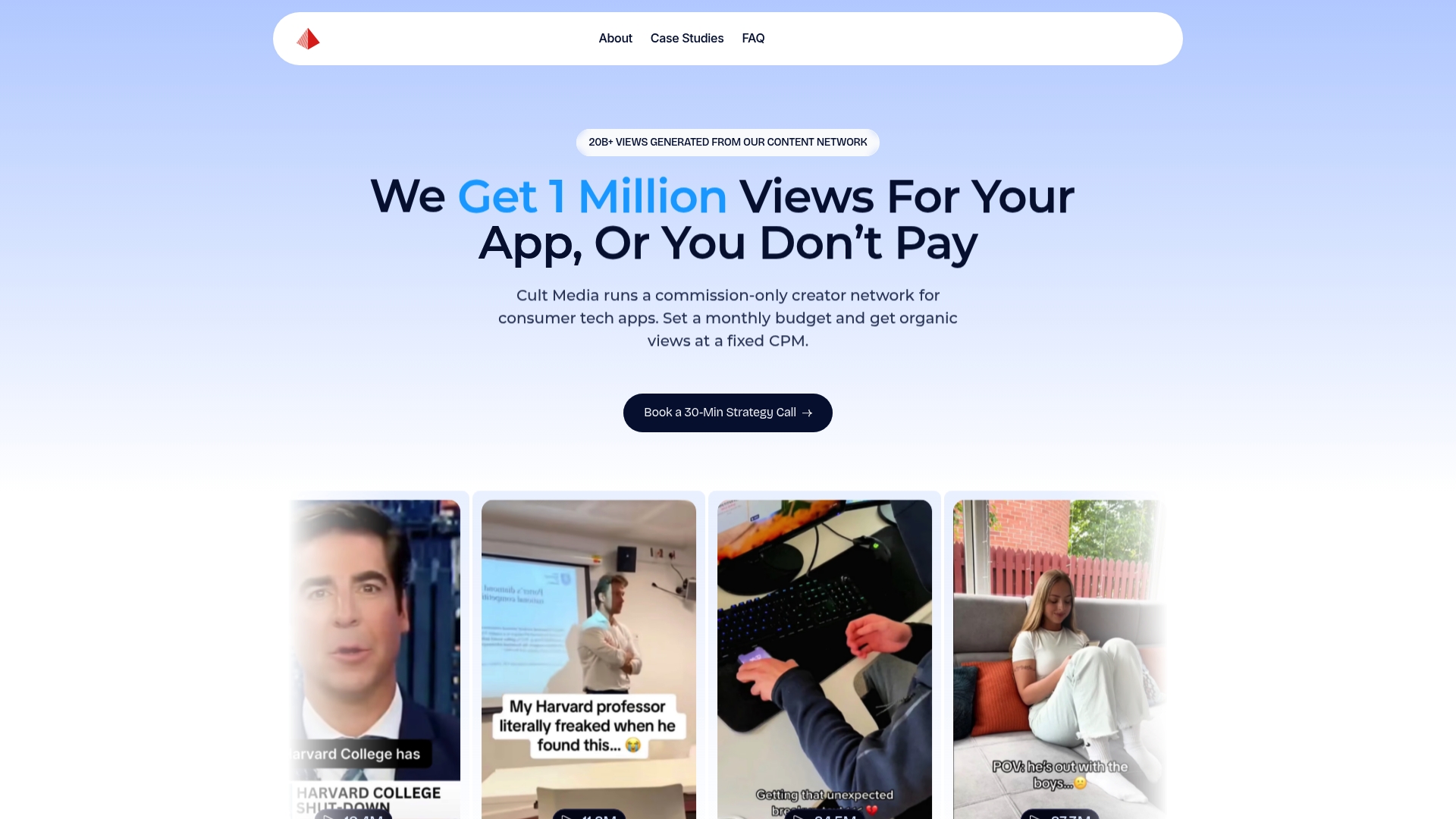
You can see how this works in practice in our creator-led growth case studies, or read how we structure the first three months in our 90-day creator management process.
FAQ
What is a good freemium conversion rate?
For self-serve freemium, 3% to 5% is commonly treated as good and 8% to 12% as great, according to ChartMogul's 2026 report. Sales-assisted motions and time-limited trials have higher benchmarks. Compare yourself with your own cohorts by channel before chasing an industry figure.
Is a 2.5% conversion rate good?
It is a little below the typical 3% to 5% target, but not alarming. In the 2023 benchmark analysis, 20% of freemium products fell below 2.5%. Check whether activation or audience quality is the bigger gap before changing the paywall.
Can creators improve free-to-paid conversion?
Indirectly, yes. Creators bring in users with a specific expectation, so content that demonstrates the paid feature and the limit that unlocks it tends to attract people who need the paid tier. Creators cannot replace good onboarding or well-placed upgrade prompts. Track cohort conversion by creator to see the effect in your own data.
How does creator content batching help?
Batching turns one brief into many hook, persona and format variants in one production round. You test them cheaply, read early hook rates, then scale the winners and compare their cohort conversion. It also keeps a steady supply of fresh creative ready when ads fatigue.
Sources
- What is good free-to-paid conversion
- The SaaS Conversion Report (ChartMogul)
- Freemium Conversion Rate Benchmarks
- SaaS Conversion Rate Benchmarks
- Scaling a SaaS Business: The Role of Freemium Models
- How to Automate UGC Video Creation
- How to Batch Create Social Media Content
- Startup growth strategy with 12-week sprints
- Content marketing automation
- YouTube hook ideas for Shorts creators