Run a phased, hypothesis-driven testing system that isolates one variable at a time, starting with the hook, before ever touching format, avatar, or CTA. Separate your testing campaigns from your scaling campaigns, budget $10 to $15 per creative for a judgment call, and hold every read to a 72-hour minimum before you act. The rest of this system builds out the framework, the metrics, and the production pipeline that keep that loop running without burning your budget or your team.
TL;DR:
- Testing should proceed through a phased, hypothesis-driven system, starting with concept screening and ending with scale validation, to filter out weak ideas early.
- Prioritize testing different hooks first by using multiple opening clips on the same content, as the hook determines overall ad success and influences downstream signals.
- Use separate campaigns for testing and scaling, with clear budgets and a minimum 72-hour read window to ensure reliable data before scaling winners.
- Focus on top-down metrics, especially hook rate, to decide whether to kill or scale a creative, accounting for realistic benchmarks and potential platform overcounting.
- Maintain a consistent flow of new concepts from multiple sourcing channels, including creator-sourced UGC and remixing, with frequent refreshes to combat creative fatigue.
Table of Contents
- The Three-Tier Creative Testing Framework for TikTok
- Which Variable Should You Test First on TikTok?
- How Do You Structure Testing and Scaling Campaigns?
- What Metrics Decide Whether a Creative Gets Killed or Scaled?
- Building a Production Pipeline That Can Feed This System
- How Fast Should You Refresh TikTok Creatives?
- How Cult Media Operationalizes This Testing System
- Reading TikTok's Algorithm Signals Correctly
- What Actually Wins on TikTok: Benchmarks and Pattern Recognition
- Compliance and Content Policy Considerations for TikTok Ads
- Three Mistakes Killing Your TikTok Testing Results
- Cult Media: Guaranteed Delivery for Teams Scaling Creative Tests
- Sources
- FAQ
The Three-Tier Creative Testing Framework for TikTok
Most brands treat creative testing as a single event: launch a batch, watch a dashboard, pick a winner. That approach misses why TikTok performance is volatile in the first place. A phased system, moving from cheap idea screening to full budget validation, filters out weak concepts before they cost you real money.
Here's how the three tiers function in practice:
- Tier 1, concept screening. Run high volumes of raw concepts at low spend, purely to find which ideas earn attention. This is your kill zone, and most concepts should die here.
- Tier 2, hook isolation. Take surviving concepts and test multiple openings against the same body content, changing nothing but the first 1 to 3 seconds.
- Tier 3, scale validation. Push winning hook and concept pairs into real budget stress tests, gating promotion on CPA and ROAS rather than early engagement.
The math behind this matters as much as the structure. Teams operating at a mature pace produce roughly 15 to 25 net-new concepts a month and promote just 2 to 4 winners into scaling budgets. That ratio, close to 1 winning asset for every 2 held in active testing, is the pipeline math you should be planning your production calendar around, not an afterthought you calculate after the fact.
Which Variable Should You Test First on TikTok?
Test the hook first, always. A weak opening kills every downstream signal before it can register, which means format, avatar, and CTA data collected against a bad hook is worthless. That order isn't arbitrary. Practitioner frameworks consistently rank the test sequence as hook, then format, then avatar, then CTA, because each layer only produces a clean signal once the layer above it has already earned attention.
Hook formats worth rotating through your Tier 2 tests:
- Direct callout ("If you use [product], watch this")
- Pattern interrupt (unexpected visual or sound cue in the first frame)
- Problem/agitation open (naming the pain point before the solution)
- Social proof lead ("Everyone's switching to...")
- Native meme or trend format re-skinned with your message
Write hypotheses, not vague comparisons. "A pattern interrupt outperforms a direct callout because our audience scrolls past straightforward ad language" is testable and repeatable. "Let's see which video wins" is not. That framing habit is what separates teams that build reusable creative knowledge from teams re-learning the same lesson every quarter.
Pro Tip: You don't need to reshoot the full asset to isolate a hook. Cut three or four different opening clips against the identical body footage, then splice each onto the same middle and CTA. One shoot day yields a full round of hook tests.
How Do You Structure Testing and Scaling Campaigns?
Testing and scaling campaigns need different bidding logic, different budgets, and different success criteria, because mixing them lets your algorithm optimize toward the wrong signal too early.
- Build a dedicated testing campaign using broad targeting and cost-cap or lowest-cost bidding, so TikTok's delivery system isn't skewed by a narrow audience before you know which creative works.
- Fund each ad group at $50 to $150 per day, with a judgment spend of $10 to $15 per individual creative before you call a result.
- Hold every read to 72 hours minimum. Early-hour swings in CTR or CPA are noise, not signal, and acting on hour six almost always means acting wrong.
- Move winners into a separate scaling campaign once they clear your thresholds, where you can apply tighter targeting and higher budgets without disturbing your testing data.
This structure mirrors the logic behind controlled experimentation more broadly: reliable causal conclusions require proper randomization and adequate sample size, and a 72-hour window with parity spend is how you get both on a platform as volatile as TikTok.
What Metrics Decide Whether a Creative Gets Killed or Scaled?
Read your metrics top-down: hook rate first, then hold or retention, then CTR, then CPA and ROAS. A miss at the top of that funnel makes everything below it meaningless. If your hook rate is weak, a decent CTR further down the funnel is a fluke from too small a sample, not a real result.
| Metric | Working benchmark range | What a miss signals |
|---|---|---|
| Hook rate (3-second view) | 25 to 35 percent | Opening fails to earn attention; kill or rewrite the first 3 seconds |
| Hold rate / average watch-through | 40 to 50% of video length | Mid-content pacing loses viewers; iterate the middle, don't rebuild the hook |
| CTR | 1 to 2% | Message or CTA mismatch with the hooked audience; test CTA copy before killing the concept |
| CPA / ROAS | Account-specific target | Consistent miss after 72 hours and parity spend means kill, not iterate |
Treat these as starting ranges, not universal law. Your own account baseline matters more than any published number, which is why engagement rate calculators built around current TikTok benchmarks are worth running before you set your own kill thresholds. Also be careful with ROAS specifically. TikTok's native attribution commonly overcounts conversions relative to third-party measurement, so pairing platform-reported ROAS with a parallel attribution check protects you from scaling a creative that only looks profitable inside TikTok's own dashboard.
Building a Production Pipeline That Can Feed This System
A phased testing system is only as good as your ability to feed it new concepts every week, and that requires a sourcing model with more than one speed setting.
- Studio tier, for polished concept validation and brand-safe hero assets, slower and more expensive but useful once a concept is proven.
- Creator-sourced UGC, for volume and authenticity, briefed loosely enough that creators can improvise within your variable of interest.
- Remix and repurpose, cutting new hooks or pacing from existing raw footage instead of commissioning anything new.
Brief creators on the variable you're testing, not a rigid script. Specify the hook angle, the narrative arc, and the CTA you want tested, then leave room for the creator's own delivery. A dedicated small team focused purely on hook swaps and re-edits is what lets brands turn one day of raw footage into a full week of Tier 2 tests.
Pro Tip: Give your editor a single raw asset and a list of five hook angles instead of five separate briefs. You'll get five testable variants at roughly the cost and turnaround of one.
How Fast Should You Refresh TikTok Creatives?
Every creative has a half-life, and on TikTok that half-life is short. Watch for the decay curve: CTR and hook rate climb early, plateau, then start sliding as frequency rises and the same audience segments see the same asset repeatedly.
- Frequency creeping past your account norm while CTR softens is your earliest fatigue signal.
- Rising CPM alongside flat or falling conversions usually means the algorithm is deprioritizing a tired asset.
- Comment sentiment turning repetitive or dismissive ("seen this one already") is a qualitative cue worth tracking manually.
Practitioner guidance suggests keeping 20 to 30% of daily spend in active testing at all times, feeding a pipeline ratio of roughly one scaling asset for every two still in testing. That ratio means your Tier 1 and Tier 2 work never stops, even while a winner is running at full budget. For a deeper look at fatigue diagnostics specifically, the practical guide to TikTok ad fatigue covers the signal thresholds worth tracking week over week.
How Cult Media Operationalizes This Testing System
Some companies run a commission-only creator network built for consumer tech apps, charging on a performance basis tied to verified organic views rather than a flat retainer. That guarantee changes the testing math directly: instead of gambling production spend on unproven concepts, clients pay against delivered views, which lowers the financial risk of running the volume of Tier 1 and Tier 2 tests this framework requires. Templates for structuring briefs and creator instructions live in the performance-based creator playbook, and hook-specific examples worth testing in your own Tier 2 rounds are broken down in seven TikTok hooks that stop the scroll.
Reading TikTok's Algorithm Signals Correctly
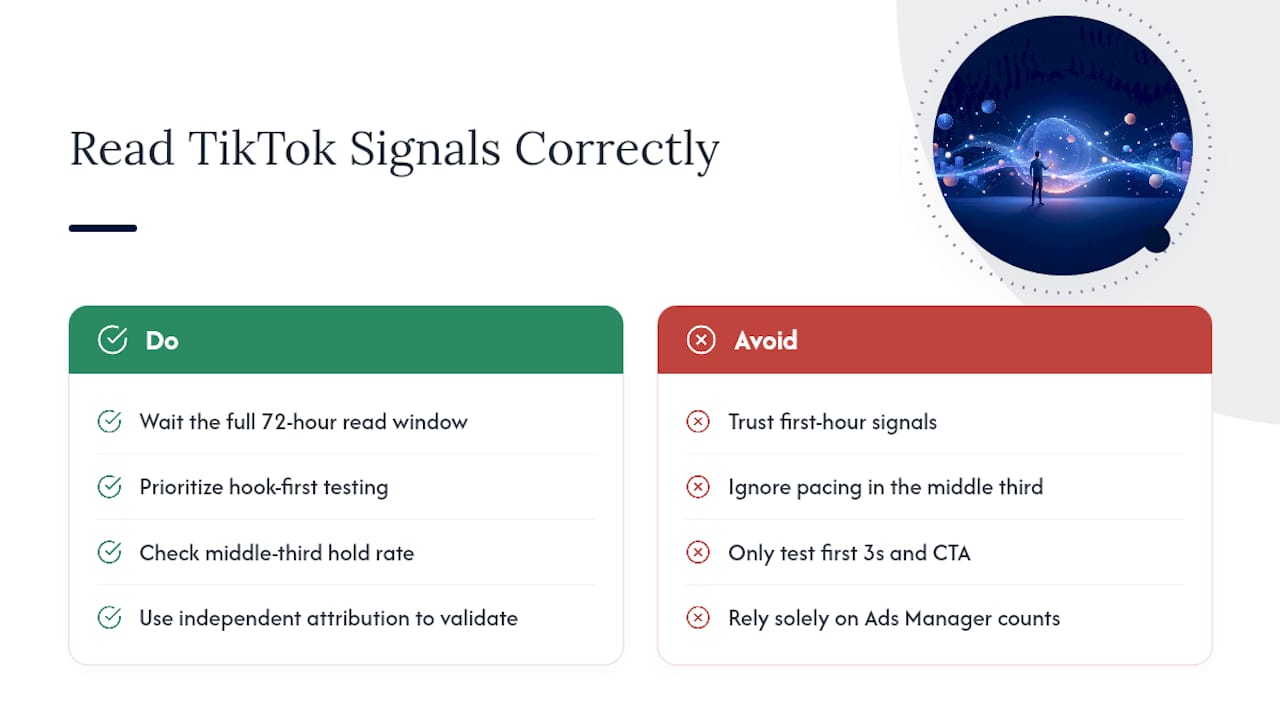
TikTok's discovery engine rewards early engagement velocity more than almost any other platform, which means your first-hour data is genuinely misleading, not just noisy. The algorithm tests a new creative against a small seed audience before deciding whether to expand distribution, so a slow first few hours often reflects seed-audience mismatch rather than creative quality. That's part of why the 72-hour read window matters more on TikTok than on platforms with slower, steadier delivery curves.
Short-form video consumption keeps climbing, and Pew Research's 2025 data on American social media use shows algorithmic, short-form discovery is now a dominant behavior pattern rather than a niche one. That behavior shift is exactly why hook-first testing outperforms format or CTA testing as a starting point. Viewers make a keep-or-skip decision almost instantly, so a creative that fails the hook test never gets the chance to prove anything else.
One overlooked signal: the middle third of a TikTok ad. Practitioner analysis has found that pacing and mid-roll escalation in that middle section materially affects watch-through and conversion, yet most teams pour all their testing attention into the first 3 seconds and the final CTA. Once your hook clears its threshold, look at hold rate specifically in that middle segment before assuming a CTA rewrite will fix a conversion problem. It might just be pacing.
Also watch for a gap between platform-reported performance and real business outcomes. Native TikTok attribution tends to overcount conversions relative to independent measurement, so a creative that looks like a scale-ready winner inside Ads Manager deserves a second look through a parallel attribution tool before you commit a large budget to it.
What Actually Wins on TikTok: Benchmarks and Pattern Recognition
The clearest pattern across high-performing TikTok accounts isn't a single viral format. It's testing discipline. Teams that treat creative as a repeatable system rather than a one-off campaign consistently outproduce competitors who wait for inspiration between launches, because volume and iteration speed compound over months in a way that any single "hit" video cannot replicate.
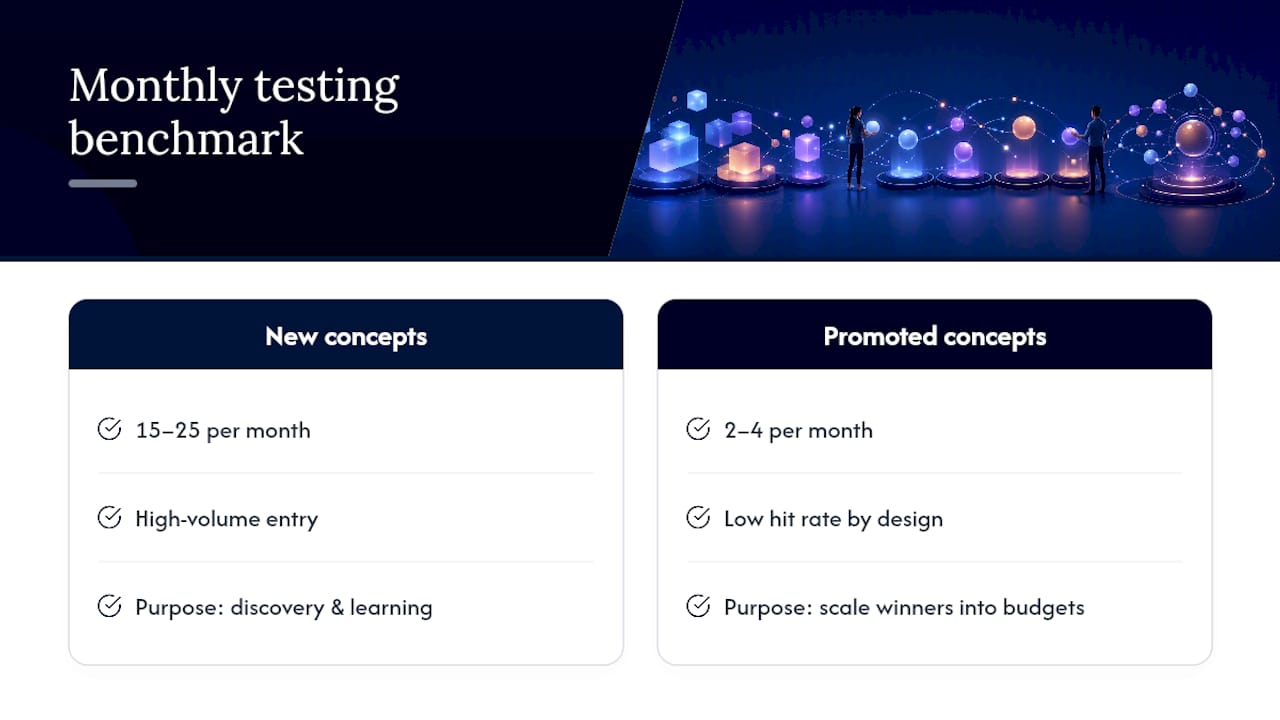
The benchmark worth internalizing is the promotion ratio: mature teams running 15 to 25 net-new concepts a month typically promote only 2 to 4 into scaling budgets. That is a low hit rate by design, and treating it as a failure rate misreads the system entirely. The pipeline is built to produce that many misses; the misses are what fund the discovery of the winners.
Format-level patterns worth testing against your own account: creator-led problem/solution narratives tend to outperform polished studio spots for cold-audience prospecting, while retargeting audiences respond better to social proof and specific outcome claims. Neither pattern is universal, which is exactly why the phased system matters more than any single "best format" claim you'll read elsewhere. Your account's own Tier 1 and Tier 2 data will tell you which pattern actually holds for your product and audience, and that data will usually beat a generic benchmark within a month or two of consistent testing.
Compliance and Content Policy Considerations for TikTok Ads
TikTok's advertising policies restrict specific claim types more aggressively than some other platforms, particularly around health outcomes, financial guarantees, and before/after style claims. Before a creative enters Tier 1, screen it against TikTok's ad policies directly rather than assuming a claim that worked on another platform will clear review here.
A few practical points worth building into your brief templates:
Native-feeling UGC content still needs to disclose paid partnerships where required, and TikTok's Branded Content Toggle exists specifically to flag sponsored creator content to both the platform and viewers. Skipping that disclosure risks both policy strikes and creator account penalties, which can quietly kill a creator relationship you were relying on for volume.
Claims around app functionality deserve particular care in the consumer tech space. A hook that implies a specific outcome ("lose weight in 2 weeks using this app") crosses into regulated claim territory even when the underlying feature is real, so brief creators toward describing what the app does rather than promising a specific result. Music and sound licensing is another quiet risk. Creator-sourced content using trending sounds is generally fine for organic posting, but boosted or fully paid ad placements sometimes require different licensing clearance, so confirm sound rights before a Tier 2 winner moves into paid scaling. Building a quick compliance check into your Tier 2 to Tier 3 promotion step catches most of these issues before they become a rejected ad or, worse, a suspended ad account.
Three Mistakes Killing Your TikTok Testing Results
Most teams sabotage their own data before they ever open a dashboard. The biggest offender: running a hook test and a concept test in the same round, then acting on results that mix two variables into one confused signal. Isolate one variable, every time, or don't trust what the numbers tell you.
Second mistake, treating testing and scaling as the same campaign. If you're not willing to build a separate testing campaign with its own budget and bidding logic, you're not really testing. You're guessing with extra steps.
For the next 48 hours: pick one live concept, cut three hook variants against identical body footage, load them into a dedicated testing campaign at $10 to $15 per creative, and put a 72-hour hold on your own itchy trigger finger before you touch the budget.
— Jax
Cult Media: Guaranteed Delivery for Teams Scaling Creative Tests
Cult Media is the alternative to a traditional retainer agency for teams that need creative testing volume without funding it out of pocket up front. Where most agencies charge a fixed monthly fee regardless of what the creative actually produces, Cult Media's commission-only model means you pay against verified organic views your campaign actually delivers.
That structure matters most for the exact problem this article walks through: running enough Tier 1 and Tier 2 volume to find real winners without absorbing the full financial risk of unproven concepts. Some creator networks handle the sourcing and production side, producing high-conversion, testing-ready content this system depends on, while guaranteed view delivery helps keep read windows filled with real data instead of thin samples. If your current testing pipeline is bottlenecked by production capacity or budget exposure rather than strategy, see how Cult Media's guaranteed-view campaigns work and get a sense of what a commission-only structure would look like against your own app's user acquisition goals.
Sources
- The Surprising Power of Online Experiments — HBR
- Americans' social media use in 2025 — Pew Research Center
- How to Build a TikTok Ad Creative Testing System That Actually Scales — D2C Times
FAQ
How Do I Become a TikTok Creative Tester?
There's no formal certification for this role. Marketers build the skill by running structured, hypothesis-driven tests inside TikTok Ads Manager, tracking hook rate and hold rate against a documented framework rather than by guessing which video "feels" right. Agencies and creator networks, including Cult Media's commission-only creator network, also hire and train specialists specifically for this function.
How Much Do 1,000 Views Cost on TikTok Ads?
Cost per view on TikTok ads varies widely by audience, industry, and season, and no single flat rate applies across accounts. Rather than fixating on a universal cost figure, benchmark your own account's cost per view against your hook rate and CTR to judge whether a creative is efficient for your specific funnel.
What Does "Creative" Mean on TikTok?
On TikTok, "creative" refers to the actual video asset running as an ad, including its hook, pacing, visuals, sound, and CTA. It's distinct from targeting or bidding strategy. A creative is the variable you test in the phased system described above, with the hook as the first and most consequential element of that asset.
How Do I Join the TikTok Creative Challenge?
The TikTok Creative Challenge is a platform-run program separate from standard paid creative testing, and enrollment details are managed directly through TikTok's own creator and business tools. For paid creative testing specifically, the phased system outlined in this article, concept screening through hook isolation to scale validation, applies regardless of whether assets originate from a Creative Challenge or a standard creator brief.
What's a Good Sample Spend for Testing a New TikTok Creative?
A working range is $10 to $15 per creative for an initial judgment call, inside a broader ad group budget of $50 to $150 per day. Hold every result to a minimum 72-hour read window, since early-hour performance on TikTok tends to swing before the algorithm finds its footing.