Whitelisted ads run creator-handle content through the brand's ad account, and they consistently beat brand-run creative because viewers trust a person's post more than a logo's. Marketers running creator partnerships should expect a 20-60% improvement in CPM, CTR, or CPA versus equivalent brand-run ads. The payoff is real, but it only shows up for teams spending enough per creator to justify the setup cost and the ongoing permissions work.
TL;DR:
- Whitelisted ads can deliver a 20 to 60 percent improvement in CPM, CTR, or CPA, but only if enough budget is allocated per creator to justify setup and permissions costs.
- Properly managing creator engagement, permissions, renewal SLAs, and detailed attribution is essential to maintain campaign performance and prevent silent drops due to expired authorization codes.
- Performance optimization benefits from using high-engagement organic posts, excluding existing followers from targeting, and avoiding low-value placements like Audience Network.
- Costs scale with creator size, ranging from $200 to over $3,000 for a six-month window, but small budgets under $5,000 per creator often do not justify whitelisting overhead.
- Agencies offering managed whitelisted campaigns can provide guaranteed views and eliminate operational burdens, ideal for teams unable to handle permissions and renewal logistics internally.
Table of Contents
- What Are Whitelisted Ads, and How Do They Differ from Brand-Run Ads?
- How Does Whitelisting Actually Work on Meta and TikTok?
- How Do You Set Up a Whitelisted Ad Campaign Step by Step?
- What Optimization Tactics Improve Whitelisted Campaign Performance?
- How Do You Measure and Report Whitelisted Ad Performance?
- What Do Whitelisted Ads Cost, and What Should the Contract Include?
- What Does a Mature Whitelisted Ad Program Look Like in Practice?
- Rules of Thumb for Scaling a Whitelisted Program
- Get Guaranteed Views Without Managing Whitelisting Yourself
- Sources
- FAQ
What Are Whitelisted Ads, and How Do They Differ from Brand-Run Ads?
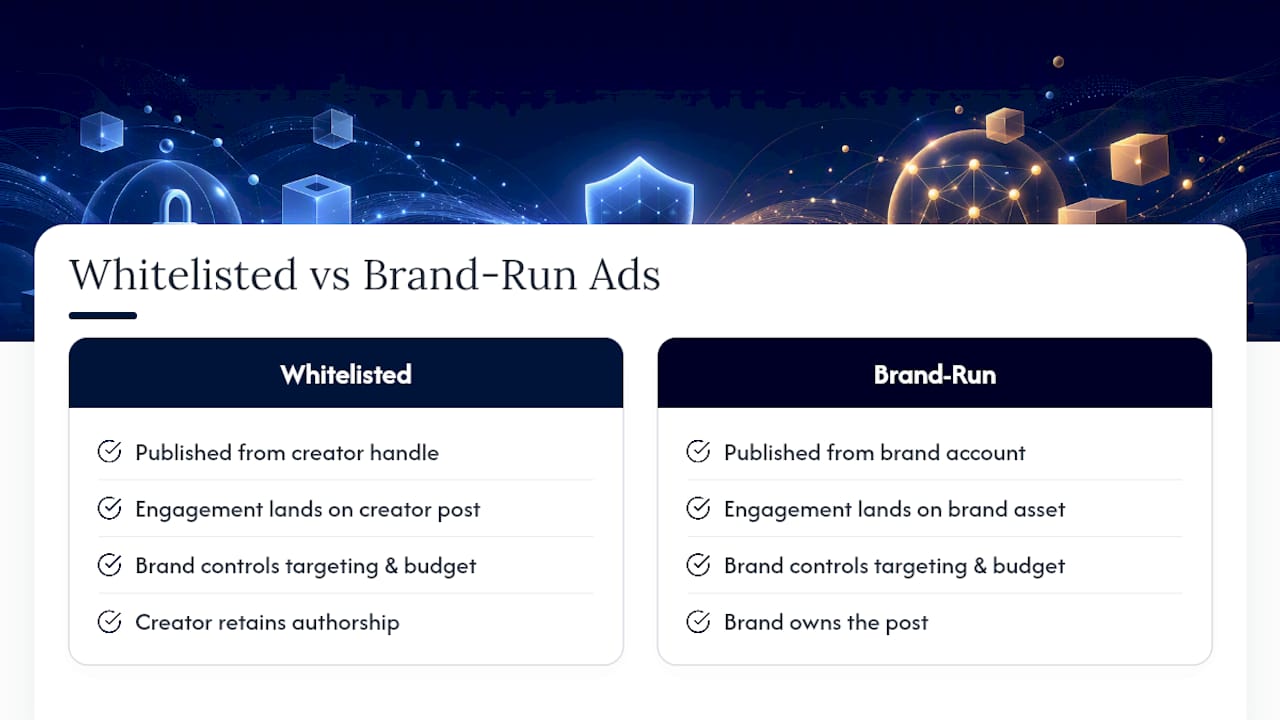
Platforms use different names for the same mechanism. Meta calls it Partnership Ads (formerly branded content ads), TikTok calls it Spark Ads, and the broader industry still defaults to "whitelisting" or "allowlisting." All three describe a brand running paid media through a creator's handle, with the creator's permission, instead of publishing from the brand's own account.
The engagement, comments, and social proof land on the creator's original post, not a brand-owned asset. The brand controls targeting and budget; the creator retains authorship. That split matters because algorithmic delivery favors posts that already carry organic engagement, and viewers pause longer on content from a person than from a company account.
Whitelisting is not universally worth the effort. It underperforms when the creator's organic engagement is already weak, when the ad spend per creator is too small to amortize setup time, or in regulated categories like finance and health, where disclosure requirements complicate creative approval.
How Does Whitelisting Actually Work on Meta and TikTok?
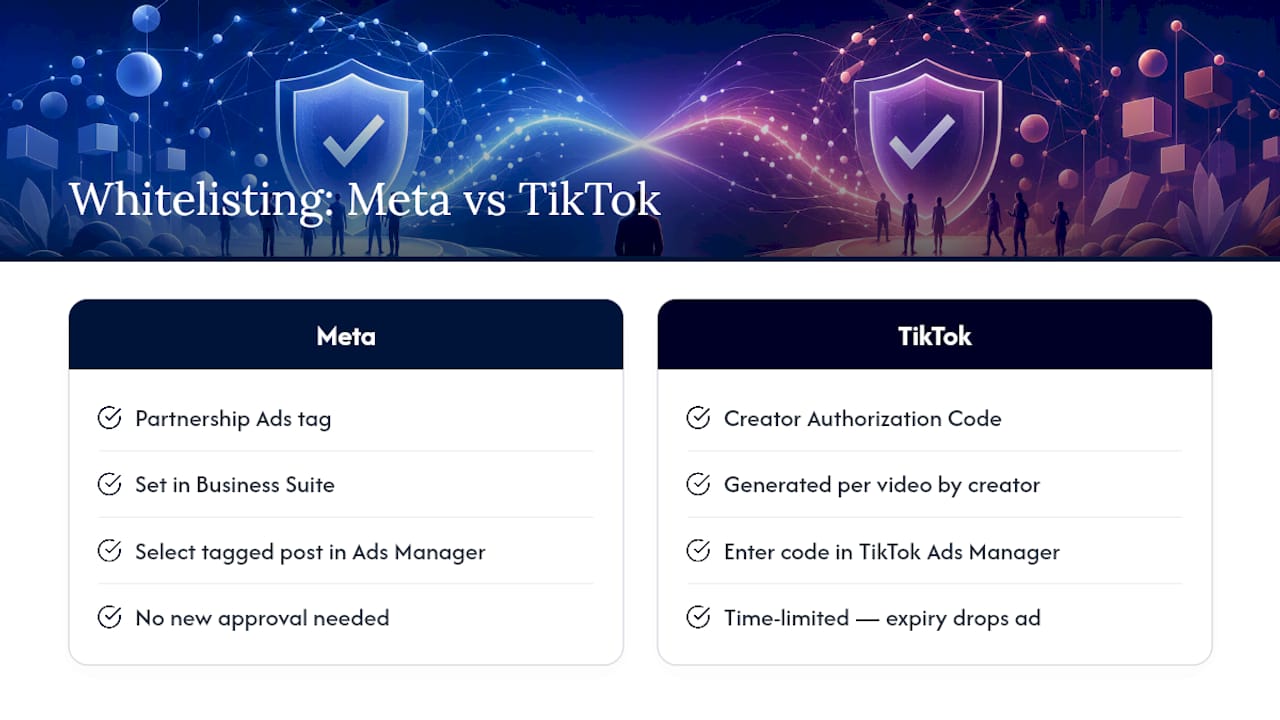
On Meta, the creator grants Partnership Ads permissions through Business Suite, tagging the brand as an authorized advertiser on a specific post. Inside Ads Manager, the brand selects that tagged post as the ad creative and builds targeting around it exactly as it would a normal ad set. No new creative approval is needed because the tag itself is the authorization.
TikTok uses an Authorization Code instead of an in-app permission tag. The creator generates a code tied to a specific video, and the brand enters it in TikTok Ads Manager to unlock Spark Ads. That code has an expiration window, and letting it lapse silently drops the ad, degrading performance without any visible error. Spark Ads inherit the video's existing likes, comments, and shares, so a post already gaining traction organically tends to convert better as paid media than a fresh, untested clip.
How Do You Set Up a Whitelisted Ad Campaign Step by Step?
A clean launch depends on sequencing permissions before creative, not after. Skipping steps here is the single most common reason whitelisted campaigns underperform in their first month.
- Vet creators on engagement, not just follower count. Prioritize creators with engagement rates above their niche average and audience sizes in the 10,000 to 250,000 range, where authenticity is usually still intact.
- Confirm platform permissions before signing. Verify the creator can grant Partnership Ads access on Meta or generate a valid Authorization Code on TikTok. Some business or creator accounts have restrictions that block this entirely.
- Negotiate renewal terms up front. Build a 24 to 72 hour renewal SLA into the contract so authorization codes get refreshed before they expire, not after a campaign has already gone dark.
- Set attribution and reporting ownership in writing. Specify who owns organic post metrics versus paid metrics to avoid disputes later.
- Structure the ad account cleanly. Use a dedicated campaign group per creator, a consistent naming convention (creator handle plus launch date), and full UTM tagging on every link so reporting stays clean from day one.
Pro Tip: Store every authorization code and its expiration date in one shared tracker, not scattered across email threads. A single missed renewal date is the most common way a whitelisted campaign quietly stops delivering.
What Optimization Tactics Improve Whitelisted Campaign Performance?
Getting the setup right unlocks the creator-handle premium; getting the optimization right is what sustains it past week two.
- Creative: Start with the creator's best-performing organic post rather than guessing at a new concept, then commission one or two native-style exclusive assets once you see which format resonates in paid delivery.
- Placement: Exclude Audience Network and other low-value automatic placements, which routinely drag down Meta whitelisted campaign performance, and split budgets by device when creative format differs meaningfully between mobile and desktop.
- Audience: Exclude each creator's existing followers from paid targeting so you're buying new reach, not resurfacing an audience that already saw the post organically. Map overlap across creators before scaling a roster, since two creators targeting the same lookalike segment quietly inflates frequency and wastes spend.
- Frequency: Set a refresh trigger at a frequency of 3 to 4 within a rolling seven-day window; past that, creative fatigue sets in fast on creator-style content because it reads as personal rather than evergreen.
- Testing: Run each creative for at least four weeks before judging it, and use geo holdouts where budget allows to isolate incremental lift from a whitelisted post rather than just observed conversions.
Refunnel's placement guidance pairs well with broader Meta lead generation setup practices for teams still building out their campaign objective structure.
How Do You Measure and Report Whitelisted Ad Performance?
Whitelisted campaigns need their own reporting lane, not a blended view with brand-run ads. Mixing the two obscures exactly the lift you're trying to prove.
- Run whitelisted creative in dedicated campaign groups with a distinct UTM parameter set so performance never blends into brand-run totals.
- Track CPM, CTR, CPA, and ROAS against platform norms, watching for the 30 to 50 percent lower CPM range that whitelisted content typically delivers over brand-run equivalents.
- Use geo holdouts or in-platform lift studies for incrementality testing when budget supports it. A holdout region tells you what would have happened without the whitelisted spend, which a simple before/after comparison cannot.
- Split attribution cleanly: organic metrics (likes, comments, shares) belong on the creator scorecard, while paid metrics (impressions, CTR, ROAS) belong on the brand dashboard. Defining this split contractually heads off internal disputes before they start.
A dependable attribution tool or MMP makes this split far easier to maintain once you're running more than a handful of creators at once.
What Do Whitelisted Ads Cost, and What Should the Contract Include?
Whitelisting fees scale with follower tier. Micro creators (5,000 to 50,000 followers) typically charge $200 to $500 for a six-month usage window, mid-tier creators (50,000 to 250,000) run $500 to $1,000, and larger creators (250,000-plus) charge $1,000 to $3,000 or more. Whitelisting is worth the fee when the resulting CPA improvement exceeds that amortized cost across the campaign's spend.
Four contract clauses matter most: the usage window and exact scope of what's being licensed, a renewal SLA for authorization codes, creative approval rules for any new assets, and clear termination and portability terms if the relationship ends. Always run ads through the platform's official partnership tag rather than an unapproved workaround, both for FTC disclosure compliance and because unofficial methods rarely survive a platform audit. Skip whitelisting entirely when planned spend per creator falls under roughly $5,000; the overhead usually outweighs the lift at that scale.
What Does a Mature Whitelisted Ad Program Look Like in Practice?
Commission-only creator networks built for guaranteed-view campaigns tend to run whitelisting as a standing operational routine, not a one-off project. A common shape is a roster of 30 to 80 creators, with whitelisting rights written into contracts for the top performers from the start. Renewals get batched on a monthly cadence, and one or two new whitelisted assets rotate in weekly to keep creative fresh. Teams handling this alone should expect that permissions tracking and code renewals consume real operational time. A managed partner absorbs that overhead and keeps the roster diversified so no single creator's performance can sink the program.
Rules of Thumb for Scaling a Whitelisted Program
Start small and prove incrementality before committing real budget. A single creator with strong organic numbers tells you less than a five-creator test with a geo holdout attached.
Diversify the roster early. Depending on one or two high-performing handles leaves the whole program exposed if a code lapses or a creator walks away. Standardize contracts and renewal SLAs across every creator, and enforce UTM and dashboard discipline from campaign one, not after reporting gets messy. Dynamic baseline modeling, rather than a static historical average, makes the strongest case when you're asking finance to expand the budget.
— Jax
Get Guaranteed Views Without Managing Whitelisting Yourself
Some agencies run whitelisted ad programs for consumer tech apps on a commission-only basis, so clients pay for verified views delivered, not for hours spent chasing authorization codes. That's the practical alternative to building this in-house: no permissions tracker to maintain, no renewal SLAs to negotiate creator by creator, and no guessing at which handle actually converts.
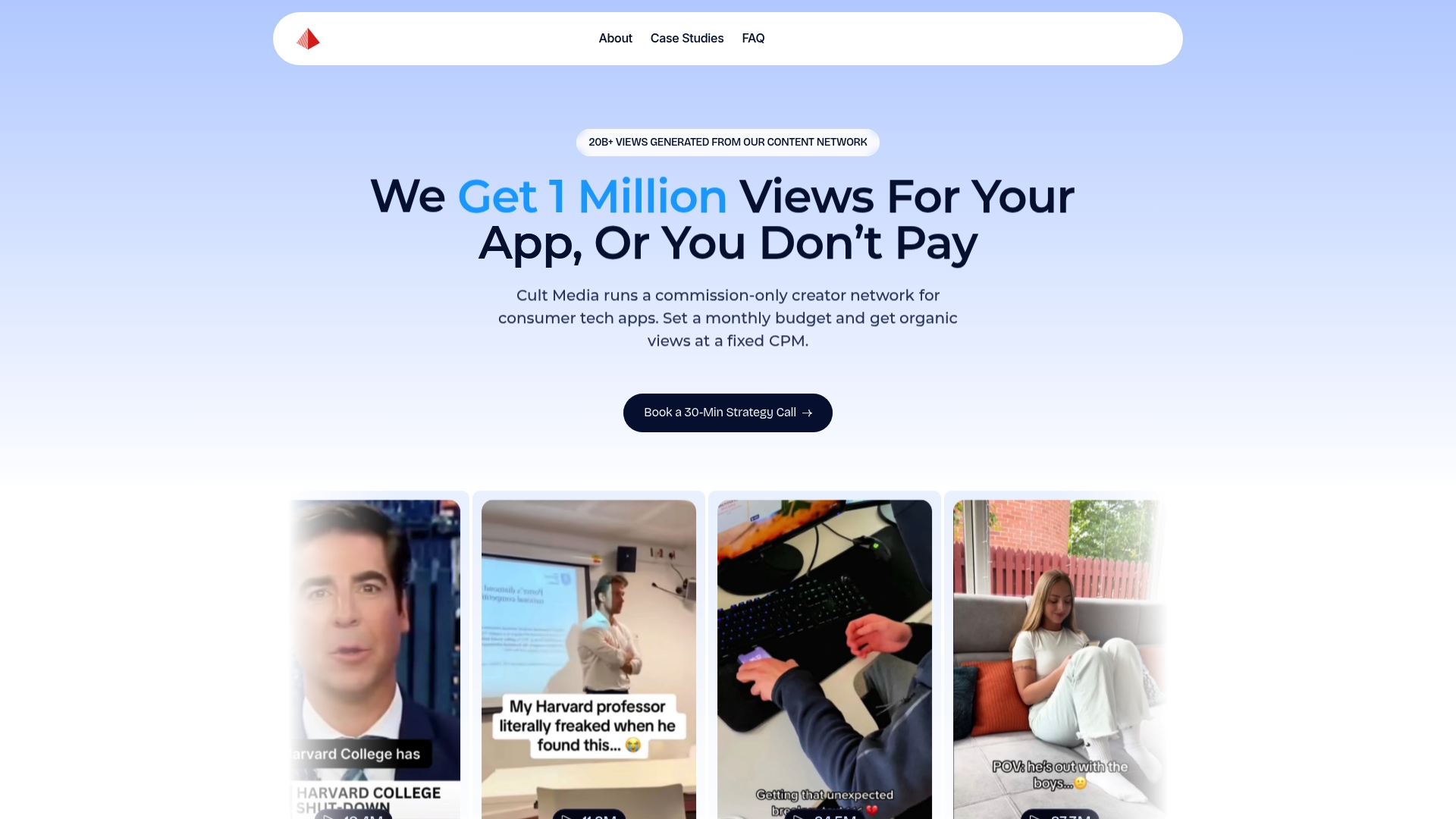
Certain agencies handle creator vetting, permissions setup, multi-platform distribution across TikTok and Instagram, and performance-based pricing tied to guaranteed views, so teams get the CPM and CPA advantages of whitelisting without absorbing the operational load described above. If your current program is stuck at the setup stage, or you're evaluating whether to build this internally versus hand it off, see how Cult Media's creator network works and get a sense of what a managed campaign could deliver for your app.
Sources
- Whitelisted Creator Ads in 2026: The Complete Guide to Spark Ads, Partnership Ads, and Creator Ad Permissions | Storika
- Whitelisted Meta Ads: A Strategy for Better Results | Refunnel Blog
- Creator Whitelisting on Meta Ads in 2026: The Complete Setup, Pricing & Performance Guide | AdRiseLab
- Creator Whitelisting Ads: CPA Benchmarking & AI Tips
FAQ
What Do Whitelisted Ads Mean?
Whitelisted ads (also called allowlisted, partnership, or Spark Ads depending on the platform) are paid ads that run through a creator's account with the brand controlling targeting and budget, rather than through the brand's own handle.
What Is Ads Optimization for Whitelisted Campaigns?
It means adjusting creative, placement, audience exclusions, and frequency caps specifically for creator-handle ads to capture the 20 to 60 percent CPM, CTR, or CPA improvement whitelisting typically delivers over brand-run creative.
What Are the Disadvantages of Whitelisting?
The main risks are authorization-code expiry silently killing performance, revoked creator access mid-campaign, and audience overlap across creators that inflates frequency and wastes spend. Small budgets under roughly $5,000 per creator often don't clear the operational overhead either.
How Much Do Influencers Charge for Whitelisting?
Fees scale with audience size. Micro creators typically charge $200 to $500 for a six-month window, mid-tier creators charge $500 to $1,000, and larger creators charge $1,000 to $3,000 or more for the same usage period.
Is Whitelisting Worth It for a Small Ad Budget?
Not usually. When planned spend per creator falls under roughly $5,000, the permissions setup and renewal management tend to cost more time than the CPA improvement is worth.