TikTok ad fatigue happens when a creative stops holding attention in the first two to three seconds and the algorithm cuts its delivery, not simply because your audience saw it too many times. Fix it fast by checking three things right now: your Average Play Time curve, your 3-second view rate, and whether CTR is falling while CPM climbs.
Three moves stop the bleeding immediately:
- Swap the 0 to 3 second hook on your worst-performing variant
- Rotate in at least two fresh creative versions from your existing library
- Pause or kill any variant with a declining 3-second view rate and rising CPA
Check these three metrics today: Average Play Time in the first two seconds, 3-second view rate, and the CTR/CPM trend over the last seven days.
Pro Tip: Don't refresh creative on a fixed weekly calendar. Set threshold triggers instead, so you rotate hooks the moment a metric crosses a defined line, not when the calendar says it's time.
Key Takeaways
TikTok ad fatigue is an early-retention failure that triggers algorithmic suppression, and preventing it requires threshold-based monitoring paired with a modular creative pipeline that ships new hooks on a spend-linked cadence.
| Point | Details |
|---|---|
| Watch early-retention metrics first | Average Play Time and 3-second view rate reveal fatigue before CTR or CPA fully decline. |
| Use combined signals, not one metric | Rising CPM with low frequency, plus falling CTR, together confirm algorithm suppression. |
| Build a modular creative pipeline | One core body with multiple hooks and CTAs produces many variants from a single shoot. |
| Refresh on thresholds, not a calendar | Trigger hook rotation when metrics cross defined limits rather than on a fixed weekly schedule. |
| Keep at least 3 active variants per ad group | A thin variant pool starves the algorithm's testing options and stalls delivery. |
Table of Contents
- What Ad Fatigue Means on TikTok (and Why the Term Is Misleading)
- Why TikTok Ad Fatigue Hits Faster Than on Other Platforms
- Signs of Ad Fatigue on TikTok: Metrics and Thresholds That Matter
- How to Monitor Fatigue Signals Inside TikTok Ads Manager
- Creative Rotation Tactics That Prevent Fatigue Before It Starts
- What to Do the Moment an Ad Shows Fatigue
- Testing Creative Refreshes Without Fooling Yourself
- How a Managed Creator Network Solves the Creative Supply Problem
- How TikTok's Delivery Algorithm Actually Decides What Keeps Running
- Targeting and Retargeting Choices That Slow Fatigue Down
- Automated Rules and Optimization Tools Built to Catch Fatigue Early
- Ad Fatigue TikTok: A Practical Guide for Performance Marketers
- Sources
- FAQ
What Ad Fatigue Means on TikTok (and Why the Term Is Misleading)
TikTok ad fatigue is a delivery problem, not a repetition problem. The creative fails to hold viewers past the first two to three seconds, and TikTok's own creative guidance confirms that failing early-retention signals gets treated as a poor user experience, triggering algorithmic suppression.
That's a different animal from Meta's version of fatigue, which is mostly about audience frequency. Meta users see the same ad too many times and tune it out. TikTok users rarely even finish watching before the algorithm has already decided the ad isn't worth showing again.
Precision in your reporting matters here:
- Creative fatigue — the asset itself stops performing regardless of who sees it
- Audience fatigue — the same people are seeing the ad too often (rare on TikTok, common on Meta)
- Algorithm suppression — TikTok is actively throttling delivery because early signals are weak
Use "creative fatigue" or "algorithm suppression" in your reporting. "Audience fatigue" will send your team chasing frequency caps that don't fix the actual problem.
Why TikTok Ad Fatigue Hits Faster Than on Other Platforms
TikTok's algorithm weighs the first two to three seconds of watch time more heavily than almost any other engagement signal, which means a weak hook gets punished within hours, not days. Distribution is also more aggressive and the interest graph denser, so TikTok cycles through creative variants faster and flags near-duplicate content quickly.
Small changes matter more here than on other platforms. Swap a trending sound or shift from talking-head to on-screen text, and TikTok often treats it as a meaningfully new asset worth re-testing with fresh reach.
Spend level accelerates all of this. Higher daily budgets and TikTok's automated bidding systems burn through a creative's productive lifespan faster:
- High-spend campaigns can show delivery loss within 48 to 72 hours
- Most creatives fatigue somewhere within a short period ranging from several days to a couple of weeks
- Automated bid strategies chase volume, which pushes a winning creative past its shelf life quickly
Signs of Ad Fatigue on TikTok: Metrics and Thresholds That Matter
Detection starts with early-retention data, not conversion data. Average Play Time in the first two seconds is your leading indicator. When the curve shows a steep drop right at the start, that's the algorithm telling you the hook failed before the message even landed.

That range signals a hook problem serious enough to trigger suppression, according to analysis from Xpand Media's rotation research, which found agencies commonly see CPA rise 30 to 80% once a creative saturates.
Secondary signals confirm the diagnosis:
- Significant week-over-week CTR decline
- CPM rising while frequency stays flat or low, a pattern Skaler's research identifies as TikTok-specific algorithm suppression rather than audience overexposure
- Conversion rate falling even though reach and impressions hold steady
Read these signals together, not in isolation. Diagnose fatigue in three steps:
- Check the 3-second view rate first. If it's dropping alongside CTR, the hook is the problem.
- Confirm frequency is low. If CPM rises while frequency stays under 2, that rules out audience exhaustion and points to creative suppression.
- Cross-reference creative version labels against your spend data to isolate exactly which variant triggered the decline.
Any one alone might just be noise. All three together mean the creative is done.
How to Monitor Fatigue Signals Inside TikTok Ads Manager
Build your monitoring view once, then check it on a set cadence instead of hunting for data every time performance dips.
- In Ads Manager, add custom columns for Average Play Time, 3-second view rate, CTR, and CPM to your reporting view.
- Set your date window to compare a trailing 3-day period against the prior 3 days, which surfaces early declines faster than a 7-day rolling average.
- Break out performance by creative ID so each hook and body variant reports separately instead of blending into one ad group average.
Name your variants with a convention that tells you what changed at a glance, something like Hook_PainPoint_v3_CTA_UrgeAction. That level of labeling makes it obvious which specific element is dragging performance.
Cadence depends on spend, with higher daily budgets requiring more frequent checks and lower budgets allowing for less frequent monitoring.
Pro Tip: Set automated rules in Ads Manager to pause any ad group where 3-second view rate drops below your threshold for 24 consecutive hours. Catching this manually every day is unrealistic once you're running more than a handful of active campaigns.
Creative Rotation Tactics That Prevent Fatigue Before It Starts
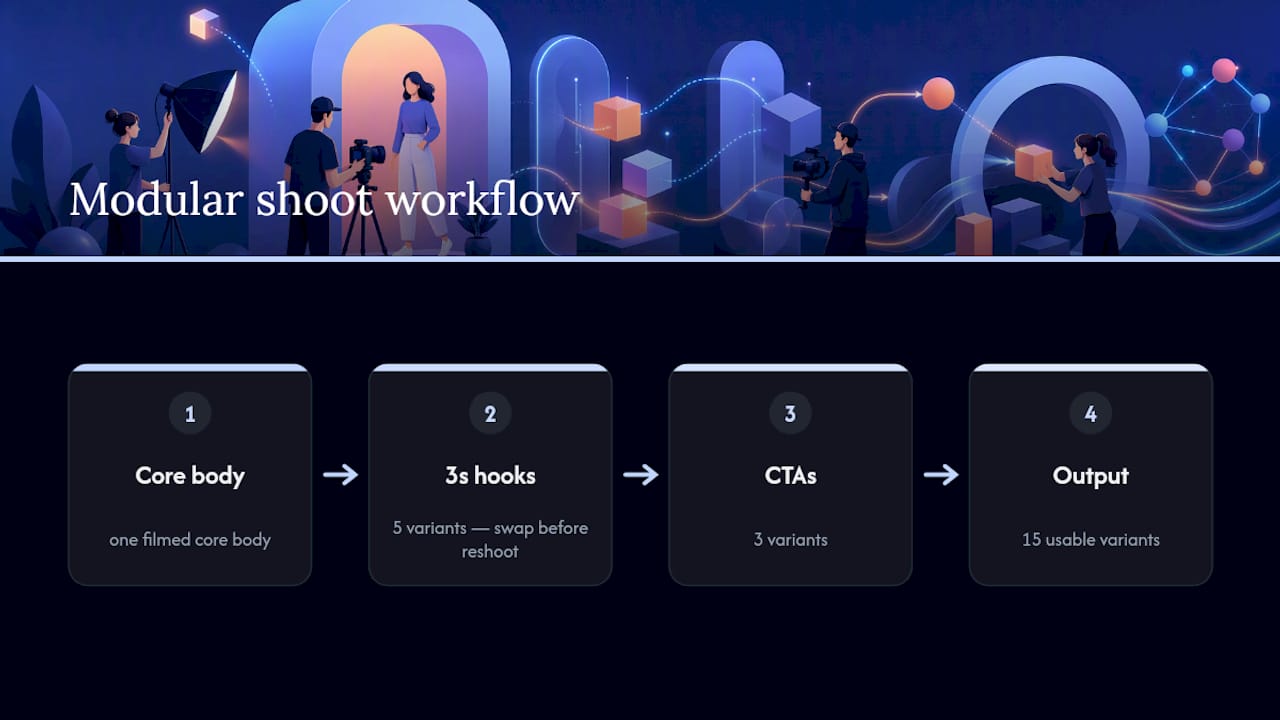
The strongest defense against fatigue is a production system that generates variants faster than TikTok can burn through them. A modular shoot, one core body filmed with five different 3-second hooks and three different CTAs, can yield 15 usable variants from a single production session. Rotating just the hook resets the algorithm's early-retention read without touching the rest of the asset.
Tie your refresh cadence to spend band, since higher budgets burn creative faster:
Beyond hooks, rotate the elements that TikTok's algorithm reads as meaningfully new: swap the background audio, bring in a different creator, insert a current trend format, or shift the opening angle between pain point, outcome, and curiosity framing.
Keep multiple active variants per ad group at all times to ensure algorithm testing options remain available. Fewer than that starves the algorithm of options to test, which shows up as stagnant delivery even before fatigue sets in. Aiming for something closer to 50 variants a month at scale keeps that pool consistently fresh, an approach worth reading more about in Cult Media's TikTok app marketing playbook.
Pro Tip: Swap the hook before you reshoot anything. A new 3-second opener on an otherwise identical body often recovers performance without the cost of a full production cycle.
What to Do the Moment an Ad Shows Fatigue
Speed matters more than perfection once fatigue signals appear. Work through remediation in order:
- Swap in a pre-built hook variant from your existing library, no new production needed.
- Test a different audio track on the same body content.
- Reduce bids on the worst-performing variant or pause it outright.
- Reallocate budget toward your current winners or a holdout ad group.
Once the bleeding stops, work on medium-term fixes: schedule a modular shoot, broaden your lookalike audience slightly if targeting has narrowed, and bring in UGC from creators with a different look or delivery style.
Use clear decision rules instead of gut calls. If 3-second view rate drops below your threshold, rotate the hook rather than killing the whole ad. Work on a rough timeline: emergency fixes within 0 to 48 hours, full variant replacement within 3 to 7 days, and a renewed creative pipeline live within 2 to 3 weeks.
Testing Creative Refreshes Without Fooling Yourself
A refresh that "worked" might just be riding a targeting change or a bid adjustment instead of an actual creative win. Isolate the variable with a clean structure:
- Launch two identical ad groups with matching targeting, budget, and bid strategy.
- Swap creative in one arm only. Keep the other running the original as a control.
- Let both arms run long enough to gather meaningful spend per arm, typically 3 to 7 days depending on your traffic volume.
- Compare 3-second view rate and CTR first, since those move fastest, then confirm the win holds up in CPA or ROAS before scaling.
Weight early-retention metrics more heavily in the first few days of a test and let conversion metrics confirm the decision once volume builds. A variant that wins on hook rate but not on CPA after a full week isn't ready to scale yet. Cult Media's organic vs. paid views breakdown covers how to read these signals alongside format performance.
How a Managed Creator Network Solves the Creative Supply Problem
Most fatigue problems trace back to one root cause: creative production can't keep pace with how fast TikTok burns through assets. Cult Media's commission-only creator network exists specifically to close that gap, supplying performance teams with a steady flow of UGC built for rapid hook permutation rather than one-off campaign assets.
That structure maps directly onto what prevents fatigue: fast hook refreshes drawn from an active creator pool, modular asset libraries instead of single hero videos, and a cadence that scales with spend rather than a fixed production calendar. Because Cult Media only gets paid on verified views delivered, the incentive to keep creative performing stays aligned with the client's, not just with billed hours.
Integrating outside creative supply with your internal testing process is straightforward if you tag assets consistently from the start.
- Route new creator variants into your existing testing structure rather than a separate campaign silo
- Track guaranteed-view content against the same 3-second view rate and CTR thresholds you apply to in-house creative
- Reconcile delivered views against your MMP data before crediting a variant as a winner
Pro Tip: Tag every guaranteed-view variant with a distinct naming convention, something like CultGV_Hook2_v1, so it's separable from organic UGC in your reporting and you can track its fatigue curve independently.
How TikTok's Delivery Algorithm Actually Decides What Keeps Running
TikTok's delivery system isn't a static auction the way older ad platforms behave. It's a continuous feedback loop that scores each impression against how the next few seconds of viewer behavior play out, then reallocates delivery in near real time based on that score.
Early retention carries outsized weight in this loop. An ad that loses viewers in the first two seconds gets read as a poor match for the audience it was shown to, even if that same ad might convert well with a different segment. The algorithm doesn't wait for a campaign-level average to confirm this. It adjusts delivery per impression, which is why fatigue on TikTok can show up within a single day of heavy spend rather than over a full week.
This also explains why creative testing on TikTok behaves differently than expected. A new hook variant essentially resets the algorithm's confidence score for that asset, giving it a fresh evaluation window instead of inheriting the declining trajectory of the original. That's the mechanical reason hook swaps recover performance faster than waiting out a slump.
Automated bidding compounds the effect. TikTok's bid systems chase efficient delivery, which means they'll pull back spend from a weakening creative faster than a marketer manually checking dashboards once a day would catch it. Understanding this loop is what separates teams reacting to fatigue after the fact from teams that catch the suppression signal within hours.
Targeting and Retargeting Choices That Slow Fatigue Down
Audience structure interacts with creative fatigue more than most teams account for. A narrow custom audience burns through impressions with the same creative faster than a broad or lookalike audience does, simply because there are fewer unique viewers to show it to before the algorithm starts recycling exposure.

Broader targeting, particularly TikTok's automated audience expansion, gives a creative more room to prove itself against a wider set of viewers before suppression kicks in. That doesn't mean abandoning precise targeting altogether. It means recognizing that a tightly scoped audience needs a faster creative refresh cadence to compensate for its smaller pool.
Retargeting audiences carry their own fatigue risk profile. Viewers who already saw your top-of-funnel creative need a genuinely different message on the retargeting side, not the same hook with a different CTA slapped on. Reusing the identical asset across both funnel stages accelerates fatigue for that specific segment even if your cold-audience numbers still look healthy.
A practical adjustment: segment your fatigue monitoring by campaign objective, not just by ad group. A prospecting campaign and a retargeting campaign running the same creative can show completely different decay curves, and averaging them together in one dashboard view hides which one actually needs attention first.
Automated Rules and Optimization Tools Built to Catch Fatigue Early
TikTok Ads Manager's automated rules function is underused for fatigue management specifically. Most teams set rules around budget caps or bid adjustments, but the same tool can trigger creative-level actions the moment a threshold is crossed, without a human needing to catch it in real time.
Configure a rule to pause any ad where 3-second view rate falls below your defined threshold for a sustained window, or to send an alert when CPM rises past a set percentage while frequency stays flat. That combination catches the algorithm-suppression pattern discussed earlier before it fully tanks campaign-level ROAS.
TikTok's optimization event settings also matter here. Campaigns optimizing toward a downstream event, like a purchase or subscription, give the algorithm more room to find the right audience for a creative before writing it off, compared to campaigns optimizing purely for clicks. That's worth weighing when a creative shows early softness but the downstream conversion data hasn't caught up yet.
Smart Performance Campaigns and automated creative optimization features can help surface which variant combinations perform best, but they work best as confirmation layers on top of manual monitoring, not a replacement for checking your Average Play Time and CTR trends directly. Automation catches the pattern faster; it doesn't replace understanding why the pattern exists.
Ready to keep your creative pipeline ahead of TikTok's suppression curve instead of chasing it? Cult Media's guaranteed-view creator network supplies the modular hook variants and UGC volume performance teams need to stay ahead of fatigue, with pricing tied directly to verified results.
Ad Fatigue TikTok: A Practical Guide for Performance Marketers
The industry still treats TikTok fatigue like a scaled-down version of Meta fatigue, and that assumption costs marketers weeks of wasted spend. Frequency caps and audience rotation, the standard Meta playbook, do almost nothing on TikTok because the failure point isn't audience exhaustion. It's a hook that stops working within hours of heavy spend.
What the evidence actually supports is a shift in priority: early-retention metrics deserve more attention than campaign-level CTR, and creative production needs to run as a standing pipeline, not a monthly task. Teams that wait for CPA to spike before refreshing creative are always reacting a step too late, because by the time CPA moves, the algorithm has already throttled delivery for days.
The overrated fix is the full reshoot. Most fatigue resolves with a hook swap on an existing body, a fraction of the cost and turnaround of new production. Save the reshoot for when hook rotation stops recovering performance entirely, not as the first response.
Prioritize building a threshold-based monitoring habit before anything else. Everything downstream, cadence, remediation, testing, only works once you can actually see the decline coming.
Sources
- Tiktokacademy
- TikTok Ad Fatigue: Why It Happens Faster Than Meta and How to Fix It
- TikTok creative fatigue at 14 days: the 8-hook rotation that ships 50 variants per month | Xpand Media
- Creative Fatigue in 2026: How Fast Meta Ads Actually Die | Skaler Blog
FAQ
What Does Ad Fatigue Mean on TikTok?
Ad fatigue on TikTok means a creative stops holding viewer attention in the first two to three seconds, causing the algorithm to reduce its delivery. It's driven by weak early-retention signals rather than audience overexposure, which is the primary driver on platforms like Meta.
Why Am I Suddenly Seeing So Many Ads on TikTok?
TikTok's ad load has grown alongside the platform's advertiser demand, and its algorithm serves more ads to users whose behavior signals higher purchase intent or engagement with ad content. Increased ad density in your feed doesn't indicate anything about your own campaigns' fatigue status.
Is TikTok Really Mostly Ads Now?
TikTok has increased ad density over time as advertiser demand has grown, though the platform still weights its feed heavily toward organic and creator content for most users. Perceived ad saturation varies significantly by account, engagement history, and region.
Why Does Facebook Feel Like It's Mostly Ads Now?
Facebook's ad load has expanded as the platform matured and organic reach for pages declined, pushing more advertisers to compete for the same feed placements. This is a separate dynamic from TikTok's fatigue mechanics, since Facebook's ad experience is shaped more by auction density than by early-retention scoring.
How Fast Does Creative Fatigue on TikTok?
Most TikTok creatives fatigue somewhere between a few days and two weeks, and high-spend campaigns can lose delivery within 48 to 72 hours. The exact window depends on daily spend, audience size, and how quickly the hook fails to hold early attention.
Recommended
- TikTok App Marketing: Performance-Based Creator Playbook - Scale Your Consumer App By Unlocking The TikTok & Instagram Systems Behind +20 Billion Views
- Organic vs Paid Views: What App Founders Must Know
- View vs Impression: What Marketers Must Track - Scale Your Consumer App By Unlocking The TikTok & Instagram Systems Behind +20 Billion Views