Yes, influencer tracking can be done compliantly, but only if you map every data flow first. Under GDPR and current FTC guidance, that means documenting consent before a single pixel fires. The immediate action is to pause or block any client-side pixels and pixel-based remarketing tags running against EU or UK audiences that lack a recorded, timestamped consent. Campaigns can be built to operate within these constraints.
TL;DR:
- Tracking pixels and remarketing tags must have recorded, timestamped user consent before firing, especially for EU and UK audiences, to ensure compliance.
- Influencer data collection often includes IP addresses, cookie IDs, click IDs, emails, or shipping details, which regulators consider personal data and require lawful handling.
- Brands are typically responsible as data controllers, and all vendors must have signed DPAs; using legitimate interest instead of consent requires documented justification.
- Consent logs should record purpose, timestamp, user IP, and version, stored alongside DPAs, with automatic deletion after 30 to 90 days to comply with audit and retention standards.
- Using promo codes and server-side attribution reduces personal data collection, lowers compliance risks, and enables measurement without invasive cookies or pixels.
Table of Contents
- What Counts as Personal Data in Influencer Tracking
- Who Is Legally Responsible: GDPR, DSA/DMA, and FTC Rules
- Contracts and Consent: Your Pre-Launch Checklist
- Privacy-Preserving Attribution That Still Proves ROI
- Running Multi-Influencer Campaigns Without Multiplying Risk
- Briefing Creators: Disclosure Copy and Data Limits
- Red Flags That Should Stop a Campaign Immediately
- Why Privacy-First Measurement Is a Growth Decision, Not Just a Legal One
- Run Creator Campaigns Without the Tracking Liability
- Sources
- FAQ
What Counts as Personal Data in Influencer Tracking
Influencer campaigns generate more identifiable data than most marketers realize. A single sponsored post can produce cookie IDs, click IDs from affiliate links, IP addresses, UTM parameters, CRM entries tied to email addresses, and shipping details once a sale converts.
Regulators do not treat these as harmless technical exhaust. GDPR classifies IP addresses and other online identifiers as personal data whenever they can be linked, directly or indirectly, to a person, a standard confirmed repeatedly in guidance on influencer marketing and GDPR compliance. That distinction matters because most influencer tracking stacks collect exactly this kind of identifier by default.
The artifacts worth auditing today:
- Cookie and click IDs generated by affiliate or link-tracking platforms
- IP addresses logged at landing pages or checkout
- UTM parameters combined with session data
- CRM records created once a follower converts to a customer
- Shipping addresses and emails from gifted-product campaigns
Aggregated reports, like "12,400 clicks from Creator A," are not personal data on their own. But the moment that dataset can be reconstructed down to an individual click or session, pseudonymization stops offering legal cover.
Who Is Legally Responsible: GDPR, DSA/DMA, and FTC Rules
Liability in influencer campaigns rarely sits with one party. Brands are typically controllers for data collected through their own shipping, payment, and remarketing systems, while agencies and tracking vendors often act as processors under a signed data processing agreement (DPA). When a brand and a creator both decide how audience data gets used, joint controllership applies, and both parties carry exposure.
Consent isn't optional for most tracking mechanics. Cookie banners and remarketing pixels generally require opt-in consent under GDPR, while some analytics processing can rely on legitimate interest, a narrower basis that still demands a documented balancing test.
Platform obligations have expanded too. The Digital Services Act and Digital Markets Act now require large platforms to expose more advertising transparency data and manage systemic risks around targeted content, a shift detailed in the EPRS briefing on DSA/DMA impacts779254_EN.pdf). In the US, the FTC's endorsement guidance puts the burden on advertisers, not creators, to monitor disclosures and run reasonable training programs.
Regulatory snapshot: The 2025 European Commission review flagged compliance gaps at major platforms including TikTok and Meta under DSA rules, according to the same EPRS briefing, signaling that enforcement against platform-level ad transparency failures is no longer theoretical.
Key liability triggers to check now:
- Is there a signed DPA with every tracking vendor and analytics processor?
- Does any campaign use legitimate interest where consent should apply instead?
- Do your platform partners meet DSA ad-transparency obligations, or does that gap fall back on you?
Contracts and Consent: Your Pre-Launch Checklist
A DPA that only lists "data processing services" in one line will not survive a regulator's request for documentation. It needs scope of processing, stated purposes, retention limits, sub-processor approval rules, and a breach notification timeline, typically 24 to 72 hours depending on jurisdiction.
Consent records need the same rigor. A valid log captures the timestamp, the specific purpose consented to, the consent-language version shown, the user's IP at capture, and the method (checkbox, banner click, form submission). Guidance from SecurePrivacy's agency compliance framework treats this five-point structure as the baseline auditors expect.
Before any campaign goes live, run this sequence:
- Deploy a consent management platform (CMP) on every landing page tied to the campaign.
- Confirm the DPA covers every vendor touching tracked data, including sub-processors.
- Set a retention schedule, commonly 30 to 90 days for cookie-based data, with automatic deletion.
- Generate a deletion certificate once retention expires, not just a deletion log entry.
- File the consent log alongside the DPA so both are retrievable in one audit request.
Pro Tip: Store your consent logs and DPAs in the same folder structure as your campaign creative briefs. When a regulator or platform partner asks for proof, you want a five-minute retrieval, not a two-week scramble.
Privacy-Preserving Attribution That Still Proves ROI
You don't need raw user-level data to prove a campaign worked. Server-side attribution moves tracking logic off the browser and onto your own servers, cutting reliance on third-party cookies while giving you cleaner conversion data, though it requires more engineering setup than a dropped pixel.

Promo codes remain one of the most underused tools in influencer measurement. A unique code per creator ties directly to a sale without collecting a single cookie, a pattern detailed in InfluenceFlow's 2026 privacy practices guide. One-time landing pages built per creator work the same way.
Where each method fits:
- First-party cookies and UTM parameters: acceptable for basic attribution when disclosed in your privacy policy, no separate consent banner required in most cases.
- Remarketing pixels: need explicit opt-in consent almost everywhere GDPR applies.
- Server-side attribution: higher setup cost, lower long-term compliance risk.
- Promo codes: zero personal data collected, commission-ready by design.
Hybrid models, mixing promo codes for commission tracking with aggregated server-side analytics for reach, tend to give marketers the clearest ROI picture while keeping retained personal data close to zero. A UGC-focused measurement approach reinforces the same principle: the less personal data you retain, the less there is to secure, breach, or explain to a regulator.
Running Multi-Influencer Campaigns Without Multiplying Risk
Scale is where compliance quietly breaks down. Ten creators means ten sets of tracking links, ten landing pages, and ten opportunities for an undisclosed pixel to slip through. The fix is procedural, not technical.
- Assign one marketing ops or compliance owner per campaign, not per creator.
- Require sign-off on every landing page and tracking link before launch, no exceptions for "quick" influencer adds.
- Run automated weekly scans for unrecognized pixels or third-party scripts, a practice standard in agency-level GDPR compliance workflows.
- Review consent logs weekly during active campaigns, not just at launch.
- Produce a deletion certificate and final audit trail within 30 days of campaign close.
Tools like the ones covered in Cult Media's influencer analytics roundup can automate parts of this scanning, but the ownership structure matters more than the software. Someone has to actually look at the reports.
Briefing Creators: Disclosure Copy and Data Limits
Creators need explicit, pre-approved language, not a vague instruction to "mention it's sponsored." Give them exact disclosure copy for captions and require they also enable the platform's built-in disclosure toggle (like Instagram's Paid Partnership label), since regulators increasingly expect both, not one or the other, per FTC disclosure guidance for influencers.
Set hard limits on what a creator can be asked to hand over:
- No raw audience-list exports, ever.
- No collecting follower emails on your behalf without a separate consent flow the follower actually sees.
- No sharing of platform-native analytics dashboards containing follower demographic breakdowns tied to identifiable accounts.
Any creator-run landing page capturing data needs its own privacy notice, a CMP banner if cookies are set, and a data-minimization rule: collect only what the campaign genuinely needs to function.
Pro Tip: Build your disclosure copy into the creator contract as an exhibit, not a Slack message. Contracts get referenced during audits; chat logs usually don't.
Red Flags That Should Stop a Campaign Immediately
Some situations carry enough legal exposure that they warrant an instant pause, not a "we'll fix it in the next sprint."
- Kidfluencers or campaigns targeting minors without verified parental consent mechanisms.
- Hidden pixels discovered on a creator's landing page that were never disclosed to your compliance team.
- Fake follower patterns inflating reach metrics, which audience-authenticity vetting can catch before payment.
- Cross-border data transfers without Standard Contractual Clauses (SCCs) or coverage under the EU-US Data Privacy Framework.
If any of these surface, pause tracking immediately, notify legal, contain the affected data, and document every step. Training logs, monitoring reports, and signed DPAs are what demonstrate to a regulator that you made a reasonable effort, a defense that documented consent frameworks consistently point to as the difference between a warning and a fine.
Why Privacy-First Measurement Is a Growth Decision, Not Just a Legal One
Most growth teams treat privacy compliance as a tax on performance. That's backwards. Every raw dataset you don't collect is a dataset you don't have to secure, audit, or explain during a breach investigation. Cult Media's model leans on verified view counts and promo-code-based attribution precisely because it produces cleaner performance signals with less legal surface area, not despite it.
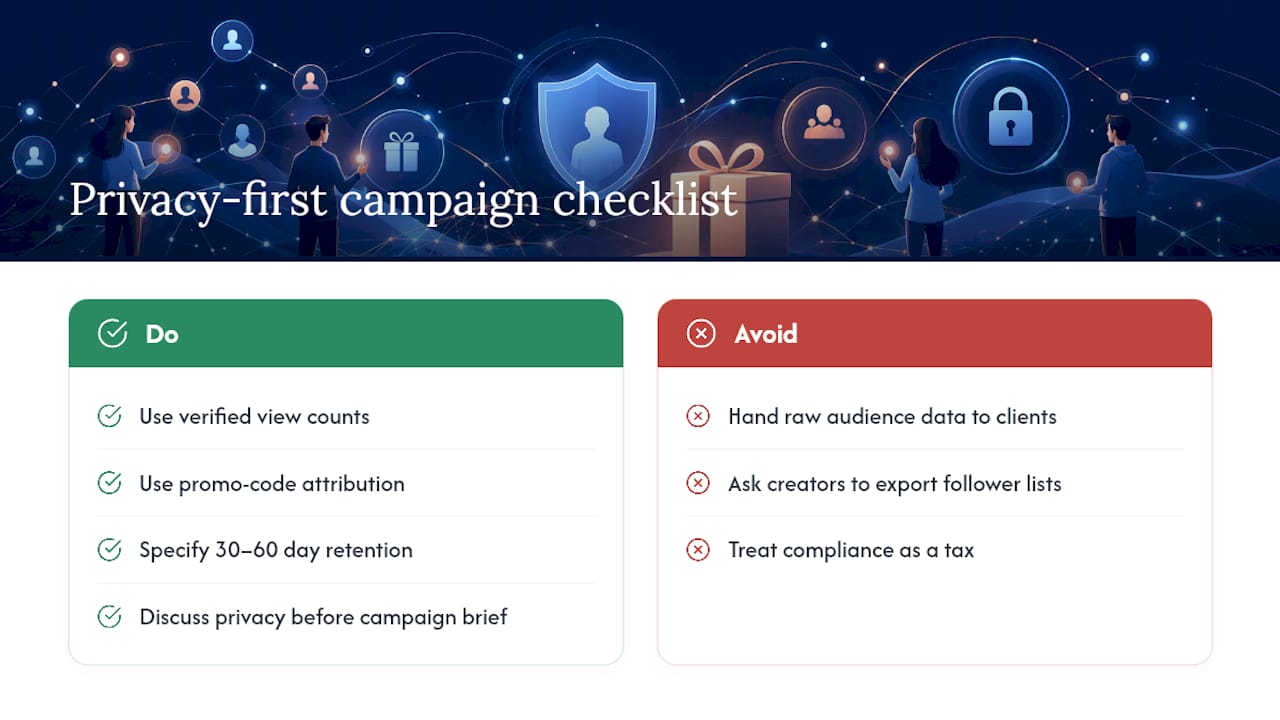
Our standard DPAs specify retention windows in the 30 to 60 day range for campaign-tracking data, sub-processor disclosure requirements, and deletion certification on request. We don't hand raw audience data to clients, and we don't ask creators to export follower lists. The measurement that matters, verified views converting to installs, doesn't require it.
If you want a working privacy-first campaign checklist or a walkthrough of how this applies to your next launch, that conversation is worth having before the campaign brief goes out, not after a regulator asks questions.
— Jax
Run Creator Campaigns Without the Tracking Liability
There are alternatives to invasive-pixel campaigns for consumer app marketers who want proof of performance without the compliance exposure. A commission-only model that pays for verified views rather than projected reach can remove the incentive to over-collect audience data. Clients pay for results delivered by the creator network rather than a retainer that assumes tracking will work.

A privacy-first measurement approach may include short retention windows, no raw audience handoffs to clients, and attribution built around verified views rather than cross-site pixels. This approach can reduce legal exposure per campaign while still providing actionable performance numbers.
If you're launching a user-acquisition push for a consumer app and want guaranteed views without the tracking headaches, start a campaign inquiry with Cult Media and see what a performance-based, privacy-aware creator campaign actually looks like.
Sources
For the legal framework, see the FTC's endorsement guidance and the EPRS briefing on DSA/DMA.
- FTC endorsements guidance
- GDPR compliance in influencer marketing (agency guide)
- Data privacy practices in influencer partnerships — 2026 guide
FAQ
Is Influencer Tracking Legal Under GDPR?
Yes, but only with a documented lawful basis, typically consent for cookies and remarketing pixels, plus a signed DPA with any processor handling the data.
What Data Do Regulators Consider Personal in Influencer Campaigns?
IP addresses, cookie IDs, click IDs tied to a session, device identifiers, and any email or shipping address collected during the campaign all count as personal data.
Do Promo Codes Avoid GDPR Requirements?
Promo codes largely sidestep consent requirements because they attribute sales without collecting cookies or personal identifiers, making them one of the cleanest attribution methods available.
Who Is Liable if a Creator's Landing Page Has a Hidden Pixel?
Liability typically falls on the brand as controller, since the FTC and GDPR both place monitoring responsibility on the advertiser, not the creator, for undisclosed tracking.
How Long Should Consent Logs Be Retained?
Most agency frameworks recommend retaining consent logs for the length of the campaign plus a documented retention window, often 30 to 90 days, followed by a deletion certificate.