App install funnels track every step a person takes from seeing your app to sticking with it, and the priority order rarely changes: fix store listing conversion first, wire up privacy-safe measurement second, then scale paid and creative spend against that foundation. Skip that sequence and you'll pay Apple Search Ads or Meta rates to send traffic into a leaky product page. The mechanisms that make this workable in 2026, Product Page Optimization and SKAdNetwork, get covered in detail below.
TL;DR:
- Correctly sequencing store listing optimization before scaling paid and measurement efforts significantly reduces wasted ad spend and improves funnel performance.
- Product page experiments should focus on one variable at a time, run long enough for statistically confident results, and prioritize icon and visual testing for the biggest conversion gains.
- SKAdNetwork and App AdAttributionKit provide privacy-safe, aggregate attribution data, but require high-volume, high-impact events to be effective for campaign optimization.
- Web landing pages and creator-driven content strategies improve measurement and lead quality for high-ARPU subscription and payment apps, though they may introduce some user friction.
- Building a creator network that guarantees actual views and aligns with measurement systems enhances top-of-funnel volume and lowers CPI in a privacy-conscious environment.
Table of Contents
- What Is an App Install Funnel and Where Do You Lose Users?
- How Product Page Optimization and Custom Product Pages Work
- Measuring iOS Installs Without Third-Party Cookies
- When a Web Funnel Beats a Direct App Store Link
- Creative and Channel Tactics That Actually Lower CPI
- Designing Experiments That Prove Real Lifts
- How Cult Media Runs Creator-First Install Funnels
- Where App Teams Should Focus Next Year
- Get a Creator-First Funnel Built Around Guaranteed Views
- Reference Docs Worth Bookmarking
- Sources
- FAQ
What Is an App Install Funnel and Where Do You Lose Users?
An app install funnel has five stages, and each one bleeds users differently. Discovery brings someone to your store listing through search, an ad, or a recommendation. Product page conversion decides whether that visit turns into a download. First open determines whether the app actually gets used once installed. Engagement covers the early sessions that predict whether someone sticks around. Retention and lifetime value (LTV) measure whether the user ever becomes worth what you paid to acquire them.
Most teams obsess over the middle of this funnel, the download, and ignore the fact that a weak first-open experience quietly erases gains made upstream. A 30% jump in product page conversion means nothing if half of new users delete the app within a day.
Each stage has its own metric, and mixing them up leads to bad decisions:
- Impressions and product page views show how many people saw your listing and how many clicked through to view it in detail.
- Conversion rate measures the percentage of product page views that became downloads. This is the number PPO tests are built to move.
- Installs and cost per install (CPI) tell you volume and price, but neither tells you quality.
- First-open rate flags technical friction: crashes, slow load times, or a broken onboarding funnel.
- Retention cohorts (Day 1, Day 7, Day 30) show whether the product delivers on what the store listing promised.
- LTV ties the whole funnel back to revenue, whether that comes from subscriptions, ads, or in-app purchases.
Your monetization model changes which of these events actually matter downstream. A subscription app cares intensely about trial-start and trial-to-paid conversion. A free-to-play game cares about Day 1 retention and early monetization events. An ecommerce app cares about first purchase and repeat purchase rate. Picking the wrong "north star" event here means optimizing for a number that doesn't move revenue, which is a common reason app install conversion benchmarks get treated as vanity metrics instead of diagnostic tools.
How Product Page Optimization and Custom Product Pages Work
Your store listing is the highest-leverage, lowest-cost lever in the entire funnel, and Apple built two tools specifically to let you test it without touching a line of code.
Product Page Optimization (PPO) lets you run controlled experiments against your default product page using up to three alternate treatments at once, testing icons, screenshots, preview videos, and text. App Analytics reports conversion rate, percentage improvement, and confidence for each treatment as the test runs.
Here's how to structure one:
- Pick one variable per test. Testing a new icon and new screenshots simultaneously tells you a combined effect happened, not which element caused it.
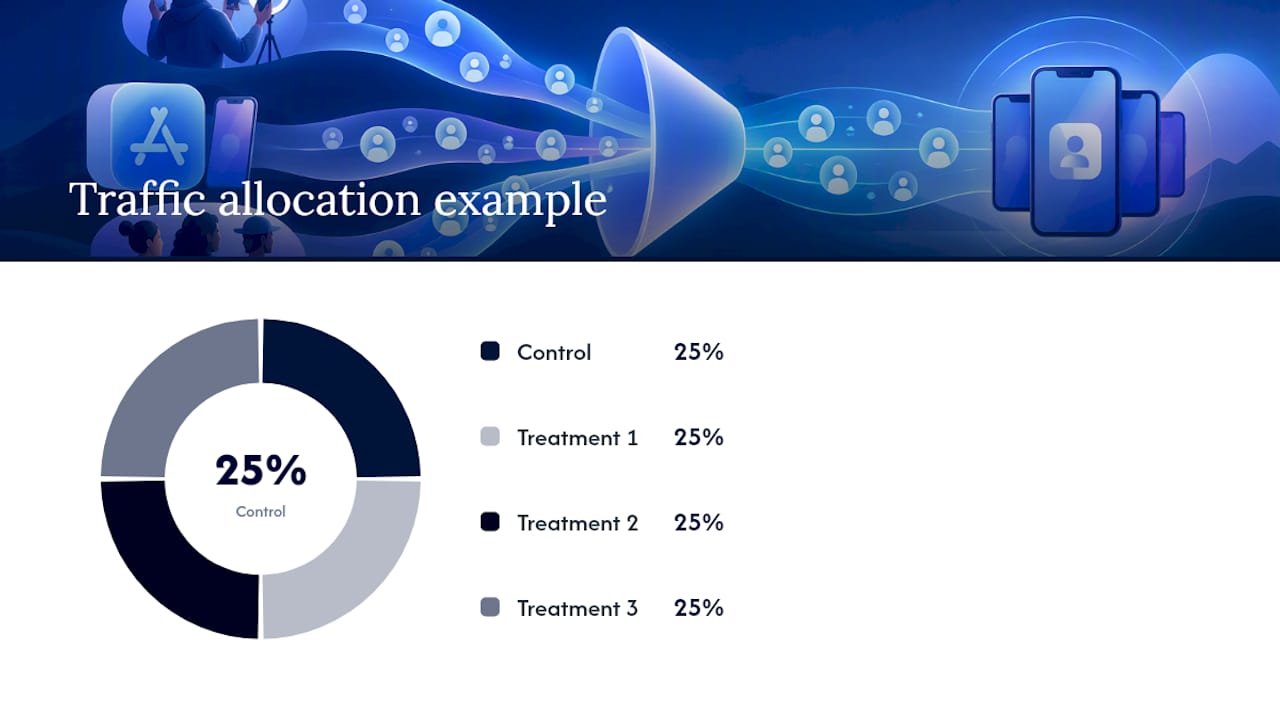
- Set traffic allocation deliberately. A 25/25/25/25 split across a control and three treatments reaches statistical clarity faster than a heavily skewed split, but it also means less traffic reaches your control, so tests on lower-traffic apps often run longer.
- Let the test run to a real sample. Apple requires a minimum of five first-time downloads before a test shows any results at all, and results update daily from there, but five downloads is nowhere near enough to trust a winner.
- Watch for the confidence threshold. Apple's system uses Bayesian methods and typically calls a treatment better or worse only once it clears 90% confidence, which is a meaningfully higher bar than the 95% frequentist significance most marketers were trained on, applied differently.
- Apply the winner, then retest the next variable. Treat this as a rolling program, not a one-time project. Tests can run up to 90 days, but most conclusive results arrive well before that ceiling if traffic volume is healthy.
Pro Tip: Don't waste a PPO test slot on a screenshot order swap when your icon hasn't been tested in over a year. Icon changes tend to move conversion more than any other single element, and most teams under-test them out of fear of "breaking brand."
Custom Product Pages (CPP) solve a different problem: matching your pitch to your traffic source. CPPs let you build tailored product pages for specific audiences or ad campaigns and route paid traffic to a page that speaks directly to that campaign's promise, rather than sending everyone to your generic default listing. The measurement advantage matters more than the creative flexibility: App Analytics reports product page views, downloads, conversion rate, and proceeds per paying user for each custom page, so you can see which campaign-specific pitch brings in the highest-value users, not just the most installs.
Run PPO and CPP together, and the winning creative from your PPO tests becomes the foundation for your CPP variants by channel, which means every dollar spent on testing pays off twice.
Measuring iOS Installs Without Third-Party Cookies
Privacy changes killed granular device-level tracking on iOS, and two Apple frameworks now define what you can and can't see about a given install.
SKAdNetwork (SKAN) is Apple's original privacy-safe attribution framework. It doesn't tell you which user converted; it tells you, in aggregate and with delay, which campaign, creative, and country combination drove a batch of installs, along with a conversion value you define yourself. That conversion value is a number between 0 and 63 (or a fine-grained/coarse value depending on schema version) that you map to post-install events like a completed onboarding step or a first purchase.
App AdAttributionKit is the newer layer that expands on SKAN's basic reporting. It provides signed attribution postbacks for both click-through and view-through installs, with click-through installs attributable for up to 30 days after the click and view-through installs attributable within a 24-hour window. Postbacks typically arrive within 24 to 48 hours depending on your settings and the crowd-anonymity thresholds Apple enforces to protect individual users, and it supports multiple postbacks so you can capture re-engagement and updated conversion values over time, not just the original install.
The practical challenge is schema design: you have a limited number of conversion value slots, and every low-volume event you assign to one wastes signal you could have used on something that matters. The guidance here is consistent across platforms:
- Prioritize high-frequency, high-impact events over rare milestones. A day-3 retention flag is more useful across your whole user base than a rare "reached level 50" event.
- Consolidate campaigns rather than fragmenting them. Google's SKAN guidance recommends aiming for a reliable volume threshold, roughly 50 installs per day per campaign, because splintering budget across a dozen narrow campaigns starves each one of enough signal to optimize against.
- Target events with meaningful daily volume. An event that fires fewer than ten times a day per campaign is close to useless for bidding algorithms trying to learn from it.
- Centralize your schema in one source of truth. Google Ads recommends exporting your conversion value schema from analytics tooling or an attribution partner rather than letting different channels define conflicting event mappings.
- Align biddable events with your schema buckets. If your ad platform bids toward "purchase" but your SKAN schema encodes "Day 1 retention," the algorithm is optimizing blind to what you're actually paying to run.
Pro Tip: Audit your SKAN schema every quarter, not just at launch. Apps that never revisit their conversion value mapping after the initial setup tend to keep optimizing for a milestone that stopped being relevant six months ago.
When a Web Funnel Beats a Direct App Store Link
Web funnels, landing pages that walk a user through a pitch before sending them to the store or straight into a payment flow, became standard practice once privacy changes cut off the granular in-app tracking marketers relied on. A web landing page sits entirely outside Apple's measurement restrictions, which means you can run whatever analytics, personalization, and testing tools you want before a user ever touches the App Store.
This approach pays off most clearly for subscription apps, payment-first products, and anything with high average revenue per user (ARPU). If your business model depends on a trial-to-paid conversion, capturing intent (and sometimes payment or email) before the install preserves signal you'd otherwise lose to Apple's privacy layer entirely.
A working web funnel typically includes:
- A landing page that mirrors or extends your ad creative's promise, rather than a generic marketing homepage.
- A personalized quiz or flow that segments users and tailors the pitch based on their answers, common in fitness, wellness, and finance apps.
- Email or payment capture before the app-store handoff, which both qualifies the lead and gives you a durable identifier independent of device-level tracking.
- Deferred deep links or universal links that carry the user's context (their quiz answers, their selected plan) straight into the app on first open, so they don't have to repeat themselves.
The tradeoff is friction. Every extra step between an ad click and an app install costs you some percentage of users who would have converted directly. Payment-first flows in particular reduce friction paradoxically well for the audiences that convert, because a user who commits to entering payment details on the web is a far stronger signal of intent than a raw app store download, which improves the quality of everyone who makes it through. For a free-to-play game with a low ARPU and impulse-driven installs, that same friction usually isn't worth the measurement gains, and a direct store link still wins.
Creative and Channel Tactics That Actually Lower CPI
Fixing your store listing before you scale paid spend isn't a nice-to-have sequencing preference. It's arithmetic. One playbook example puts it plainly: improving store conversion substantially can sharply reduce CPI for the same ad spend, because the ad dollars didn't change, only the number of people who convert once they land.
Once your store foundation is solid, a few tactics move the needle further:
- Treat your icon, screenshots, and preview video as living creative, not launch-day artifacts. Refresh them on the same cadence you refresh ad creative, since App Store visuals fatigue with repeat viewers the same way Facebook ads do.
- Localize beyond translation. Keyword research and screenshot messaging that work in the US often flop in markets where the core value proposition needs reframing entirely.
- Run creator-led UGC campaigns deliberately, not opportunistically. Creator content that performs well organically tends to drive branded search volume that compounds app-store ranking independent of paid spend, which is a return paid ads alone don't generate.
- Defend your brand terms in Apple Search Ads even when you rank organically for them, since competitors bidding on your name will happily take that traffic if you leave it open.
- Consolidate iOS paid campaigns rather than fragmenting them by micro-audience, both for the SKAN volume reasons covered above and because fragmented campaigns dilute the learning phase of most ad platforms' bidding algorithms.
Pro Tip: If you're running creator content and paid social simultaneously, feed your best-performing organic creator clips directly into your paid campaigns as ad creative. Content that already proved it can hook a cold audience organically tends to outperform anything built specifically for an ad brief.
Third-party ASO platforms, tools like Apptenium's testing features, can help smaller teams run structured keyword and creative experiments when you don't have the internal tooling to manage PPO and CPP tests manually alongside paid campaign data.
Designing Experiments That Prove Real Lifts
A creative test that isn't designed properly will hand you a false winner, and a false winner that gets scaled into paid spend is an expensive mistake. Before launching any test in this funnel, whether it's a PPO variant, a CPP page, or a web funnel landing page, work through this checklist:
- Write the hypothesis first. State what you're changing and why you expect it to move the metric, not just "test new screenshots."
- Pick one primary metric. Conversion rate for store tests, cost per install for paid tests, Day 7 retention for onboarding tests. Secondary metrics can inform, but only one decides the winner.
- Set a minimum detectable effect (MDE). Decide in advance how small a lift is still worth acting on, since tiny, noisy lifts waste testing cycles chasing statistical ghosts.
- Allocate traffic based on your volume, not a default split. Lower-traffic apps need more traffic concentrated per variant to reach a usable sample within a reasonable window.
- Define your stopping rule before you start. Apple's Bayesian confidence approach means you're watching a probability estimate update daily rather than waiting for a fixed p-value, so decide upfront what confidence level triggers a decision, whether that's Apple's own 90% guidance or a stricter internal bar.
- Connect the metric back to revenue before declaring victory. A conversion rate lift that brings in users who churn faster than your baseline isn't a win, it's a trade.
Set a weekly cadence for reviewing test dashboards rather than checking daily, since day-to-day fluctuation in early results is mostly noise and daily checking tempts teams to call winners before confidence has actually stabilized. Tie every store or creative test back to a 90-day operating rhythm, similar to the cadence laid out in a structured B2B roadmap, so testing doesn't become a disconnected side project separate from your actual acquisition budget decisions.
How Cult Media Runs Creator-First Install Funnels
Our workflow starts with the creative brief, not the media plan. We identify which funnel stage is actually underperforming, whether that's product page conversion, first-open completion, or early retention, and build creator content specifically to move that number rather than defaulting to generic brand awareness content.
From there, the sequence runs: creative brief, creator production, paid distribution, landing or store page optimization, then measurement and iteration. Creator content we produce doesn't just feed paid channels. It's designed to perform organically first, which is where the compounding effect on branded search and app-store ranking shows up over a full campaign cycle rather than a single ad set.
We track a consistent dashboard across every campaign: view volume from creator content, landing page conversion where a web funnel is in play, product page conversion once traffic hits the store, install volume, first key event completion, and downstream LTV by cohort. Guaranteed-view creator campaigns feed directly into PPO and CPP testing, since creator-driven traffic often behaves differently than paid social traffic and deserves its own custom product page variant, and into SKAN schema decisions, since the same high-frequency events are mapped across both organic and paid measurement to keep signal consistent.
For teams building out their own short-form creator strategy alongside this funnel work, our YouTube Shorts playbook covers the tactical execution side in more depth.
Where App Teams Should Focus Next Year
The teams that win in a privacy-first environment aren't the ones with the biggest paid budgets. They're the ones who fixed their store conversion and creative before they scaled spend, because every dollar poured into paid acquisition gets multiplied or wasted by whatever conversion rate the store listing already has.
My honest read: too many growth teams treat SKAN and App AdAttributionKit as compliance obstacles to work around instead of measurement systems to design for deliberately. That mindset produces sloppy conversion value schemas stuffed with rare events that generate no usable signal. Set up a simple, high-frequency schema early, even before you think you need the sophistication, and you'll spend far less time reverse-engineering broken attribution six months into a scaled campaign.
Creator-driven demand and web funnels aren't alternatives to paid acquisition. They're what makes paid acquisition efficient in an environment where you can't track every user individually anymore.
— Jax
Get a Creator-First Funnel Built Around Guaranteed Views
Everything in this guide, PPO testing, SKAN schema design, web funnels, works better when the top of the funnel is already producing content people actually want to watch. That's the gap Cult Media fills: a commission-only creator network where you pay for verified, guaranteed views rather than locking into a flat retainer for content that may or may not land.
The creator partnerships offered are built to feed the systems covered above, aim to lower CPI by improving the quality of traffic hitting the store listing, and integrate with reporting through App Analytics and SKAN schema. Instead of guessing which creative might work, creator-produced content is matched to funnel weak points, paid for on a performance basis tied to real views delivered. If your store conversion and measurement setup are solid but your top-of-funnel volume is thin, that's exactly the problem this model solves. Visit the Cult Media creator network to see how a guaranteed-view campaign could plug into your next quarter's install strategy.
Reference Docs Worth Bookmarking
Implementing everything above means working directly from primary documentation rather than secondhand summaries, since Apple and Google update these systems often enough that guides go stale fast.
- Apple's PPO documentation explains treatment limits, confidence thresholds, and test duration in full.
- Apple's Custom Product Pages help page covers how to build and measure campaign-specific pages.
- App AdAttributionKit's developer page details attribution windows and postback mechanics.
- Google's SKAdNetwork setup guidance walks through schema export and campaign measurement integration.
- GoPractice's web funnel guide breaks down landing flow structure for subscription and payment-first apps.
Sources
- Product Page Optimization - Acquisition - App Store Connect Analytics - Help - Apple Developer
- Custom Product Pages - Acquisition - App Store Connect Analytics - Help - Apple Developer
- Google Ads guidance on SKAdNetwork and conversion value schemas
FAQ
What Is the Best Funnel Software for App Installs?
There isn't a single best tool, because "funnel software" for app installs spans App Store Connect's native App Analytics, third-party ASO platforms like Apptenium, and web funnel builders for landing pages outside the app store. Most growth teams combine App Analytics for PPO and CPP data with a separate attribution or analytics tool for SKAN schema management and web funnel tracking.
How Do I Set Up an App Install Funnel?
Start by mapping your five funnel stages, discovery, product page conversion, first open, engagement, and retention, then identify which stage is currently your weakest link using App Analytics data. From there, run a PPO test on your store listing, build a SKAN conversion value schema around your highest-frequency post-install events, and only then scale paid spend against that foundation.
Is Funnel Marketing Outdated?
No, but the tactics have shifted significantly since privacy changes limited device-level tracking. Funnel marketing today relies more on aggregate, privacy-safe signals like SKAN conversion values and web funnel data captured before the app store handoff, rather than the granular per-user tracking that defined the pre-2021 era.
Do I Need a Web Funnel If I Already Have a Good App Store Listing?
Not necessarily. Web funnels pay off most for subscription apps, payment-first products, and high-ARPU apps where capturing intent before the store handoff preserves valuable measurement signal. A free-to-play or impulse-download app with a strong store listing often converts better with a direct link and less friction.
How Does Cult Media Help With App Install Funnels?
Cult Media runs a commission-only creator network that produces guaranteed-view campaigns designed to feed directly into your store optimization and SKAN measurement setup, aiming to lower CPI and raise install quality. Pricing is available on request through the Cult Media site.
Recommended
- Creator Whitelisting: Lower CPA for Consumer Apps
- Modash vs HypeAuditor: Performance Creator Campaigns for App Growth
- Drive Revenue in 72 Hours: Track Influencer Installs for Apps
- TikTok App Marketing: Performance-Based Creator Playbook - Scale Your Consumer App By Unlocking The TikTok & Instagram Systems Behind +20 Billion Views