If your immediate goal is measurable sales with low upfront cost, affiliate marketing is typically the better first step. If your goal is brand trust and consideration, influencer marketing is usually the better investment. Most mature programs eventually run both, since combining the two tends to maximize return, and neither works without disciplined tracking and FTC-compliant disclosure.
TL;DR:
- Affiliate marketing delivers measurable sales using tracking links and cookies, with commissions paid only upon a sale or action.
- Influencer marketing prioritizes brand awareness and trust, with content formats like short videos and UGC driving engagement rather than immediate conversions.
- Blending affiliate and influencer tactics into one creator-led system improves attribution, reduces waste, and maximizes return on investment.
- Measurement methods differ: affiliate tracking relies on attribution windows and analytics tools; influencer impact needs promo codes, UTMs, and view-through metrics.
- A hybrid approach requires clear creative briefs, disclosure compliance, and testing creative concepts before scaling to optimize performance.
Table of Contents
- A Quick Comparison of Affiliate vs Influencer Marketing
- What Affiliate Marketing Is and How It Actually Works
- What Influencer Marketing Is and What Each Creator Tier Delivers
- Operational Differences That Actually Change Your Results
- The Real Pros and Cons of Running an Affiliate Program
- The Real Pros and Cons of Running an Influencer Program
- How to Measure and Attribute Performance Across Both Channels
- Choosing Affiliate, Influencer, or a Hybrid Approach
- Combining Both Into a Single Creator-Led Growth Engine
- A Practitioner's Checklist for Creator-Led Campaigns
- Common Mistakes Growth Teams Make With Creator Programs
- How We Help: A Commission-First Creator Network for App Growth
- FAQ
- Sources
A Quick Comparison of Affiliate vs Influencer Marketing
The two models solve different problems, and conflating them is the most common planning error we see among growth teams. Affiliate marketing is built for measurable sales; influencer marketing is built for awareness and trust, with sales as a secondary, harder-to-isolate outcome.
The practical differences show up in five areas: what you are optimizing for, how you pay partners, how clean your data is, how much creative control you retain, and how long you wait for results.
- Primary objective: affiliates generally drive conversions closer to purchase, while influencers drive awareness and consideration at earlier stages of the funnel.
- Payment structure: affiliates earn commission tied to a sale or action; influencers typically charge a flat fee, sometimes with a performance bonus layered on top.
- Measurement clarity: affiliate performance is trackable down to the click and sale; influencer impact often requires promo codes, UTMs, or view-through modeling to approximate.
- Creative control: brands set strict guidelines for affiliate link placement and disclosure; influencers negotiate more creative freedom, which usually produces more authentic-feeling content.
- Timeline and risk: affiliate programs scale slowly but carry low financial risk per partner; influencer campaigns can produce faster visibility but require upfront spend before any sales materialize.
The industry consensus is shifting toward blending both inside one creator-led growth engine rather than running them as separate budgets. A recent CreatorIQ report found that brands are activating across a diverse mix of boosted posts, sponsored content, affiliate partnerships, and UGC campaigns simultaneously, treating them as one connected system rather than four separate line items.
What Affiliate Marketing Is and How It Actually Works
Affiliate marketing pays a partner a commission when their referral results in a sale, a lead, or another defined action. The mechanics depend on tracking: a unique link or code is assigned to each affiliate, a cookie or server-side event records the referral, and an attribution window (commonly 7 to 30 days, depending on the program) determines how long the affiliate gets credit after the click.
Programs run through two main paths. Affiliate networks (think managed marketplaces that connect brands with publishers) handle tracking, payouts, and compliance in exchange for a platform fee. Direct partnerships skip the network and negotiate terms one-on-one, which usually means better margins but more manual tracking work.
Affiliate partners fall into recognizable behavior patterns:
- Content and review sites that rank for comparison or "best of" searches and convert through contextual links.
- Coupon and deal sites that capture already-intending buyers at the point of purchase.
- Email and loyalty publishers that monetize an existing subscriber list.
- Creator-affiliates who blend content creation with affiliate links, overlapping with influencer tactics.
Commission models vary: cost-per-action (CPA) pays a flat fee per sale, revenue share pays a percentage, and hybrid models combine a smaller flat fee with a percentage kicker for high performers. Payout logistics matter more than most brands expect: affiliates expect timely, predictable payment schedules, and slow payouts are a common reason top performers walk away from a program.
The KPIs that matter are conversion rate (CVR), average order value (AOV), customer acquisition cost (CAC), and affiliate-specific ROI (revenue generated per dollar paid in commission). Fraud risk, including cookie stuffing and fake traffic, requires active monitoring rather than a one-time setup.
Pro Tip: Audit your top 10 affiliates quarterly for traffic quality, not just sales volume: a partner driving high volume with low conversion quality is often a fraud signal before it is a performance problem.
What Influencer Marketing Is and What Each Creator Tier Delivers
Influencer marketing pays creators to produce content that features a brand, typically prioritizing reach and perceived authenticity over direct, trackable sales. The tier a brand chooses changes both the cost and the type of result it can expect.
Nano creators (roughly 1,000 to 10,000 followers) deliver the highest engagement rates and the lowest cost, trading scale for intimacy with a tightly engaged audience. Micro creators (10,000 to 100,000) sit in a similar range and, according to recent industry reporting, are now preferred by 73% of brands for their cost-to-engagement trade-off. Mid-tier and macro creators (100,000-plus) offer broader reach but at a steeper price and often a lower engagement rate per follower.
Content format drives performance as much as follower count does:
- Short-form video (Reels, TikToks, Shorts) tends to outperform static posts for both reach and completion rate.
- User-generated content (UGC) style videos, shot to look native and unscripted, often convert better than polished brand ads because they read as a real recommendation rather than an ad.
- Instagram and TikTok Stories work well for time-sensitive promotions and swipe-up or link-in-bio actions.
- Long-form reviews (YouTube, blog) build consideration for higher-ticket or more technical products.
Deal structures range from one-off sponsored posts to content bundles (several pieces across formats) to long-term ambassador relationships, which build cumulative trust over repeated exposure. Many brands now add performance bonuses on top of a flat fee, rewarding a creator when their content hits an engagement or conversion threshold.
The KPIs that matter here are reach, engagement rate, view-through conversions, and assisted conversions, meaning sales that occurred after exposure to influencer content but were closed through another channel.

Operational Differences That Actually Change Your Results
The comparison above is useful for a quick scan, but five operational factors determine whether either model actually works for your business, and they are easy to underestimate during planning.
- Payment alignment shapes behavior: commission-only affiliates are incentivized purely by conversion, so they gravitate toward tactics that close sales even when those tactics feel less brand-safe; flat-fee influencers are incentivized by brand satisfaction and renewal, which usually produces more polished but less conversion-obsessed content.
- Measurement complexity differs sharply: affiliate attribution is largely solved by existing tracking infrastructure, while influencer attribution typically requires promo codes, UTMs, and multi-touch modeling layered on top, as outlined in our guide to tracking influencer installs for apps.
- Creative control trades off against authenticity: tightly scripted affiliate link placement is easy to enforce; influencer content performs best with creative latitude, which means brands trade some control for content that feels less like advertising.
- Speed to optimization compounds over time: affiliate programs generate clean conversion data almost immediately, letting teams reallocate budget to top performers within weeks; influencer programs need more campaigns before patterns in creative and creator fit become statistically useful.
- Fraud and trust risks differ by channel: affiliate programs face cookie stuffing and fake-traffic risk, while influencer programs face fake-follower risk and disclosure non-compliance, both of which the FTC's Endorsement Guides treat as a material connection that must be disclosed clearly and placed with the endorsement itself.
The Real Pros and Cons of Running an Affiliate Program
Affiliate programs appeal to growth teams because the unit economics are predictable: you pay only when a result occurs, which makes budgeting and forecasting straightforward.
- Pay-for-performance structure keeps spend tied directly to revenue, protecting margin during slow periods.
- Scale through partners lets a small internal team manage hundreds of publishers without producing content directly.
- Predictable unit economics make affiliate ROI one of the easiest growth channels to model and defend in a budget review.
The drawbacks are just as real. Brands have limited creative control over how affiliates represent the product, which creates inconsistent messaging across the program. Partner quality varies widely, from high-intent content sites to low-value coupon pages that primarily capture customers who would have purchased anyway, a pattern sometimes called channel cannibalization.
Operationally, payout timing matters more than most new program managers expect: affiliates evaluate programs partly on how reliably and quickly they get paid, and slow payment cycles drive away your best partners first. Contract terms should specify attribution windows, prohibited tactics (like bidding on branded search terms), and clear fraud-detection rules, since cookie stuffing and incentivized fake traffic are the two most common abuse patterns in unmanaged programs.
The Real Pros and Cons of Running an Influencer Program
Influencer marketing earns its budget through trust. A recommendation from a creator an audience already follows tends to carry more credibility than a brand ad, and the content produced often has a longer shelf life, getting reused in paid ads, on product pages, or in email long after the original post.
- Trusted storytelling builds consideration faster than direct-response ads for unfamiliar products.
- Higher-quality creative assets can be repurposed across paid and organic channels well beyond the original campaign.
- Stronger top-of-funnel lift shows up in branded search and direct traffic even when individual posts are hard to attribute directly.
The drawbacks center on measurement and risk. Attribution is inherently harder since a viewer rarely clicks a link the moment they see a post, and upfront spend is usually required before any results appear, unlike commission-only affiliate deals. Brand safety is a real concern: a poorly vetted creator can create reputational risk, and a mismatched creator-audience fit wastes budget regardless of follower count.
Operational discipline reduces most of this risk. Content approval workflows should be agreed upon before filming, disclosure rules need to be written into every contract rather than left to creator discretion, and contracts should specify usage rights, exclusivity terms, and revision limits upfront.
Pro Tip: Build disclosure language directly into the content brief, not just the contract: creators are far more likely to disclose correctly when the exact wording and placement are provided rather than implied.
How to Measure and Attribute Performance Across Both Channels
Measurement is where most affiliate and influencer programs succeed or fail, and the tactics differ meaningfully between the two.
For affiliate tracking:
- Assign unique links or codes per partner, never a shared generic link, so performance can be isolated.
- Decide between network-based tracking (easier setup, platform fee) and direct server-side tracking (more control, more engineering lift).
- Set attribution windows deliberately. A shorter window favors last-click tactics; a longer window gives credit for influence further from the sale.
For influencer tracking, UTM parameters, dedicated promo codes, and view-through attribution models fill the gap that affiliate-style links leave in awareness-driven content. A disclosure-focused study found that experienced creators increasingly adopt their own first-party tracking or custom codes, which gives brands a clearer signal alongside standard UTM tracking.
The KPIs worth insisting on across both channels:
- CPA or CAC, to compare cost-efficiency across channels on equal footing.
- ROAS, to tie spend directly to revenue.
- Assisted conversions, to credit influencer-driven awareness that closes through another channel.
- Engagement-to-conversion ratio, to flag content that generates attention without driving action.
- LTV uplift, to see whether influencer-acquired customers retain differently than affiliate-acquired ones.
Our campaign reporting guide and our analytics tool comparison cover platform selection in more depth, and practical reporting frameworks like the one in Growth Reach Marketing's ROI playbook illustrate how service businesses structure similar reporting even outside ecommerce.
Choosing Affiliate, Influencer, or a Hybrid Approach
The right starting point depends on a short diagnostic, not a coin flip.
- Define the primary goal. If it is immediate sales with tight budget control, start affiliate. If it is building trust for a new or unfamiliar product, start influencer.
- Check your margin. Thin margins favor commission-only affiliate structures, since you only pay for completed sales. Healthier margins can absorb the upfront cost of influencer fees.
- Consider the sales cycle. Short, impulse-driven purchases suit affiliate links placed at the point of decision. Longer consideration cycles benefit from influencer content that builds familiarity over multiple touches.
- Look at repeat purchase rate. High-LTV, repeat-purchase products justify influencer spend because the payback period extends across future orders, not just the first sale.
- Assess your organic awareness baseline. A brand with little existing recognition usually needs influencer-driven trust-building before affiliate links have an audience worth converting.
As a rule of thumb: new brands with no existing demand should weight budget toward influencer awareness first, then layer affiliates once there is traffic to convert. Established brands with existing demand and high-LTV products often get the fastest ROI from a hybrid launch, as detailed in our influencer budgeting framework.
Combining Both Into a Single Creator-Led Growth Engine
The highest-performing programs no longer treat affiliate and influencer as separate budgets. Sprout Social's analysis describes brands assigning affiliate links or unique promo codes directly to influencers, which closes the attribution loop while preserving the creator's natural voice.
Common hybrid structures include:
- Giving long-term creators an affiliate link or code alongside their flat fee, so upfront awareness spend also generates trackable conversions.
- Adding performance bonuses to ambassador contracts, rewarding creators whose content drives measurable sales beyond the base fee.
- Using creator whitelisting to run paid ads directly through a creator's handle, which often lowers CPA compared to standard brand-run ads.
- Testing organic influencer content first, then amplifying the top performer with paid distribution once it proves out.
Briefing creators for this kind of hybrid work requires specificity: clear placement instructions for the link or code, a tight call to action, tracking parameters built into the brief itself, and guardrails that preserve the authentic tone that made the content work in the first place. Our breakdown of UGC versus influencer content goes deeper into which format fits which stage of this funnel.
A Practitioner's Checklist for Creator-Led Campaigns
Running affiliate and influencer tactics as one system, rather than two silos, comes down to a few repeatable operational habits.
- Creative brief: specify native format, the key moment the product should appear, and a single, clear call to action; vague briefs produce content that looks like an ad rather than a recommendation.
- Distribution mix: launch organically first, then amplify the top-performing piece with paid media rather than guessing which concept to boost in advance.
- Compliance checklist: confirm disclosure wording and placement before a single piece of content goes live, following FTC endorsement guidance and our own disclosure rules breakdown.
- Optimization cadence: test three creative concepts, identify the top performer within the first 3 to 7 days, then shift paid budget toward it while converting remaining interest with affiliate links or promo codes.
Pro Tip: Treat the first week of any new creative concept as a test, not a launch: the fastest way to waste a media budget is scaling a concept before you know which one actually works.
Common Mistakes Growth Teams Make With Creator Programs
The biggest mistake is treating affiliates and influencers as separate departments with separate budgets and separate success metrics. That separation hides the obvious move: giving a trusted influencer an affiliate code and letting one piece of content do both jobs.

The second mistake is chasing vanity metrics, like follower count or raw impressions, without mapping them to an actual conversion pathway. A creator with modest reach but a clear path to purchase will usually outperform a larger creator whose audience never converts.
The third, and most consequential long-term, is treating disclosure as a legal checkbox instead of a trust signal. Transparent disclosure protects the relationship with your audience far longer than it costs you in short-term clicks.
— Jax
How We Help: A Commission-First Creator Network for App Growth
We run a commission-only creator network built for consumer tech apps that need creator-driven growth without committing to upfront influencer fees before results are proven. Instead of paying for exposure and hoping it converts, we tie our pricing to verified organic views, which keeps the financial risk on performance rather than on your budget.
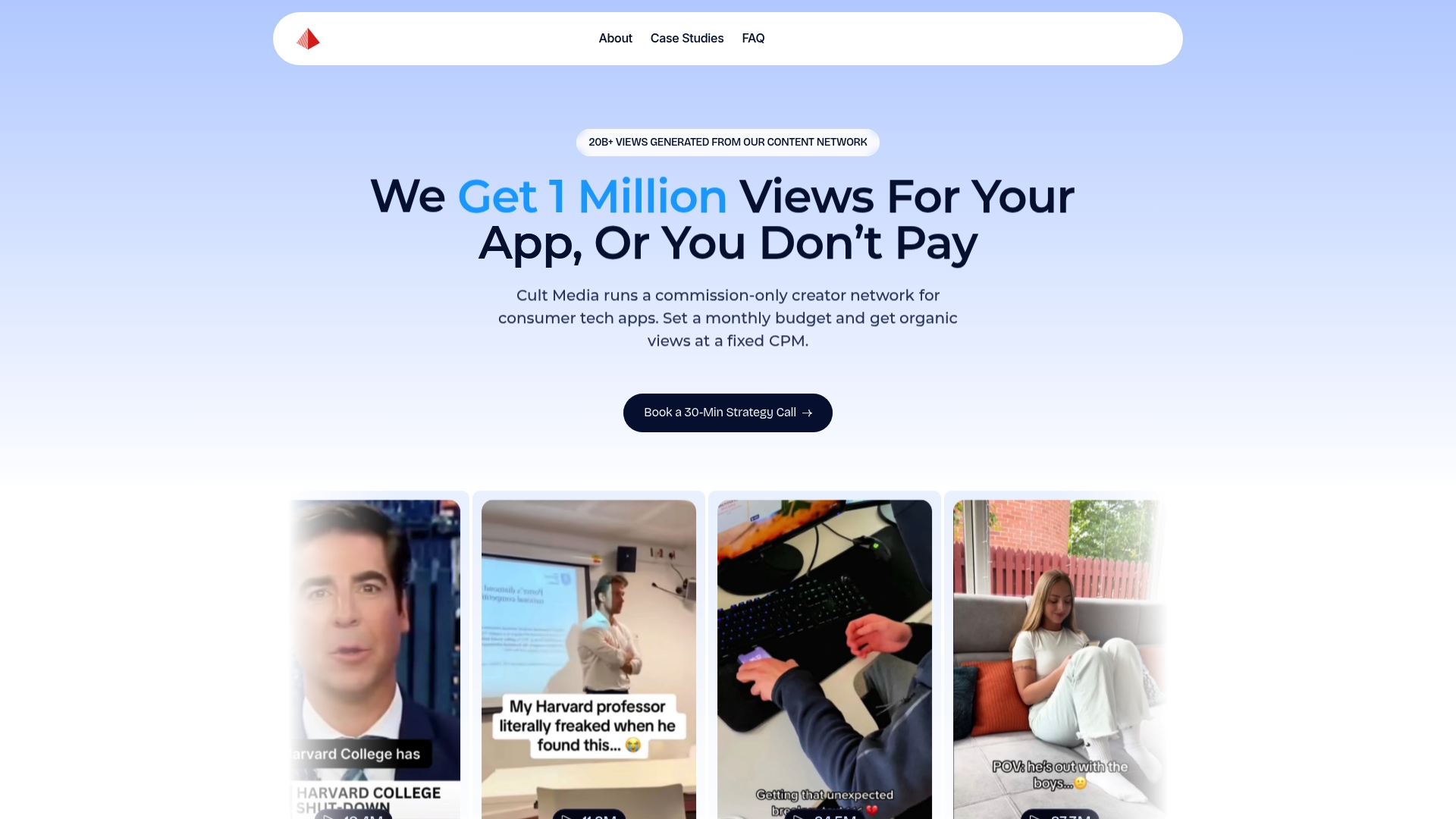
Our model combines custom-built UGC strategy, end-to-end creator management, and multi-platform distribution, then applies performance data to improve what gets made and where it runs. This fits consumer app teams and growth marketers who want a managed creator engine without hiring an internal team to run it.
- We handle creative strategy, creator sourcing, and distribution as one connected process, not separate vendors.
- Pricing aligns with delivered results.
- Our case studies show outcomes like 42,500 signups at $0.28 each for a consumer finance app.
If this fits how your team wants to grow, start with our commission-only creator network and see how a performance-first creator engine could apply to your app.
FAQ
What is the main difference between affiliate and influencer marketing?
Affiliate marketing pays a commission tied to a specific sale or action, while influencer marketing typically pays a flat fee for content focused on awareness and trust. Affiliate performance is directly trackable through links and codes, while influencer impact usually requires promo codes, UTMs, or view-through modeling to approximate.
Can affiliate and influencer marketing work together?
Yes, many brands now give influencers an affiliate link or unique promo code so their content drives both awareness and trackable sales. Industry reporting shows brands increasingly blending boosted posts, sponsored content, affiliate partnerships, and UGC into one creator-led strategy.
Do influencers have to disclose affiliate links or sponsorships?
Yes. FTC endorsement guidance requires clear, conspicuous disclosure of material connections, including affiliate links, free products, and paid sponsorships, placed with the endorsement itself rather than buried in a bio or caption.
Does requiring disclosure hurt engagement or sales?
Research on disclosure requirements found that transparency rules can reduce short-term engagement with affiliated content, but disclosures mitigate the negative effect and protect long-term audience trust. Creators with established credibility tend to see a smaller drop when disclosing clearly.
How much does a commission-only creator network cost?
Pricing for our commission-only creator network is tied to verified organic views delivered by the creator network rather than a flat fee, and specific terms are available on request through Cult Media.
Sources
- FTC's Endorsement Guides: What People Are Asking | Federal Trade Commission
- Creator Marketing Enters the Era of Efficacy: Brands Demand Scalable ROI as Creator Budgets Surge 171%, CreatorIQ Report Finds
- Affiliate marketing vs. influencer marketing — Sprout Social
- Academic paper on FTC policy effects on viewer engagement with affiliated content