Micro influencers win on conversion and ROI; macro influencers win on reach and awareness. That single rule of thumb holds across most U.S. campaigns, and 77% of consumers say they prefer influencer-generated content rather than professionally scripted ads, which is why performance-focused brands increasingly default to micro-first strategies before scaling up.
- Conversion and CPA goals: Test 4–8 micro creators (10K–100K followers) on a performance or commission model. Expect higher engagement rates and lower CPE.
- Awareness and reach goals: Allocate macro or mega talent with large followings for broad impressions, PR moments, or product launches that need immediate scale.
- Hybrid or uncertain objectives: Sequence tiers, starting with micro for proof-of-concept and layering in macro once creative is validated. Performance-based partners that tie payment to verified views, like Cult Media's commission-only model, reduce upfront risk at either tier.
Key Takeaways
Micro influencers consistently deliver lower CPE and stronger conversion signals for performance campaigns, while macro influencers remain the most efficient tool for generating absolute impressions at scale.
| Point | Details |
|---|---|
| Micro for conversion, macro for awareness | Match the tier to your KPI: micro for CPA/CPE goals, macro for impressions and brand lift. |
| Engagement rate vs. absolute interactions | A 5% rate on 50K followers yields fewer total interactions than 1.5% on 700K; always model both. |
| CPE modeling changes the budget math | Pooling 4–8 micro creators at $100–$500 each often beats one macro post at $5,000–$25,000 on both CPE and CPA. |
| Hybrid sequencing reduces creative risk | Run micro creators first to validate messaging, then activate macro talent with proven creative angles. |
| Performance-based models align incentives | Commission or guaranteed-view structures tie creator payment to verified outcomes, not vanity metrics. |
Table of Contents
- How micro vs macro influencers are actually defined
- Head-to-head: comparing the metrics that matter
- When to use each tier: campaign types and activation notes
- Pricing models and how to measure campaign ROI
- How to choose the right influencer: a vetting checklist
- How to run a hybrid micro-plus-macro campaign
- What the data actually says about engagement, CPE, and scale
- Where most brands get this wrong
- Cult Media's performance-based creator network
- Sources
- FAQ
How micro vs macro influencers are actually defined
The industry has no single governing standard for follower ranges, but most U.S. marketers and platforms converge on five tiers:
| Tier | Follower Range | Typical Platform Context |
|---|---|---|
| Nano | 1K–10K | Instagram, TikTok, niche communities |
| Micro | 10K–100K | Instagram, TikTok, YouTube Shorts |
| Mid-tier | 100K–500K | Instagram, YouTube, TikTok |
| Macro | 500K–1M | Multi-platform, national reach |
| Mega/Celebrity | 1M+ | All platforms, mass-market |
Shopify's influencer playbook places micro creators at roughly 10K–100K followers and highlights their accessibility for scalable, long-term partnerships. That range is the most widely cited in U.S. practitioner guides, though YouTube creators often command higher thresholds before they're classified as macro, given the platform's longer-form format and different monetization dynamics.
Follower count is only a starting point. Audience fit, content niche, and engagement quality determine whether a creator actually moves your KPI. The FTC's endorsement guidelines require clear disclosure at every tier, and platforms like Instagram and TikTok have built-in paid-partnership labels that satisfy this requirement when used correctly.
Head-to-head: comparing the metrics that matter
The table below maps the eight dimensions marketing teams use most often in internal briefs and vendor selection.
| Dimension | Micro (10K–100K) | Macro (500K–1M+) |
|---|---|---|
| Reach (impressions) | Limited per post; scalable by pooling creators | High per post; single-creator scale |
| Engagement rate | 3–8% on Instagram (often higher on TikTok) | 1–3% on Instagram; lower on average |
| Absolute interactions | Lower per creator; higher when 10+ creators run simultaneously | High per post from one creator |
| Cost per post | Lower flat fees; often commission-eligible | Higher flat fees; rarely performance-based |
| Content production | Creator-led UGC; minimal brand production overhead | Often requires brand briefs, legal review, and agent negotiation |
| Authenticity / audience fit | High; niche audiences trust creator recommendations | Moderate; broader audience, lower personal connection |
| Availability / scalability | High; easier scheduling and approvals | Lower; managed by agents, longer lead times |
| Best KPIs | CPE, CPA, conversion rate, UGC volume | Impressions, brand lift, share of voice |
The engagement-rate gap is real, but it can mislead. For pure awareness volume, that macro post wins on raw numbers. For CPE and conversion efficiency, the micro creator often wins once you factor in audience relevance and cost.
Pro Tip: Always calculate absolute interactions alongside engagement percentage. A high engagement rate on a small audience can still produce fewer total touchpoints than a lower rate on a large one. Match the metric to your KPI before declaring a winner.
When to use each tier: campaign types and activation notes
Campaign objective is the clearest signal for which tier to activate. Here's how common campaign types map to the right choice:
Micro influencers are the stronger fit for:
-
Performance acquisition campaigns: 6–12 micro creators posting 2–3 times each over 4–6 weeks generates content volume, A/B testing data, and conversion signals at manageable CPE. Ideal for app installs, DTC product trials, and subscription sign-ups.
-
UGC sourcing: Micro creators produce authentic, platform-native content that brands can repurpose across paid channels. Whitelisting that content for paid amplification frequently lowers CPA compared to studio-produced creative.
-
Niche community activation: A creator with 30K followers in a specific vertical (personal finance, home fitness, indie gaming) reaches a pre-qualified audience that a macro generalist cannot replicate.
-
Event RSVPs and local launches: Micro creators with geographically concentrated audiences drive foot traffic and local sign-ups more efficiently than national macro talent.
Macro influencers are the stronger fit for:
- Brand awareness and PR moments: A single macro post can generate millions of impressions in 24–48 hours, making it the right tool for product launches, rebrands, or cultural moments where speed and scale matter more than conversion rate.
- Seasonal flash sales: High-reach posts timed to a sale window (Black Friday, back-to-school) create urgency at scale. Pair with a trackable promo code to measure direct attribution.
- Credibility signaling: For new brands entering a competitive category, a single macro placement can establish legitimacy quickly, particularly in beauty, fashion, and consumer tech.
Hybrid is preferable when:
- You need both proof-of-concept data and broad reach in the same campaign window.
- Your creative hasn't been validated yet. Micro creators test messaging at low cost before you commit macro budget.
- The product has a long consideration cycle. Micro creators build trust over time; macro creates the initial awareness spike.
Pricing models and how to measure campaign ROI
Influencer pricing in the U.S. follows several distinct models, and the right one depends on your campaign objective and risk tolerance.
Common pricing structures:
- Flat fee per post: Fixed payment regardless of performance. Common for macro and mid-tier talent. Predictable budget, but no performance guarantee.
- Performance / commission: Creator earns based on verified views, clicks, or conversions. Aligns creator incentives with brand outcomes. More common with micro and nano tiers.
- Affiliate / CPA: Creator earns a percentage of sales driven by a unique link or code. Low upfront cost, but requires robust tracking and works best with high-converting products.
- Whitelisting / usage rights: Brand pays to run paid ads through the creator's account. Typically adds 20–30% to the base rate but often delivers lower CPA than brand-owned creative.
- Retainer / ambassador: Monthly fee for ongoing content and exclusivity. Builds long-term brand association; best suited for micro creators with strong audience loyalty.
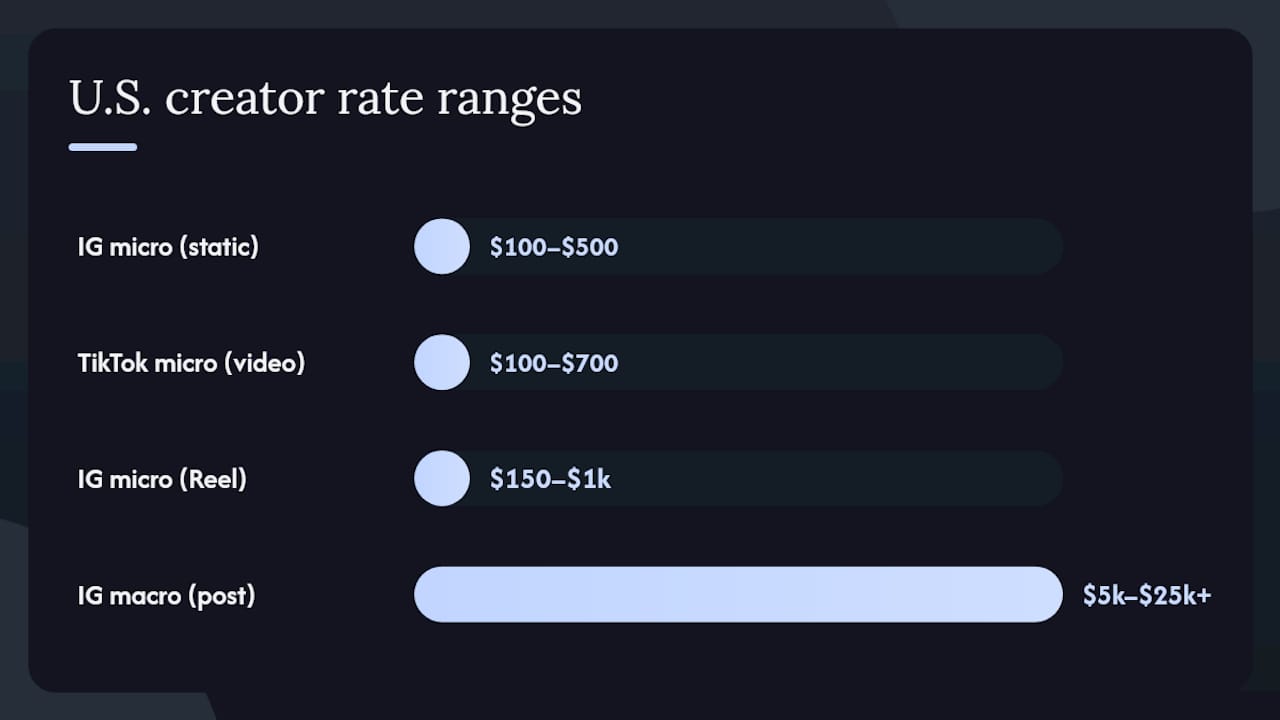
Ballpark U.S. rate ranges vary significantly by platform and format. On Instagram, micro creators typically charge $100–$500 per post for static content and $150–$1,000 for Reels. Macro creators on the same platform often command $5,000–$25,000+ per post. TikTok rates tend to run slightly lower for micro creators ($100–$700 per video) but can spike for macro talent with proven virality.
Measuring ROI: the metrics that matter
Cost per engagement (CPE) = Total spend ÷ Total engagements (likes + comments + shares + saves). Use CPE to compare creative buys across tiers on an apples-to-apples basis.
Cost per acquisition (CPA) = Total spend ÷ Total conversions (installs, purchases, sign-ups). CPA is the definitive metric for performance campaigns. If your CPA target is $8 per app install, a micro creator delivering 500 installs at $3,000 spend ($6 CPA) beats a macro creator delivering 1,200 installs at $18,000 spend ($15 CPA), even though the macro post generated more absolute conversions.
A common reporting pitfall: teams track engagement rate but not absolute interactions, or track impressions but not conversion rate. Neither metric alone tells the full story. For awareness campaigns, report impressions and reach. For performance campaigns, report CPA and conversion rate. Mixing the two in a single KPI dashboard creates misleading conclusions about which tier is "working."
The global influencer market has grown into a multi-billion-dollar industry, which means more creators, more pricing variance, and more need for rigorous CPE modeling before committing budget.
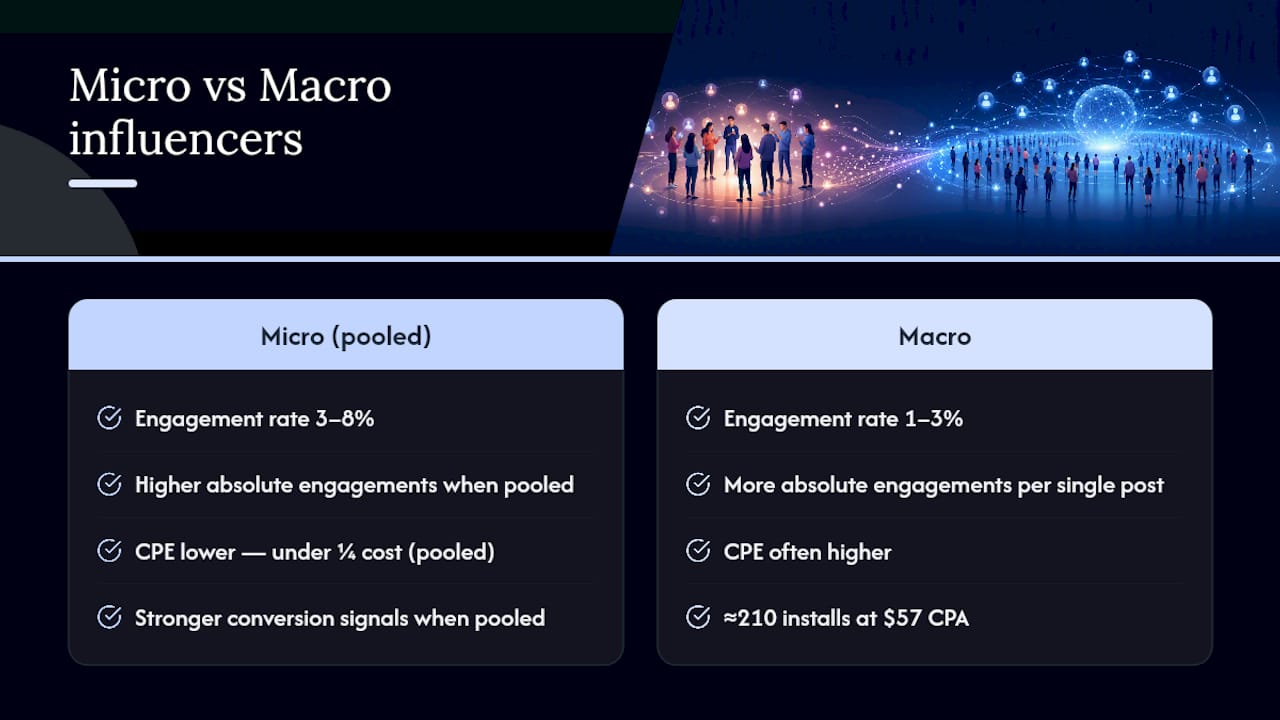
Statistic to cite in planning docs: Instagram micro influencers average 3–8% engagement, while macro influencers typically average 1–3%. At equal spend, that gap often translates directly to a lower CPE for micro-tier buys.
How to choose the right influencer: a vetting checklist
Use this checklist during outreach, vetting, and contracting to reduce risk and protect campaign ROI.
- Define your KPI first. Is the goal CPA, CPE, impressions, or UGC volume? The answer determines which tier to prioritize before you look at a single creator profile.
- Check audience quality, not just follower count. Use a platform analytics tool or request a media kit. Look for audience demographics (age, gender, geography), follower growth trajectory, and any sudden spikes that signal purchased followers. Cult Media's creator audience quality checklist outlines the specific signals to audit.
- Audit engagement authenticity. Review the comment section. Generic comments ("great post!", emoji-only replies) at high volume suggest bot activity. Genuine engagement shows specific, conversational responses to the content.
- Assess content fit and brand safety. Scroll 60–90 days of content. Does the creator's tone, production quality, and subject matter align with your brand? Have they promoted direct competitors recently?
- Request past performance data. Ask for screenshots of post-level analytics: reach, impressions, saves, link clicks, and story swipe-up rates if applicable. Creators who can't or won't share this data are a red flag for performance campaigns.
- Verify geography and demographics. A creator with 80K followers but 60% international audience delivers far less value to a U.S.-only campaign than their follower count suggests.
- Confirm disclosure compliance. Every paid partnership in the U.S. requires FTC-compliant disclosure. Confirm the creator understands this and has used paid-partnership labels or #ad tags correctly in past sponsored content. Academic and watchdog research on social media influencer credibility underscores why disclosure and brand-safety vetting remain non-negotiable at scale.
- Negotiate contract essentials. A solid influencer contract covers: deliverables (post count, format, platform), posting window (specific dates and times), usage rights (duration, channels, paid amplification), exclusivity (category and duration), revision rounds, payment triggers (post-publish or performance milestone), and FTC disclosure requirements.
- Set measurement and reporting expectations upfront. Agree on which metrics will be reported, how, and when. For performance campaigns, define the tracking mechanism (UTM link, promo code, pixel) before the brief goes out.
- Plan for post-campaign analysis. Document CPE, CPA, and content performance by creator. This data informs tier selection and creator retention for the next campaign cycle.
Pro Tip: For time-sensitive campaigns, micro creators are operationally faster. They're typically self-managed, respond to briefs within 24–48 hours, and don't require agent negotiation. Macro talent often needs 4–6 weeks of lead time and multiple approval rounds.
How to run a hybrid micro-plus-macro campaign
Combining both tiers in one campaign captures credibility at the niche level and scale at the mass level. Three approaches work consistently:
Sequential funnel
Run micro creators first (weeks 1–3) to generate UGC, test messaging, and collect conversion data. Identify the top-performing creative angles. Then activate one or two macro creators (weeks 4–6) using the validated messaging. This approach reduces the risk of committing large macro budgets to unproven creative. Roster's practitioner analysis supports this sequencing model for DTC brands, noting that micro creators often occupy the revenue sweet spot before macro amplification.
Simultaneous reinforcement
Launch micro and macro creators in the same week for a product launch or seasonal campaign. Macro creates the awareness spike; micro creators generate the social proof and conversion content that captures the demand the macro post created.
Content sourcing plus paid amplification
Commission micro creators primarily for UGC production. Whitelist the best-performing content and run it as paid social through the creator's account or your own. This model extracts maximum value from micro-creator authenticity while using paid distribution to reach macro-level audiences. Organic vs. paid view dynamics matter here: organic creator posts build trust signals, while paid amplification scales reach without the flat-fee cost of a macro placement.
Budget modeling example: A $30,000 campaign budget could fund one macro post at $20,000 plus five micro posts at $2,000 each. The right split depends on whether your primary KPI is impressions (favor macro) or CPE/CPA (favor micro pool).
Pro Tip: Creative consistency is the biggest operational risk in hybrid campaigns. Brief all creators on the same core message, visual cues, and CTA before launch. Use a shared asset folder with approved logos, product shots, and copy guidelines to prevent brand drift across 15+ creator posts.
What the data actually says about engagement, CPE, and scale
The engagement-rate advantage for micro creators is well-documented. Instagram micro influencers commonly average 3–8% engagement, while macro influencers typically sit at 1–3%, according to InfluencerFee's quantitative framework. That gap narrows on TikTok, where algorithmic distribution can give any creator outsized reach regardless of follower count.
The more useful calculation for planning is CPE modeling. A macro creator with a large follower count and lower engagement rate typically generates more absolute engagements but often at higher cost per engagement. To match the macro creator's absolute engagement volume using multiple micro creators at similar cost effectiveness, you would need several micro posts whose combined engagements approximate the macro post's total. The micro pool delivers more engagements at less than a quarter of the cost.
The macro post generates approximately 210 installs at $57 CPA. For consumer app acquisition, that difference is the entire business case for micro-first strategies.
That said, absolute interaction volume still favors macro for awareness objectives. And for product categories where credibility transfer from a single recognizable name matters (luxury goods, enterprise software, mass-market CPG), a macro placement may justify its premium. The right answer is always KPI-specific.
InfluencerFee's analysis of micro vs. nano influencers also shows that pooling multiple micro creators frequently delivers stronger conversion signals than a single macro post at equivalent spend, reinforcing the case for creator diversification in performance campaigns.
Where most brands get this wrong
The most common mistake is treating follower count as a proxy for campaign value. A brand manager sees 1.2 million followers and assumes the post will move the needle. It might, on impressions. But if the audience skews international, the engagement is passive, and there's no performance accountability in the contract, that macro spend often delivers less measurable ROI than a well-structured micro pool at a fraction of the cost.
The second mistake is running one-off macro placements without follow-through. A single macro post creates a spike, not a trend. Without micro-creator reinforcement, social proof, or retargeting, that awareness dissipates within 48–72 hours. The brands that consistently outperform on influencer ROI treat macro as the top of a funnel, not the whole funnel.
The third mistake is ignoring CPE entirely and optimizing for engagement rate alone. Higher engagement rates for micro creators don't guarantee better campaign value on their own. Cost-per-engagement and eventual conversion rate versus spend are the true measures.
The fix is structural: build a performance-based buying model from the start. Commission-only or guaranteed-view structures, like those Cult Media uses for consumer app campaigns, tie payment to verified outcomes rather than vanity metrics. That alignment changes how creators approach content and how brands measure success. For app-focused growth teams, a performance-based creator playbook that maps creator tiers to verified view targets and CPA benchmarks is the most reliable way to de-risk influencer spend.
Cult Media's performance-based creator network
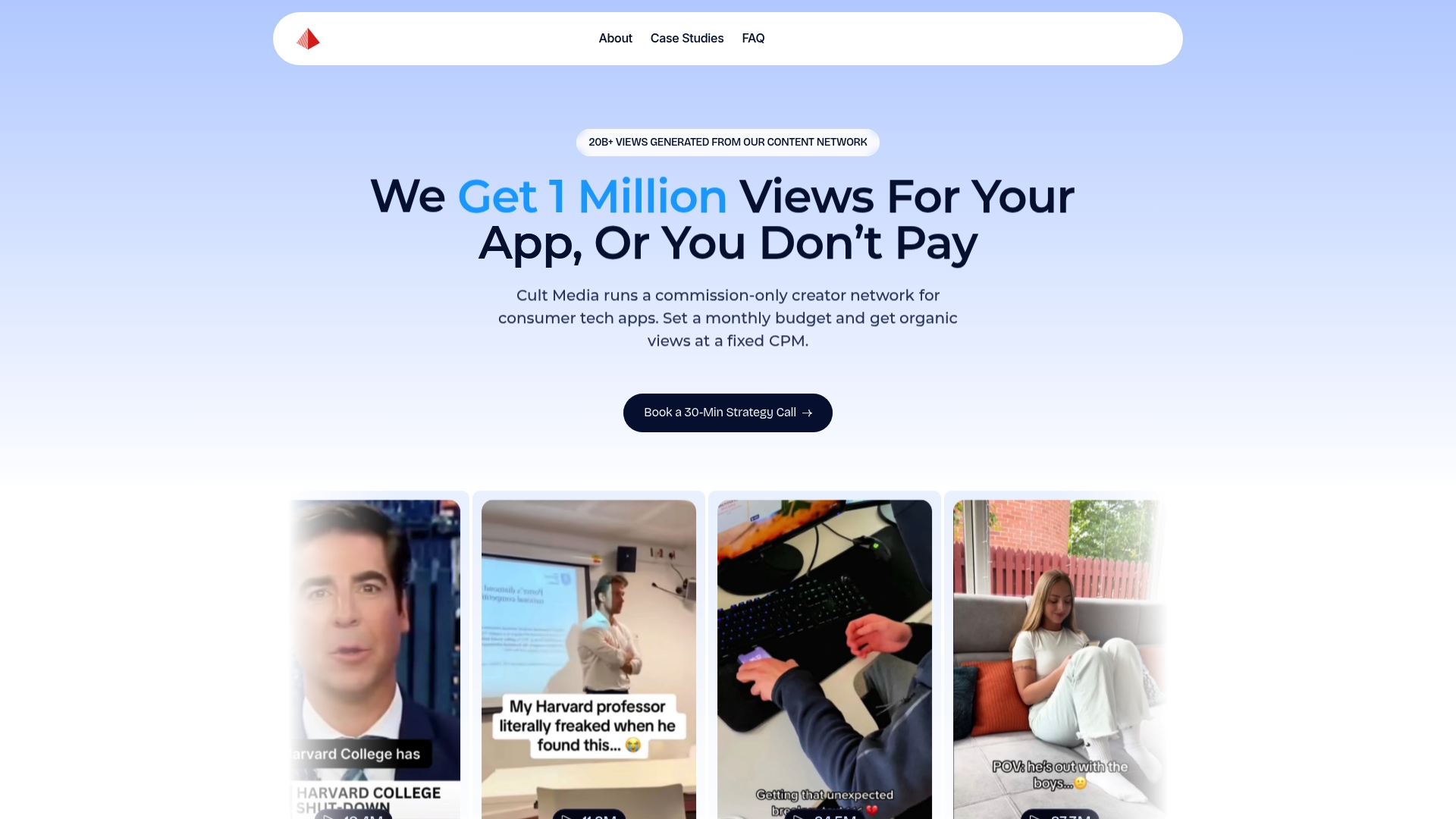
Consumer app teams that need guaranteed results from creator campaigns don't have to choose between micro reach and macro scale. Cult Media's commission-only creator network delivers guaranteed views on TikTok and Instagram, with payment tied to verified organic performance rather than flat fees or retainers. Every campaign is built around a custom UGC strategy, end-to-end creator management, and high-conversion content formats proven across 20+ billion tracked views.
If your CPA target isn't being met by traditional influencer buys, see how Cult Media structures performance-based campaigns for consumer tech apps.
Sources
- Micro Influencers in 2026: Playbook for Cost, Compliance, and Conversion - Shopify
- Global influencer market size — Statista
FAQ
What is the difference between a micro and macro influencer?
Macro influencers have 500K–1M+ followers, generate greater absolute impressions per post, and are better suited for broad awareness campaigns.
What are the four main types of influencers?
Most practitioners recognize nano (1K–10K), micro (10K–100K), macro (500K–1M), and mega or celebrity (1M+) as the four primary tiers, with mid-tier (100K–500K) often added as a fifth category in detailed planning frameworks.
When does a micro influencer outperform a macro influencer?
Micro influencers tend to outperform on performance campaigns where CPE and CPA are the primary KPIs. Their niche audiences, higher engagement rates, and lower flat fees typically produce a lower cost per acquisition for conversion-driven objectives like app installs or DTC purchases.
What is an example of a macro influencer campaign?
A consumer tech brand launching a new product might partner with a macro creator who has 500K–1M followers to generate millions of impressions in a 24–48 hour window, using a trackable promo code to measure direct attribution alongside the awareness lift.
Do micro influencers require FTC disclosure?
Yes. FTC endorsement guidelines apply at every follower tier in the United States. Any paid partnership, gifted product, or affiliate arrangement requires clear disclosure, typically via Instagram's paid-partnership label, TikTok's branded content toggle, or an explicit #ad tag in the caption.
Recommended
- View vs Impression: What Marketers Must Track - Scale Your Consumer App By Unlocking The TikTok & Instagram Systems Behind +20 Billion Views
- Scale Your Consumer App By Unlocking The TikTok & Instagram Systems Behind +20 Billion Views
- Organic vs Paid Views: What App Founders Must Know
- Best UGC Platforms for Consumer App Growth in 2026