Use a hybrid base-plus-performance influencer contract with precisely defined triggers, transparent attribution, and a reconciliation process to align incentives and avoid disputes. This structure protects creators with a guaranteed floor while rewarding results that matter to your CAC. Three priorities make it work: exact metric definitions and payment triggers, a transparent measurement and reconciliation process, and payment bands that reward outperformance without punishing a slow week.
TL;DR:
- Using precise, measurable triggers and transparent reconciliation processes reduces disputes and ensures creators are paid fairly based on verified results.
- The core metrics for payment should be cost-per-acquisition, sales lift, or branded-search lift, not engagement rate or raw reach, which are easy to inflate.
- Structuring payments with a sizeable guaranteed base fee and tiered bonuses encourages ongoing creator engagement and enables fair performance evaluation.
- Accurate attribution relies on specific tracking methods like unique promo codes, affiliate links, and clear data ownership, with review periods to verify results before payout.
- Contracts should include clear legal protections, detailed content approval processes, and performance-based termination clauses with cure periods, to prevent operational disputes and protect both parties.
Table of Contents
- Core Elements Every Performance Contract Needs
- Which Performance Metrics Should You Pay On?
- How Should You Structure Payment to Keep Creators Onboard?
- How Do You Make Attribution Defensible?
- What Legal Protections Belong in the Contract?
- What Operational Clauses Actually Prevent Disputes?
- Sample Clauses and Negotiation Tips You Can Adapt
- Building Optimization and Review Cycles Into the Contract
- How Should Content Approval and Creative Control Work?
- Termination Clauses Tied to Performance Standards
- Cult Media's Take on Performance-First Creator Agreements
- A Managed Alternative If You'd Rather Skip the Drafting
- Sources
- FAQ
Core Elements Every Performance Contract Needs
Most brands still negotiate influencer deals as if they were booking a magazine ad: flat fee, vague deliverables, no accountability. The global influencer market keeps growing, and finance teams are done funding campaigns with no tie to outcomes.
A performance contract that holds up needs these clauses, at minimum:
- Deliverables and specs — exact formats, platforms, posting windows, and revision rounds.
- Metric definitions and triggers — a precise description of what counts as a qualifying conversion, click, or sale.
- Fee schedule — base rate, bonus tiers, any payment cap, disbursement timing, and kill-fee terms.
- Usage rights and licensing — scope, duration, whitelisting rights for paid media, and repurposing terms.
- FTC disclosure clause — compliance tied directly to payment eligibility.
- Reporting and data access — dashboard access, raw data delivery, and a defined reconciliation procedure.
- Dispute resolution — a review window and a named process for contesting attributed results.
Vague trigger language is the single biggest reason these deals end in disputes, according to contract management researchers at SirionLabs. Every clause above exists to remove ambiguity before it costs you a relationship or a legal bill.
Which Performance Metrics Should You Pay On?
Pay on outcomes the creator cannot manipulate and you can verify independently. Three metrics hold up under scrutiny: cost-per-acquisition tracked through unique promo codes or affiliate links, sales lift measured against a holdout or matched-market group, and branded-search lift, which captures the jump in search volume for your brand name after a post goes live. Industry guidance on performance-based deals treats these three as the defensible core for tying pay to results.
Avoid paying directly on engagement rate or raw reach. Both are easy to inflate with pods, bots, or simple algorithmic luck, and neither has a reliable line to revenue.
- Use: CPA via tracked links, sales lift, branded-search lift.
- Avoid: engagement rate, raw view count, follower growth.
- Match the window to the format: short-form, impulse-buy content justifies a tight attribution window; long-form reviews need a longer tail.
- Band your thresholds instead of setting a single cliff, so a creator who lands at 92% of target still earns a partial bonus.
Pro Tip: Never set a single all-or-nothing threshold. A creator who misses a hard cliff by one sale has zero incentive to keep pushing traffic your way for the rest of the campaign window.
How Should You Structure Payment to Keep Creators Onboard?
The hybrid model wins because it protects the creator's time and production costs while still rewarding results. Analysis of hybrid creator contracts shows flat-fee-plus-bonus deals close faster and produce cleaner attribution data than pure commission arrangements, largely because creators aren't desperate enough to game the numbers.
- Size the base fee at roughly 60 to 70% of expected total compensation. This covers production costs and content quality regardless of outcome, which keeps creators willing to sign in the first place.
- Build tiered bonus bands, not a single payout. A common structure pays 100% of target bonus at goal, 130% at 125% of goal, and 150% at 150% of goal or higher.
- Decide whether the bonus pool is capped. For multi-creator programs, a fixed aggregate bonus budget allocated pro rata by verified performance limits your finance exposure while still rewarding standouts.
- Set the accounting recognition schedule. Recognize the base fee on delivery and acceptance of content; recognize bonus liability only once the attribution window closes and figures are reconciled.
Framing the bonus as upside, not a penalty for underperformance, keeps the talent pipeline open for repeat campaigns.
How Do You Make Attribution Defensible?
Name the exact tracking mechanism in the contract text, not just in a follow-up email, specifying unique promo codes or an affiliate link to ensure precise cost-per-acquisition tracking. Specify unique UTM parameters, a dedicated promo code, an affiliate link, or pixel-based tracking, and state who owns the platform generating that data.
- Set the attribution window to match the purchase cycle: 7 to 30 days for direct-to-consumer impulse buys, 30 to 90 days for considered purchases like software subscriptions or big-ticket hardware.
- Require shared, read-only dashboard access rather than a summary PDF at campaign's end.
- Build in a 7 to 10 day reconciliation period after the campaign closes before final payment is due.
- Address known failure points up front: pixel misfires, coupon leakage to unaffiliated deal sites, and cross-channel conversions where a customer saw the content but bought through a different path.
- Document a binary verification step (a single named party confirms the number) and a process for adjusting figures if either side disputes them.
Practitioner guidance from Influencer Marketing Hub points to attribution ambiguity as the leading cause of payment disputes, and recommends exactly this kind of mandatory post-campaign review before money changes hands. For long-form video or in-depth reviews with delayed purchase decisions, weight sales lift and branded-search lift more heavily than short-window CPA, since those formats convert slowly.
What Legal Protections Belong in the Contract?
A performance contract carries more legal exposure than a flat-fee deal because money now depends on a contested number. Legal guidance on influencer agreements points to five areas brands consistently under negotiate:
- FTC disclosure language tied explicitly to payment eligibility, with a clear disclosure standard the creator must follow before content counts toward any metric.
- IP and usage rights, choosing between work-for-hire and a time-limited license, and separately negotiating whitelisting rights if you plan to run the content as paid ads.
- Exclusivity scope, kept narrow (a specific product category, a defined window) rather than an open-ended competitor ban.
- Indemnities and liability caps that protect both sides from claims tied to the content itself.
- Choice of law and a dispute-resolution mechanism, ideally mediation before arbitration, spelled out with timelines.
What Operational Clauses Actually Prevent Disputes?
Most influencer disputes are not contract failures. They're process failures, where the contract technically covered the issue but nobody followed the steps in time.
- Set a reporting cadence. Require real-time dashboard access plus a formal interim report at the 30-day mark for longer campaigns.
- Build the reconciliation workflow into the timeline. Data is pulled and shared within 7 to 10 days of campaign close, and either party has a 30-day window to dispute a figure before it's final.
- Frame kill fees as remedies, not punishments. A late-delivery penalty should scale with the delay, not zero out the entire fee for a 48-hour slip.
- Give creators an onboarding checklist covering promo codes, UTM tags, and pixel placement before the first post goes live, so tracking is correct from day one.
- Write in a data-transparency clause requiring shared analytics throughout the campaign, not just at the end. Sharing dashboards with creators reduces disputes and creates a feedback loop that improves the next campaign.
Pro Tip: Send the onboarding checklist before the contract is even signed. Creators who understand the tracking setup upfront rarely dispute the numbers later, because they watched them build in real time.
Sample Clauses and Negotiation Tips You Can Adapt
Copy-ready language speeds up legal review and reduces back-and-forth with creators who are seeing a performance model for the first time.
- Trigger definition: "A qualifying conversion means a completed purchase attributed via the unique promo code [CODE] within [X] days of the creator's post, verified through [named platform]."
- Attribution and tracking: "Brand and Creator agree that all conversions will be tracked exclusively through [UTM parameter/affiliate link], with data reconciled within 7 to 10 business days of campaign end."
- Bonus-tier schedule: "Creator earns 100% of Bonus at Target, 130% at 125% of Target, and 150% at 150% of Target or above, calculated on verified net sales."
- Disclosure requirement: "Payment is contingent on Creator's use of FTC-compliant disclosure language on all qualifying content."
- Kill fee: "Late delivery beyond [X] days reduces the base fee by [Y]% per day, capped at [Z]%."
Creators who've only worked flat-fee deals often assume a performance bonus is a way to underpay them. The fix isn't more legal language. It's showing them the guaranteed floor first, then explaining the bonus as money they wouldn't otherwise see at all.
Before finalizing, run every draft past legal review for jurisdiction-specific disclosure rules and indemnity language, and confirm the tracking vendor named in the attribution clause actually supports the promo-code or pixel method you specified.
Building Optimization and Review Cycles Into the Contract
A performance contract shouldn't lock in one set of targets and disappear until payout day.
At each checkpoint, the contract should require both parties to review performance against target, flag any tracking issues, and agree on whether creative needs adjustment. This isn't a renegotiation of the fee structure. It's a working session that catches a broken promo code or an underperforming hook before the whole budget is spent chasing it.
For always-on or multi-phase creator programs, write in a formal quarterly review that resets targets based on the prior period's actual conversion data rather than the original guess. Influencer contract design research from Stanford's Graduate School of Business shows that contract terms materially shape creative output, meaning a contract that never adjusts targets will eventually produce content optimized for the wrong goal.
Give the creator a defined path to propose creative pivots mid-campaign if early data shows a format isn't converting, rather than locking them into a brief that isn't working. A short addendum process, where both sides can sign off on a revised approach within 48 hours, keeps optimization from turning into a full contract renegotiation every time something needs to change.
How Should Content Approval and Creative Control Work?
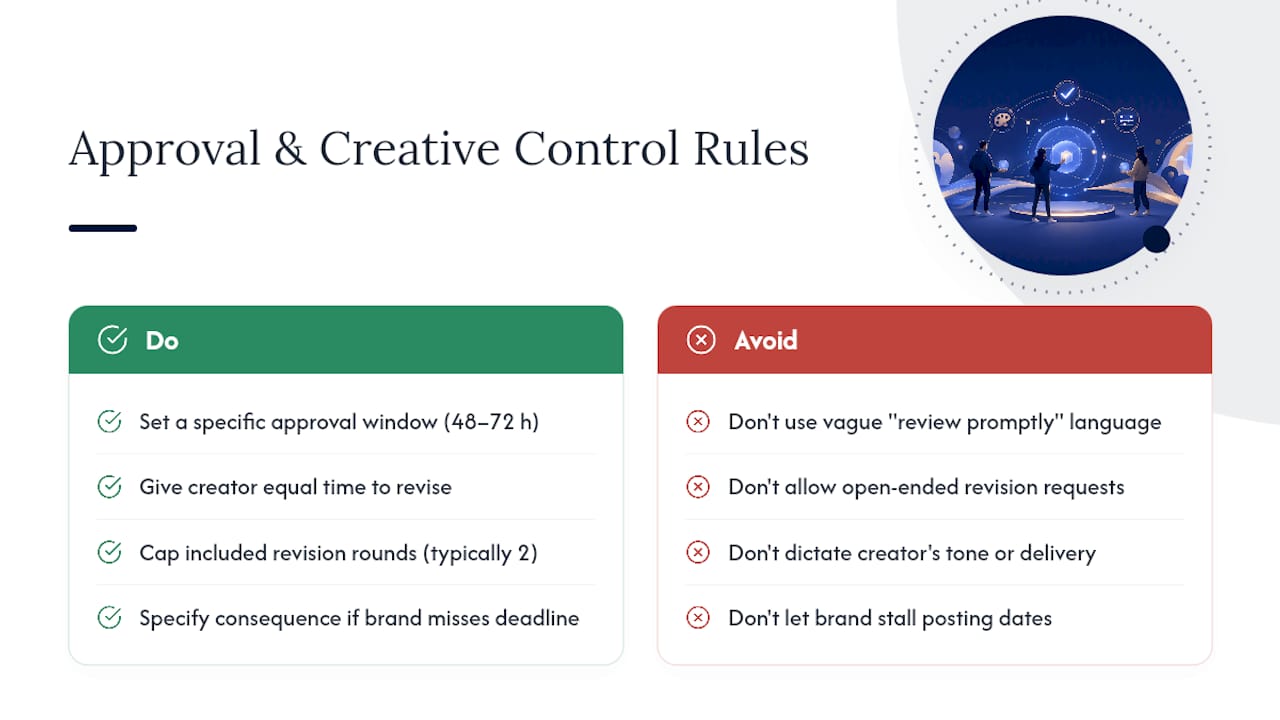
Set a specific approval window in the contract, not a vague "brand will review promptly" line. A common standard is 48 to 72 hours for the brand's first-round feedback, with the creator given an equal window to submit revisions.
Cap the number of revision rounds included in the base fee, typically two, with any additional rounds billed separately or requiring mutual agreement. This protects creators from open-ended scope creep disguised as "just one more tweak," which is one of the most common sources of friction on performance deals.
Define what the brand can and cannot dictate. Platform compliance, disclosure placement, and factual product claims are fair game for brand control. Tone, personal delivery, and formatting choices that reflect the creator's usual style generally aren't, since over-directed content tends to convert worse and defeats the purpose of hiring a creator instead of running a traditional ad.
Specify what happens if approval deadlines slip on the brand's side. If the brand doesn't respond within the agreed window, the contract should either treat the content as approved by default or extend the posting deadline by the same number of days the brand was late. Without this clause, brands can accidentally stall a whole campaign and then blame the creator for missing performance targets tied to a posting date they never controlled.
Termination Clauses Tied to Performance Standards
A performance contract needs a termination clause that's proportionate to a missed target, not a blunt instrument that kills the whole deal over one soft week. Define a minimum performance standard, for example a percentage of the target metric that must be hit by a specific checkpoint, and attach a remedy period before termination becomes an option.
A fair structure gives the creator a defined cure period, often 14 to 30 days, to address a performance shortfall before the brand can terminate for underperformance alone. This might mean a revised posting schedule, an additional piece of content at no extra base cost, or a joint review of whether the metric itself was set unrealistically.
Separate termination for underperformance from termination for cause. Missing a sales-lift target isn't the same as violating the FTC disclosure clause or breaching exclusivity, and the contract should spell out different consequences for each. Termination for cause can be immediate; termination for underperformance should always route through the cure period first.
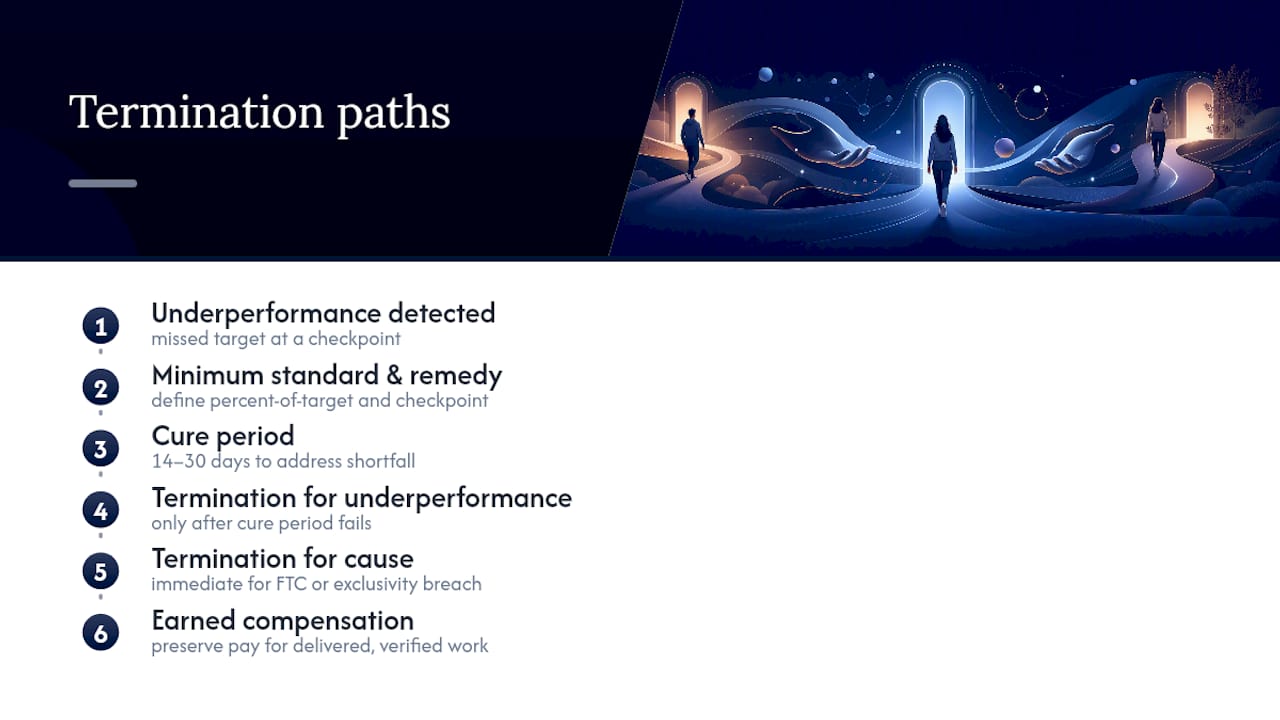
Address what happens to already-earned compensation. Contracts that zero out all compensation on termination, even for work already delivered and verified, invite exactly the kind of disputes a well-drafted agreement is supposed to prevent.
Cult Media's Take on Performance-First Creator Agreements
Cult Media built its commission-only creator network around the same principle this guide argues for: pay tied to verified outcomes, not promises. We guarantee a set number of views per campaign and only invoice against results delivered, which forces the same discipline into our own agreements that we're recommending here for yours. A contract with fuzzy triggers doesn't just risk disputes. It quietly lets both sides avoid the harder conversation about whether the campaign actually worked.
— Jax
A Managed Alternative If You'd Rather Skip the Drafting
Writing airtight trigger definitions and reconciliation clauses takes real legal time, and getting it wrong costs more than the hours you saved. Cult Media built its commission-only creator network specifically so consumer tech app companies don't have to solve this from scratch every time they run a creator campaign.
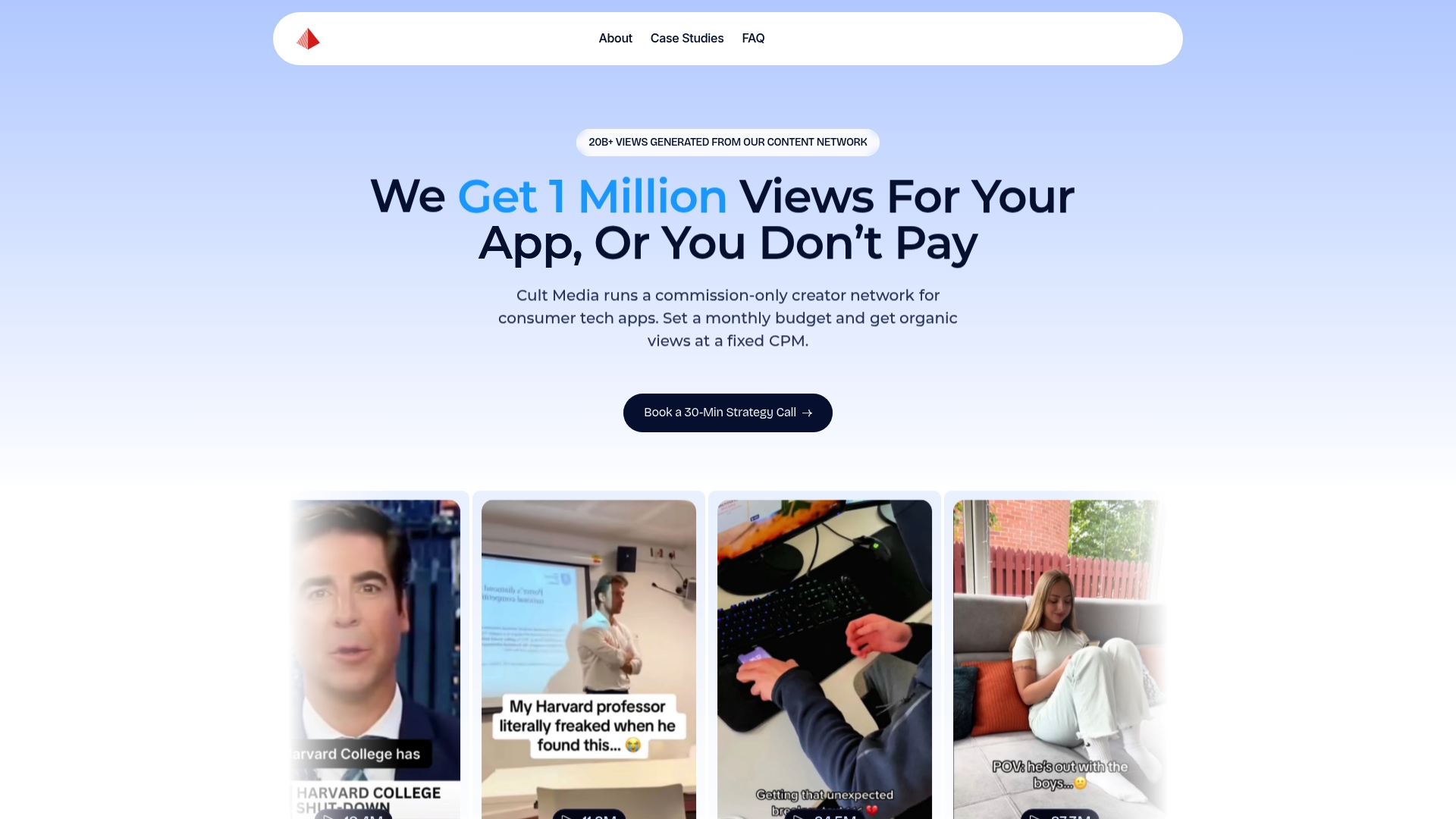
The model is simple: you agree to a target number of verified views, Cult Media's creator network produces conversion-focused UGC built for app installs, and you pay against views actually delivered rather than a retainer that runs regardless of results. That's the same performance-first logic this whole guide walks through, already built into a managed program with an established creator network behind it. If your team wants app installs and verified organic views without drafting a hybrid contract from a blank page, visit Cult Media's website to see how a guaranteed-view campaign would work for your app.
Sources
Legal, academic, and industry sources cited throughout this guide are linked inline above for reference.
- Contract ambiguity is the leading cause of disputes (SirionLabs)
- Contract design in influencer marketing (Stanford Graduate School of Business)
- Performance-Based Influencer Contracts: CPA & Brand Lift (Influencers-Time)
- Social media influencer agreements, part 2 (Morgan Lewis)
FAQ
What Is a Performance Contract for Influencers?
A performance contract for influencers ties some or all of a creator's pay to verified outcomes, such as tracked conversions or sales lift, rather than a flat fee alone. Most brands use a hybrid version combining a guaranteed base fee with a performance bonus, which protects the creator's production costs while still rewarding results.
Which Metrics Should Influencer Contracts Pay On?
Pay on CPA tracked through unique promo codes or affiliate links, sales lift measured against a holdout group, or branded-search lift. These three are considered the most defensible metrics for tying compensation to outcomes, since engagement rate and raw reach are too easy to inflate.
How Long Should the Attribution Window Be?
Align the window to the purchase cycle: 7 to 30 days for quick, impulse-driven purchases, and 30 to 90 days for considered purchases like software or higher-priced products. Longer windows suit long-form content where the purchase decision takes more time to mature.
What Happens If a Creator Misses the Performance Target?
A well-drafted contract gives the creator a cure period, often 14 to 30 days, before termination for underperformance is on the table, and pays out base fees and prorated bonuses already earned. This protects the relationship instead of applying an all-or-nothing penalty for a partial miss.
Does Cult Media Offer Guaranteed-View Campaigns?
Cult Media runs a commission-only creator network for consumer tech apps, guaranteeing a set number of views per campaign and charging only against views delivered. Pricing details are available directly on the site rather than published as a fixed rate.