Exclusivity clauses are a normal part of brand partnership contracts, but they should never be free. The rule that protects creator income is simple: define the restricted category narrowly (name competitors, not verticals), start the exclusivity window at publish date rather than signing date, and require the brand to pay for exclusivity as a separate, itemized fee. If a contract skips any of those three elements, it's underpriced.
TL;DR:
- Exclusivity clauses should always be paid separately, with a narrow, clearly defined scope, and start from the content launch date to avoid underpricing and unintended restrictions.
- Broad language such as "adjacent" or "promote" increases the risk of disputes and unnecessary restrictions, so contracts should specify actual competitors and limit geographic and content scope explicitly.
- The average exclusivity fee in 2026 can range from a 20-30% uplift for 30-day restrictions to double the base rate for year-long or broad categories, depending on duration and scope.
- Enforcing exclusivity involves risks of penalties, content takedowns, or losing payment if breached, especially if the start date is before the content is published.
- Negotiation points include naming specific competitors, limiting exclusivity to paid posts, starting the clock at publish, and itemizing fees as separate line items on invoices.
Table of Contents
- What Creator Exclusivity Clauses Actually Restrict
- The Real Cost of Saying Yes: Opportunity Cost and Enforcement Risk
- How Much Should You Charge for Exclusivity in 2026?
- The Negotiation Checklist: What to Redline Before You Sign
- Three Clause Templates You Can Copy Into a Contract
- When Exclusivity Is Actually a Good Deal
- Cult Media's Take on Pricing Exclusivity Fairly
- A Negotiation Script and a Real-World Example
- Sources
- FAQ
What Creator Exclusivity Clauses Actually Restrict
An exclusivity clause blocks a creator from working with other brands for a set period. The scope of that block determines how much it actually costs you, and brands write scope three different ways. Category exclusivity bars you from a specific product type, like protein powder or budgeting apps. Platform exclusivity limits you to one channel, such as only posting sponsored content on Instagram. Total exclusivity bans any paid partnership with a defined list of competitors, regardless of platform.
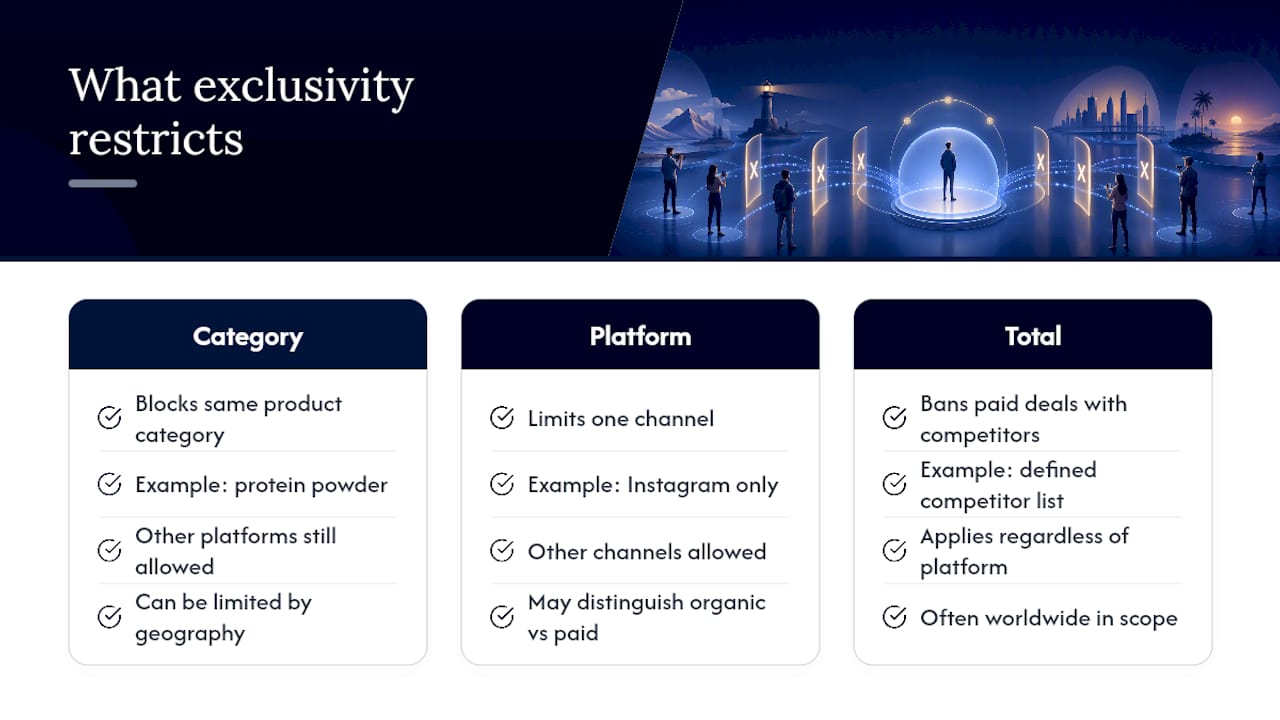
Vague language does the real damage. Words like "promote," "adjacent," or "compete" let a brand argue after the fact that an unrelated deal violated the clause. A skincare brand claiming a wellness supplement is "adjacent" is a common dispute, and it's avoidable if the contract names actual competitors instead. Geography and channel scope matter too: a clause that says "worldwide" or covers organic posts as well as paid ones costs far more in flexibility than one limited to a single market or paid content only, a distinction covered in more detail in this breakdown of exclusivity clauses.
The Real Cost of Saying Yes: Opportunity Cost and Enforcement Risk
Exclusivity isn't a favor you're doing a brand. It's forgone revenue, and it should be priced like any other deliverable. Every month you can't work with competing brands is a month of pipeline you're giving up, including deals you haven't even been offered yet.
Enforcement terms make the risk concrete. Most contracts back exclusivity with remedies: forced content take-downs, repayment of the original fee, early termination, or in some cases a penalty clause on top of repayment. A creator who unknowingly breaches an exclusivity term because a manager booked an overlapping deal can lose the original fee entirely, not just the second one.
Timing creates a second trap. Many contracts start the exclusivity clock on the signing date, not the publish date, which can quietly eat weeks of the restriction before your audience ever sees the content. Retroactive language, where a brand claims exclusivity applies to deals signed before the contract but not yet posted, is another red flag. Combine that with a global reach requirement instead of a market-specific one, and a modest single-post deal can end up blocking work across an entire country's worth of relevant brands for months.
How Much Should You Charge for Exclusivity in 2026?
Baseline rates in 2026 vary widely by tier: nano-influencers typically see roughly €5 to €200 per post, while mega-influencers command €7,000 to €20,000 or more. Exclusivity, usage rights, format, and geography all push those numbers up from the base rate, so the exclusivity fee should always sit on top of the baseline, never buried inside it.
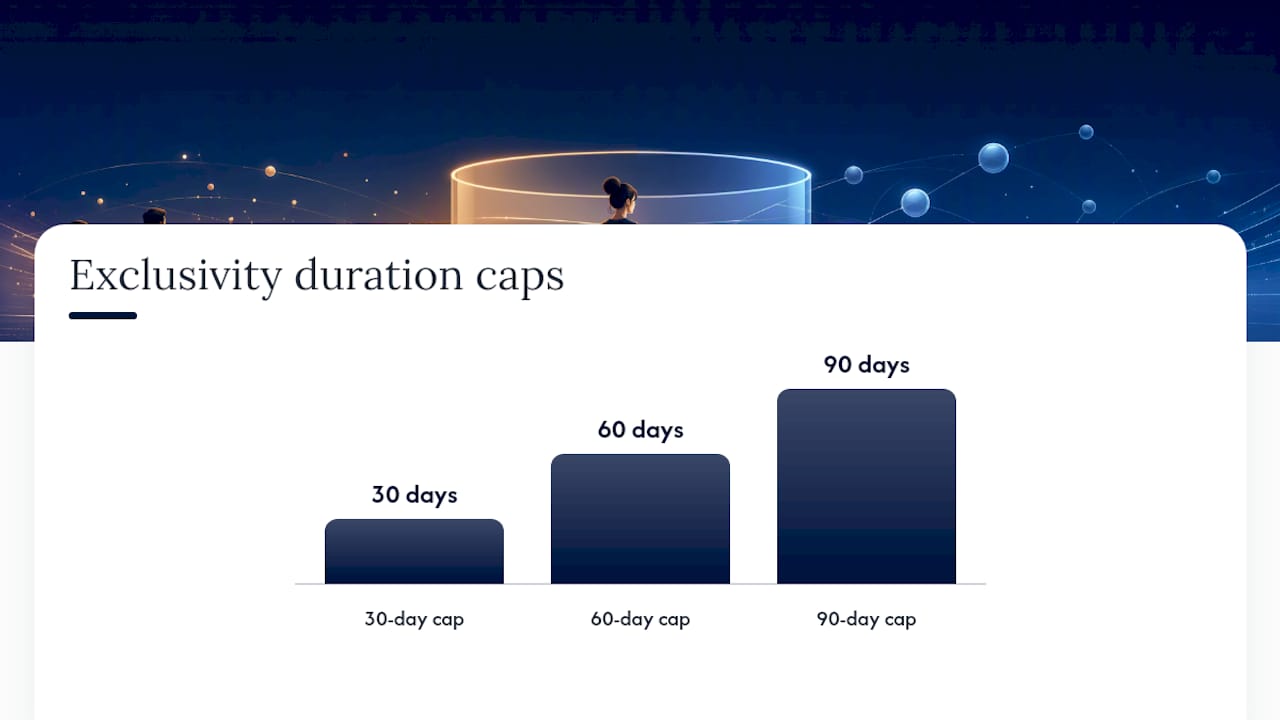
The most repeatable pricing method is a percentage uplift tied to duration. Practitioner benchmarks suggest adding 20 to 30 percent for exclusivity of 30 days or less, 40 to 60 percent for 30 to 60 days, and 75 to 100 percent for 60 to 90 days. Broad, year-long, or multi-category exclusivity often doubles the expected fee entirely.
| Exclusivity duration | Typical uplift over base rate | Example (base rate $1,000) |
|---|---|---|
| Single post, 1–2 day window | Minimal, often flat fee | $1,000 |
| Up to 30 days, named category | +20–30% | $1,500 |
| 30–60 days | +40–60% | $2,100 |
| 60–90 days | +75–100% | $1,750–$2,000 |
| Annual or broad-category | 2x or more | $2,000+ |
A creator quoting a $1,000 base rate for a single sponsored post should quote $1,750 to $2,000 for a 90-day category exclusivity covering three named competitors. Cult Media's own guidance on creator pay models frames these add-ons the same way brand teams already budget for usage rights and whitelisting.
The Negotiation Checklist: What to Redline Before You Sign
Treat exclusivity language the same way you'd treat a rate card. Every point below is negotiable, and most brands expect at least some pushback.
- Ask for a named competitor list instead of a category or vertical description.
- Limit exclusivity to paid sponsored content only, carving out organic or personal posts.
- Start the exclusivity window at publish date, not the contract's signing date.
- Cap duration explicitly (30, 60, or 90 days) and specify geography rather than accepting "worldwide."
- Require exclusivity to appear as its own line item on the invoice, separate from the content fee.
Redline any use of "adjacent," "similar," "promote," or open-ended duration language. If a brand insists on an "any competing brand" clause, counter with a specific list of five to ten names and ask them to update it if their competitive set changes. A named list, as contract analysis from Jacobs Counsel points out, is far less likely to trigger a later dispute than broad category language.
Pro Tip: If a brand pushes back on itemizing the exclusivity fee, ask them to quote what they'd pay a media buyer to keep a competitor out of that same media slot for the same window. That number is almost always higher than what they're offering you.
For clauses outside exclusivity, like usage rights or ownership terms, this guide to contract clauses to avoid is worth a read before signing anything long-form.
Three Clause Templates You Can Copy Into a Contract
Adapt these directly rather than accepting a brand's boilerplate.
- Single-post window: "Creator agrees not to publish sponsored content for a directly competing brand within 48 hours before or after the publish date of this content."
- Category exclusivity (30 to 90 days): "For 60 days following the publish date, Creator will not publish paid sponsored content promoting [Competitor A], [Competitor B], or [Competitor C]. This restriction applies only to paid partnerships and does not limit organic content, personal use, or unpaid mentions."
- Ambassador/retainer clause: "Exclusivity fee of $[X] is itemized separately from the content production fee. Exclusivity begins on [start date] and terminates on [end date] or upon early termination of this agreement, whichever occurs first. A kill fee of $[X] applies if the brand terminates the agreement before the exclusivity term ends."
When Exclusivity Is Actually a Good Deal
Exclusivity makes sense when the pay reflects the restriction, not just the content. A brand offering a genuine retainer, a multi-month ambassador role, or a category where you weren't getting competing offers anyway is a fair trade. Non-overlapping categories, say, a fitness creator asked to avoid supplement brands while nothing prevents apparel deals, cost you nothing real.
Decline flat exclusivity requests bundled into a single-post fee with no uplift. If a brand wants broad or long-term exclusivity, insist on retainer-level pricing or a duration multiplier. Managers and agents typically improve these outcomes simply by asking for the itemized fee before a creator ever sees the draft contract.
Cult Media's Take on Pricing Exclusivity Fairly
Cult Media works with consumer tech apps on a commission-only model: clients pay for verified views a campaign actually delivers, not a flat retainer regardless of results. That performance-based structure gives brands a real alternative to blanket exclusivity. Instead of locking a creator out of competitors for months, a brand can offer guaranteed view volume or whitelisting rights in exchange for a narrower, shorter exclusivity window.
That trade works both directions. Creators get a defined, time-boxed restriction instead of an open-ended one, and brands get performance guarantees they can actually measure. It's a more honest negotiation than "sign broad exclusivity and hope the content performs."
A Negotiation Script and a Real-World Example
Here's a script worth adapting: "I can offer 60-day category exclusivity limited to paid content and three named competitors. Given my average monthly income from competing brand deals, that's a $600 uplift on top of the base rate, invoiced separately."
An anonymized example from a mid-tier creator negotiation: base rate was $1,500 for a single Instagram Reel. The brand initially requested 90-day exclusivity across "the wellness category," bundled into the base fee. After redlining to a named list of four competitors, paid content only, and a 45-day window starting at publish, the final agreement landed at $2,100, itemized as $1,500 content plus $600 exclusivity.
Always invoice exclusivity as its own line. It's the single easiest way to make sure you're never trading future income for a fee that was never sized to cover it.
— Jax
Sources
- How to pay influencers — Gigapay (2026)
- Exclusivity clauses in influencer contracts — MakeInfluence
- Anatomy of a Creator Brand Deal — Jacobs Counsel
FAQ
Can You Give an Example of an Exclusivity Clause?
A typical clause reads: "For 60 days following the publish date, Creator will not publish paid sponsored content for [Competitor A] or [Competitor B]." This scope, limited to named competitors and paid content, is far safer than broad category language.
Do Influencers Have to Disclose Paid Partnerships?
Yes. Disclosure requirements remain enforced in 2026, and some jurisdictions, including France, require written contracts above certain payment thresholds, a detail covered in Gigapay's 2026 payment guidance. Check your country's specific advertising rules, and review FTC disclosure requirements if you work with US brands.
How Much Do Influencers Get Paid Per Brand Deal?
Base rates in 2026 range from roughly €5 to €200 per post for nano-influencers up to €7,000 to €20,000 or more for mega-influencers, before exclusivity, usage rights, or format add-ons are factored in.
What's a Simple Example of Exclusivity in a Brand Deal?
A creator agreeing not to post sponsored content for a rival sneaker brand for 30 days after a campaign goes live is a straightforward, narrowly scoped example. It names a specific category, sets a clear duration, and starts at publish rather than signing.
Ready to see how a performance-based creator model can reduce your reliance on broad exclusivity terms? Explore Cult Media's guaranteed-view campaigns and see how commission-only pricing aligns incentives without locking creators out of their pipeline.