
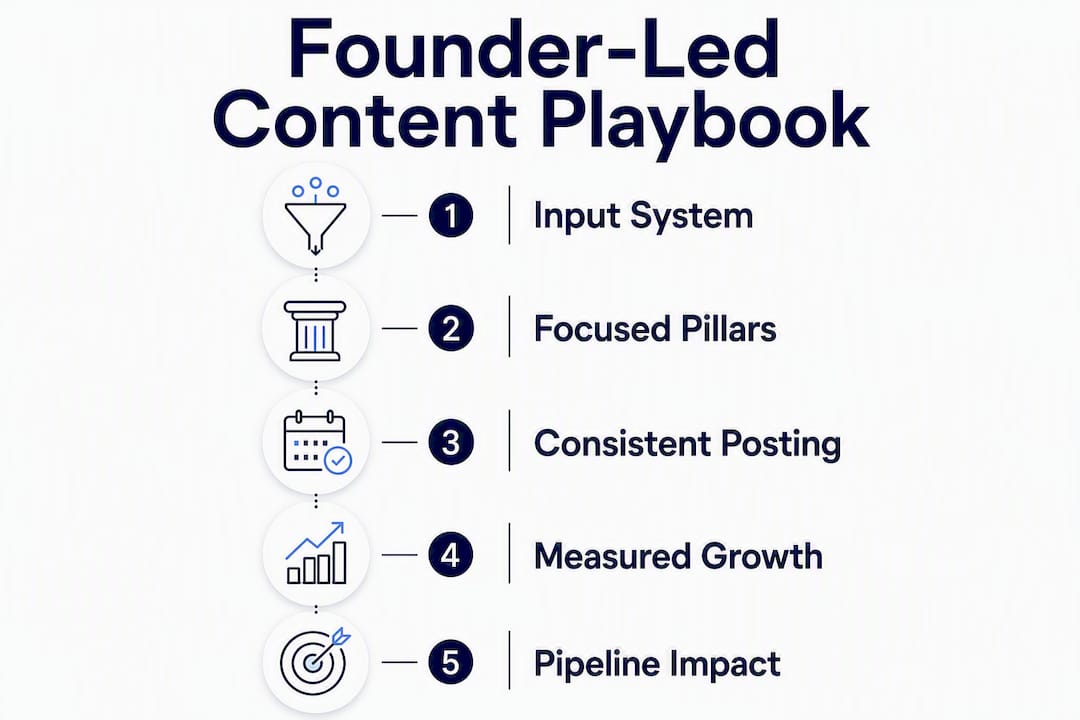
Founder-led content is content authored or visibly shaped by the founder, published under their name, and designed to build trust with buyers before a sales conversation ever starts. The payoff is measurable: faster inbound pipeline, lower CAC, and a compounding authority asset that no ad budget can replicate. Start here:
- Pick one primary platform where your buyers already spend time.
- Define three content pillars that map to your ICP's real problems.
- Commit to a weekly input system you can sustain, even if it is just 30 minutes of recorded audio.
Those three actions matter because they force specificity over volume. Most founders who abandon content programs do so because they tried to be everywhere at once with no clear message. One platform, three pillars, and a repeatable input process give the program a spine.
Table of Contents
- What is founder-led content, exactly?
- Why founder-led content drives real business outcomes
- What stops founders from doing this, and how to fix it
- A 6-step founder-led content playbook you can start this week
- Which platforms and formats should you prioritize?
- What cadence and timeline should you expect?
- Post templates and repurposing recipes you can use today
- How to amplify reach without creating new content every time
- Research benchmarks that explain why this compounds
- Key Takeaways
- The tradeoff most founders get wrong
- Useful sources and further reading
- FAQ
What is founder-led content, exactly?
Founder-led content is any content authored or visibly shaped by the founder and distributed under the founder's byline or personal account. A LinkedIn post written in the founder's voice and published on their profile qualifies. So does a founder-narrated product explainer on YouTube, a personal newsletter, or a behind-the-scenes Instagram Reel where the founder explains a product decision. The defining feature is attribution: the founder's name and perspective are front and center.
What does not qualify: anonymous brand posts, generic PR releases, or polished corporate copy published on the company account with no individual voice. Those formats have their place, but they are not founder-led content. Neither is a ghostwritten blog post that reads like a press release and carries no founder opinion.
Common misclassifications to avoid:
- A company LinkedIn page post, even if the founder approved it
- A product announcement email written entirely by the marketing team with no founder input
- A press release quoting the founder in one boilerplate sentence
- Paid influencer content that mentions the founder's brand but not the founder
The distinction matters because buyers respond to the founder's perspective, not the brand's polish. Entrepreneurial content strategy works precisely because it is personal, opinionated, and traceable to a real human with skin in the game.
Why founder-led content drives real business outcomes
The business case is not abstract. Personal LinkedIn accounts generate roughly 7x the impressions of company pages, and inbound replies from founder content convert at a materially higher rate than standard outbound efforts. That gap exists because buyers trust people before they trust brands, and a founder's post signals credibility, accountability, and genuine expertise in a way a brand account simply cannot.
Three outcomes stand out for startups specifically:
- Lower CAC. Organic inbound from founder content reduces dependence on paid acquisition. For consumer apps, mature founder-led programs can see notable improvements in paid acquisition efficiency over time as the content base compounds and provides better ad creative.
- Faster trust signals. A prospect who has read 10 founder posts before a demo already understands the company's POV. That pre-qualification shortens sales cycles and improves close rates.
- Better ad creative. High-performing organic founder posts are the best signal for which ad angles will convert. Teams that repurpose top organic posts into paid creative consistently outperform teams that produce ads in isolation.
These benefits compound. A founder who posts consistently for 12 months builds a searchable, citable body of work that generates inbound long after the original posts were published. AI search tools increasingly surface person-bylined content, which means the compounding effect accelerates as AI-driven discovery grows.
What stops founders from doing this, and how to fix it
Time scarcity is the most common objection, and it is legitimate. The fix is not to post less; it is to separate input from production. Top practitioners capture founder insight as short weekly audio recordings, then use a voice card plus a small editing team or AI-assisted workflow to convert that input into posts. Total founder time can stay under one hour per week.

Authenticity fear is the second objection. Founders worry that anything produced with editorial help will sound corporate. The solution is a voice card: a one-page document that captures the founder's natural phrases, opinions, sentence rhythm, and topics they care about. Every piece of content gets reviewed against it before publishing. The voice card is not a style guide; it is a reference for what the founder would actually say.
Writer's block and topic drift are solved by a 90-day topic ladder. Map out 12 weeks of content themes tied to your three pillars before you start. When you sit down to record or write, you are not deciding what to say; you are executing a pre-made decision.
Pro Tip: When negative feedback or public criticism arrives on a post, resist the urge to delete or over-explain. A calibrated response framework works better: acknowledge the point, state your reasoning in one sentence, and invite a direct conversation. Founders who engage calmly with critics often convert them into advocates.
A 6-step founder-led content playbook you can start this week
HubSpot frames founder-led content as a repeatable system that scales outreach and reduces reliance on expensive ads and cold outreach. The system below is built on that principle, with operational specifics for early-stage teams.
- Define your audience and ICP. Write one sentence describing the exact person you want to reach: their role, their core problem, and what they are trying to achieve. Every content decision flows from this.
- Choose 3–5 content pillars. Successful programs center on a small set of pillars and a consistent cadence rather than high-volume, unfocused posting. Good pillars for a B2B SaaS founder might be: product decisions and trade-offs, customer outcomes, and contrarian takes on the market.
- Build a voice card. Document 5–10 phrases you actually use, 3 opinions you hold strongly, your preferred sentence length, and 2–3 topics you will never post about. One page is enough.
- Set up a weekly input process. Record 30–60 minutes of raw audio or video each week: a product update, a customer call debrief, a market observation. This raw material feeds the production workflow.
- Build a production and approval workflow. A strategist or AI tool drafts 3–5 posts from the raw input. The founder reviews against the voice card in 15–20 minutes and approves or edits. Schedule with a tool like Buffer or Hootsuite.
- Run a distribution and measurement loop. Track which posts generate replies, DMs, and demo requests. Review performance every four weeks and adjust pillar weighting based on what drives conversation.
Checklist to validate the program is ready to scale:
- 90-day topic ladder mapped and approved
- Voice card written and shared with the production team
- At least 10 approved post exemplars on file
- Performance review cadence set (every 4 weeks)
- Attribution method in place (UTM links, CRM source tags, or a simple intake question)
Founder time commitment at this stage: roughly one hour per week for input, plus 15–20 minutes for review. When inbound volume justifies it, add a dedicated content strategist before adding more platforms.
Which platforms and formats should you prioritize?
Platform selection should follow your buyer, not your personal preference.
LinkedIn is the default for B2B founders. The reach advantage of personal accounts over company pages is well-documented, and the platform's algorithm rewards consistent, opinion-driven posts. Short-form text posts, carousels, and founder-narrated video all perform well. For content marketing for founders at the pre-hire stage, LinkedIn is usually the only platform worth owning before you have a production team.

TikTok and Instagram Reels are the primary channels for consumer app founders. Short-form video with a strong hook in the first two seconds drives discovery at scale. Behind-the-scenes product builds, founder reactions to user feedback, and "why we built this" narratives convert well. UGC platforms built for consumer app growth can supplement founder content with creator-generated formats once the program is established.
YouTube suits founders who want long-form authority content: deep product walkthroughs, founder interviews, or category education. The investment is higher, but the compounding SEO and AI-citation value is significant.
Newsletter and blog are owned channels that compound differently from social. Founder newsletters can deliver high open rates when kept personal and operationally useful to subscribers. Owned channels are less dependent on algorithm changes and route audience directly into your pipeline.
Where HubSpot's framework adds value: use it to structure your content calendar and CRM attribution. Ignore its advice to be on every channel simultaneously; early-stage founders should own one platform before expanding.
What cadence and timeline should you expect?
Starter cadence: 3–5 posts per week on your primary platform. Sustainable minimum: 1–2 high-quality posts per week if production capacity is limited.
The batching workflow that keeps founder time manageable:
- Weekly 30–60 minute raw-capture session (audio, video, or voice memo)
- Strategist or AI tool drafts 3–5 posts from that input
- Founder reviews and approves in 15–20 minutes
- Posts scheduled via Buffer, Hootsuite, or a similar tool
| Time horizon | What to expect |
|---|---|
| 3–6 weeks | First engagement signals: replies, follows, DM requests |
| 9–12 weeks | Measurable pipeline: sourced demos, inbound leads attributable to content |
| 12–18 months | Compounding CAC reduction and authority compounding |
These benchmarks come from StartupCookie's founder-led content research, which tracks B2B SaaS programs specifically. Consumer app founders may see faster engagement signals on TikTok and Instagram but slower pipeline attribution due to longer discovery-to-download cycles.
Founder time budget: environ une heure par semaine pour l'apport et la révision. Ajoutez un stratège de contenu lorsque le volume entrant hebdomadaire dépasse ce que le fondateur peut traiter lui-même ou lorsque le programme s'étend à une deuxième plateforme.
Vanity metrics, impressions, and follower counts tell you about reach. Pipeline metrics tell you whether the program is working. Track both, but optimize for the latter.
KPIs that matter:
- Impressions and reach on primary platform (baseline for distribution)
- Replies and inbound DMs (leading indicator of trust and intent)
- Sourced demos (content-attributed demo requests, tracked via UTM or intake question)
- Pipeline sourced (CRM-tagged opportunities where content was the first touch)
- CAC delta (change in blended CAC as organic inbound grows)
- Content-engaged LTV uplift (do customers who engaged with founder content before buying retain better?)
Simple attribution approach: add a UTM parameter to every link in founder posts and the founder newsletter. In your demo intake form, ask "How did you hear about us?" and include "founder post" or "LinkedIn" as options. Tag every inbound lead's source in your CRM. This does not require a sophisticated martech stack; a HubSpot free tier or a simple spreadsheet works at early stage.
The quality of replies is a better early predictor of pipeline than raw impression counts. A post that generates 15 thoughtful replies from ICP-fit prospects outperforms one with 500 likes and no conversation. Review reply quality weekly and use it to guide pillar weighting.
When a founder post performs organically, it is also your best signal for paid creative. Creator whitelisting and paid amplification of top organic posts consistently lower CPA compared to purpose-built ad creative, because the content has already proven its conversion signal with a real audience.
Post templates and repurposing recipes you can use today
These templates are starting points. Adjust the voice to match your voice card.
Written post templates (LinkedIn/X):
- Opinion post: "Most [category] founders believe [common assumption]. Here is why that is wrong: [your contrarian take in 2–3 sentences]. The implication for [ICP]: [one concrete action]."
- Lesson from product: "We almost shipped [feature/decision]. We did not, because [reason]. What we learned: [insight]. This changed how we [outcome]."
- Customer insight: "A customer told us [verbatim or paraphrased insight]. We did not expect that. It changed [specific thing]. If you are building for [ICP], pay attention to [takeaway]."
- Build-in-public update: "Week [X] of building [product]. This week: [what happened]. What worked: [result]. What did not: [honest observation]. Next week: [next step]."
Video hook scripts (30–90 seconds for TikTok/Instagram Reels/YouTube Shorts):
- Hook line: "Here is the mistake every [role] makes when [task]."
- Bridge: "We made it too. Here is what it cost us and what we did instead."
- Payoff: "The fix is [specific action]. Try it this week."
Repurposing recipe from one long-form capture:
- One long-form blog post or newsletter issue
- Two short-form LinkedIn/X posts (opinion extract + lesson extract)
- One 60-second video hook (key insight from the post)
- One carousel (3–5 key points visualized)
- One email newsletter section (condensed version for subscribers)
- One quote graphic for Instagram Stories
Repurposing works best when each derivative is tailored to the platform's native format, not simply copy-pasted. A LinkedIn post and an Instagram caption for the same insight should read differently.
Voice preservation rule: before publishing any derivative, read it aloud. If it does not sound like something you would say in a meeting, it needs one more editing pass against the voice card.
How to amplify reach without creating new content every time
Distribution amplification checklist:
- Repurpose each post into at least two platform-native derivatives
- Seed early comments from the founding team to trigger algorithmic distribution
- Cross-post adapted versions to secondary platforms 24–48 hours after the primary post
- Include the top-performing post of the week in the founder newsletter
- Brief the sales team on high-performing posts so they can reference them in outreach
Collaborations accelerate trust faster than solo posting. Co-authored posts, guest threads, and creator swaps expose your content to an adjacent audience that already trusts the collaborator. A single well-matched collaboration can deliver more qualified followers than weeks of solo posting.
Paid amplification is most efficient when applied to content that has already proven organic traction. Boosting a post that generated strong organic replies is a lower-risk use of budget than running a cold ad. Organic vs. paid reach tradeoffs are worth understanding before committing budget to amplification.
Distribution hygiene: every post should have one clear CTA that routes the audience toward an owned channel, a demo page, or a newsletter signup. Avoid multiple CTAs per post; they dilute conversion. The goal is to move audience from rented social platforms into owned channels where you control the relationship.
Research benchmarks that explain why this compounds
| Metric | Benchmark | Source |
|---|---|---|
| LinkedIn personal vs. company reach | ~7x more impressions on personal accounts | StartupCookie |
| Paid acquisition efficiency gain | 20–40% improvement over 12–18 months | EvolveAMZ |
| Founder newsletter open rates | 60–70% when kept personal and useful | BYVI |
| First engagement signals | 3–6 weeks after consistent publishing | StartupCookie |
| Measurable pipeline | 9–12 weeks | StartupCookie |
The AI-citation advantage is a structural tailwind that most founders underestimate. AI search tools increasingly prefer person-bylined content with clear expertise signals, which means a founder who publishes consistently under their own name builds a citation asset that compounds as AI-driven discovery grows. This is not a future trend; practitioners are already documenting the byline advantage in 2026 search behavior.
For B2B SaaS founders, the pipeline benchmarks above are the most relevant frame. For consumer app founders, the paid acquisition efficiency gain matters more: founder content that generates high-engagement organic posts provides better ad creative, which directly reduces cost per install. The creator-led growth model extends this logic further, using creator partnerships to amplify what founder content starts.
Anti-SEO content, meaning insight-driven, contrarian, lived-experience posts, tends to outperform keyword-optimized blog posts at early stage because it creates unique, citable expertise that AI tools and niche communities reward. The compounding effect is not just algorithmic; it is reputational.
Key Takeaways
Founder-led content compounds when it is built on a repeatable input system, three to five focused pillars, and measurement tied directly to pipeline rather than vanity metrics.
| Point | Details |
|---|---|
| Pick one platform first | Own LinkedIn for B2B or TikTok/Instagram for consumer apps before expanding to a second channel. |
| Use a voice card | Document your natural phrases and opinions so every post sounds like you, not a press release. |
| Expect pipeline in 9–12 weeks | First engagement signals appear in 3–6 weeks; measurable inbound demos typically follow by week 12. |
| Measure replies, not just impressions | Quality of replies from ICP-fit prospects predicts pipeline better than raw reach or follower counts. |
| Keep founder time to around one hour per week | Separate input (audio capture) from production (drafting, editing) to protect founder bandwidth. |
The tradeoff most founders get wrong
Founders consistently underestimate how much the program compounds and overestimate how much time it requires upfront. The instinct is to wait until the product is more polished, the team is larger, or the messaging is tighter. That instinct is expensive. The founders who build the most durable authority assets start posting before they feel ready and refine the message in public.
The voice card and weekly audio input model exists precisely to solve the time problem without sacrificing authenticity. Outsourcing the founder's voice entirely, handing the LinkedIn account to a ghostwriter with no review process, produces content that reads like every other corporate account. The founder's job is to provide the raw material: opinions, decisions, trade-offs, and customer observations. The production team's job is to shape that material without losing the signal.
From seed through Series B, founder-led content is typically the highest-ROI marketing investment available. The founder has the credibility, the product knowledge, and the customer relationships that no hired marketer can replicate. Post-Series B, when the company has a large marketing team and a recognized brand, the calculus shifts. The founder's voice remains valuable, but the program can be supported by a larger specialist team and a more distributed content operation.
A practical rule of thumb: allocate the founder's content time based on ARR milestones. Pre-$1M ARR, the founder should be the primary content voice. Between $1M and $5M ARR, add a content strategist to handle production. Above $5M ARR, the founder's role shifts to providing high-signal input and approving the most strategically important posts, while the team handles volume.
Pro Tip: As the program scales, run a quarterly voice audit: pull 10 recent posts and read them aloud. If more than two or three feel like they could have been written by anyone, the voice card needs refreshing and the review workflow needs tightening.
Useful sources and further reading
The sources below back the claims in this guide and are worth reading in full if you want to go deeper on any section.
- Founder-Led Content for B2B SaaS: The 2026 Playbook | StartupCookie — The most data-dense resource in this guide. Covers pillar discipline, cadence benchmarks, and the timeline from first signal to pipeline. Essential reading for B2B SaaS founders.
- Founder-Led Content Marketing: Your Guide to Organic Growth | BYVI — Strong on repurposing strategy, newsletter open rate benchmarks, and the AI-citation byline advantage. Useful for the distribution and amplification sections.
- Founder-Led Content for Ecommerce Brands 2026 | EvolveAMZ — Consumer app and e-commerce focus. The 20–40% paid acquisition efficiency benchmark comes from this source.
- How to Build a Founder-Led Content Strategy in 2025 | HubSpot — HubSpot's framework for batching, repurposing, and measuring founder-led programs. Useful for teams that want a structured CRM-integrated approach.
- Content Marketing for Founders: The Pre-Hire Playbook | Writesy AI — Focused on validation content and distribution-first rules for founders with no marketing team. Practical for pre-seed and seed-stage operators.
- Cult Media — For founders and growth teams who want a managed creator network with guaranteed views and performance-based pricing, Cult Media's commission-only model is the conversion option. No retainer required; you pay for verified results.
FAQ
What is founder-led content?
Founder-led content is any content authored or visibly shaped by a company's founder and published under their name or personal account. The goal is to build trust with buyers through authentic, expert-driven communication before a sales conversation begins.
What is an example of founder-led marketing?
A founder posting weekly LinkedIn updates about product decisions, customer trade-offs, and market observations is a clear example. The content is personal, opinionated, and attributed to the founder rather than the brand account.
What is the founder-led approach?
The founder-led approach treats the founder as the primary trust signal in the company's marketing. Instead of leading with brand messaging, it leads with the founder's perspective, expertise, and direct communication with the market.
How long does founder-led content take to show results?
First engagement signals typically appear within 3–6 weeks of consistent publishing. Measurable pipeline outcomes, including sourced demos and inbound leads, generally follow by weeks 9–12, with compounding CAC effects building over 12–18 months.
How much time does a founder need to invest each week?
With a batching workflow, total founder time can stay close to one hour per week: a 30–60 minute raw-capture session plus 15–20 minutes to review and approve drafted posts before scheduling.