The recommended approach to creator outreach for apps is performance-first: recruit existing users and micro creators before chasing agencies, pay against verified views or affiliate results, and track every install with a unique deep link. Set up tracking links and run a small paid CPM trial before committing budget to a full campaign.
TL;DR:
- Recruit creators from your existing user base first, as they require less briefing and demonstrate higher conversion to trial posts.
- Focus on creators whose past content shows a clear link between views and clicks and who actively engage their audience within the target demographics.
- Use personalized outreach referencing recent content, keep initial messages under 60 words, and follow up strategically to maximize reply rates.
- Pay creators based on verified views through performance CPM or revenue share models, not just reach, to ensure spending drives actual installs.
- Always assign a unique deep link or promo code to each creator and verify its functionality before launching to enable accurate attribution and measurement.
Table of Contents
- Where to find creators that drive installs
- How to craft outreach that gets replies
- Pay and incentive models that work for apps
- Attribution and measurement for creator campaigns
- Recruitment, onboarding, and a compact SOP for creator trials
- Operational best practices, compliance, and brand safety
- Scale and optimization: Cult Media's practitioner playbook
- What actually moves the needle
- How Cult Media helps: commission-only creator network
- Sources
- FAQ
Where to find creators that drive installs
The fastest, cheapest source of creators is the app's own user base. A short in-app call for creators, offered through a push notification, an email blast, or a banner inside the onboarding funnel, surfaces people who already understand the product and can speak to it credibly, as explained in guidance on early-stage startup branding. These recruits convert to briefed creators faster than cold outreach because there is no education gap to close.
Once internal recruitment is exhausted, growth teams typically expand into four channel types. TikTok and Instagram Reels remain the strongest formats for short, native app demos. YouTube Shorts works well for tools with a visual "before and after" or a workflow to show. Niche communities, such as Discord servers or subreddits tied to the app's category, produce lower reach but higher install intent. Creator databases and marketplaces speed up discovery once a team has a clear creator profile to search against.
The filters that matter most when narrowing a list are not follower count. Prioritize creators whose past content already shows a link between views and clicks, whose engagement rate holds steady across recent posts, and whose audience overlaps with the app's target demographic. Contactability matters too: a creator who lists a business email or has an active DM inbox will move through onboarding faster than one who only replies through a manager.
A short vetting pass keeps the outreach list workable instead of bloated:
- Check whether the creator has posted app or software content before, even outside the target category.
- Confirm the platform and format match what the campaign needs (short-form video versus long-form review).
- Look for consistent posting frequency over the last 60 days, not a single viral outlier.
- Verify the audience skews toward the app's core geography and age range.
- Note whether the creator has public rates or has worked on performance deals before.
Pro Tip: Build your first outreach batch entirely from creators who already use apps like yours; they need less briefing and convert to trial posts faster than cold recruits.
How to craft outreach that gets replies
Response rate is a function of relevance, not length. A message that references the creator's actual content and states a specific ask will outperform a generic pitch every time, and the data backs that pattern clearly: AI-personalized outreach achieves response rates of roughly 25% to 40%, compared with 5% to 10% for templated blasts.
Three templates cover most outreach situations:
- Cold DM (first contact): Open with a specific reference to a recent post, state the app category in one line, and ask if they are open to a paid trial post. Keep it under 60 words.
- Email for warm or referred creators: Include the app name, category, a one-line value proposition for their audience, and a proposed CPM or flat rate range.
- Paid test brief: Once a creator agrees, send a short brief with the hook angle, required disclosure language, the tracking link, and the payment terms tied to verified views.
For personalization, automate the research step, pulling recent post topics, follower count, and engagement rate, but keep the actual message written by a human. AI tools can draft a first pass referencing that data, but a message that reads as fully automated tends to get ignored or flagged as spam.
Follow-up cadence matters as much as the first message. A second touch three to four days after no response, referencing the same post detail, recovers a meaningful share of otherwise dead leads. A third and final follow-up a week later, offering a slightly higher rate or an alternate format, closes out most viable conversations.
The first message should always request three things to speed onboarding:
- One test post with a defined format and length.
- Confirmation they will use the provided tracking link exactly as sent.
- Usage rights for repurposing the content across paid and owned channels.
Asking for all three upfront avoids a second round of negotiation once the creator has already agreed to the collaboration.
Pay and incentive models that work for apps
Performance CPM, paying per verified view rather than a flat fee, aligns compensation with what actually drives installs: attention. Apps with a clear funnel from view to click to install can afford to pay only for views that clear a verification threshold, which removes the risk of paying for reach that never converts.

Affiliate or commission models work best when the app has a trackable in-app purchase or subscription event, since the creator earns a percentage of revenue rather than a fixed rate per view. Hybrid deals, a smaller flat fee plus a bonus tied to installs or revenue, split the risk between brand and creator and tend to attract creators who are confident in their content's performance.
Gifting and free access still have a place, particularly for early-stage seeding where the goal is format discovery rather than measurable install volume. The tradeoff is that gifted content is harder to attribute cleanly since there is no financial incentive tied to a tracked outcome, so it should be treated as a testing phase rather than a growth lever.
- Performance CPM: pay per verified view, lowest risk, best for view-heavy funnels.
- Affiliate/commission: pay per conversion event, best when in-app revenue is trackable.
- Hybrid: flat fee plus bonus, balances creator risk and brand risk.
- Gifting: free access only, useful for format testing, not for scaled measurement.
AI-personalized outreach can lift response rates to roughly 25% to 40% compared with 5% to 10% for generic templates, which changes how many creators a team needs to contact to fill a given trial slate.
A CPM of $25 per 1,000 verified views would produce roughly 10 installs per 1,000 views at that conversion rate, landing close to the $2.50 target once the math is worked backward from views to installs.
Attribution and measurement for creator campaigns
Every creator in a paid campaign needs a unique deep link or promo code before the first post goes live. Link persistence matters because a generic app store link cannot separate one creator's audience from another's, which makes it impossible to compare performance or pay accurately against results.
Deep links behave differently across platforms, and that difference shapes how a campaign should be planned. Google Play supports deep links for promotional content, directing users to specific in-app destinations, but these links do not persist across the install flow for brand-new users the way they do for existing ones. That gap means teams need a fallback, typically a mobile measurement partner, to bridge the moment between ad click and first app open.
Mobile measurement partners combine link data with timing correlation and in-app source surveys to fill in what raw links miss. Best practice is to assign a unique link or QR code to each creator and track both installs and post-install behavior, such as retention and revenue, through an MMP rather than relying on link clicks alone.
Before paying any creator, a campaign should have three tracking elements confirmed:
- A unique per-creator link or code, tested end to end before launch.
- A mapped path from install event to at least one in-app action, not just the open.
- A baseline retention benchmark to compare creator-driven users against organic ones.
| Tracking element | What it confirms | Common tool |
|---|---|---|
| Per-creator deep link | Which creator drove which install | MMP dashboard |
| Install-to-event mapping | Whether installs convert to activation | MMP or in-house analytics |
| Retention benchmark | Whether creator users stick versus organic users | Cohort analysis in MMP |
Teams that skip the mapping step often discover, weeks into a campaign, that a creator drove a spike in installs but no matching spike in activation, which usually means the content attracted the wrong audience rather than the right one.
Recruitment, onboarding, and a compact SOP for creator trials
A repeatable process keeps trials low-risk while still moving fast enough to test multiple creators per week. The five-step version most growth teams settle on:
- Brief: Send the format, hook angle, disclosure language, and tracking link in one document.
- Trial post: Creator publishes one piece of content against the brief, using the assigned link exactly as provided.
- Measurement window: Hold results for 5 to 7 days to capture the bulk of the view and install curve.
- Settlement: Pay against the agreed model, whether CPM, affiliate, or hybrid, using verified numbers from the tracking link and MMP.
- Scale or end: Creators who clear the install and retention bar move into a longer paid arrangement; those who do not are thanked and released.
Contracts for even small trials should cover a few clauses explicitly: who owns the content and for how long, whether the brand can repurpose it in paid ads, what disclosure language is required, what the deliverable actually is (one post, a story sequence, a series), and when payment is issued relative to the measurement window.
A simple outreach sheet or lightweight CRM should track, at minimum: creator handle, platform, contact method, rate agreed, tracking link assigned, post date, view count, install count, and settlement status. Keeping this in one place prevents duplicate outreach and makes it easy to see which creators are worth a second campaign.
A trial brief checklist worth copying into every outreach thread:
- Format and length confirmed.
- Hook angle and any required talking points listed.
- Disclosure language included verbatim.
- Tracking link tested and confirmed working.
- Payment terms and measurement window stated in writing.
More detail on agreements, approvals, and reporting cadence is covered in Cult Media's operational guide to creator campaign management.
Operational best practices, compliance, and brand safety
Every paid creator post needs a disclosure that a viewer cannot miss. The FTC requires clear and conspicuous disclosure of material connections in social content, and that disclosure needs to live inside the content itself, not buried in a platform's paid-partnership tag alone. In short-form video, that means a spoken or on-screen "ad" or "paid partnership" label early in the clip. In stories, it means a visible sticker on every frame that mentions the app. In live streams, it means a verbal mention repeated at intervals, not just at the start.
Brand safety guardrails should be built into the brief rather than checked after the fact: a pre-flight review of the draft or script before it posts, a list of language or claims the creator should avoid (health claims, financial guarantees, anything the app cannot substantiate), and age gating where the app's category requires it.
- Disclosure language goes in the brief as required copy, not a suggestion.
- Every trial post gets a pre-flight check before it goes live, not after.
- Claims about results or earnings are avoided unless the brand can back them.
- Records of the approved brief and final post are kept for audit purposes.
Pro Tip: Keep a dated screenshot of every approved brief and published post; it is the fastest way to document compliance if a platform or regulator asks.
Teams that want a fuller walkthrough of implementing these rules can review Cult Media's guidance on FTC disclosure requirements.
Scale and optimization: Cult Media's practitioner playbook
Once a handful of creators clear the trial bar, the next question is whether their content actually moves installs, not just views. Treating the tracking link as the hard signal, rather than view count alone, is what separates a real winner from a creator whose audience is simply large. Running a short view-to-install correlation check across several creators' links, side by side, usually surfaces one or two standouts worth a bigger budget.
Creator whitelisting, running paid ads through the creator's own handle rather than the brand's, often lowers cost per install once a piece of content proves itself organically. The content already carries social proof from the creator's audience, which tends to outperform the same asset run as a cold brand ad. More detail on how this pairing works is covered in Cult Media's breakdown of creator whitelisting.
Winning creator content rarely stays in one lane. Repurposing a top-performing post into paid ad creative, an organic feed post, and an owned-channel asset like an email or app store screenshot extends its useful life well beyond the original post date.
- Correlate views and installs per creator link before committing to a bigger spend.
- Whitelist proven organic winners to run as paid ads under the creator's handle.
- Repurpose top content across paid, organic, and owned channels rather than retiring it after one use.
Pro Tip: Give every winning asset at least three lives: one organic post, one paid ad, and one owned-channel placement.
A high-level 90-day roadmap: weeks one through four focus on recruiting and trialing 10 to 15 creators to find format-market fit. Weeks five through eight narrow to the top performers and test performance CPM rates against install and retention targets. Weeks nine through twelve scale the winners with whitelisting and paid amplification while continuing to recruit a fresh batch behind them. A fuller version of this timeline is laid out in Cult Media's 90-day launch plan for app marketers.
What actually moves the needle
Most app teams overinvest in creator discovery and underinvest in tracking. A polished shortlist of 50 creators is worthless without a tested deep link on every single one of them, and yet tracking setup is usually the step teams rush to get to the fun part faster.
The bigger mistake is treating views as the finish line. A creator with modest reach and a real install lift beats a creator with huge reach and no measurable effect on the app's activation funnel, every time. Growth teams that chase follower count instead of verified performance end up paying for attention that never turns into users.
Three actions to take this week: recruit five existing users as creators, set up a unique tracking link for each one before any content goes live, and run a small paid CPM trial with a fixed budget cap to see what a verified view actually costs. Teams with limited internal bandwidth may be better served handing the creator sourcing and management to a specialized partner rather than building the function from scratch. Whichever path a team takes, resist scaling ad spend on any creative until the install lift is confirmed, not assumed.
— Jax
How Cult Media helps: commission-only creator network
Cult Media runs a commission-only creator network built specifically for consumer tech apps, which means payment is tied to verified views rather than flat retainers or guesswork. For growth teams without the bandwidth to source, vet, and manage creators week over week, outsourcing creator management can reduce financial risk when testing new channels.
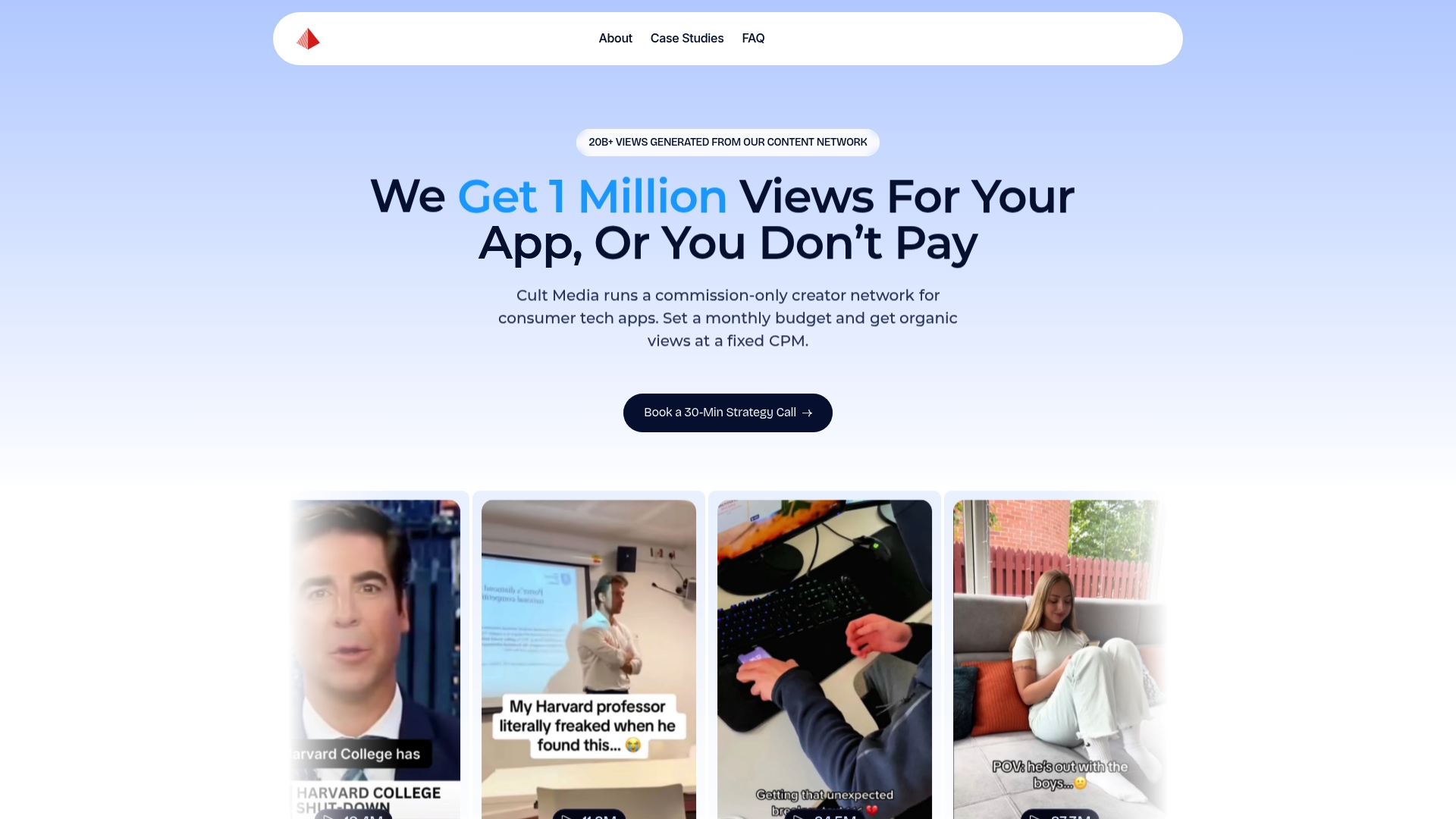
The service includes guaranteed view campaigns, UGC strategy, creator management, and multi-platform distribution once a piece of content proves itself. It suits teams that need speed and delivery certainty over building an in-house creator function from scratch, particularly during a launch window when internal capacity is already stretched thin.
- Guaranteed view campaigns with performance-based pricing tied to verified organic views.
- Full creator sourcing, vetting, and management handled end to end.
- Multi-platform distribution once a winning asset is identified.
Teams evaluating whether a managed program fits their launch timeline can review Cult Media's commission-only creator network to see the current offering and get started.
Sources
- Disclosures 101 for Social Media Influencers (FTC)
- Promotional content deep links (Google Play Console)
- Influencer marketing for apps: How to measure campaigns | Adjust
- Influencer Marketing Benchmark Report 2025 | Creator Rates (Janney AI)
FAQ
What is the 5-3-2 rule in Instagram marketing?
Definitions vary across marketing guides, but a common version describes a content mix: five curated or educational posts, three engagement-focused posts, and two promotional posts within a given cycle. It is a general content-balance rule rather than a standard specific to app creator campaigns.
Is Collabstr a legitimate platform for creator outreach?
Marketplace platforms for creator discovery vary in vetting quality, and the article does not have direct data on any specific marketplace's legitimacy. Growth teams evaluating any creator marketplace should check contactability, sample content quality, and past brand reviews before committing budget.
Which brands send PR packages to small influencers?
Many consumer brands run gifting programs aimed at micro and nano creators as a low-cost way to test content formats before paid deals. Because gifted content carries no financial incentive tied to a tracked outcome, it works best for format discovery rather than measurable install attribution.
How much does it cost to promote an app through creators?
Cost depends heavily on the pay model chosen, whether performance CPM, affiliate commission, or a hybrid flat-fee-plus-bonus structure, and on creator tier. Cult Media's commission-only creator network ties cost directly to verified views, with pricing available on request based on campaign scope.
How do you track which creator drove an app install?
The standard method is assigning each creator a unique deep link or promo code and combining that data with a mobile measurement partner to track installs and post-install behavior. This setup, recommended for app campaigns generally, lets teams compare creators fairly and pay based on verified results rather than self-reported numbers.