
Verified views tracking is the process of measuring and validating creator-delivered views against a set of billable outcomes, using platform APIs and attribution data instead of self-reported numbers. The single approach that holds up under audit combines unique per-creator links, deep linking through a mobile measurement partner, promo codes as a clickless fallback, server-to-server billing integration, and organic uplift modeling. Some networks run campaigns on a stack that pays per verified view rather than per impression estimate.
TL;DR:
- Verified views are confirmed through platform APIs and tracking links, ensuring accurate billing based on actual creator-driven views rather than estimates.
- The measurement stack includes unique per-creator links, deep linking via an MMP, promo codes as a fallback, server-to-server revenue attribution, and real-time API data.
- Implementing verified views tracking requires generating links, testing inside app browsers, integrating billing, and maintaining detailed dashboards for dispute resolution.
- Extending attribution windows and modeling organic uplift are crucial to capturing all creator-driven installs, especially with privacy changes and rising ad blockers.
- A campaign-based, pay-for-verified-views model minimizes risks, with daily and long-term reconciliation, and depends on strict operational rules and audit trails.
Table of Contents
- Why Verified Views Tracking Matters for Performance Creator Deals
- The Measurement Stack That Actually Delivers Verifiable Views
- Step-by-Step Checklist to Implement Verified Views Tracking
- Common Attribution Blind Spots and How to Fix Them
- Building a Dashboard That Resolves Payment Disputes
- How Cult Media Runs Verified Views Tracking in Practice
- What Growth Teams Should Demand Before Signing Anything
- Get Guaranteed, Verified Views Without the Retainer Risk
- Sources
- FAQ
Why Verified Views Tracking Matters for Performance Creator Deals
Paying per view only works if the view count can survive a dispute. A creator's screenshot of TikTok analytics can be edited, cropped, or simply out of date by the time you see it. Platform-verified API pulls solve that problem because the numbers come straight from the source, updated on a schedule you control, and CultureX's approach to campaign tracking shows how daily dashboards with 90-day dynamic tracking replace the spreadsheet-and-screenshot routine most brands still rely on.
Verified views also feed everything downstream. Installs, trial starts, and subscription revenue all trace back to a view count you can trust, which is the entire justification for a cost-per-view billing model.
The KPIs worth tracking on a verified-view buy are narrower than most teams assume:
- CPV (cost per view): what you actually pay once counts are verified
- CPE (cost per engagement): likes, comments, shares relative to spend
- CPI (cost per install): the view-to-download conversion rate
- Reach vs. impressions: unique viewers versus total plays
- ER by reach: engagement rate divided by unique reach, not total views
The Measurement Stack That Actually Delivers Verifiable Views
Verified views tracking is not one tool. It is five components working together, and skipping any one of them creates a gap a creator or a platform algorithm can exploit.
- Unique per-creator, per-placement links. Every creator gets a distinct short link, and every placement (a TikTok video versus an Instagram Story from the same creator) gets its own variant. SimpleURL's guidance on multi-platform tracking makes the case plainly: shared links hide which placement actually converted, which makes optimization guesswork.
- Deferred deep linking through an MMP. Mobile measurement partners preserve the destination inside your app even after a user bounces through the App Store or Google Play, so a viewer who clicks a TikTok link still lands on the exact screen the creator promised.
- Promo codes as a clickless fallback. Plenty of viewers watch a video, close the app, and search for yours later without ever tapping the link. A matching promo code captures that conversion deterministically.
- Server-to-server billing integration. Connecting your MMP to a billing provider like RevenueCat or Adapty attributes actual revenue events, not just installs, back to the creator who drove them. Instally's model for tracking installs and revenue pairs unique links with RevenueCat, Stripe, and Adapty integrations specifically so revenue gets credited per creator.
- Platform-verified API pulls over scraped estimates. Public-facing view counts on Instagram or TikTok are frequently rounded or delayed. Hyperr's breakdown of real-time Instagram tracking notes that only an API connection with creator consent produces numbers accurate enough for CPV billing.
Pro Tip: Test every tracking link inside the actual in-app browsers of TikTok and Instagram before launch, not just in Safari or Chrome. Deep links behave differently inside a platform's webview, and that's where most attribution breaks silently.
Daily API pulls combined with 90-day dynamic tracking after publication let you catch late-arriving views without waiting on a creator to check in.
Step-by-Step Checklist to Implement Verified Views Tracking
Getting this live for one campaign takes four phases, and skipping the order tends to create rework later.
1. Pre-launch
- Set your primary KPI (CPV, CPI, or blended) and pick an attribution window before any creative goes out using the guidance in Track Med Spa Campaign ROI: A Clinic Owner’s Playbook.
- Capture a 60 to 90 day organic baseline so you can isolate what the campaign actually adds.
2. Measurement setup
- Generate unique deep links per creator and per placement through your MMP.
- Build matching promo codes and QR codes for offline or no-click scenarios.
- Test every link inside each platform's native browser.
3. Integrations
- Connect your MMP to your billing provider for S2S revenue events.
- Get API access or creator consent for platform-verified metrics.
- Schedule daily pulls for the duration of the flight.
4. Operational rules
- Onboard each creator with a unique link and login.
- Automate payout triggers once a verified-view threshold clears.
- Keep an audit log tied to every payout, not just a running total.
5. Reporting
- Run daily dashboards while the campaign is live, then shift to 90-day dynamic tracking.
- Reconcile final numbers 60 to 90 days out, once subscription revenue has settled.
Common Attribution Blind Spots and How to Fix Them
The biggest blind spot in creator campaigns is watch-then-search behavior: a viewer sees the content, closes the app, and searches your app by name a day later. That install shows up as organic even though the creator caused it, and it is exactly why Airbridge's comparison of promo codes and tracking links concludes that neither method alone captures full influencer-driven install volume.
The fix is layered, not singular: links catch clickers, codes catch no-click converters, and uplift modeling estimates the rest against your baseline. Privacy changes like Apple's App Tracking Transparency and rising ad-blocker use only widen this gap, which is why Apptica's attribution framework treats incrementality testing as required evidence, not an optional add-on.
Practical mitigations that hold up:
- Extend attribution windows to a longer period suitable for influencer-driven conversions.
- Deploy per-creator deep links even for creators you expect to drive mostly organic search.
- Model your baseline before launch, not retroactively.
Pro Tip: If a creator's "organic uplift" looks too clean, cross-check it against competitive-intelligence data for the same period. A spike that coincides with a competitor's outage or news event isn't your creator's doing.
Building a Dashboard That Resolves Payment Disputes
A dashboard built to justify a per-view payout needs specific rows, not a generic overview. At minimum: verified views, CPV, a platform-by-platform breakdown, unique reach, engagement rate, installs split between link-driven and code-driven, attributed revenue from S2S events, and a separate line for modeled organic uplift.
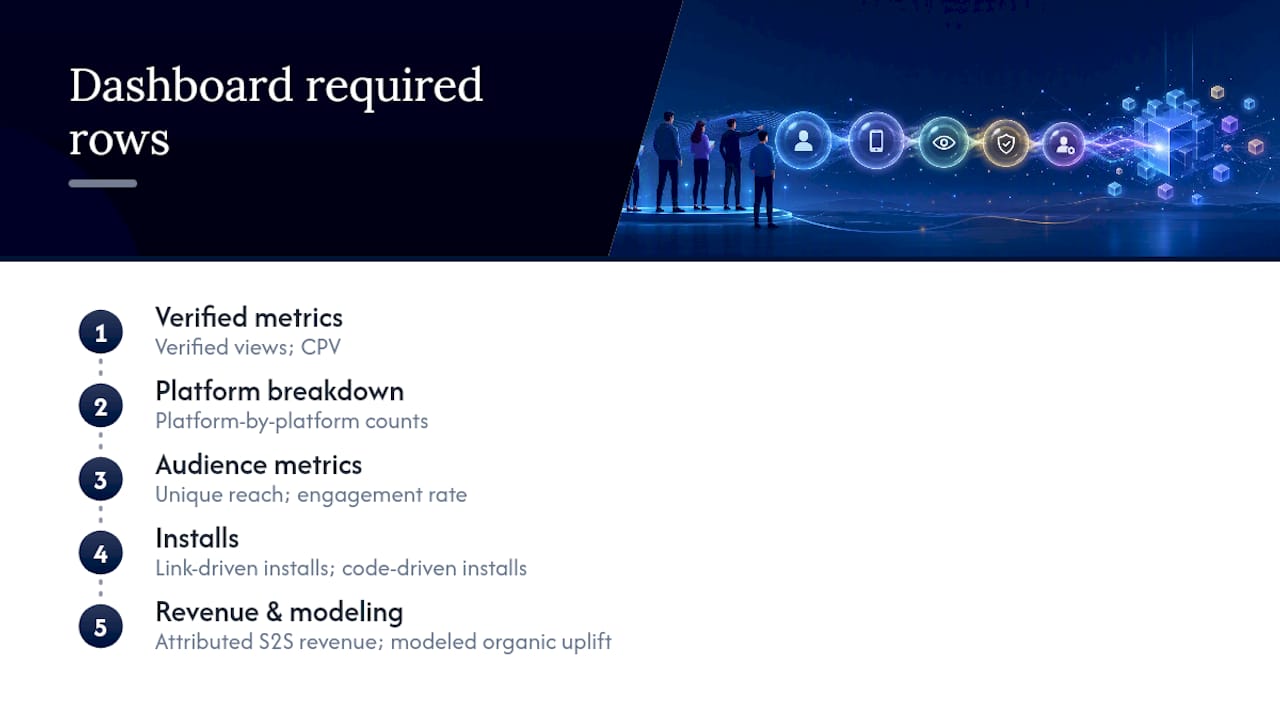
That last split matters more than it sounds. CultureX and Instally both recommend separating deterministic counts, the numbers a link or a code proves outright, from modeled numbers that come from baseline comparison. Mixing the two into one total is how payment disputes start.
Cadence follows the campaign lifecycle: daily dashboards while creators are actively posting, 90-day dynamic tracking after each video goes live, and a full reconciliation at 60 to 90 days once subscription revenue has had time to settle. Keep raw API pull records, the signed creator agreement, and the payout log on file for every campaign. When a creator questions a number, you want a source document, not a memory of what the dashboard said last month. You can dig deeper into how views differ from impressions when scoping which line items belong in that report.
How Cult Media Runs Verified Views Tracking in Practice
A commission-only creator network built around consumer app growth ties payment directly to verified views rather than a flat retainer. That structure requires operational components such as platform-verified API pulls, unique per-creator links, automated payout rules once a view threshold is confirmed, and an audit trail behind every transaction.
Before a creator joins a campaign, Cult Media runs them through an audience quality audit to screen for the kind of inflated or low-value following that inflates view counts without moving installs.
What Growth Teams Should Demand Before Signing Anything
Test the measurement plumbing before you test the creative. A guaranteed-view campaign is only as good as the tracking underneath it, and creative performance means nothing if you can't verify what drove it. Start with a small pilot, require API access or platform-verified pulls in writing, and get audit logs and payout triggers defined before the first creator posts.
— Jax
Get Guaranteed, Verified Views Without the Retainer Risk
Some creator campaigns operate on a commission-only basis where payment tracks verified views instead of a flat monthly fee, aligning the incentive to deliver real performance with the network.
A pilot with Cult Media follows the same structure covered above: a unique tracking link for every creator, daily dashboards while content is live, payout rules that trigger only once views clear platform verification, and a revenue reconciliation process tied to your billing provider. If you're weighing this against a traditional retainer agency or building the stack in house, the difference comes down to risk: you pay for delivered views, not promised reach. Visit the Cult Media landing page to request a pilot quote and see what an implementation checklist looks like for your app category.
Sources
For platform data, MMP deep-linking setup, and organic uplift modeling, start with Instally's install and revenue tracking docs and Apptica's attribution framework before your next integration conversation.
- Influencer Attribution: Promo Codes vs Tracking Links — Airbridge
- Instally — Track App Installs & Revenue from Every Link
- How to attribute influencer campaigns in mobile marketing — Apptica
- How to track Instagram influencer campaign performance in real time — Hyperr
FAQ
What Counts as a "Verified" View?
A verified view is one confirmed through a platform's API pull, not through a screenshot or estimated public count, which is why Instagram Insights data requires API access rather than manual reporting.
How Long Should an Attribution Window Be for Influencer Campaigns?
Most sources recommend 14 to 30 days or longer, since influencer-driven installs often lag behind the initial view by days rather than minutes.
Do I Need Both Tracking Links and Promo Codes?
Yes. Links capture clickers, but they miss viewers who watch content and search for the app later, so codes and organic uplift modeling fill that gap.
How Does Cult Media Verify Views Before Paying Creators?
Cult Media ties payout to platform-verified API pulls and unique per-creator links, with automated triggers that only release payment once a verified-view threshold is confirmed.
How Often Should Verified View Dashboards Update?
Daily during an active campaign, shifting to 90-day dynamic tracking after publication, with a final reconciliation at 60 to 90 days for subscription revenue.