Before you pay for a single guaranteed view, require five things from any creator or vendor: per-placement raw logs, unique-viewer counts, retention windows matched to your campaign brief, a measurable SLA with reimbursement terms, and third-party or vendor-produced attestation. Anti-fraud for social views is not a compliance afterthought. It is the mechanism that turns a numeric promise into billable, auditable inventory you can defend to your CFO.
Each piece does specific work. Raw logs let you reconcile the vendor's numbers against your own platform analytics instead of trusting a dashboard screenshot. Unique-viewer counts expose repeat-hit inflation that padded aggregate totals hide. Retention windows matched to your brief, not the vendor's default, catch views that vanish after a platform audit. An SLA with reimbursement triggers gives you recourse instead of a shrug. Attestation, whether third-party or documented vendor process, gives you something to show a skeptical finance team or, if it ever comes to that, a regulator.
Build this into your RFP:
- Per-placement timestamped logs, not aggregated totals
- Unique-viewer counts separate from raw view counts
- A defined post-audit retention window (72 hours minimum)
- Written refund or make-good terms tied to specific thresholds
- Attestation rights, third-party or documented internal process
Pro Tip: Never skip the minimum test order. Run 500 to 1,000 views through a new vendor first, wait out the platform's audit window, and check the survival rate before committing to a full campaign.
Key Takeaways
Guaranteed creator-driven views only become billable inventory when raw logs, unique-viewer counts, and a reimbursement-backed SLA are locked into the contract before any views are delivered.
| Point | Details |
|---|---|
| Demand raw logs upfront | Require per-placement, timestamped logs before signing, not after a dispute starts. |
| Run a test order first | Order a small batch, wait the 72-hour audit window, and check the post-audit removal rate before scaling. |
| Set a hard failure threshold | Treat post-audit removal above 20 percent as an automatic fail for that provider. |
| Structure payment around risk | Use staged payments or a holdback tied to verified survival rates, not gross delivery. |
| Choose verification-first partners | Cult Media's commission-only model pays only for views that survive audit, aligning its incentives with yours. |
Table of Contents
- What Is Viewbotting and Why It Threatens Guaranteed View Campaigns
- What Analytics Red Flags Signal Fake Views?
- What Technical Signals Do Anti-Fraud Systems Use to Detect Viewbots?
- How Do You Vet a Vendor Before Paying for Guaranteed Views?
- What Should You Do When You Suspect Viewbotting?
- What Should Guaranteed-View Verification Reports Include?
- What Does Successful Anti-Fraud Implementation Look Like in Practice?
- How Are Fraud Schemes Evolving?
- How Does Fraud Prevention Affect Creator Reputation and Trust?
- Cult Media's Perspective on Verified, Billable Views
- Get a Sample Verification Report From Cult Media
- Sources
- FAQ
What Is Viewbotting and Why It Threatens Guaranteed View Campaigns
Viewbotting is the use of automated programs, headless browsers, click farms, or coordinated engagement pods to artificially inflate views, concurrent viewers, or short-form completion rates. It targets the exact metrics that guaranteed-view contracts are priced against, which makes it a direct financial threat rather than a background nuisance.
The damage goes beyond one bad campaign. Digiday's reporting on viewbotting describes "marketplace contamination": when creators inflate audience signals, it skews sponsorship pricing and creator selection across the entire market, not just the fraudulent campaign itself. A creator who buys views to look bigger distorts what every buyer after you thinks that creator is worth.
Platforms punish this unevenly. YouTube, TikTok, and Twitch all reserve the right to strip inflated views, demonetize accounts, or remove creators from partner programs, but enforcement lags the fraud. Advertisers absorb the interim cost: wasted spend, broken attribution models, and campaign optimization decisions built on numbers that later disappear.
Detection is improving but inconsistent. vidIQ notes that platforms increasingly separate public view counts from the numbers used for advertiser billing, which means a view can be publicly visible and still worthless to your campaign math. That gap is exactly where buyer-side verification has to fill in.
What Analytics Red Flags Signal Fake Views?
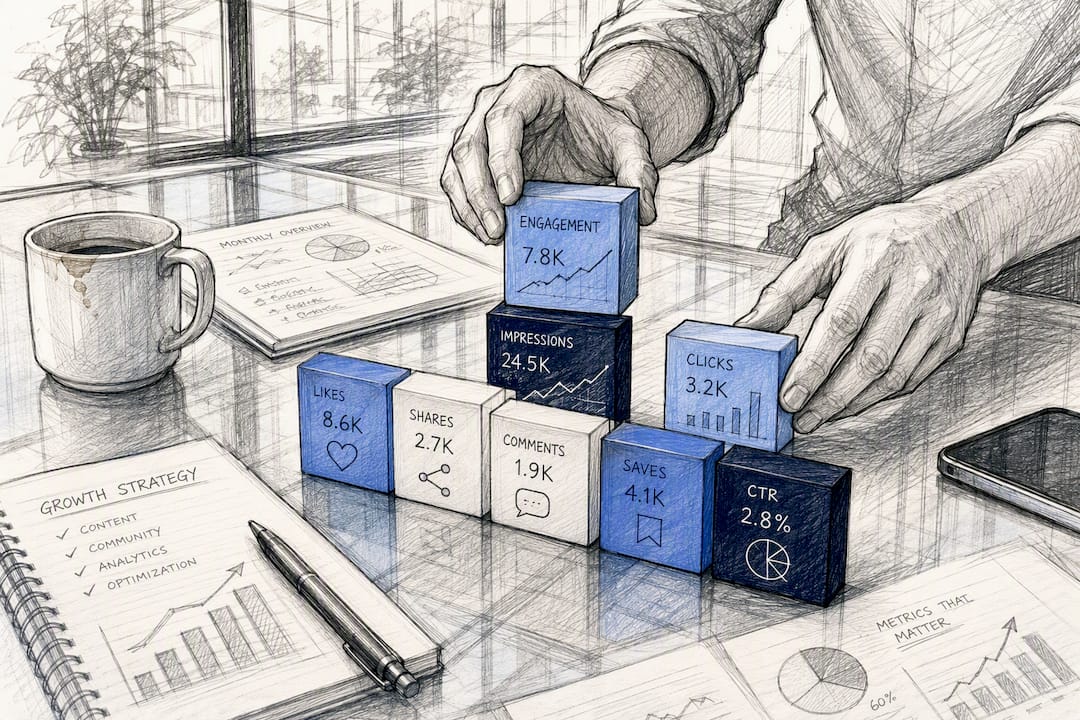
Check watch time first. A view with a session duration near zero, especially on short-form content where a genuine watch typically runs several seconds into the clip, is the fastest tell you have. Bots click and disappear; humans, even distracted ones, tend to linger.
Run this sequence on every placement:
- Place a minimum test order rather than the full campaign volume.
- Wait the full platform audit window, roughly 72 hours, before evaluating results.
- Check the post-audit removal rate against a hard threshold.
- Review the retention curve shape, not just the average view duration.
- Cross-check traffic source and geographic distribution against the creator's stated audience.
- Scan for repeated account patterns in comments or engagement.
The numbers matter here. SMMNut's quality framework finds that genuine views typically show a 5 to 15 percent post-audit removal rate, while fraudulent views often show 30 to 60 percent or higher, along with a measurable drag on average view duration. High removal rates should fail the provider outright.
Other signals worth building into your dashboard: engagement-to-view ratio (likes, comments, shares relative to total views), chat activity during livestreams, sudden unexplained spikes in followers or views, and traffic sources that don't match the platform or region the creator claims to reach. ClickGUARD's practitioner guide lists short session duration, low engagement ratio, and strange referral logs as the most common bot fingerprints, and recommends checking them together rather than relying on any single metric.
Pro Tip: Treat the 72-hour post-audit removal rate as your single most reliable triage number. If a provider's views survive that window at 85 percent or better, everything else is confirmation, not diagnosis.
What Technical Signals Do Anti-Fraud Systems Use to Detect Viewbots?
Modern detection systems don't rely on one signal. They stack several: real-time environmental analysis (checking device, browser, and network conditions against known bot profiles), fingerprinting, headless-browser detection, rate-pattern analysis (how fast and how uniformly views arrive), account-creation pattern review, IP and proxy analysis, and session-interaction heuristics that look at scroll, pause, and replay behavior.
Anura's fraud detection approach centers on real-time environmental analysis, and the company markets very high marking accuracy for correctly flagging fraudulent traffic when the system is properly implemented. That kind of accuracy claim is worth asking about directly: what's the false-positive rate, and how is it measured?
Two distinctions matter most for buyers:
- Real-time blocking vs. post-hoc detection. Real-time systems stop fraudulent views before they ever hit your billing meter. Post-hoc detection catches them after the fact, which means you're disputing charges instead of avoiding them.
- False-positive risk. An overly aggressive filter can flag genuine viewers as fraudulent, which undercounts your real reach and complicates SLA math in the opposite direction.
Ask any vendor to produce these report elements: timestamped raw logs at the session level, per-session fraud flags with the reason code, unique-viewer counts broken out from total views, device and geographic breakdowns, and a defined window during which false-positive disputes can be reviewed and corrected.
How Do You Vet a Vendor Before Paying for Guaranteed Views?
Pre-contract vetting is cheaper than post-campaign disputes. Run a minimum test order, screen-record the metric snapshots at delivery and again after the audit window, check engagement quality manually, and verify audience geography against what the creator claims. Attach a durable fraud flag to any creator's record who fails, so the next buyer on your team doesn't repeat the mistake.
Ask every vendor these questions before signing anything:
- How do you source views, and can you name the platforms and methods involved?
- Can I audit per-placement raw logs, or only aggregated summaries?
- What's your refill or make-good policy if delivered views don't survive audit?
- What's the dispute window, and who arbitrates disagreements?
- Do you cover platform-level post-audit removals, or is that my risk alone?
Storika's guidance on influencer fraud recommends embedding these audience-quality checks into the vetting workflow before contract signature, not as an ad-hoc audit afterward. That sequencing matters: regulators are treating fabricated social metrics as an enforcement priority, and a documented pre-contract process is your best evidence of good faith if a dispute ever escalates.
Your contract should include:
- A guaranteed net-verified-views figure, not a gross delivery number.
- Refund or make-good triggers tied to a specific post-audit removal threshold.
- Audit access to raw, per-placement logs on request.
- Attestation rights, allowing third-party or independent review of delivery data.
- A fixed timeline, in days, for dispute resolution.
Because detection is never perfect, pricing should absorb some of that uncertainty. Staged payments, a holdback percentage released after the audit window closes, or a small performance escrow all shift risk away from you and onto the party best positioned to manage it.
What Should You Do When You Suspect Viewbotting?
Move fast, but move in order. The moment you suspect fraudulent delivery, follow this sequence:
- Pause billing and further delivery from the flagged placement immediately.
- Capture raw analytics: export data and screenshot dashboards with timestamps.
- Request the vendor's raw logs for the disputed placement.
- Run a retained-sample audit against your own platform analytics.
- Open a formal dispute under your contract's SLA terms.
- Pause any future placements from the flagged creator pending resolution.
Evidence quality determines outcomes. Platforms and vendors respond to timestamped exports, UTM-tagged landing-page logs, and funnel-echo metrics (download or signup activity that should correlate with genuine view volume) far more readily than a verbal complaint.
Escalation has a natural order: start with a vendor make-good request, escalate to a formal platform report if the vendor is unresponsive, move to contract termination if the pattern repeats, and treat public disclosure as a last resort reserved for unresolved, material harm.
Keep a standing evidence file for every flagged placement: export dates, screenshot timestamps, correspondence with the vendor, and your internal audit notes. If a dispute ever reaches legal or regulatory review, that file is your record.
What Should Guaranteed-View Verification Reports Include?
A verification report is only as good as its fields. At minimum, require this per placement:
| Data Field | Why It Matters |
|---|---|
| Timestamp | Confirms delivery window and supports audit reconciliation |
| Session ID or hashed unique-viewer ID | Separates unique viewers from repeat-hit inflation |
| Watch duration | Flags short-session bot behavior |
| Traffic source | Detects anomalous or non-organic referral patterns |
| Geo (country and region) | Confirms audience matches the creator's stated reach |
| Device type | Surfaces headless-browser or emulator activity |
| Flagged-fraud boolean | Shows what the vendor's own system already caught |
| Platform audit status | Tracks whether the platform itself later removed the view |
LuvKaizen's five-signal verification standard builds on this same logic: geo composition, engagement ratios, view velocity, account quality, and funnel echo together validate a placement far more reliably than any single number.
Delivery cadence matters as much as the fields themselves. Ask for a daily per-placement CSV, a weekly aggregate summary, and API access on request for teams running high volume. Reconcile every export against your own view versus impression tracking so you're comparing the vendor's claims to what your own analytics actually recorded, not just accepting their totals at face value.
What Does Successful Anti-Fraud Implementation Look Like in Practice?
The strongest anti-fraud programs share a common structure regardless of platform or campaign size: verification happens before payment, not after a dispute. A consumer app running a multi-creator TikTok campaign, for instance, benefits from staging payment against post-audit survival rates rather than gross delivery, because it removes the incentive for any single creator to pad numbers in the first 72 hours.
The pattern that separates working programs from failed ones is sequencing. Teams that require a minimum test order before scaling a creator relationship consistently catch fraudulent sourcing before it touches real budget. SMMNut's research on test-order protocols supports this: a small initial order, evaluated after the platform's own audit window closes, gives buyers a low-cost signal about vendor quality before committing to volume.
Campaigns that build funnel-echo checks into their reporting, tracking whether view volume correlates with actual app installs or signups, catch a second category of fraud that view counts alone miss entirely: views that are technically "real" (a human clicked play) but sourced from bot farms or engagement pods with no buying intent whatsoever. A TikTok-specific creator playbook that ties creator performance to install-through-rate, not just view count, catches this gap before it becomes a wasted quarter of spend.
The common thread across every successful implementation is the same: verification data arrives with the delivery, not after a problem surfaces.
How Are Fraud Schemes Evolving?
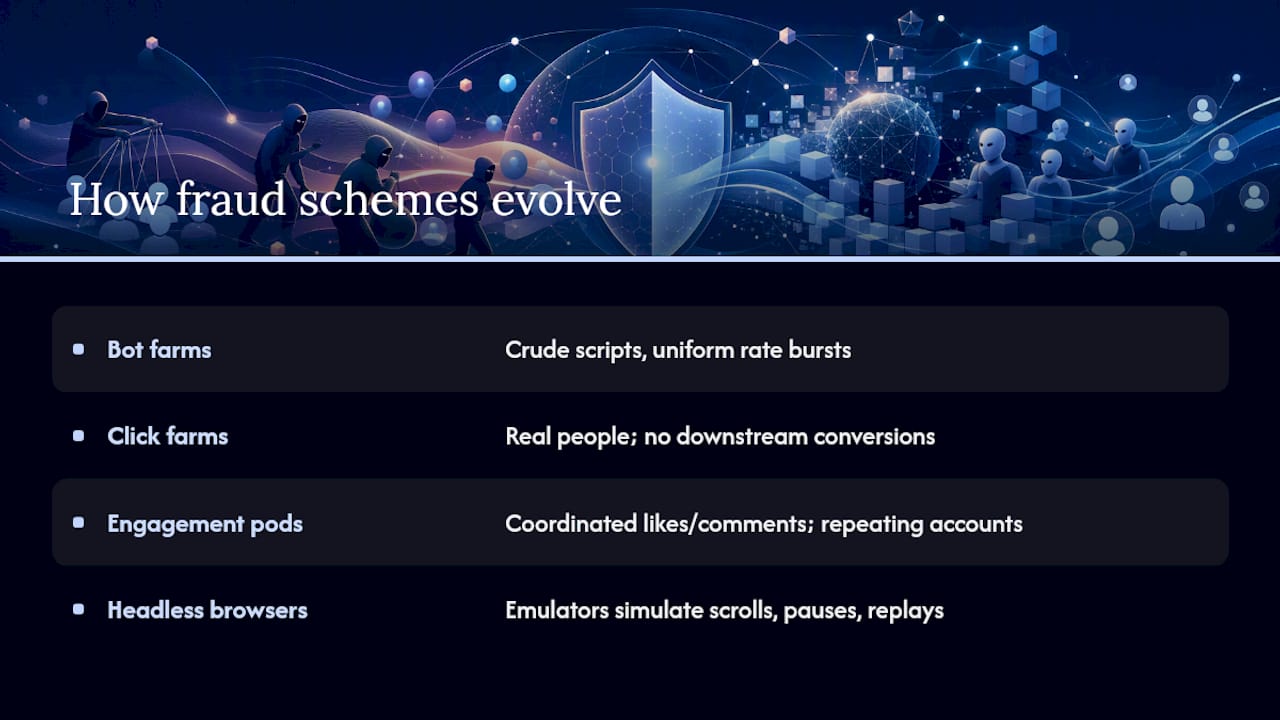
Fraud tactics have moved well past simple bot farms. Early viewbotting relied on crude automated scripts that were relatively easy to catch through rate-pattern analysis, since bot traffic arrived in unnatural, uniform bursts. That era isn't gone, but it's no longer the primary threat.
Current schemes increasingly mimic human behavior closely enough to pass casual review. Click farms staffed with real people watching videos on real devices produce views that look organic in basic metrics but fail on funnel echo, since the "viewers" never convert to any downstream action. Engagement pods, coordinated groups that like, comment, and share each other's content on schedule, inflate engagement-to-view ratios in ways that look healthy until you check whether the same accounts appear across dozens of unrelated creators.
Headless browsers and device emulators represent the more sophisticated end of the spectrum, capable of simulating scroll behavior, pause patterns, and even replay activity closely enough to challenge some detection systems. This is precisely why Anura's real-time environmental analysis approach focuses on device and network-level signals rather than surface-level engagement metrics; the fraud has adapted to fool the metrics that used to be sufficient on their own.
The practical takeaway for buyers: any single-signal detection method is now obsolete. Multi-signal verification, combining rate patterns, device fingerprinting, funnel echo, and account history, is the only approach that keeps pace with how fast fraud tactics shift.
How Does Fraud Prevention Affect Creator Reputation and Trust?
Anti-fraud measures protect more than your campaign budget. They protect the creator's own market value, whether the creator realizes it or not.
A creator whose audience numbers are inflated by even one bad vendor relationship carries that contamination into every future deal. Digiday's marketplace-contamination framework applies here directly: once a creator's signals are known or suspected to be padded, buyers discount their rates across the board, not just for the flagged campaign. The creator pays a long-term reputational cost for a short-term numbers boost, often one they didn't orchestrate themselves.
Audiences notice too, even indirectly. Viewers who sense a creator's engagement doesn't match their stated following tend to disengage, which shows up eventually as declining organic reach regardless of what the paid numbers say. Verified delivery protects the creator's standing with their actual audience, not just with the brands paying them.
For growth teams, this creates a durable incentive alignment worth building into vendor selection: work with creators and networks that treat fraud prevention as part of their own brand protection, not just a buyer-side compliance checkbox. A creator who insists on clean, auditable delivery is signaling something about how they intend to build a long-term career, not just close one contract.
Cult Media's Perspective on Verified, Billable Views
We built Cult Media's commission-only model because it forces the incentive question every buyer should be asking: does the vendor get paid regardless of view quality, or only when views survive audit? Ours only get paid for verified results, which means padding numbers costs us money, not just credibility.
Internally, we require minimum test orders on every new creator relationship, per-placement logging on every campaign, a refundable SLA tied to post-audit thresholds, and durable quality records attached to each creator's file. That structure exists to protect your CPI math and keep attribution clean from day one.
Get a Sample Verification Report From Cult Media
If you've read this far, you already know the real cost of guaranteed views isn't the CPM. It's paying for views that vanish after a platform audit and wrecking your CAC math in the process. Cult Media's commission-only structure means we only collect when views are verified and billable, which puts the fraud risk on us instead of your budget.

Every campaign includes:
- Per-placement raw logs, not aggregated summaries
- A refundable SLA tied to post-audit survival thresholds
- Funnel-echo checks connecting views to actual app installs
- Post-campaign attestation you can hand to finance or to legal
Request a test order and a sample verification report before committing to a full campaign. Visit Cult Media to see exactly what a per-placement audit export looks like and get a quote scoped to your app's guaranteed-view campaign.
Sources
- WTF is viewbotting? - Digiday
- What is Viewbotting? How Fake Views Work & How to Stop Them | Anura
- Influencer Fraud Detection: How to Spot Fake Followers and Bought Engagement Before You Pay a Creator | Storika
- Real vs Fake YouTube Views — How to Evaluate Quality Before You Buy | SMMNut
- Verified Views: Auditing Clipping Campaigns for Bots
FAQ
What Is Anti-Fraud for Social Views?
It's the combination of detection technology, contract terms, and audit processes that verify a social media view came from a real, engaged viewer rather than a bot, click farm, or engagement pod.
How Long Should a Post-Audit Verification Window Last?
Most practitioner frameworks recommend at least 72 hours, since that's the window during which platforms typically complete their own fraud removal passes.
What Post-Audit Removal Rate Should Fail a Vendor?
A removal rate above 20 percent is a reasonable failure threshold, since genuine views typically fall in the 5 to 15 percent range while fraudulent views often show 30 to 60 percent or higher.
Does Cult Media Guarantee Verified Views?
Cult Media operates on a commission-only model that pays only for views verified through per-placement logging and post-audit survival, aligning its incentives with the buyer's from the start.
What's the Fastest Way to Spot a Fake View Batch?
Check average watch time and the engagement-to-view ratio together; a session that ends almost immediately with no corresponding likes, comments, or shares is the clearest early signal.
Recommended
- Creator Audience Quality: Audit Checklist for Guaranteed Views - Scale Your Consumer App By Unlocking The TikTok & Instagram Systems Behind +20 Billion Views
- View vs Impression: What Marketers Must Track - Scale Your Consumer App By Unlocking The TikTok & Instagram Systems Behind +20 Billion Views
- Organic vs Paid Views: What App Founders Must Know
- Creator Whitelisting: Lower CPA for Consumer Apps