Commission-only influencer marketing works, but only under narrow conditions: strong product-market fit, a low-funnel offer with a short path to purchase, airtight tracking, and fast, reliable payouts. Creator acceptance of pure commission deals is limited, so production-heavy campaigns usually need a hybrid structure with a base fee. Any commission or affiliate arrangement also requires FTC-compliant disclosure and validated reporting before you scale spend.
TL;DR:
- Use a hybrid deal for most creators: a production fee plus commission; reserve pure commission for established partners with proven conversion history.
- Set rates from average order value, gross margin, and allowable acquisition cost, and price production, usage rights, and paid amplification separately.
- Define payable events and rules for returns, refunds, and duplicate orders before launch; set attribution windows of 7 to 30 days based on purchase cycles.
- A basic affiliate plugin can handle a handful of creators, while dozens of partnerships with mixed payouts call for dedicated software and automated reconciliation.
- Run test orders before launch and assign one person to validate the first week of results, catching tracking errors before payouts begin.
Table of Contents
- Why many creators resist pure commission-only deals
- Compensation models: commission-only, hybrid, and tiered rates
- Operational checklist and contract terms every commission-only campaign needs
- Tools and platform choices for tracking commission-based programs
- Our take: structuring commission-first campaigns that respect creators
- How our commission-only creator network supports performance campaigns
- FAQ
- Sources
Why many creators resist pure commission-only deals
Creators turn down commission-only offers more often than brands expect. Survey data on willingness to work purely on affiliate terms without a base fee consistently shows that a minority of creators accept those terms, which is why most professional partnerships include at least a small guarantee.
The resistance makes sense once you look at what creators are actually being asked to absorb. A commission-only structure pushes conversion risk and unpaid production time onto the creator: if your landing page underperforms, your checkout breaks, or your offer doesn't resonate, the creator earns nothing despite delivering the content and the audience. According to DWT's analysis of FTC endorsement guidance, shifting conversion and technical risk entirely onto creators filters out the professional partners who refuse to gamble on variables they don't control.
Creators who do take commission-only deals typically expect:
- A baseline fee or flat minimum alongside the commission, even if modest.
- Transparent, real-time reporting on clicks, conversions, and payout status.
- Clear usage rights for their content, with a defined time window and platform scope.
- A reasonable attribution window that doesn't penalize them for delayed purchases.
Pro Tip: Ask prospective creators how they currently track their own affiliate links. Their answer tells you instantly whether they're set up to operate professionally or are new to performance deals.
Compensation models: commission-only, hybrid, and tiered rates
Four structures cover most commission-based influencer marketing programs, and each fits a different stage of creator maturity and campaign risk.
- Commission-only: creators earn a percentage of each verified sale or signup, with no base pay. Works best with established creators who already believe in the product and have proven conversion history.
- Hybrid: a flat fee covers production and posting, plus a commission on performance. This is the default for most programs because it compensates creators for guaranteed work while still rewarding results.
- Tiered commission: the percentage increases as a creator hits volume thresholds, rewarding your best performers without raising base costs for everyone else.
- Fixed fee plus bonus: a set payment for the content itself, with a one-time bonus tied to a specific performance milestone, useful when you want predictable costs with upside for standout results.
Setting the commission rate starts with your margin, not a round number. A workable formula ties the rate to average order value (AOV), gross margin, and the customer acquisition cost (CAC) you're willing to pay.
Production costs, paid amplification rights, and usage rights should be priced into the program separately rather than absorbed into the commission rate, since bundling them tends to undervalue the content itself. Our guide on affiliate versus influencer marketing breaks down when a performance-only structure outperforms a fixed deal, and our creator pay models framework walks through sample economics in more detail.
Operational checklist and contract terms every commission-only campaign needs
A commission-only program lives or dies on whether results are verifiable and disputes are resolvable. Before launch, decide on the payable event: is it a completed sale, a trial signup, or an app install that survives a fraud check? Define validation rules up front, including how returns, refunds, and duplicate orders affect payout.

Tracking method matters just as much. Unique promo codes are easy for creators to promote verbally but prone to leakage across channels. Trackable links offer cleaner attribution but depend on the creator actually using them instead of a bio link that gets edited. Deep links into an app give the most reliable data for mobile campaigns but require more technical setup on your end.
Contracts should spell out:
- The attribution window (commonly 7 to 30 days depending on purchase cycle length).
- Payout timing and how disputed or returned orders are handled.
- Whether the creator or the brand can run paid amplification behind the content.
- Content usage rights: duration, platforms, and whether the brand can repurpose it in ads.
Compliance isn't optional. The 2023 FTC Endorsement Guides and the Federal Register's published examples require clear, conspicuous disclosure of any material connection, including commission arrangements, and brands carry responsibility for monitoring that creators comply. Our breakdown of FTC disclosure rules for 2026 covers exact wording that holds up under scrutiny.
Pro Tip: Run a small batch of test orders through your tracking system before full launch, and name one person responsible for validating the first week of results. For deeper contract language, our piece on performance contracts that preserve creator relationships is worth a look before you send a draft agreement.
Tools and platform choices for tracking commission-based programs
The right tool depends on program scale, not ambition. A lightweight affiliate plugin bolted onto your ecommerce platform can handle a handful of creators with simple code-based tracking. Once you're running dozens of partnerships with mixed payout structures, a dedicated affiliate platform or creator ops system earns its cost through automation and fewer manual errors.
Whichever stack you choose, prioritize:
- Fraud detection that flags duplicate or suspicious conversions before payout.
- Automated payout scheduling tied to your validation rules, not manual approval every cycle.
- Creator-facing dashboards so partners can see their own performance without asking you.
- Exportable order ledgers your finance team can reconcile against actual revenue.
Server-side attribution is worth the added setup for mobile apps or high-volume programs, since it survives browser tracking restrictions better than client-side pixels. For smaller or earlier-stage programs, a weekly reconciliation cadence with finance sign-off before each payout run is usually enough to catch discrepancies early. Our roundup of influencer analytics tools compares options across these categories in more depth, and the UGC creator vetting guide from a partner in performance creative is a useful companion for recruiting creators who are already set up to track their own results.
Our take: structuring commission-first campaigns that respect creators
Commission-only deals succeed when someone manages the incentive gap between brand and creator, not when brands simply shift risk downward and hope for the best. The programs that hold up over multiple cycles are the ones where a hybrid base, clean verification, and paid amplification behind top content turn a creator's single post into a repeatable income stream instead of a one-time gamble.
We design these structures around that principle: a baseline that respects a creator's production time, verification rules that isolate what a creator actually controls, and paid distribution layered behind content once it proves it converts. That combination tends to keep higher-quality creators in the program past the first campaign, which is where most commission-only efforts quietly fail.
Risk shared well keeps creators in the room. Risk shifted entirely keeps only the ones with nothing better to do.
— Jax
How our commission-only creator network supports performance campaigns
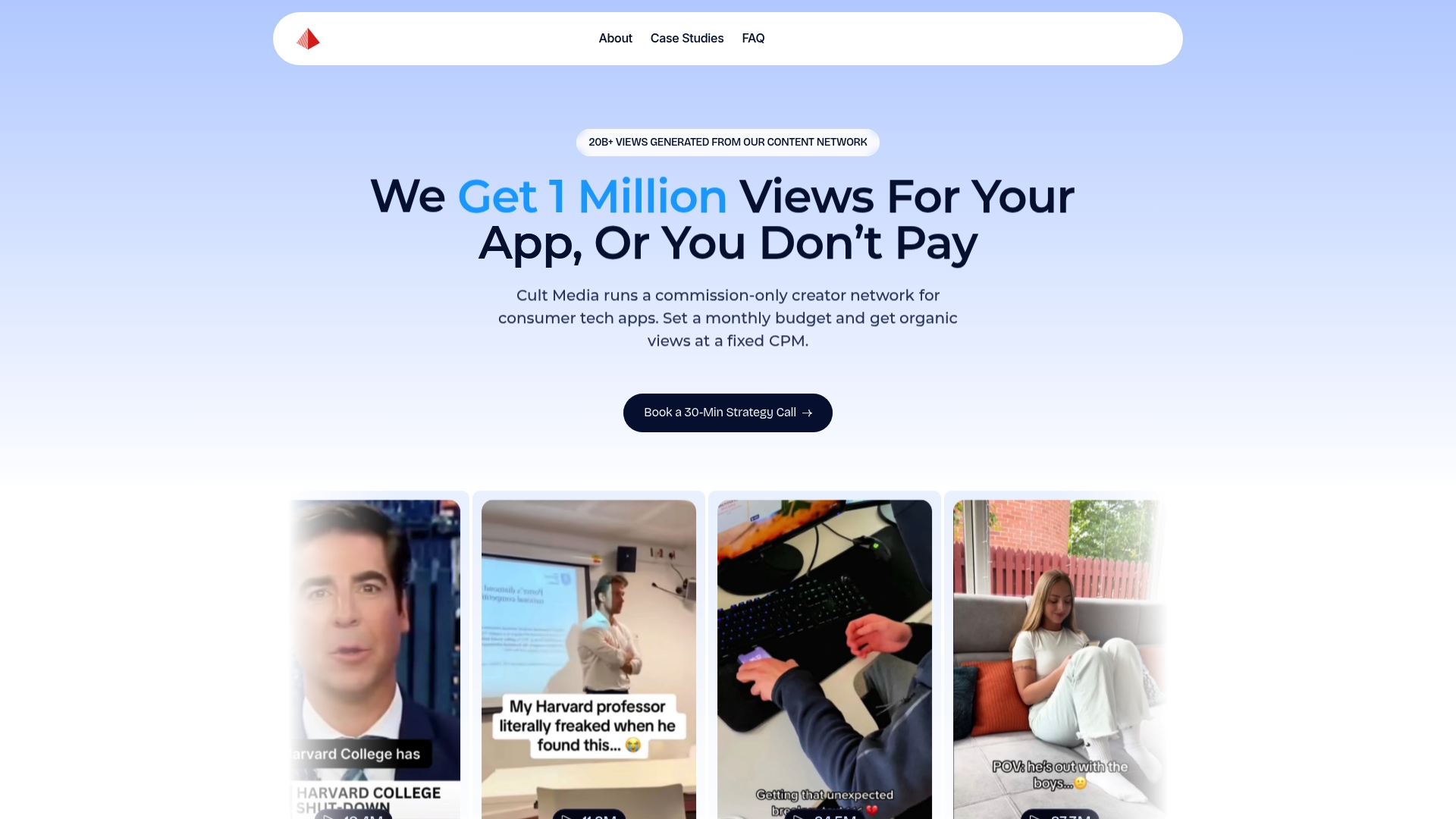
Some commission-only creator networks are designed specifically for consumer tech apps that want measurable acquisition without paying for reach they can't verify. Campaigns may combine guaranteed view delivery, custom UGC strategy, end-to-end creator management, and pricing tied to verified organic views, so every dollar maps to a result you can check.
This approach fits brands in a specific position:
- Consumer app founders and growth teams who need user acquisition tied to actual verified performance, not impressions.
- Ecommerce and SaaS teams that already have a low-funnel, high-converting offer ready for creator-driven traffic.
- Agencies managing multiple app clients who want a done-for-you creator layer instead of building one internally.
You can see how this plays out in practice in our case studies on creator-led growth, including a campaign that drove 42,500 signups at $0.28 each through organic UGC. If you want a sense of what a commission-first program could look like for your app, request a growth consultation and we'll walk through the setup.
FAQ
Is commission-only influencer marketing realistic for most brands?
It works best for brands with a proven, low-funnel offer and reliable tracking already in place. Most programs end up hybrid, pairing a base fee with commission, because creator willingness to accept pure commission terms is limited.
Do commission-only creators still need to disclose the partnership?
Yes. The FTC's Endorsement Guides require clear, conspicuous disclosure of any material connection, including a commission or affiliate arrangement, regardless of whether a base fee is involved.
What should I check before choosing a creator for a commission-only deal?
Ask how they currently track affiliate performance and whether they've worked on commission terms before. Creators who manage their own links and reporting tend to convert more reliably than those new to performance deals.
How do I set a fair commission rate?
Base the rate on your average order value, gross margin, and the CAC you're willing to pay, then translate that percentage into a dollar figure per sale before presenting it.
What's the biggest operational mistake brands make with commission-only programs?
Brands often fail to define the payable event and validation rules before launch, leaving disputes over returns or duplicate orders unresolved. Isolating what a creator actually controls, rather than making them absorb checkout or site performance issues, keeps professional creators in the program.
Sources
- FTC: Endorsement Guides (business guidance)
- Federal Register: Guides concerning the use of endorsements and testimonials in advertising
- DWT insights on FTC endorsement guidance and advertiser responsibility