The fastest way to make a video script convert is to engineer an irresistible hook, write every line for the ear, and test hooks until one wins. Platform hook windows run from 1–3 seconds on TikTok and Reels up to 8–10 seconds on long-form YouTube, and narration should land near 150 words per minute for natural pacing. Get those two variables right before you touch anything else.
TL;DR:
- The most effective video scripts rely on a strong hook, tailored to the platform's time window, and tested multiple variations for maximum clickability.
- Script structures like AIDA, PAS, BAB, and VSL should be matched to the video's length and purpose, with each stage carefully timed for optimized persuasion.
- Shorter scripts (15 to 30 seconds) should focus on a punchy hook, one proof point, and a clear CTA, while longer scripts incorporate multiple proof points and detailed mechanisms.
- Testing hooks against audience behavior is crucial, with performance tracked via view rate, retention, and click-through metrics to scale successful variations.
- Working with professional creator networks that operate on a commission-only basis ensures scripts reach the right audience and performance targets without upfront costs.
Table of Contents
- Which Conversion Framework Should You Use?
- What Should a Script Template Look Like by Length?
- What Psychological Triggers Actually Drive Conversions?
- How Do You Format a Script for Production?
- How Should You Adapt a Script for Each Platform?
- How Do You A/B Test and Scale a Winning Script?
- What a Commission-Only Creator Network Sees That Solo Writers Miss
- Ready to Turn Scripts Into Guaranteed Views?
- Sources
- FAQ
Which Conversion Framework Should You Use?
Script structure decides more than most marketers assume. A study of 3,500 performance video ads found script quality explains 50 to 70% of conversion variance, while production quality accounts for just 15 to 20%. Picking the right persuasion architecture matters more than the camera you shoot on.
- AIDA (Attention, Interest, Desire, Action) works best for short ads and social spots where you have seconds to earn a click.
- PAS (Problem, Agitate, Solution) fits explainer videos selling a fix to a specific pain point.
- BAB (Before, After, Bridge) suits testimonial-style content and app demos showing transformation.
- VSL (video sales letter) architecture handles long-form sales video with high-ticket offers or complex products.
Run every script through the same checklist: hook type first, proof placed right after the problem is named, and a CTA that lands within the final 10 to 15% of runtime. VSL scripts differ because they stack proof multiple times and dedicate a full stage to explaining the mechanism behind the offer. The VSL structure runs seven stages: hook, problem agitation, credibility bridge, mechanism, proof stack, offer stack, and close, each with its own timing budget.
What Should a Script Template Look Like by Length?
Word counts scale directly with the 150 WPM benchmark, so a 30-second script needs roughly 75 words, not 150.
- 15 seconds (about 35–40 words): Hook → one proof beat → CTA. No room for a setup; state the payoff in the first line.
- 30 seconds (about 75–90 words): Hook → problem → proof → CTA. This is the standard social ad length.
- 60 seconds (about 150 words): Hook → problem → mechanism → proof → CTA. Enough space for one objection handle.
- 90 seconds (about 220 words): Hook → problem → mechanism → two proof points → objection → CTA.
- 5 minutes (about 750 words): Full VSL sequence across all seven stages, with 30 to 60 seconds allotted per stage depending on offer complexity.
That's not a retention problem, it's an onboarding problem. [App name] cuts drop-off by fixing the first three screens. Download it free and see your day-one numbers shift. A 60-second skeleton just adds a mechanism line ("Here's how it works...") and a second proof point before the same CTA.
What Psychological Triggers Actually Drive Conversions?
Hooks fail for a predictable reason: they describe the product instead of triggering a reaction. Group hook formulas by the trigger they exploit.
- Pain hooks: "Still losing users after day one?"
- Curiosity hooks: "The one screen killing your retention rate."
- Proof hooks: "This app hit 100,000 downloads in 30 days doing this."
- Pattern interrupt hooks: Open mid-action, mid-sentence, or with an unexpected visual before any words appear.
Proof stacking works in a specific order: lead with a metric, follow with a named case, close with a short testimonial line. Keep each proof beat under two sentences. Five CTA templates cover most situations: the specific next step ("Tap the link and try it free"), risk reversal ("Cancel anytime, no card required"), urgency anchor ("Offer ends Friday"), benefit restate ("Get your first result in 24 hours"), and curiosity close ("See what happens when you switch"). Cult Media's own CTA wording guide breaks down which phrasing performs best by funnel stage.
Pro Tip: Write five hook variations before you write a single line of body copy. The hook is the only sentence that has to fight for attention against a thumb already moving toward the next post.
How Do You Format a Script for Production?
Two-column AV format, with visuals on the left and audio on the right, works best for ads and explainers where timing between voice and image has to match exactly. Single-column format is fine for training videos or talking-head content where visual cues matter less. Canva's video script templates include both formats, plus space to mark B-roll, lower thirds, and on-screen text separately from spoken lines.
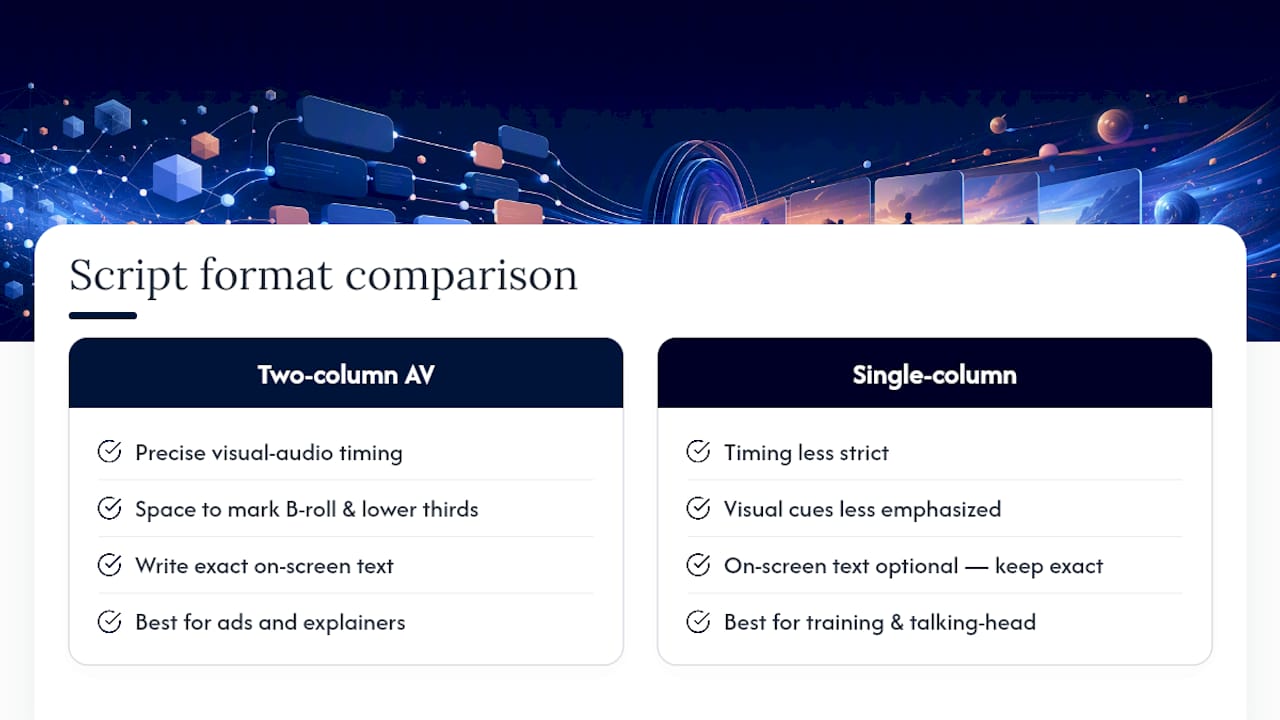
Mark every cutaway with a timestamp and a one-line description, and write exact on-screen text rather than paraphrasing it. Then run the read-aloud test: read the script out loud, mark where you run out of breath, and split the sentence there. Swap "it is" for "it's" everywhere. The read-aloud method exists because scripts that read fine on a page often sound stiff coming out of an actual mouth, and fixing that on paper is cheaper than a reshoot.
How Should You Adapt a Script for Each Platform?
- TikTok/Reels: 1 to 3 second hook window, 15 to 25 words before the first cut, pattern interrupt at the very first frame.
- Meta feed ads: roughly 3 second hook window, slightly more setup room since the audience isn't scroll-swiping as fast.
- YouTube Shorts: similar to TikTok, but reward for a strong second beat is higher since watch-time weighs heavily in Shorts distribution.
- Long-form YouTube: 8 to 10 second hook window, room for a proper cold open before the intro.
Converting a 60-second script into a 15-second TikTok cut means keeping only the hook and the single strongest proof line, then cutting straight to the CTA. Cult Media's breakdown of TikTok hook examples shows how much gets stripped out in that process.
How Do You A/B Test and Scale a Winning Script?
Testing hooks only works if everything else stays fixed: same creative, same CTA, same targeting. Track the 3-second view rate, retention through the 10 to 30 second mark, click-through rate, and final conversion rate, and set kill/scale thresholds before the test starts, not after you see results.
- Write 3 script frameworks with 2 hook variations each, six total assets.
- Produce all six and launch simultaneously.
- Run the test for 48 to 72 hours minimum before judging.
- Kill any variant underperforming the account average 3-second view rate.
- Scale the winner's budget, don't rewrite it.
- Feed the winning hook pattern back into your next batch of scripts.
Tracking verified view data against these thresholds is exactly the kind of measurement Cult Media's view tracking framework was built around.
What a Commission-Only Creator Network Sees That Solo Writers Miss
Running scripts through dozens of creators at once exposes something a single writer never sees: which hook survives a rewrite in someone else's voice. Cult Media pairs template discipline with guaranteed view targets, so a hook that tests well on paper still has to prove itself against real audience behavior before a client pays for it. The best practice is simple: hand creators the hook verbatim, give them latitude on delivery, and never let brief drift erase the line that earned the click in the first place.
— Jax
Ready to Turn Scripts Into Guaranteed Views?
Writing a high converting script is only half the job. Getting it in front of the right creators, at scale, without paying a flat retainer regardless of outcome, is the harder half most marketers never solve. There are services that run commission-only creator networks built specifically for consumer tech apps, where clients pay only upon achieving verified performance targets.
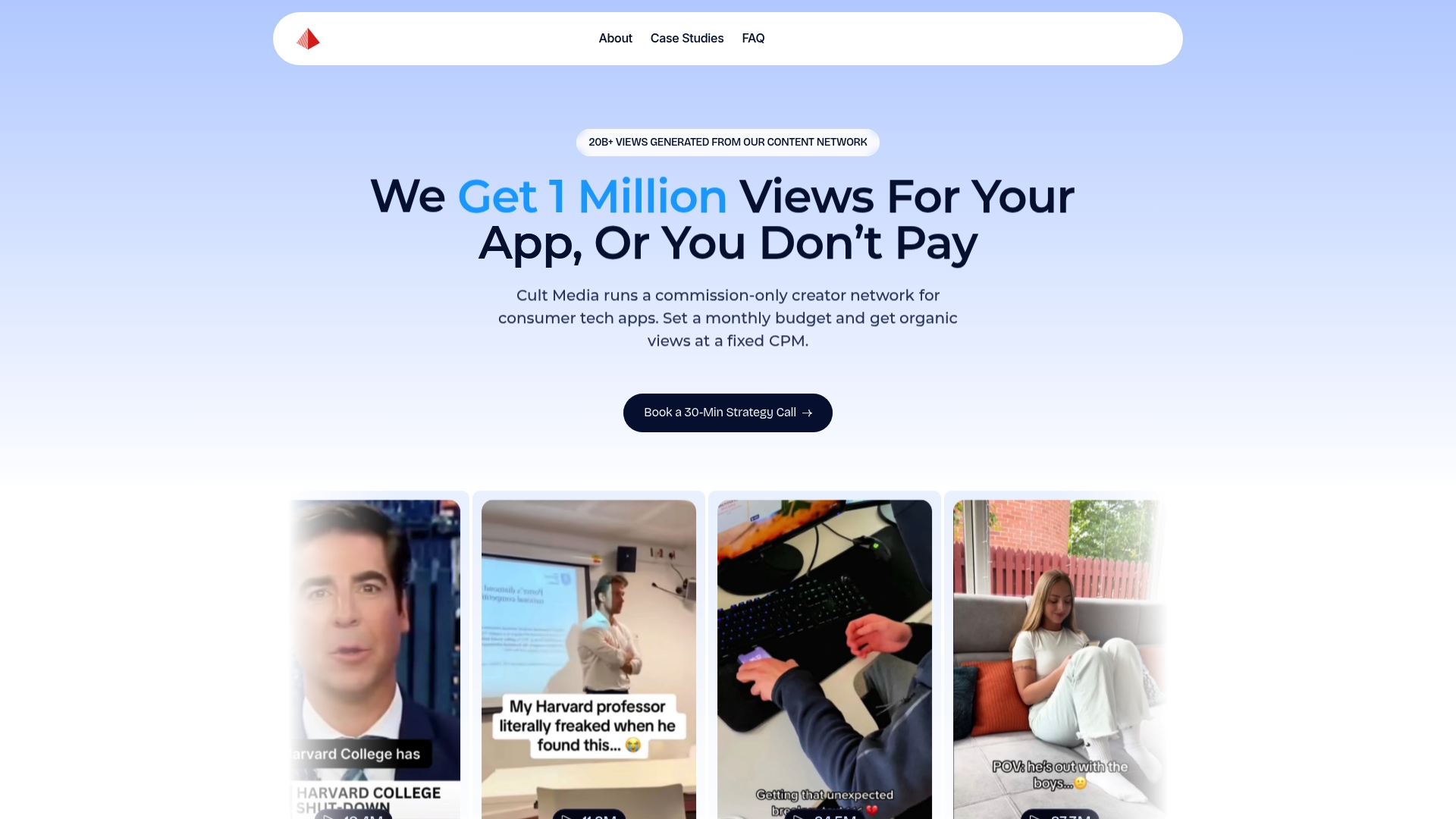
DIY testing makes sense when you're validating a single concept on a small budget, but professional support from a digital growth agency can help scale your video scripts effectively. Once you know which hook works and need it distributed across a real creator network at volume, managed campaigns close the gap that solo testing can't. Some agencies transfer full content rights and assign dedicated account management to ensure consistency across creator briefs. Visit the commission-only creator network page to request a campaign estimate. Initial discussions typically cover current customer acquisition cost, target view volume, and evaluating which existing scripts are worth scaling.
Sources
FAQ
What Are the Different Types of Video Scripts?
The main types are ad scripts (short, hook-driven), explainer scripts (problem/solution structure), VSL scripts (long-form, multi-stage persuasion), and UGC-style scripts (conversational, testimonial-driven). Each maps to a different framework, whether that's AIDA, PAS, BAB, or full VSL architecture.
How Long Is a 3-Minute Video Script?
At the 150 WPM benchmark, a 3-minute script runs roughly 450 words. That's enough room for a full problem, mechanism, and multi-point proof stack before the close.
Can AI Create a Script From a Video?
AI tools can generate hook ideas and rough drafts quickly, but outputs need rewriting for brand voice and trimmed to actual script-level brevity before use. Treat AI as an ideation step, not a final draft.
Can You Provide an Example of a Video Script?
That's not a retention problem, it's an onboarding problem. [App name] fixes the first three screens automatically. Download it free and watch your day-one numbers change." That's a full PAS structure in under 90 words.
What Does Cult Media Charge for Campaigns?
Cult Media runs on a commission-only, performance-based model tied to verified views, with pricing available directly through the creator network landing page rather than a published rate card.