
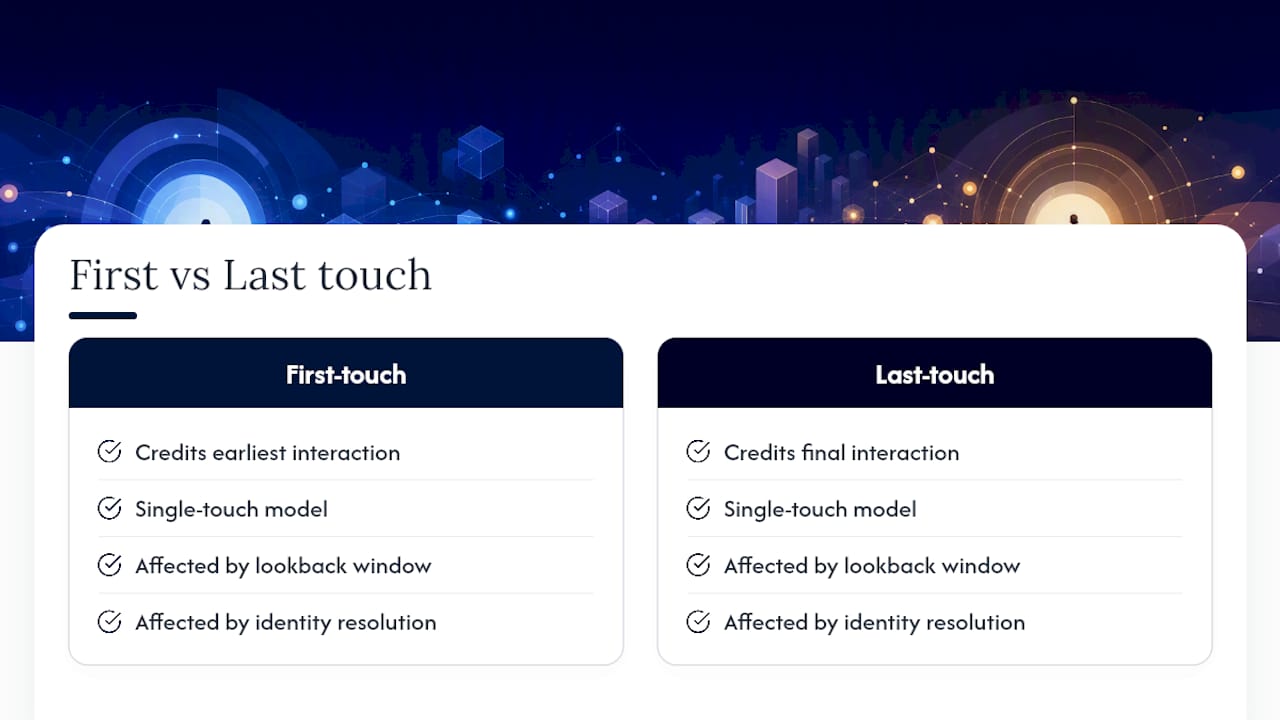
First-touch attribution assigns all credit to the interaction that started a customer's journey; last-touch attribution assigns it all to the interaction right before conversion. Neither model captures what happened in between, so each answers a different question, first-touch about discovery, last-touch about closing. The practical move is to run both, quantify how much they disagree, and reserve budget reallocations for what an experiment confirms, not what a single report implies.
TL;DR:
- Running both first-touch and last-touch models and comparing their results reveals channels that may be undervalued or overvalued, especially when they sharply disagree.
- Single-touch models often bias reporting, overestimating demand-generating channels like content and organic search or closing channels like retargeting and email, respectively.
- A significant attribution gap score indicates a channel primarily creates demand or closes deals, guiding smarter budget allocations and testing before reallocating funds.
- For long sales cycles, especially in B2B, relying solely on one model risks misallocating budgets, making dual-model comparison and experiments essential.
- Proper attribution requires accurate identity resolution, consistent lookback windows, and careful tracking hygiene, or else reports risk drifting from reality over time.
Table of Contents
- What First-Touch and Last-Touch Attribution Actually Measure
- Two Journeys, Two Very Different Winners
- What Each Model Rewards and What It Erases
- Where Single-Touch Reporting Quietly Misleads Budgets
- When To Run First-Touch vs When To Run Last-Touch
- Measuring the Gap: A Formula and a Testing Playbook
- Beyond Single-Touch: Multi-Touch and Data-Driven Models
- Keeping Your Attribution Data Defensible Over Time
- How Creator Campaigns Show Up Under First vs Last Touch
- What Marketing Leaders Should Actually Prioritize
- A Different Lens for Creator Campaigns: Where Cult Media Fits
- Sources
- FAQ
What First-Touch and Last-Touch Attribution Actually Measure
First-touch attribution, sometimes called first-click, credits the earliest recorded interaction in a customer's path, whatever channel introduced them to your brand. Last-touch attribution, or last-click, does the opposite: it hands 100% of the credit to whatever happened immediately before conversion, even if that touchpoint was the fifth or fifteenth interaction. Both are single-touch models. Both are also the two oldest and most widely deployed models in marketing analytics, largely because they're simple to calculate and easy to explain to a finance team.
The mechanics get more complicated than the definitions suggest. What counts as "first" or "last" depends entirely on your lookback window, the span of time a platform will look back through a user's history to attribute a conversion. A 30-day window and a 90-day window can produce two different "first" touchpoints for the same customer. Identity resolution matters just as much: if a prospect researches on their phone and converts on a desktop three weeks later, a system without cross-device tracking will record a new "first touch" on desktop and lose the original discovery channel entirely.
Platform behavior has shifted in ways analysts need to track. Google has deprecated several single-touch models in its own tools, pushing advertisers toward data-driven attribution while keeping last-click available as a baseline. Google's own model comparison report still lets you view first-touch and last-touch alongside data-driven, and it explicitly recommends testing the newer model with attention to cost-per-conversion and conversion value, rather than assuming last-click is still the safest default. If you're auditing historical reports, check which model your platform silently used before recommending any budget change based on them.
Two Journeys, Two Very Different Winners
The clearest way to see the gap between these models is to run the same customer path through both and watch the credit move.
Journey A: a mobile game install
- Day 1: sees a creator's TikTok video, doesn't click.
- Day 4: clicks a YouTube pre-roll ad, visits the app store, doesn't download.
- Day 9: searches the brand name on Google, clicks a paid search ad, downloads.
Under first-touch, the creator video gets full credit, even though it wasn't a tracked click. Under last-touch, branded paid search takes 100%, despite spending nothing to create demand; it simply caught someone who was already looking.
Journey B: a B2B software trial
- Week 1: reads a blog post found through organic search.
- Week 3: opens a retargeting email after downloading a gated report.
- Week 6: clicks a LinkedIn ad and signs up for a trial.
First-touch hands the win to organic content. Last-touch hands it to LinkedIn, the channel that happened to be present at the finish line.
Both journeys show the same structural problem: the model you choose decides which team looks like it's winning, regardless of what actually moved the customer. Edge cases make this worse. Cross-device switches, dark social shares that carry no trackable link, and UTM parameters stripped by email clients or payment processors can all silently reassign a "first" or "last" touch to the wrong channel, sometimes turning an assisted conversion invisible and a bystander channel into the credited hero.
What Each Model Rewards and What It Erases
First-touch systematically overvalues discovery channels, organic search, content marketing, and top-of-funnel awareness ads, because it can't see anything that happened after the initial spark. It ignores every touchpoint that nurtured the lead toward an actual decision. Last-touch does the reverse: it overvalues branded search, retargeting, and email, the channels that show up right before someone was already convinced, while ignoring whatever generated that intent in the first place.
Many analytics platforms still default to last-click reporting, which quietly trains teams to over-invest in closing channels unless someone deliberately overrides the setting, according to attribution guides comparing first click vs last click behavior across common tools.
| Factor | First-touch | Last-touch |
|---|---|---|
| Credit goes to | First identifiable interaction | Final interaction before conversion |
| Best use | Measuring demand generation and awareness | Measuring closing efficiency |
| Common bias | Overvalues SEO, content, top-funnel ads | Overvalues branded search, retargeting, email |
| Implementation complexity | Moderate (needs consistent first-touch capture) | Low (most platforms default to this) |
Reading either table row in isolation is the mistake. The real signal comes from comparing what each model says about the same channel.
Where Single-Touch Reporting Quietly Misleads Budgets
The most common single-touch mistake is cutting a channel that shows weak last-touch numbers, without checking whether it's generating first-touch demand that other channels are simply closing. A content program can look like a money pit under last-click reporting while it's actually the reason branded search volume exists at all. Cut it, and branded search volume, and the "efficient" last-touch conversions it produces, quietly declines a few months later.
Middle-funnel and offline interactions disappear from both models just as easily. A trade show conversation, a customer service call, or a podcast mention rarely gets logged as either a first or a last touch, yet it can be the moment that actually resolved a buyer's hesitation. Both first-touch and last-touch assign 100% of credit to one interaction, which means everything else in the path, often the majority of it, gets erased from the report entirely.
Before acting on a single-touch signal, check:
- Does this channel show up as an assisted conversion in a multi-touch or model comparison report?
- Has the lookback window changed recently, and does that explain a sudden shift in credit?
- Is the "last touch" actually a branded or direct visit that only exists because of upstream demand?
- Would a holdout experiment confirm this channel's real contribution before you cut its budget?
Pro Tip: Before you defund a channel based on a weak last-touch number, pull its assisted-conversion count for the last two full sales cycles. A channel that rarely closes but consistently assists is doing its job, just not the job last-touch measures.
When To Run First-Touch vs When To Run Last-Touch
Match the model to the business question, not the other way around.
- Ask "what's creating demand?" Run first-touch. It's the right lens for evaluating content, SEO, top-of-funnel ads, and any campaign meant to introduce your brand to people who've never heard of it.
- Ask "what's closing deals?" Run last-touch. It's the right lens for retargeting, branded search, and email sequences aimed at people already in an active decision.
- Match the model to the sales cycle. Short B2C funnels (impulse purchases, app installs) tolerate last-touch reasonably well since the gap between discovery and conversion is small. Long B2B cycles distort badly under either single-touch model because so much happens in between.
- When the two models disagree sharply, run both and compare cohorts before moving budget. Disagreement isn't a data error; it's a signal that a channel's real job differs from the job your default report assumes.
- Prioritize an experiment over a report whenever the reallocation being considered is large enough to hurt if the report is wrong.
Measuring the Gap: A Formula and a Testing Playbook
Instead of eyeballing two reports and guessing which one is "more right," calculate an Attribution Gap Score: (first-touch revenue − last-touch revenue) ÷ (first-touch revenue + last-touch revenue). A score near zero means a channel performs similarly under both models, a strong signal it's a genuine full-funnel contributor. A score pushing toward +1 marks a demand creator that rarely closes; a score pushing toward -1 marks a closer that rarely originates demand.
Say organic content shows significantly higher first-touch revenue than last-touch revenue, a clear demand-creator signature. That's a channel to protect even when its last-click numbers look thin.
To calculate this in-platform, run the model comparison report inside Google Ads and pull last-click against data-driven attribution side by side. Watch two columns specifically: cost/conversion and conversion value/cost. A campaign that looks inefficient under last-click but improves meaningfully under data-driven is being undervalued by your default model, not underperforming in reality.
Reports alone can't prove causation, though. Build a real testing playbook:
- Run geo or audience holdouts, withholding a channel from a comparable segment to see what conversion volume actually changes.
- Use time-based tests, pausing a channel for a defined window and comparing downstream conversions against a historical baseline.
- Treat a valid revenue test as one with a large enough sample, a clean control group, and a time horizon long enough to capture the actual sales cycle, not just the last seven days.
Beyond Single-Touch: Multi-Touch and Data-Driven Models
Linear attribution splits credit evenly across every touchpoint in the path, a fair but blunt instrument that treats a passing ad impression the same as a decisive product demo. Time-decay attribution weights recent touchpoints more heavily, useful when buying cycles are short and recency genuinely signals intent. Position-based models, often called U-shaped or W-shaped, deliberately overweight the first and last touches (and, in W-shaped, a key middle touch like a demo request) while splitting a smaller share among everything else.
Data-driven attribution skips fixed weighting rules entirely and uses your own conversion data to calculate credit algorithmically, comparing converting and non-converting paths to see which touchpoints actually correlate with conversion. It's the model Google now steers advertisers toward as its default recommendation, according to the same model comparison guidance that still keeps last-click available as a fallback.
None of these models work without groundwork. Data-driven and multi-touch approaches need consistent UTM tagging across every campaign, CRM linkage that ties a marketing touchpoint to actual closed revenue, and enough conversion volume for the algorithm to detect a real pattern rather than noise. A brand doing a few dozen conversions a month doesn't have enough data for data-driven attribution to outperform a well-run Gap Score analysis on top of first-touch and last-touch.
The honest threshold for switching: once single-touch reports consistently disagree in ways that change real budget decisions, and you have the identity and revenue data to support it, multi-touch stops being a nice upgrade and becomes the more accurate picture.
Keeping Your Attribution Data Defensible Over Time
Attribution reporting degrades quietly unless someone maintains it on purpose. A few habits keep first-touch and last-touch numbers comparable month over month instead of drifting apart for reasons nobody can explain later.
- Store first-touch as an immutable field at lead creation. Once a CRM record captures the first channel, source, and campaign, don't let later activity overwrite it; update last-touch in a separate, mutable field instead.
- Standardize lookback windows across every report you run, and write the window down somewhere your whole team can see it. A 30-day comparison next to a 90-day comparison isn't really a comparison.
- Audit UTM hygiene regularly. Email clients, payment processors, and app store redirects routinely strip or overwrite UTM parameters, silently corrupting both first-touch and last-touch data at the exact moments that matter most.
- Document consent-loss handling. When a user declines tracking consent, decide in advance how that gap gets logged, rather than letting it default to "direct" and quietly inflate a channel that did none of the work.
Pro Tip: Run a quarterly spot check: pull ten converted customers, trace their full path manually, and compare it against what your reports show as first and last touch. If the manual trace and the report disagree more than once or twice, your tracking has a gap worth fixing before you trust the aggregate numbers. For a broader look at which metrics actually belong in a campaign report, see this campaign reporting guide.
How Creator Campaigns Show Up Under First vs Last Touch
Creator-driven awareness campaigns tend to post strong first-touch numbers because a video is often the very first brand exposure a future user gets, well before they ever search a brand name or click a store listing. The actual install or subscription frequently registers as a last-touch event tied to a completely different channel, say, a branded search click three days later, which can make the creator content look invisible in a last-click report even though it started the chain.
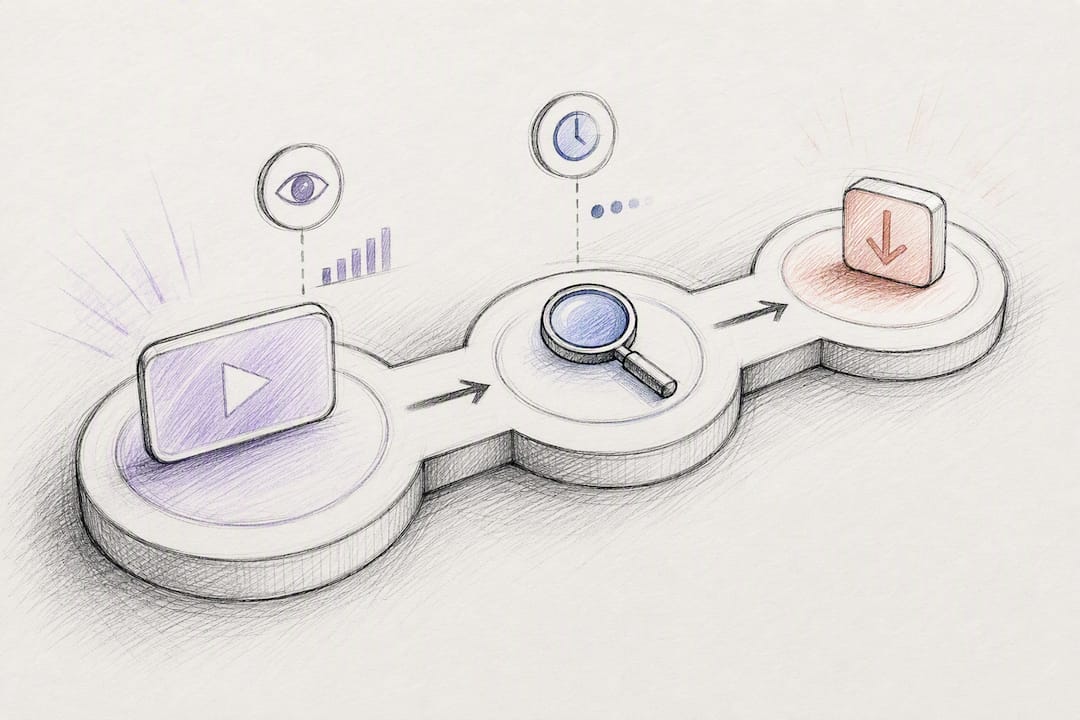
Tracking this responsibly means watching more than views. Impressions, view-through rate, install volume, and install-to-revenue cohorts over a defined window (commonly 7 to 30 days for consumer apps) all matter, and the distinction between a view and an impression is worth understanding on its own, covered in more depth in this view vs impression breakdown. Linking a creator view to a downstream install also requires deliberate tracking setup, detailed in this guide to tracking influencer installs, rather than assuming the connection will show up automatically in a standard last-touch report.
What Marketing Leaders Should Actually Prioritize
Stop treating first-touch and last-touch as competitors for the title of "true" attribution. They're diagnostic instruments built to answer different questions, and the moment you force one to answer both, you get a distorted picture that neither model was designed to produce.
If I had to rank priorities for a team just getting serious about this: fix identity resolution and revenue linkage before you touch a single dollar of budget. A perfect Gap Score calculation on messy UTM data is still built on sand. Once your data can be trusted, run the comparison, flag the channels where first-touch and last-touch disagree sharply, and let a holdout experiment settle the argument before you reallocate anything meaningful. Reports raise the question. Only a test answers it.
— Jax
A Different Lens for Creator Campaigns: Where Cult Media Fits
Attribution models tell you which channel gets credit. They don't create the discovery moment in the first place, and that's where a commission-only creator network earns its place in the stack. A commission-only creator network works on guaranteed views: you agree on a target with a vetted creator network, and you pay only for verified views delivered, not for a retainer that runs whether the content performs or not.
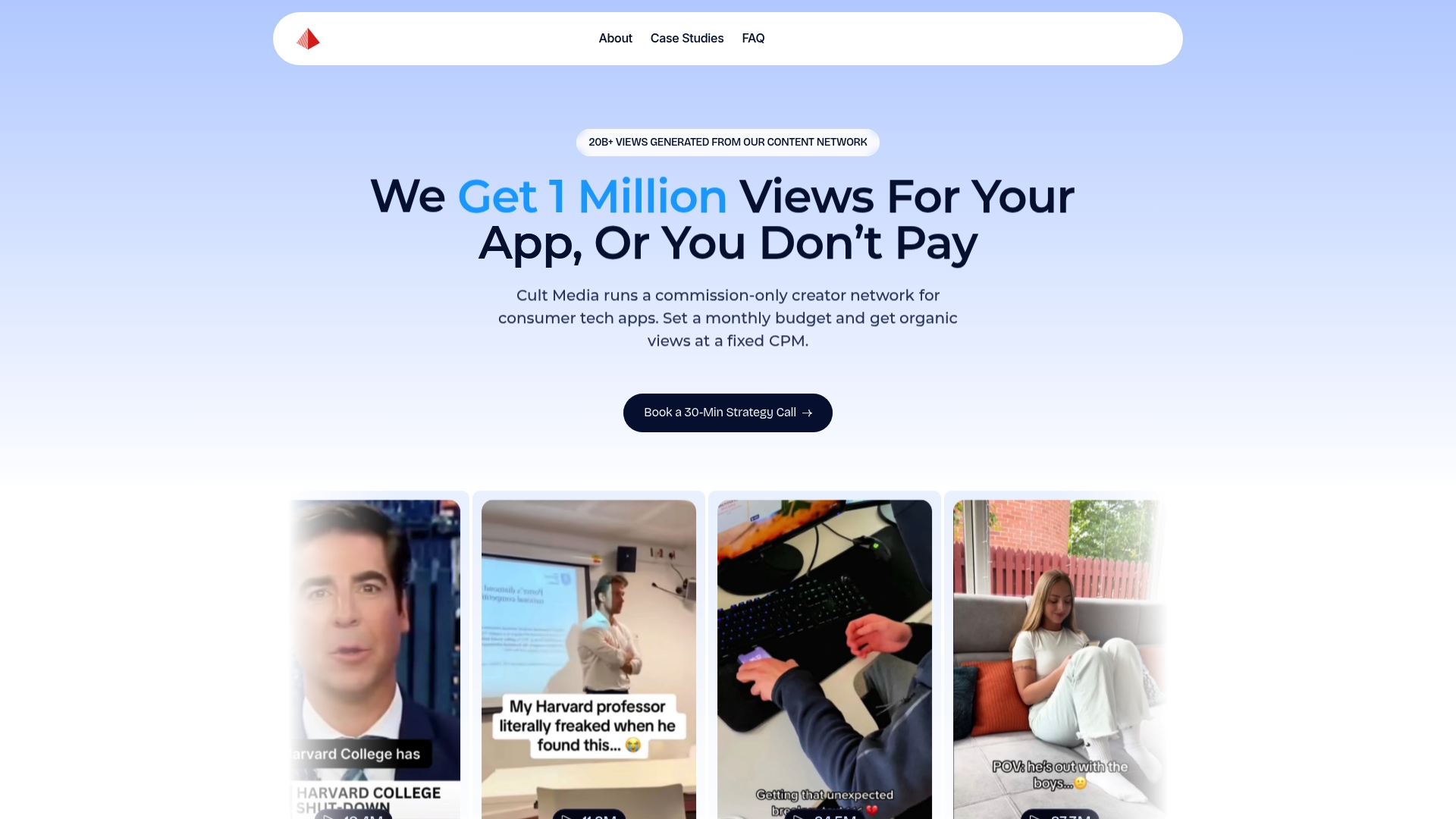
That model matters specifically because creator content behaves like a first-touch channel almost by definition, it's frequently the first exposure a future user gets to your app, long before a branded search or an app-store visit closes the loop. Judging that content by last-touch numbers alone will make it look like it isn't working, when the real story is that it's generating demand another channel is simply capturing. Pairing guaranteed-view campaigns with the install-tracking and cohort practices covered above lets you see that contribution instead of losing it. If your team is evaluating creator-driven acquisition and wants a pricing model tied to delivered results rather than upfront spend, the Cult Media landing page is the place to see how a campaign gets scoped.
Sources
Start with Google's own model comparison and attribution guidance, the Gap Score methodology, and a practical breakdown of KPI selection for online marketing when benchmarking channel performance.
- About attribution models (Google Ads Help)
- First-Touch vs Last-Touch Attribution: Which model should you use? (SaaS Analytics)
- First-Touch vs Last-Touch Attribution | PageDuel
FAQ
What Is the Difference Between First-Touch and Last-Touch Attribution?
First-touch attribution gives all the credit to the very first interaction a customer had with your brand, while last-touch gives all the credit to the final interaction right before they converted. Both are single-touch models, meaning they ignore everything that happened in between, which is why comparing them side by side reveals more than trusting either one alone, according to research on first-touch vs last-touch models.
What Is the Drawback of Using the Last-Touch Attribution Model?
Last-touch systematically overvalues closing channels like branded search, retargeting, and email while ignoring whatever generated the original demand. It can lead teams to defund top-of-funnel investments like content or awareness ads, not realizing those channels were driving the very conversions last-touch is crediting elsewhere.
What Is the 7 Touch Rule in Marketing?
The idea behind this rule of thumb is that a prospect typically needs several exposures to a brand before converting, which is part of why single-touch models miss so much of the real story. Exact figures vary by industry and source, so treat it as a directional principle rather than a fixed count to design your funnel around.
Which Attribution Model Is Best?
There's no universal best model; the right choice depends on the question you're asking and the data quality you have. First-touch and last-touch work as a fast diagnostic pair for most teams, and calculating an Attribution Gap Score between them helps decide when it's time to move to data-driven or multi-touch attribution instead.