For dating apps, creator-led organic content paired with paid amplification is the fastest path to scalable awareness and install lift. This approach works best for growth marketers and small founding teams who need trust signals before users will hand over personal details and photos. When organic creator content feeds a paid amplification plan tied to first-party measurement, the result is faster awareness, stronger trust, and installs you can actually attribute.
TL;DR:
- Vet creators for audience age, region, and relationship status, plus engagement quality, content tone, and disclosure history; request raw clips and test two or three.
- Run a pilot with 10 to 20 creator posts, tracked assets, a capped budget, a brand lift study, and preset go or no go thresholds.
- Secure paid media reuse rights for at least 12 months in creator agreements; renegotiating after content performs well can cost more.
- Let creators post organically first, then amplify only assets with strong viewer completion and substantive comments across TikTok, Instagram Reels, and YouTube Shorts.
- Give each creator a deep link and creative ID, connect first party install events, and require sponsorship disclosures early in videos and on screen.
Table of Contents
- Why Creators Matter for Dating Apps: The Strategic Role and When to Use Them
- How to Find and Vet Dating App Influencers Who Convert
- High-Performing Creative Formats and Hooks for Dating App Campaigns
- Measurement, Attribution, and Legal Disclosure Every App Marketer Must Plan For
- Execution Checklist: Brief Runbook From Pilot to Scale
- Strategies for Integrating Dating App Influencers Into Broader Marketing Campaigns
- Analyzing Competitor Influencer Strategies Within the Dating App Niche
- Author Perspective: How Cult Media Structures Creator Campaigns for Dating Apps
- Ready to Put Creators Behind Your Install Numbers?
- FAQ
- Sources
Why Creators Matter for Dating Apps: The Strategic Role and When to Use Them
Dating apps sell a decision that feels personal and a little risky. A paid ad can state a value proposition, but it cannot replicate the cultural validation a creator provides when they film a genuine first-date story or walk followers through a match conversation. Creators prime discovery in a way static ads rarely manage, because the content reads as peer recommendation rather than brand messaging.
The strongest dating app campaigns treat creators as a full-funnel asset rather than a single awareness tactic:
- Awareness: creators introduce the app to audiences who have not considered it, using formats native to the platform.
- Consideration: follow-up content, comments, and creator replies answer the objections a paid ad cannot.
- Trust: seeing a recognizable person use the app lowers the perceived risk of signing up.
- Creative seeding: the organic posts that perform best become the raw material for paid amplification.
Prioritize creator investment during specific windows: when you are validating product-market fit in a new city or demographic, when launching into a niche audience that paid targeting struggles to reach precisely, and when retention dips and you need authentic reengagement content rather than another discount push.
How to Find and Vet Dating App Influencers Who Convert
Sourcing creators for a dating app is different from sourcing for most consumer products, because disclosure history, audience authenticity, and content tone all affect whether the partnership builds trust or damages it. Start with three channels: creator marketplaces, each platform's native discovery tools, and targeted hashtag or niche searches around dating, relationships, and lifestyle content.
Once you have a shortlist, run every candidate through a consistent vetting process:
- Check audience overlap. Confirm the creator's followers match your target age range, region, and relationship status profile.
- Assess audience quality. Look at engagement distribution, not just follower count. A smaller account with consistent comment activity usually outperforms a larger one with flat engagement.
- Review content fit. Watch several recent posts to confirm the creator's tone matches how you want the app represented.
- Audit disclosure history. Creators who already label sponsored content clearly are lower-risk partners under FTC endorsement guidance.
- Screen for fraud signals. Sudden follower spikes, inconsistent engagement rates, and comment sections full of generic replies all point to fake followers, something regulators specifically flag as a deceptive practice.
You can speed up step two with a tool like the engagement rate calculator from Mastros, which pulls real engagement data from sample posts instead of relying on follower totals alone.
After vetting, request content samples before signing anything, run a small test spend with two or three creators, and require performance reporting plus reuse rights in the contract so winning content can move into paid media later.
Pro Tip: Ask for a 60-second raw clip before the final edit. Unscripted footage tells you more about a creator's natural tone than their polished portfolio does.
High-Performing Creative Formats and Hooks for Dating App Campaigns
Short-form vertical video built around authentic storytelling outperforms polished brand content for dating apps, largely because the format mirrors how people already share dating stories with friends. The strongest campaigns lean into a handful of proven hooks:
- First-date reveals: a creator recounts a recent date they got through the app, building narrative tension before the payoff.
- Success stories: longer-arc content showing a match that turned into a relationship, which builds credibility over time.
- Product walkthroughs: a quick screen-recorded tour of a standout feature, framed as a tip rather than an ad.
- Social proof and micro-testimonials: short clips of real users reacting to matches or app features, stitched together for variety.
The distribution play matters as much as the content itself. Let creators seed organically first so the content earns genuine engagement before any money moves behind it. Once a handful of posts separate themselves by view-through rate and comment quality, boost those specific assets with paid spend across TikTok, Instagram Reels, and YouTube Shorts rather than spreading budget evenly across every post. This sequencing protects budget from underperforming creative and puts paid dollars only behind content that has already proven it resonates.
Measurement, Attribution, and Legal Disclosure Every App Marketer Must Plan For
Native platform metrics tell you how a post performed on that platform, not whether it drove installs, which is why IAB measurement guidance recommends brand-lift testing and first-party event integrations as the connective tissue between creator exposure and business outcomes.
Creator measurement remains fragmented across platforms, so IAB guidance points teams toward brand-lift studies and first-party data rather than relying on native metrics alone, since siloed reporting makes it difficult to compare performance across creators and channels.
Build attribution into the campaign from day one:
- Use unique deep links and promo codes per creator so installs tie back to a specific post.
- Tag every asset with a tracked creative ID before it goes live.
- Run a small-sample uplift test to validate that creator exposure is actually moving installs, not just views.
Legal compliance is not optional. The FTC's plain-language influencer guide requires disclosures like "Ad" or "Sponsored" to appear clearly and early, on-screen in video rather than buried in a caption or hashtag string. Build disclosure language into every creator brief rather than leaving it to individual judgment, and review our deep-link tracking guide for how to pair compliant disclosures with trackable links.
Execution Checklist: Brief Runbook From Pilot to Scale
Running a creator campaign for a dating app comes down to three stages, each with its own gate before moving forward.
- Brief and legal checklist. Define objectives and KPIs up front, write disclosure language into the creator agreement, and specify creative rights for reuse in paid media.
- Pilot. Run 10 to 20 creator posts with consistent tracking, set a modest test budget, define a measurement plan that includes a brand-lift micro-study, and set clear go or no-go thresholds before spending more.
- Scale. Put paid media behind the assets that cleared your thresholds, invest in longer-term relationships with the creators who performed best, and automate reporting so the team can review results weekly instead of rebuilding dashboards each time.
Pro Tip: Lock in reuse rights for at least 12 months at the brief stage. Renegotiating rights after a post performs well costs more than securing them up front.
For teams that want install tracking instrumented correctly before launch, our guide to tracking influencer installs covers the technical setup in more detail.
Strategies for Integrating Dating App Influencers Into Broader Marketing Campaigns
Creator content works best when it is not treated as a separate line item from the rest of your marketing calendar. Align creator posts with planned app updates, seasonal dating moments, and paid campaign flights so the messaging reinforces itself across channels instead of competing for attention.
A practical way to do this is to brief creators on the same core narrative your paid ads are running that quarter, then let each creator interpret it in their own voice. This keeps messaging consistent while preserving the authenticity that makes creator content work in the first place. When a paid campaign is pushing a new feature, have creators demonstrate that feature naturally in their content rather than running a disconnected promotion.
Repurposing matters here too. The same short-form asset that performed well organically can be cut down for email campaigns, embedded on landing pages, or used as a testimonial in app store listings. Cross-platform reuse of a single strong asset is generally more efficient than commissioning separate content for every channel, since the creative work is already proven.
Finally, loop creator performance data back into your broader planning cycle. If a certain hook or format consistently outperforms others, that insight should shape the next quarter's paid creative brief, not just the next creator campaign. Treating creator content as an input to the whole marketing system, rather than an isolated tactic, is what separates a one-off campaign from a repeatable growth channel.

Analyzing Competitor Influencer Strategies Within the Dating App Niche
Before locking in your own creator strategy, spend time studying what competing apps are doing publicly. Search relevant hashtags and watch which creators repeatedly appear across multiple dating apps, since that overlap tells you where the most trusted voices in the space already have an audience relationship.
Pay attention to format choices as much as creator selection. If several competitors are leaning into success-story narratives while few are using product walkthroughs, that gap might be an opening rather than a reason to copy the crowd. Note how disclosures are handled too. Apps that disclose clearly and early tend to draw less negative comment-section scrutiny than those that bury sponsorship language, which is a useful signal for your own brief.
Track posting cadence and platform mix as well. A competitor running heavy TikTok activity but ignoring Instagram Reels may be leaving an audience segment unaddressed, which is worth testing in your own distribution plan. The goal of this analysis is not to mirror competitor campaigns but to identify where the category's creator strategy is saturated and where it still has room for a sharper, more specific angle.
Author Perspective: How Cult Media Structures Creator Campaigns for Dating Apps
We run creator campaigns for consumer apps on a commission-only model. Our team handles creator sourcing, content production, and paid amplification together, while we expect app teams to own product inputs and the measurement stack that ties installs back to specific creative. In the first 90 days, a healthy partnership should show a clear pilot result, a short list of creators worth extending, and a measurement setup that survives scrutiny.
— Jax
Ready to Put Creators Behind Your Install Numbers?
We built our commission-only creator network specifically for consumer tech apps. Our team handles sourcing, content production, and paid amplification end to end, including the kind of creator-led growth work behind our content engine for 0G Labs.
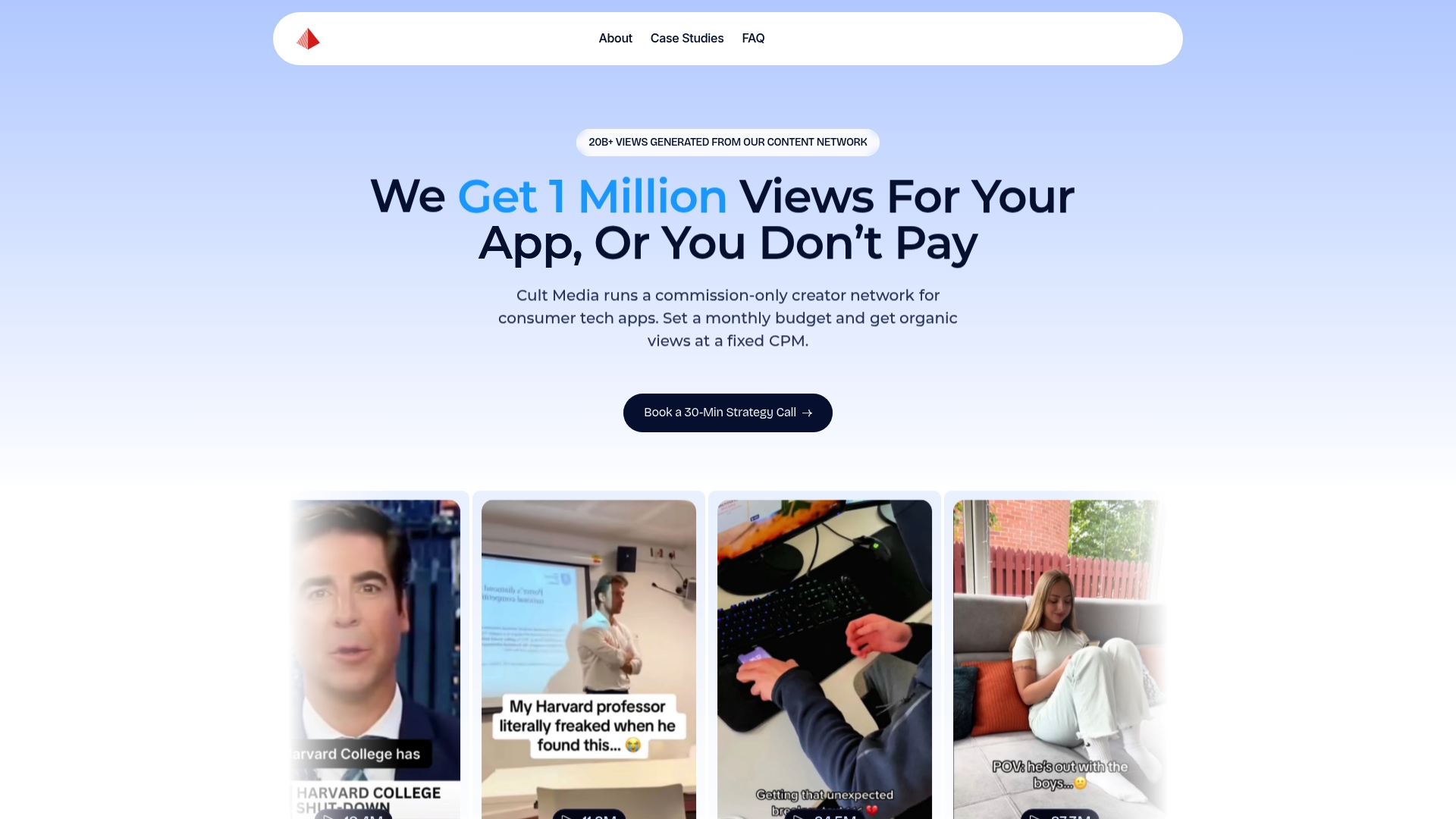
If you are ready to pilot a creator campaign for your dating app, visit Cult Media to request a pilot and see how a commission-only structure fits your growth plan.
FAQ
What makes dating app influencer marketing different from other app categories?
Dating apps rely on personal trust and perceived safety more than most app categories, so creator authenticity matters more than reach alone. A creator with a smaller, highly engaged audience often outperforms a larger account with generic engagement patterns.
How much should a dating app budget for a creator pilot?
Costs vary by platform, creator tier, and campaign scope, and Cult Media's own pricing is available on request rather than published. A reasonable pilot structure runs a moderate number of creator posts with a capped budget before deciding whether to move into paid amplification.
What disclosure language do dating app influencers need to use?
Creators need clear, conspicuous labels like "Ad" or "Sponsored" placed early in the content, not buried in a caption or hashtag, according to the FTC's plain-language guide. In video content, the disclosure should appear on-screen or be stated early in the audio.
How do you measure whether a creator campaign actually drove installs?
The most reliable approach combines deep links, tracked creative IDs, and a brand-lift test rather than relying on a single platform's native metrics, which IAB guidance notes are siloed by design. First-party event integrations give the clearest picture of install attribution.
Should dating apps work with one creator long-term or rotate creators constantly?
Long-term relationships with a small group of proven creators tend to build more trust over time than constant rotation, since audiences recognize the creator's continued endorsement. That said, rotating in new creators periodically helps reach fresh audience segments the core group does not cover.
Sources
- FTC's Endorsement Guides — What People Are Asking
- Guides Concerning the Use of Endorsements and Testimonials in Advertising — Federal Register
- What’s Real, What’s Missing, and What Unlocks the Next Wave of Spend (IAB)
- Disclosures 101 for Social Media Influencers (FTC)