For creator-driven app campaigns, the right approach is a mobile-first landing experience that deep-links into the app and aligns app-store assets to the creator's promise. Google's own deep-link guidance and Apple's product-page testing framework both point toward the same principle: friction kills conversion. Cult Media builds these campaigns around installs and in-app events, not raw clicks, because that is what platform data actually supports.
TL;DR:
- Deep linking and mobile-first design are essential, with Google and Apple both emphasizing frictionless experiences that match creator promises.
- Campaigns should use variant mapping and aligned creative assets to maintain message consistency and improve conversion rates.
- Implementing and testing deferred deep links and store page experiments can double or more conversion rates when properly managed.
- Accurate measurement requires combining attribution data, in-app event tracking, and verification to assess true creator impact beyond just install counts.
- Scaling creator campaigns benefits from standardized onboarding, clear variant mapping, and dynamic content personalization aligned with platform requirements.
Table of Contents
- Core elements of high-converting creator landing pages
- Mobile UX and deep-linking implementation
- Aligning store product pages and A/B testing with creator angles
- Measurement, attribution, and KPI design for creator campaigns
- Operations and onboarding: running creator landing-page campaigns at scale
- Quick checklist and landing-page template elements for creator campaigns
- SEO optimization strategies for creator landing pages
- Conversion rate optimization techniques tailored for creators
- Integration with social media platforms for creator landing pages
- Examples and case studies of successful creator landing pages
- Personalization and dynamic content strategies for creator landing pages
- What most growth teams get wrong about creator landing pages
- How Cult Media runs creator campaigns end to end
- Sources
- FAQ
Core elements of high-converting creator landing pages
A creator landing page succeeds or fails on message match. The hook a creator uses in their video, the call to action they speak on camera, and the landing page a viewer taps into all need to say the same thing in the same voice. When a creator promises "this app fixed my sleep schedule in a week," the landing page cannot open with generic product copy about features. It needs to continue the story the viewer just watched.
Mobile-first design is not optional here. Creator traffic arrives almost entirely from phones, mid-scroll, with low patience for load time. A page needs a single clear call to action above the fold, imagery or video that echoes the creator's own content style, and trust signals that feel native to the platform the viewer came from, not corporate testimonials that feel out of place next to a TikTok.
The most reliable operational model is variant mapping: one creator angle produces one landing page variant, which routes to one deep link or store treatment. This keeps attribution clean and lets a team isolate which creative angle is actually driving installs.
Before launch, a few things need to be locked down:
- Brief copy should quote or paraphrase the creator's actual hook, not a generic value proposition.
- Hero creative should match the aspect ratio and visual tone of the source content, not a repurposed desktop banner.
- Trust signals (creator name, follower context, a recognizable clip) should appear within the first screen.
- The CTA button copy should mirror the verb the creator used on camera.
Skipping this alignment is the single most common reason creator campaigns underperform relative to the views they generate.
Mobile UX and deep-linking implementation
Deep links solve a specific problem: a viewer taps a link, and instead of landing on a generic app-store page, they land inside the exact in-app experience the creator described. Deferred deep links extend that further, routing a user to the right in-app screen even if they had to install the app first. Google's guidance recommends mobile-first experiences built around deep links or deferred deep links for app campaigns, and reports advertisers who implement deep linking see conversion-rate gains of more than 2X on average.
Engineering needs to handle a short list of tasks before any campaign goes live:
- Host an assetlinks.json file for Android and an apple-app-site-association file for iOS.
- Add associated-domains entitlements to the app so it recognizes incoming universal links.
- Test deferred deep-link behavior for users who do not yet have the app installed.
- QA the fallback path for users who decline to install, routing them to a standard store listing or smart banner.
Firebase's migration guide for moving from Dynamic Links to App Links and Universal Links walks through hosting the association files and updating app code to receive the deep-link data, which is the same setup most creator campaigns need regardless of ad platform.
At the campaign level, deep links should be set per ad group so each creator's traffic routes to its matching in-app destination, and parameter hygiene matters: inconsistent UTM or click ID formatting is one of the fastest ways to break attribution downstream.
Pro Tip: Test the full deferred deep-link path on a fresh device with the app uninstalled before a campaign launches, not after.
Aligning store product pages and A/B testing with creator angles
The app-store listing is part of the landing experience, whether a growth team treats it that way or not. A viewer who clicks through a creator's link and lands on a mismatched store page (wrong screenshots, wrong headline promise) drops off before ever opening the app.
Both major stores support structured experiments. Apple's product page optimization allows testing up to three alternate treatments against the original, and recommends waiting for a treatment to reach at least 90% confidence, with results requiring at least five first-time downloads attributed to the test, before declaring a winner. Google Play's store listing experiments work similarly, letting teams test icons, screenshots, and preview videos while reporting acquisition and one-day retention per variant.
A few operational rules keep these tests useful:
- Change one asset per test (icon, screenshot set, or preview video) so the result points to a clear cause.
- Route creator traffic spikes directly to the treatment that matches that creator's content style, then measure the lift.
- Never run two overlapping store tests at once. Overlap makes it impossible to tell which asset actually drove the change.
- Give each test enough time and volume to hit the confidence threshold before making a decision.
Measurement, attribution, and KPI design for creator campaigns
Installs and meaningful in-app actions should sit at the top of any creator campaign's KPI list, ahead of clicks. Google recommends keeping conversion windows for in-app actions at 30 days or less for App campaign scenarios, and that window should be documented and shared across the team before launch so everyone is reading the same number the same way.
Creator marketing is scaling faster than the infrastructure built to measure it. The IAB's measurement landscape report recommends combining deterministic signals with incrementality testing and independent verification, since last-click and platform-native metrics tend to undercount a creator's assisted and upper-funnel impact.
Practical setup work supports that recommendation:
- Import in-app events through Firebase or App Store Connect so conversion data reflects real user behavior, not just install counts.
- Use attribution sharing between ad platforms and analytics tools wherever the platform allows it.
- Reconcile creator self-reported view or click numbers against platform data regularly, since the two rarely match exactly.
- Apply traffic-quality controls, including viewability checks and third-party verification, to segment out invalid or bot traffic before it pollutes conversion reporting.
Platform attribution should never be treated as a full census of creator impact. Pairing it with cohort incrementality tests and assisted-conversion metrics gives a more honest picture of what a creator actually contributed, a point the IAB makes directly when it calls for cross-platform measurement standards and full-funnel attribution. Growth teams running their own tracking can also review practical guidance on identifying non-human or AI-driven traffic, which overlaps with the same traffic-quality discipline creator campaigns require.
Operations and onboarding: running creator landing-page campaigns at scale
Scaling from a handful of creators to hundreds requires a repeatable onboarding process, not improvisation for each new partner. Cult Media documents a 7 to 10 day creator onboarding cycle within a 90-day launch plan, which keeps creative, engineering, and measurement teams working from the same variant map instead of reacting to each new piece of content individually.
The same structure that works for five creators needs to hold at fifty:
- Assign each creator angle a named landing variant and a corresponding deep-link or store treatment before content goes live.
- Build QA into the handoff between creative approval and measurement setup so broken links never reach paid spend.
- Route measurement ownership to one person per campaign phase to avoid conflicting attribution reads.
Cult Media's operational pillars for creator campaign management outline this handoff in more detail for teams building it in-house.
Pro Tip: Decide upfront whether a campaign needs agency-managed guaranteed views or in-house activation. Guaranteed-view models remove the volume-forecasting problem entirely, which matters most once a program passes about twenty active creators.
Quick checklist and landing-page template elements for creator campaigns
A launch-ready creator landing page needs a short list of confirmed items before it goes live:
- Page load under a few seconds on a mid-tier mobile connection.
- Hero asset matched in aspect ratio and tone to the creator's content.
- One primary call to action, with no competing secondary buttons.
- Deep-link mapping confirmed for every creator variant, including the deferred fallback.
- Analytics events tagged for install, first open, and key in-app action.
- QA pass on both the install path and the fallback path for users without the app.
- Store experiment routing confirmed so the right treatment receives the right traffic.
Template structure typically includes a hero section, a proof panel showing the creator's actual content or handle, a CTA block, a short product demo, and a brief privacy or attribution note. A working example: a creator angle about saving time on meal planning maps to a landing variant built around that exact claim, a deep link into the app's meal-planning screen, and a store listing treatment featuring that same use case in its screenshots.
SEO optimization strategies for creator landing pages
Creator landing pages rarely rank on their own, since most campaigns route paid and social traffic directly to them rather than relying on organic search. Even so, a handful of SEO fundamentals protect a page's discoverability and its ability to earn organic traffic as a secondary channel.
Page speed matters twice over here: it is both a conversion factor for creator traffic and a ranking factor for any organic visibility the page might pick up. Compressing hero video and image assets, lazy-loading below-the-fold content, and avoiding heavy third-party scripts all help.
Structured, descriptive metadata still counts. A title tag and meta description that reflect the actual offer, rather than generic app-store language, give search engines a clearer signal about page content. Canonical tags matter more than usual here, since creator campaigns often generate dozens of near-identical landing variants; without canonicalization, search engines can flag them as duplicate content and suppress all of them.
Internal linking from a brand's main site to its creator landing pages, and back again, helps establish those pages as legitimate parts of the site rather than orphaned campaign assets. A short, benefit-led URL slug that matches the page's core promise also helps both users and search engines understand the page before they even click.
None of this replaces the paid and social distribution that actually drives creator campaign volume. It simply protects the investment already made in the page, so it can pick up incidental organic traffic without extra work.
Conversion rate optimization techniques tailored for creators
Standard landing page CRO tactics apply here, but creator traffic behaves differently than search or display traffic, and the optimization approach needs to reflect that.
Viewers arriving from a creator's content have already been sold on an idea. The landing page's job is to confirm that idea quickly, not reintroduce the product from scratch. Long-form explanations of features that the creator never mentioned tend to hurt conversion rather than help it, because they interrupt the narrative the viewer is already following.
Form fields, where they exist, should be minimized. A pattern documented in landing-page friction research for PPC advertisers shows that cutting a form down to three or four fields reduces drop-off, a principle that applies directly to any creator landing page collecting an email or phone number before directing a user to install.
Social proof needs to match the platform. A testimonial quote that reads well on a SaaS homepage looks out of place next to creator content; a short video clip, a follower count, or a recognizable creator face performs better because it matches the format the viewer just consumed.
Testing should focus on the elements most likely to move installs: headline framing, CTA button copy, and the order in which proof and demo content appear. Testing background colors or minor layout shifts rarely moves the needle as much as testing whether the page opens with proof or with the offer itself.
Integration with social media platforms for creator landing pages
Every major short-form platform now supports some version of in-app or swipe-up linking, and a creator landing page needs to account for the platform it is receiving traffic from, not just the creator sending it.
TikTok, Instagram Reels, and YouTube Shorts each render links differently and apply their own tracking parameters. A landing page built for TikTok's in-app browser needs to load cleanly inside that browser's constraints, which are stricter than a standard mobile Safari or Chrome session. Testing a page only in a standard browser and assuming it behaves the same inside a platform's native webview is a common and avoidable mistake.
Pixel and SDK integration matters as much as the visual design. Each platform's tracking pixel needs to fire correctly on the landing page for retargeting and lookalike audience building to work, and that setup should be confirmed before a creator's content goes live, not after the first week of underwhelming numbers.
Cult Media's playbook for aligning creator content with app growth systems covers this platform-specific setup in more detail, particularly around matching creative specs to each platform's native format rather than reusing one asset everywhere.
Cross-platform consistency still matters even as execution varies. The core promise, the CTA language, and the deep-link destination should stay the same across TikTok, Instagram, and YouTube versions of a campaign, even though the landing page rendering and tracking setup underneath differ by platform.
Examples and case studies of successful creator landing pages
The clearest pattern across effective creator landing pages is narrow focus. Rather than presenting an app's full feature set, the strongest pages isolate the single use case a creator demonstrated and build the entire page around confirming that one outcome.
A consumer finance app that generated 42,500 signups at $0.28 each through organic UGC built its landing experience around the specific savings behavior creators demonstrated on camera, rather than a general product tour. A communication coaching app that cut its customer acquisition cost by 64% through systematic UGC testing achieved that result by testing landing variants against specific creator angles rather than running one static page across all creator content.
Both examples point to the same underlying pattern: message match and variant testing outperform a single polished page trying to serve every creator angle at once. A page built for one creator's specific hook consistently outperforms a generic page asked to do double duty across a dozen different creators with different framings.
Personalization and dynamic content strategies for creator landing pages
Static landing pages built to serve every visitor identically leave conversion on the table when creator traffic is this segmented. Dynamic content, where the page adjusts based on which creator or platform sent the traffic, closes that gap without requiring a completely separate page for every single creator.
A common approach uses URL parameters to trigger dynamic elements: the creator's name or handle appears in the proof panel, the hero video swaps to match the platform the traffic came from, or the CTA copy shifts slightly to echo that specific creator's phrasing. This keeps the underlying page infrastructure simple while still delivering the message match that drives conversion.
Personalization at this level does not require a large engineering lift. A templated page with a handful of dynamic content blocks, driven by URL parameters or UTM tags, covers most of what a creator campaign needs without building a fully custom page per partner. The tradeoff to manage is scale: dynamic blocks need clear fallback content for any traffic that arrives without the expected parameters, so no visitor ever sees a broken or blank section.

The teams that get the most out of dynamic content treat it as an extension of the variant mapping discussed earlier, not a replacement for it. Dynamic blocks handle the smaller adjustments, like creator name or platform-specific video, while the core landing variant still needs to match the broader creative angle.
What most growth teams get wrong about creator landing pages
Most growth teams treat the landing page as an afterthought to the creative brief, when it deserves the same attention as the video itself. The creator's hook does the work of stopping the scroll, but the landing page decides whether that attention turns into an install, and a mismatched page wastes the entire cost of the creator placement.
The bigger mistake is chasing click-through rate as a proxy for success. A page can pull in plenty of clicks and still convert poorly if the promise on the page does not match what the viewer just watched. Installs and in-app events tell the real story, and platform guidance from Google and the measurement caveats from the IAB both point in the same direction: attribution is imperfect, so the discipline has to come from the page and the process, not just the tracking pixel.
— Jax
How Cult Media runs creator campaigns end to end
A commission-only creator network built specifically for consumer tech apps operates with a pricing model tied directly to verified organic views rather than upfront retainers. For a growth team weighing whether to build this landing-page and deep-link infrastructure in house or hand it to a managed partner, the practical difference comes down to speed and coordination.
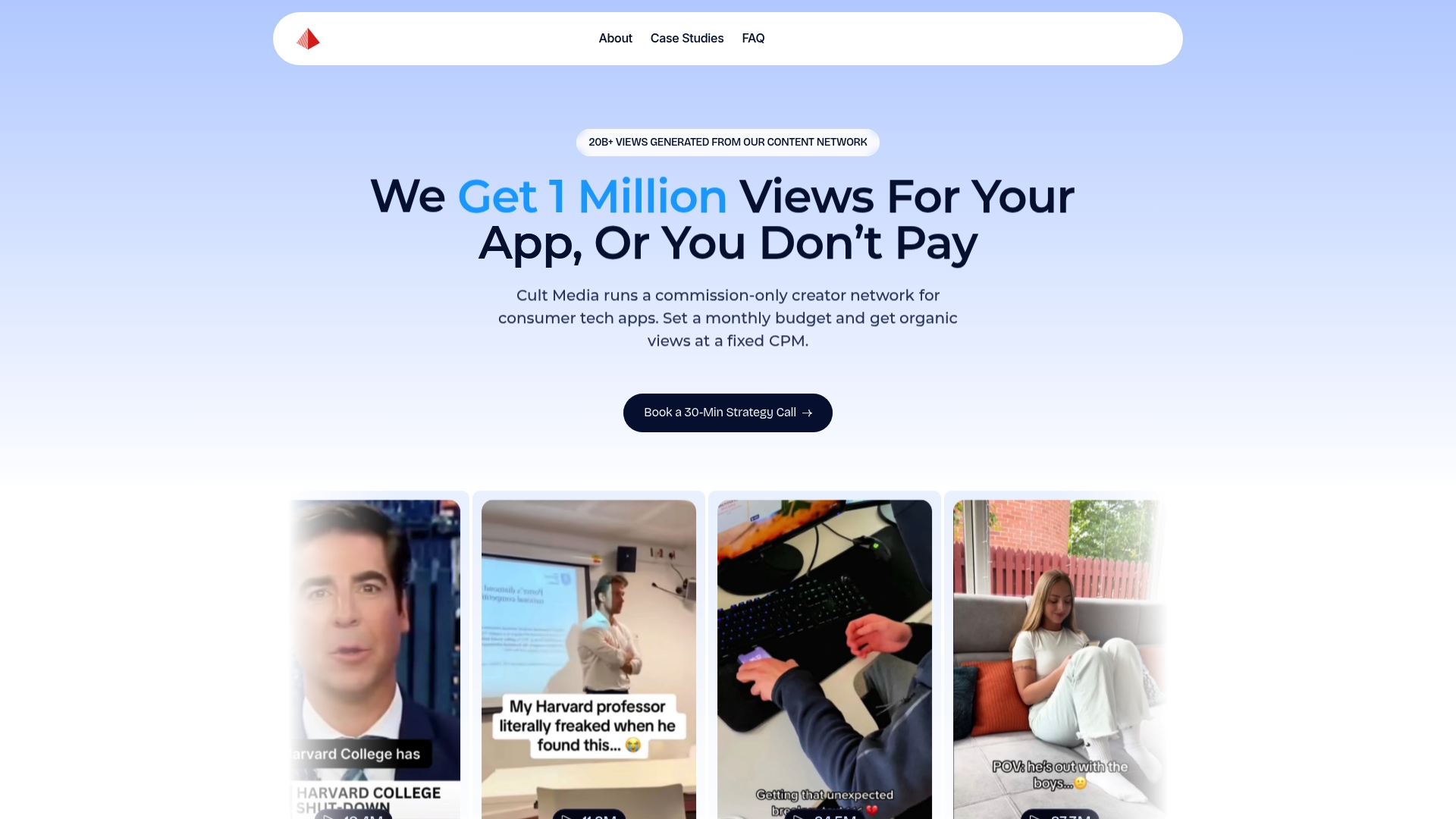
The model covers the full chain described throughout this article:
- Guaranteed view campaigns paired with custom-built UGC strategy for each app.
- End-to-end creator management, from sourcing to content approval.
- High-conversion content creation matched to platform-specific formats.
- Deep-link mapping and measurement handoff so installs and in-app events are tracked from day one, not bolted on after launch.
Consumer apps that have gone through this process can be reviewed directly. The content engine behind a $290 million raise for 0G Labs and the broader set of creator-led growth results show how the variant mapping and onboarding structure described above plays out across different app categories. Pricing for the commission-only creator network is available on request, tied to the specific view volume and campaign scope a growth team needs.
Sources
- Best practices for implementing deep links — Google Business
- Product page optimization — Apple Developer
- IAB: Measurement landscape in the Creator Economy — January 2026
- Migrate from Dynamic Links to App Links & Universal Links — Firebase
FAQ
What makes a landing page effective for creator-driven app traffic?
An effective creator landing page matches the exact hook and promise the creator made on camera, loads quickly on mobile, and routes the visitor through a deep link straight into the relevant part of the app. Google's guidance points to deep linking as a core driver of that conversion gain.
How do deferred deep links differ from standard deep links?
A standard deep link routes an existing app user directly to a specific in-app screen, while a deferred deep link remembers that destination even if the user has to install the app first. Both rely on hosted association files and app-side code, as outlined in Firebase's migration guide.
How long should attribution windows be for creator app campaigns?
Google recommends keeping conversion windows for in-app actions at 30 days or less for App campaign scenarios, and that window should be documented and shared across creative, media, and measurement teams before launch. Shorter, clearly defined windows reduce disputes over which creator or channel gets credit for a given install.
How many variants should Apple's product page tests include?
Apple's product page optimization tool allows testing up to three alternate treatments against the original listing at once. Apple recommends waiting until a treatment reaches at least 90% confidence, with a minimum of five first-time downloads attributed to the test, before declaring a winner.
When does it make sense to hire a managed creator network instead of running campaigns in-house?
A managed, commission-only model tends to make sense once a program needs guaranteed view volume and coordinated onboarding across many creators at once, which is harder to build from scratch than to plug into an existing operational process. Cult Media's commission-only creator network ties pricing directly to verified views, which shifts that operational and forecasting burden away from the in-house team.