Earned Media Value (EMV) is an estimate of what your influencer content would have cost as paid advertising, expressed in dollars. It is not revenue, and no credible report should present it that way. Used correctly, EMV works as a directional benchmark for comparing creators and justifying budget, paired with tracked conversions and ROAS rather than standing in for them.
TL;DR:
- EMV should be consistently calculated using transparent inputs, with platform-specific CPM rates and engagement values, to avoid inflated or inaccurate estimates.
- A healthy EMV-to-spend ratio is around 5:1, with ratios below 3:1 indicating overpriced placements or ineffective creator matching.
- Using EMV to compare creators is most effective when weighted by engagement quality and cost-efficiency, not solely by raw dollar figures.
- EMV is best used for benchmarking awareness and justifying budgets internally, but should always be paired with tracked conversions for performance evaluation.
- Switching to guaranteed-view and performance-based models offers more reliable return measurements than relying solely on simulated EMV estimates.
Table of Contents
- What EMV Measures (and Why It's Not AVE or ROI)
- How to Calculate EMV: A Hybrid Formula With a Worked Example
- Platform CPM Benchmarks and EMV-to-Spend Ratios
- When EMV Helps and Where It Misleads You
- How to Report EMV Without Confusing Finance
- Why Guaranteed Views Change How We Think About EMV
- How EMV Calculation Shifts by Industry and Campaign Type
- Real-World EMV Application: What Case Studies Actually Show
- Choosing Influencer Partners With EMV Data
- The Bottom Line on EMV
- Cult Media: Guaranteed Views Instead of an EMV Guessing Game
- Sources
- FAQ
What EMV Measures (and Why It's Not AVE or ROI)
EMV converts organic reach and engagement into a paid-media-equivalent figure. It tells you what a comparable ad buy would have cost to generate the same impressions and interactions, not what the campaign earned in revenue. That distinction separates EMV from ROI, which tracks actual dollars returned against dollars spent.
EMV descends from Advertising Value Equivalency (AVE), a metric AMEC has explicitly recommended against because it inflates perceived value without accounting for context, sentiment, or placement quality. EMV survives, and AVE mostly hasn't, because marketers still need a common currency to benchmark creators and defend budgets to finance. A well-built EMV figure typically includes:
- Impression-based reach converted through a CPM rate
- Weighted engagement actions (likes, comments, shares, saves)
- Multipliers for sentiment, placement, or content format
The math only holds up if every one of those inputs is disclosed, not buried in a vendor's black box.
How to Calculate EMV: A Hybrid Formula With a Worked Example
The most defensible approach blends impression-based media value with weighted engagement value, since Brandwatch's methodology guidance treats hybrid formulas as the standard for capturing both reach and interaction quality. The formula:
EMV = (Impressions ÷ 1,000 × CPM) + [(Likes × value) + (Comments × value) + (Shares × value)] × sentiment/placement multiplier
Here's how to apply it:
- Set your CPM. Pull a platform-specific rate (more on ranges below) or use your own historical paid media data if you have it.
- Assign per-engagement values. Common ranges run $0.01 to $0.04 per like, $0.10 to $0.50 per comment, and $0.05 to $0.25 per share, adjusted by platform and industry.
- Apply a multiplier. Add 1.1x to 1.5x for strongly positive sentiment or premium placement (Stories, pinned comments, in-feed video), and reduce below 1.0x for lukewarm or mixed reception.
- Sum impressions and engagement value, then multiply.
A worked example: a TikTok creator post earns 500,000 impressions, 20,000 likes, 800 comments, and 400 shares. At a $10 CPM, the impression value is (500,000 ÷ 1,000) × $10 = $5,000. Engagement value: (20,000 × $0.02) + (800 × $0.25) + (400 × $0.15) = $400 + $200 + $60 = $660.
Statistic to know: Later's benchmarking guidance notes that many brands treat a 5:1 EMV-to-spend ratio as a strong result, with exceptional campaigns reaching closer to 10:1. If your campaign spent $1,500 to generate that $6,792 figure, you're sitting at roughly 4.5:1, solid but short of exceptional.
Platform CPM Benchmarks and EMV-to-Spend Ratios
CPM rates shift constantly with platform algorithm changes and ad demand, so treat any range as a starting point, not gospel. Current guidance from Nowadays' 2026 benchmarking data puts typical ranges at roughly $8 to $12 CPM on TikTok, $10 to $15 on Instagram, $15 to $25 on YouTube, and $20 to $35 or higher on LinkedIn, with X sitting closer to the Instagram range depending on account niche.
Once you've calculated EMV, sanity-check it against spend:
- A ratio below 3:1 usually signals overpriced placements, weak creator fit, or an inflated multiplier somewhere in your math.
- 5:1 is the widely cited healthy benchmark for a campaign that's performing as expected.
- Ratios approaching 10:1 are exceptional and worth investigating for what made the content work, so you can repeat it.
Micro and nano creators frequently outperform larger accounts on this ratio. Smaller audiences tend to carry higher engagement rates relative to follower count, which pushes EMV efficiency up even when raw impressions are modest. If your goal is EMV efficiency rather than sheer reach, weighting budget toward that tier usually pays off.
When EMV Helps and Where It Misleads You
EMV earns its place in three scenarios: benchmarking creators against each other inside a single campaign, reporting on awareness-stage activity where conversions haven't happened yet, and justifying budget to stakeholders who think in advertising-equivalent dollars rather than engagement rates.
It misleads you in equally predictable ways:
- Inconsistent multipliers between campaigns make year-over-year comparisons meaningless.
- Sentiment blindness lets a viral negative post inflate EMV as if it were positive coverage.
- Inflated impression counts (bot views, low-quality placements) push the number up without any real audience behind it.
- Reach-over-relevance thinking rewards creators with big audiences over creators who actually convert.
Pro Tip: Freeze your CPM source and engagement multipliers before a campaign starts, not after you see the results. Changing the formula mid-report to hit a nicer number is the fastest way to lose credibility with finance.
The fix for most of this is transparency: disclose your CPM source, freeze your multiplier logic, and always pair the EMV line with tracked conversions or brand lift data where you have it.
How to Report EMV Without Confusing Finance
The single biggest reporting mistake is presenting EMV on the same line as revenue with no explanation. Sprout Social's guidance is blunt about this: EMV needs a clear label as an advertising-equivalent estimate every time it appears, or someone in a budget meeting will eventually mistake it for actual dollars earned.
Build your report with these columns side by side, never EMV alone:
- EMV, with a footnote stating the CPM source and multiplier logic used
- Tracked conversions (installs, sign-ups, purchases) attributed through UTMs or promo codes
- ROAS or CPA on any spend tied to the campaign
- Content licensing value, if you're paying for usage rights separately
- Brand lift or sentiment data, where you have it
Calculate EMV at campaign completion for one-off pushes. For ongoing creator programs, recalculate monthly so you can spot decay or improvement in efficiency, and roll figures up quarterly when you're setting benchmarks for future budget requests. Sample phrasing that keeps finance oriented: "This campaign generated an estimated $6,792 in advertising-equivalent value (EMV, calculated at a $10 CPM plus weighted engagement) against 340 tracked app installs at a $4.40 CPA." That sentence does the job EMV alone never can: it shows the estimate and the outcome finance actually cares about.
Why Guaranteed Views Change How We Think About EMV
Cult Media works exclusively with consumer tech apps on a commission-only model, which means EMV isn't the number that determines whether a campaign was worth running. Guaranteed views tied to a fixed CPM already answer the spend-efficiency question before EMV enters the conversation. That reframes what EMV is for in our reporting:
- Jax's internal creator-benchmarking templates use EMV to compare creator performance within a campaign, never as a stand-in for install numbers.
- Verified view counts and conversion tracking sit above EMV in every client report, not beside it as an afterthought.
- Case-study templates pair EMV with actual install and CPA data so clients see both the advertising-equivalent estimate and the real outcome side by side.
That ordering matters more than the formula itself.
How EMV Calculation Shifts by Industry and Campaign Type
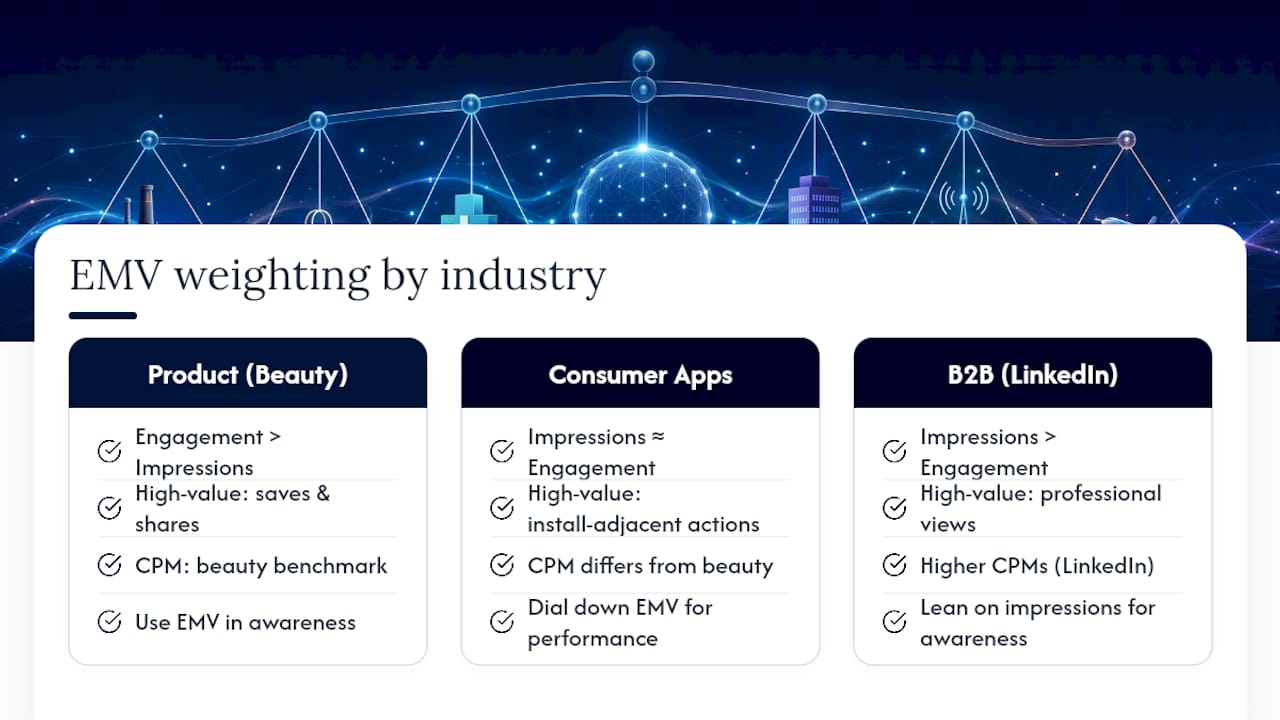
A beauty brand running a product-seeding campaign will weight EMV differently than a consumer tech app running a download push, and both differ from a B2B SaaS company sponsoring a LinkedIn creator. Product-based industries (beauty, fashion, food) tend to lean on high per-engagement values because saves and shares correlate closely with purchase intent, so those actions get weighted more heavily than raw impressions.
Consumer app campaigns, by contrast, usually discount engagement value in favor of install-adjacent behavior. A comment that says "just downloaded this" is worth more analytically than a generic "love this" comment, even though a standard EMV formula treats them identically unless you build in a custom multiplier. This is where the CPM pricing model becomes relevant. Understanding how CPM is priced for your specific vertical helps you avoid borrowing a beauty-industry CPM benchmark for an app install campaign, where the audience value and conversion pathway look nothing alike.
B2B and enterprise campaigns on LinkedIn skew the other direction entirely. Impressions carry more weight relative to engagement because the audience size is smaller and each impression represents a higher-value professional viewer, which is part of why LinkedIn CPMs run higher than TikTok's or Instagram's. Awareness-stage campaigns across any industry tend to over-index on impression value since there's no conversion data yet to balance the formula. Performance-stage campaigns, especially app growth pushes, should always dial down EMV's role in the final report and let installs and CPA carry the argument. The formula stays the same across industries. The weighting inside it should not.
Real-World EMV Application: What Case Studies Actually Show
Campaigns that report EMV alongside hard outcomes tend to follow a consistent pattern: the EMV figure justifies the initial spend decision, and the conversion data justifies renewing the partnership. A consumer app running a TikTok seeding campaign across a slate of micro-creators will typically show an EMV several multiples above spend, which supports the budget request to leadership. But the renewal decision almost always comes down to which specific creators drove verified installs, not which ones produced the highest individual EMV.
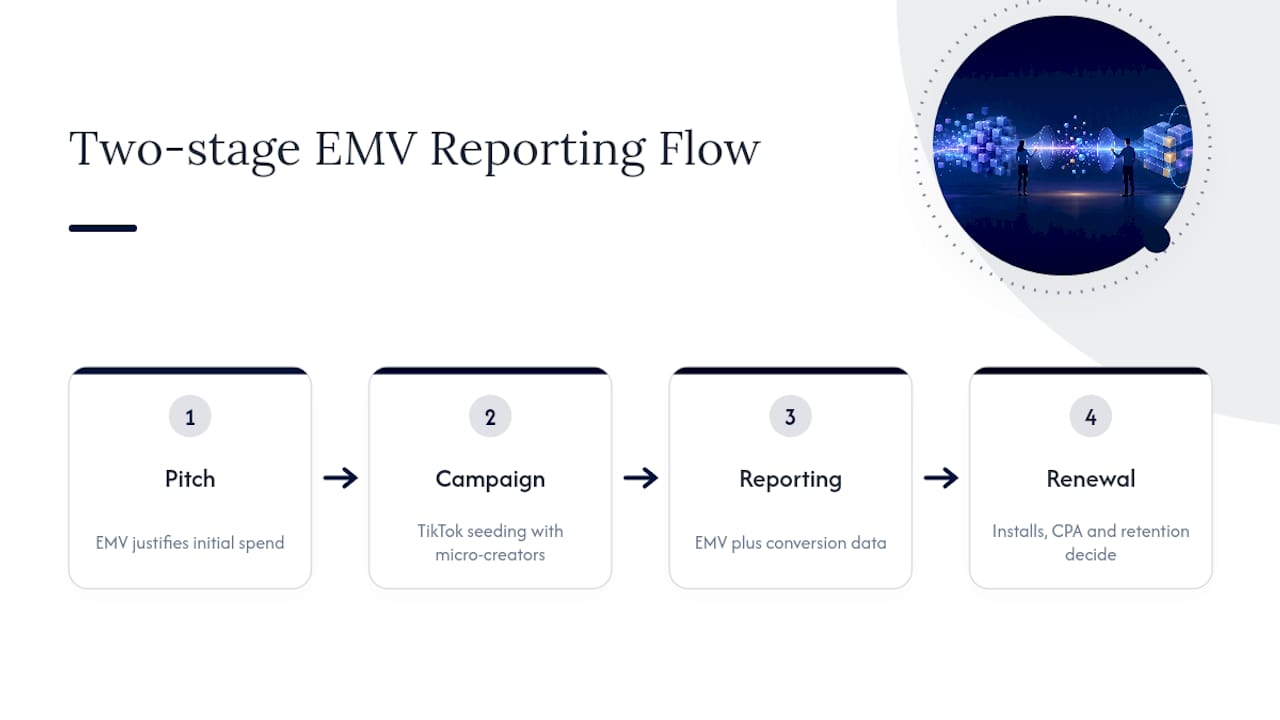
This split shows up repeatedly in how growth teams structure their reporting. The initial pitch to secure budget leans on EMV because it's the number that translates into a currency finance already understands. The follow-up report, once the campaign has run, leans on installs, CPA, and retention because those numbers determine whether the same creators get rebooked. Teams that skip straight to EMV in both stages tend to lose credibility once someone on the finance side asks why an EMV-heavy campaign didn't move download numbers. Teams that present both from the start avoid that conversation entirely.
The practical lesson: treat EMV as the number that opens the budget conversation, and treat conversions as the number that closes the renewal conversation. Trying to make one metric do both jobs is where most EMV-based case studies fall apart under scrutiny.
Choosing Influencer Partners With EMV Data
EMV data is genuinely useful for creator selection, but only when you use it to compare like with like. Ranking creators by raw EMV across different follower tiers just rewards reach, which is exactly the trap AMEC warns against when it comes to advertising-equivalent metrics generally. A better approach: calculate EMV-per-dollar-spent for each creator you're evaluating, and rank on that ratio instead of the raw dollar figure.
Look at engagement quality alongside the number. A creator generating $8,000 in EMV from a video with heavy bot-like comment patterns is a worse bet than one generating $5,000 from a video with genuine, specific audience reactions, even though the raw figure favors the first. Tools built for influencer analytics can help flag that kind of engagement quality issue before you commit budget to a creator based on EMV alone.
Finally, weight your selection criteria toward the campaign goal, not the metric that's easiest to calculate. If you're running an awareness push, EMV-per-dollar and reach quality matter most. If you're running a performance push tied to app installs, a creator's historical conversion rate should outrank their EMV figure every time, even when that creator's EMV looks less impressive on paper.
The Bottom Line on EMV
EMV earns its keep as a comparison tool, not a scoreboard. The moment a report treats it as revenue, it stops being useful and starts being a liability the first time someone in finance asks a hard question. Calculate it consistently, disclose the assumptions behind it, and let tracked conversions carry the weight EMV was never built to carry.
— Jax
Cult Media: Guaranteed Views Instead of an EMV Guessing Game
Some companies in consumer tech use commission-only models where clients pay for guaranteed, verified views rather than for projected advertising-equivalent estimates. That's a meaningfully different risk profile than a retainer-based agency asking you to trust an EMV projection before any content goes live.

Instead of reporting EMV as the headline number and hoping it correlates with downloads, Some companies use performance-based pricing that ties payment directly to verified views delivered by a creator network, with content rights transferring to the client. That structure means the incentive alignment problem EMV was always meant to paper over (are these creators actually driving outcomes, or just impressions) gets solved at the pricing level instead of the reporting level. If you're evaluating how to budget an influencer campaign for app growth, start by checking current campaign structures and guaranteed-view terms on the Cult Media landing page to see how a performance-first model compares to your current reporting approach.
Sources
- Say no to AVEs — AMEC
- Earned media value (EMV) — Brandwatch
- Earned Media Value (EMV) — Later help center
- Earned Media Value (EMV): How to Calculate It With 2026 Benchmarks - Nowadays
FAQ
What does EMV stand for in marketing?
EMV stands for Earned Media Value, an estimate of what your organic influencer content would have cost if you'd bought equivalent reach and engagement as paid advertising.
How do I calculate EMV?
Use a hybrid formula: (impressions ÷ 1,000 × CPM) plus weighted engagement value (likes, comments, shares), then apply a sentiment or placement multiplier, as detailed in the calculation example above.
Does influencer marketing really pay off?
It can, but the payoff shows up in tracked conversions and CPA, not in EMV alone; brands that pair EMV with verified installs or sales get a much clearer picture of actual return. Some companies offer guaranteed-view, commission-only models designed to make returns verifiable rather than estimated.
What is the 5:3:2 rule on Instagram marketing?
The 5:3:2 rule is a content-mix guideline suggesting 5 curated posts, 3 original posts, and 2 personal or promotional posts out of every 10, though it's a general social media planning framework rather than an EMV-specific standard.
What is a good EMV-to-spend ratio?
Many brands treat a 5:1 ratio as strong performance, while exceptional campaigns can reach closer to 10:1; a ratio under 3:1 usually signals a problem with creator fit, placement, or inflated inputs in the calculation.