The CPM pricing model charges advertisers a fixed rate for every 1,000 impressions delivered. The formula is straightforward: CPM = (Total Spend ÷ Impressions) × 1,000. Spend $15,000 to generate 2,400,000 impressions and your CPM is $6.25. Cost per mille functions as both a buying mechanism and a reporting metric, which is why you'll see it used to negotiate placements and to benchmark campaign efficiency in the same planning doc.
Pro Tip: CPM is the right lens for reach and frequency goals. If your KPI is conversions or clicks, you need a different buying model — or at minimum, a secondary metric alongside CPM.
Key Takeaways
The CPM pricing model is most effective when paired with viewability verification and a secondary conversion metric, because impression volume alone does not predict campaign outcomes.
| Point | Details |
|---|---|
| CPM formula | CPM = (Total Spend ÷ Impressions) × 1,000; eCPM flips this for publisher-side comparison. |
| Viewability standard | MRC requires 50% of pixels in view for 1 second; always buy vCPM or attach a viewability SLA. |
| Creator CPM benchmarks | Mid-tier creators average ~$28.40 CPM; micro-influencers average ~$34.15 CPM per Q3 2026 data. |
| Budget planning | Impressions needed = Reach × Frequency; Spend = (Impressions ÷ 1,000) × CPM. |
| Cult Media approach | Commission-only verified-view campaigns tie CPM spend to confirmed delivery, not served impressions. |
Table of Contents
- What does the CPM pricing model actually measure?
- How do you calculate CPM? Two worked examples
- CPM vs. CPC vs. CPA: which model fits your goal?
- What are vCPM, eCPM, and tCPM?
- What is a good CPM, and what moves the rate?
- How to plan budgets with CPM and control costs mid-campaign
- Common CPM pitfalls and how to verify your numbers
- The CPM trade-off most marketers underestimate
- Cult Media delivers guaranteed views on a verified CPM model
- Sources
- FAQ
What does the CPM pricing model actually measure?
CPM measures exposure, not action. Adjust defines CPM as a fixed rate per 1,000 impressions and positions it as the natural choice for brand awareness buys where reach and frequency matter more than click-through rates.
The model fits these campaign objectives well:
- Brand awareness and reach: You're paying for eyeballs, not clicks. CPM guarantees a volume of impressions at a predictable cost.
- Frequency planning: Buying on CPM lets you control how many times a defined audience sees your creative.
- Guaranteed placements: Premium publishers and creator networks often sell on CPM because it reflects the value of their audience, regardless of user behavior.
- Email sends: Some platforms price bulk email delivery on a CPM basis, charging per 1,000 messages sent.
Where CPM underperforms is direct response. Investopedia notes that CPM alone doesn't capture engagement or conversion performance, which means a campaign with a low CPM and a 0.1% click-through rate may be far less efficient than one with a higher CPM and a 2% CTR. For conversion-driven campaigns, CPC or CPA models tie spend directly to outcomes.
CPM applies across display, video, audio, out-of-home, and creator-driven paid amplification. The inventory type changes the benchmark, not the math.
How do you calculate CPM? Two worked examples
The calculation has three inputs: total spend, total impressions, and the multiplier of 1,000.
Step-by-step:
- Identify your total ad spend in dollars.
- Identify your total impression count.
- Divide spend by impressions.
- Multiply the result by 1,000.
Example 1 — Standard display buy: A brand spends $8,000 on a display campaign that delivers 4,000,000 impressions. CPM = ($8,000 ÷ 4,000,000) × 1,000 = $2.00 CPM
Example 2 — Creator-amplified campaign: A consumer app allocates $22,000 to a creator network delivering 1,100,000 verified views. CPM = ($22,000 ÷ 1,100,000) × 1,000 = $20.00 CPM
The creator buy costs ten times more per thousand, but the audience quality and conversion intent are typically higher. That's the trade-off CPM alone won't show you.
Cheat sheet for Google Sheets or Excel:
=( B2 / B3 ) * 1000 where B2 = spend and B3 = impressions.
eCPM (effective CPM) flips the formula for publishers and lets advertisers compare across pricing models: eCPM = (Revenue ÷ Impressions) × 1,000. If a CPC campaign earns $500 from 250,000 impressions, its eCPM is $2.00 — directly comparable to a CPM buy at the same rate.
Pro Tip: Build both formulas into your campaign tracker. CPM tells you what you paid; eCPM tells you what you got. Running them side by side is the fastest way to spot underperforming placements.
CPM vs. CPC vs. CPA: which model fits your goal?
| Buying Model | Best For | Key Advantage | Main Risk |
|---|---|---|---|
| CPM | Brand awareness, reach, frequency | Predictable impression volume | Pays for non-converting views |
| CPC | Traffic, consideration, clicks | Spend tied to user action | Click fraud; ignores impression quality |
| CPA | Conversions, installs, leads | Spend tied to outcomes | Higher unit cost; publisher risk |
CPM wins when your goal is top-of-funnel reach at scale. CPC is the right model when you need traffic and have a landing page built to convert. CPA shifts performance risk to the publisher or creator, which is why rates are highest and supply is most limited.
Hybrid models and eCPM let you compare across these structures without switching platforms. A publisher selling on CPC can be evaluated on eCPM to see whether their traffic is actually cheaper than a CPM buy at the same audience quality.
Negotiation points when buying CPM:
- Request a viewability guarantee (minimum 70% viewable impressions) as a condition of the buy.
- Ask for make-good provisions if delivered impressions fall short of contracted volume.
- Negotiate a frequency cap to avoid burning through creative against the same users.
Pro Tip: When a publisher resists a viewability SLA, that's a signal about their inventory quality. A confident publisher with premium placements will agree to viewability minimums without hesitation.
What are vCPM, eCPM, and tCPM?
Raw CPM counts every served impression, including ads that load below the fold and are never seen. Three measurement variations address that gap.
The MRC/ANA viewability standard for display ads: at least 50% of the ad's pixels must be in view for at least 1 second to count as a viewable impression. For video, the threshold rises to 50% in view for 2 continuous seconds. This standard, documented in the ANA measurement guidelines, is the baseline for any viewability SLA you negotiate.
vCPM (viewable CPM): Charges only for impressions that meet the MRC threshold. Google Ads support recommends updating legacy CPM bids to vCPM because standard CPM bids may be automatically converted, and vCPM ensures you pay only for ads users actually had the opportunity to see. Amazon Ads similarly documents vCPM as the standard for display placements on its platform.
eCPM (effective CPM): A normalization metric, not a buying model. It converts any pricing structure into a per-thousand-impression figure so you can compare a CPC campaign against a CPM buy on equal footing.
tCPM (target CPM): A bidding strategy used in programmatic environments where the platform optimizes delivery to hit a target CPM while maximizing reach within that constraint.
Understanding the difference between a view and an impression is foundational here. A served impression and a viewed impression are not the same metric, and conflating them inflates your apparent reach.
Pro Tip: Always require a third-party viewability tag (IAS, DoubleVerify, or Moat) on any CPM buy above $5,000. Self-reported viewability from a publisher is not an independent audit.
What is a good CPM, and what moves the rate?
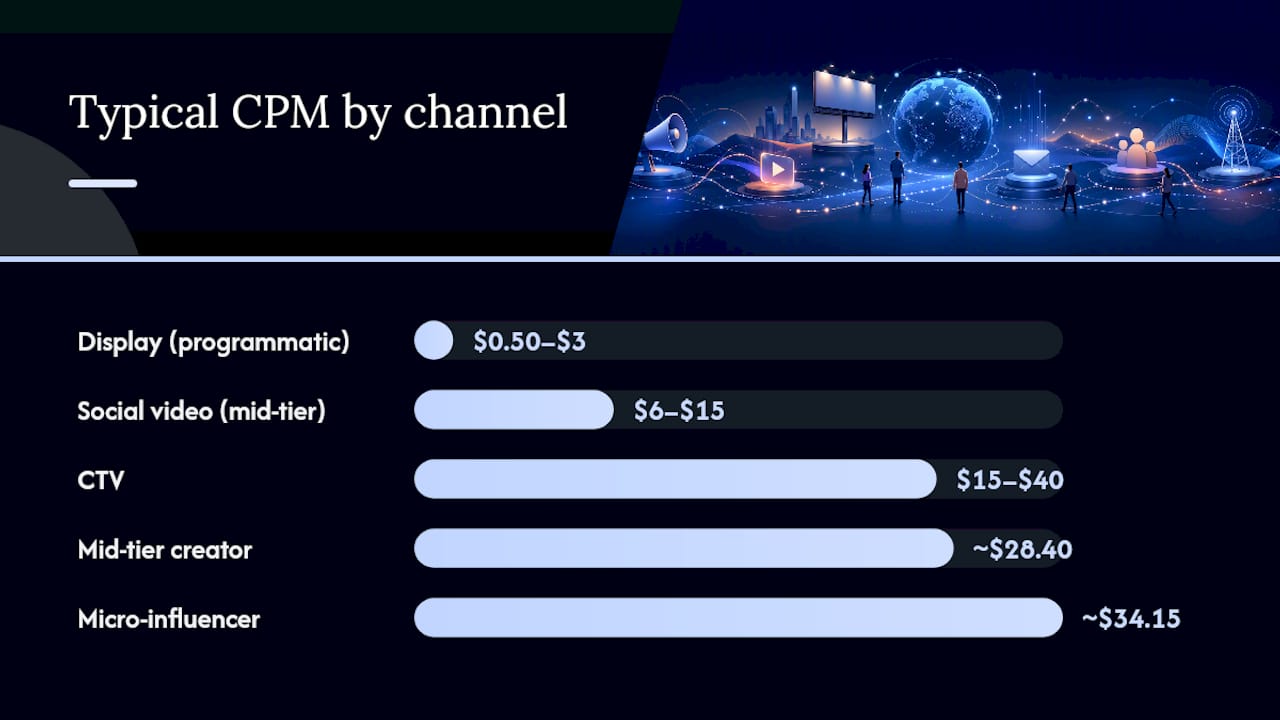
CPM benchmarks vary significantly by channel, format, and audience. The ranges below are directional; always contextualize by your specific audience and conversion rates before using them as targets.
| Channel / Format | Typical CPM Range | Key Driver |
|---|---|---|
| Display (programmatic) | $0.50–$3 | Audience targeting depth |
| Social video (mid-tier) | $6–$15 | Engagement rate, platform |
| Mid-tier creator content | ~$28.40 | Creator audience quality |
| Micro-influencer content | ~$34.15 | Niche audience, higher intent |
| Connected TV (CTV) | $15–$40 | Premium inventory, targeting |
| Audio / podcast | $15–$25 | Host-read format, listener loyalty |
Creator CPM benchmarks from 2026 show a bifurcated market with mid-tier creators commanding moderate CPM rates, while micro-influencers typically command higher CPMs, reflecting the premium buyers place on niche, high-intent audiences. Hybrid pricing (flat fee plus commission) is increasingly common in creator deals, which changes how you calculate effective CPM for those buys.
Factors that push CPM higher:
- Premium, high-intent audiences (finance, health, B2B decision-makers)
- Rich media and video formats
- Q4 seasonality and holiday ad windows
- Exclusive or direct publisher placements
Factors that lower CPM:
- Broad, untargeted audiences
- Remnant or run-of-network inventory
- Off-peak timing (January, mid-summer)
- Repurposed content on lower-demand placements
Statista's platform CPM data tracks average annual CPM rates across social platforms and is useful for setting directional benchmarks before entering negotiations.
Pro Tip: A low CPM is not automatically a win. Always calculate cost per outcome alongside CPM.
How to plan budgets with CPM and control costs mid-campaign
Budget planning with CPM starts from your reach and frequency targets, then works backward to spend.
Planning formula:
- Define your target reach (unique users) and desired frequency (impressions per user).
- Calculate total impressions needed: Impressions = Reach × Frequency
- Calculate required spend: Spend = (Impressions ÷ 1,000) × CPM
Worked example: You want to reach 500,000 users three times each at a $12 CPM.
- Impressions needed: 500,000 × 3 = 1,500,000
- Spend required: (1,500,000 ÷ 1,000) × $12 = $18,000
Optimization checklist during a live campaign:
- Targeting adjustments: Narrow audience segments that show high CPM with low conversion rates.
- Creative refresh: Rotate creative every 7–10 days to counter frequency fatigue and maintain CTR.
- Placement exclusions: Remove low-viewability placements identified by your third-party tag.
- Dayparting: Concentrate delivery in hours when your audience is most active to improve conversion efficiency.
- Pacing controls: Use even pacing rather than front-loaded delivery to avoid burning budget in low-quality inventory windows.
- Floor price negotiation: On direct buys, negotiate a CPM floor with a volume commitment in exchange for a rate reduction.
For creator campaigns, use a creator audience quality audit before committing budget. Verified audience composition directly affects whether a $30 CPM creator buy outperforms a $5 programmatic placement.
Pro Tip: Negotiate hybrid deals with creators: a base CPM for guaranteed views plus a performance bonus tied to installs or click-through rate. This aligns creator incentives with your conversion goals and keeps your base CPM predictable.
Common CPM pitfalls and how to verify your numbers
CPM campaigns carry three structural risks that erode spend without appearing in headline metrics.
Checklist of common pitfalls:
- Non-viewable impressions: Ads served below the fold or in low-attention placements count toward your impression total but deliver no real exposure.
- Bot traffic and ad fraud: Invalid traffic inflates impression counts without any human audience behind them. MRC-certified verification vendors (IAS, DoubleVerify, HUMAN) filter this at the tag level.
- Reporting discrepancies: Publisher-reported impressions and DSP-counted impressions routinely diverge by 10–20%. Always reconcile at the log level before signing off on delivery.
Verification steps:
- Require MRC-certified third-party viewability tags on every placement.
- Run log-level reconciliation between your DSP and publisher reports at the end of each flight.
- Request a post-campaign viewability report from your verification vendor before releasing final payment.
- For creator campaigns, require platform-native analytics screenshots alongside any third-party reporting.
One privacy note: ensure your verification tags and pixel-based measurement comply with applicable data privacy regulations, including CCPA for California audiences.
The CPM trade-off most marketers underestimate
CPM is the most transparent pricing model in digital advertising, and that transparency is also its trap. Because the math is simple and the metric is universal, teams often treat a low CPM as proof of efficiency. It rarely is.
The real question is never "what did I pay per thousand impressions?" It's "what did those impressions actually do?" A $4 CPM on a programmatic display network sounds efficient until you calculate that it took 800,000 impressions to generate 40 clicks, putting your effective CPC at $80. Meanwhile, a creator campaign at $28 CPM might deliver 1,000 clicks from 100,000 views, at an effective CPC of $2.80.

The shift toward vCPM and viewability SLAs is the industry's attempt to close that gap. But viewability is still a proxy for attention, not a measure of it. The next frontier is outcome-linked CPM: paying a CPM rate but guaranteeing a minimum conversion floor. That's the model creator networks like Cult Media are already running, where the CPM is tied to verified views rather than served impressions, and the campaign doesn't close until the delivery is confirmed.
Cult Media delivers guaranteed views on a verified CPM model
Most CPM buys leave you reconciling discrepancies between served impressions and actual reach. Cult Media's commission-only creator network eliminates that gap by charging only for verified views delivered by managed creators on TikTok and Instagram.

For consumer tech app teams, this means your CPM spend maps directly to confirmed audience exposure, not server-side impression counts. Cult Media handles creator sourcing, content production, and end-to-end campaign management, so your growth team focuses on conversion rather than creator logistics. Every campaign is priced on a performance basis: you pay for views delivered, not views promised.
If you're planning a creator-driven reach campaign and want CPM accountability built into the contract, see how Cult Media works.
Sources
The sources below are the most reliable references for validating CPM figures, viewability standards, and platform-specific documentation.
- What is CPM? Cost per mille explained | Amazon Ads
- Cost per thousand (CPM) | Investopedia
- Viewable CPM bidding (Google Ads support)
- ANA measurement guidelines (viewability / MRC reference)
Use the ANA/MRC document when writing viewability SLAs. Use the platform docs (Google, Amazon) when auditing how your DSP counts impressions. Use the creator benchmark report when negotiating influencer CPM rates.
FAQ
What does $10 CPM mean?
A $10 CPM means you pay $10 for every 1,000 impressions delivered. A campaign buying 500,000 impressions at $10 CPM costs $5,000 total.
What does $15 CPM mean?
At $12 CPM, every 1,000 impressions costs $12. To reach 1,000,000 impressions, your total spend would be proportional.
How do you calculate CPM?
Divide total spend by total impressions, then multiply by 1,000. A $8,000 spend across 4,000,000 impressions equals a $2.00 CPM.
What is a good CPM for influencer campaigns?
Based on Q3 2026 benchmarks, mid-tier creators average around $28.40 CPM and micro-influencers average around $34.15 CPM. Whether those rates are "good" depends on your audience quality and conversion rate, not the CPM figure alone.
What is vCPM and why does it matter?
It's a more accurate measure of real exposure than raw CPM and is the format Google Ads recommends over legacy CPM bidding.
Recommended
- Creator Whitelisting: Lower CPA for Consumer Apps
- Creator-Led Growth: The 2026 Playbook for Growth Teams - Scale Your Consumer App By Unlocking The TikTok & Instagram Systems Behind +20 Billion Views
- View vs Impression: What Marketers Must Track - Scale Your Consumer App By Unlocking The TikTok & Instagram Systems Behind +20 Billion Views