
Run the pilot before you write the strategy deck. The single highest-leverage move for cross-border creator campaigns is a 4 to 8 week test with local micro and mid-tier creators, guaranteed view metrics, and one culturally specific creative brief per market. Unilever proved the model at scale by activating roughly 50,000 creators for its World Cup campaign, and Cult Media applies the same tiered logic on a commission-only basis for consumer apps entering new markets.
Three moves matter in week one:
- Research the ground truth. Identify which platforms and subcultures actually drive discovery in the target market, not which ones perform at home.
- Shortlist local casters first. Prioritize creators with in-market audience trust over global follower count.
- Launch a pilot with guaranteed metrics. Tie spend to verified views or engagement, not impressions alone.
Key Takeaways
Cross-border creator campaigns succeed when local creators serve as cultural translators, verified performance metrics gate every scale decision, and casting quality outweighs script polish.
| Point | Details |
|---|---|
| Pilot before you scale | Run a 4 to 8 week pilot with a gating metric before committing budget to a full market rollout. |
| Cast for local trust first | Prioritize creators with in-market credibility over global follower count in every new market. |
| Storytelling beats view counts | Shift briefs toward lived-experience storytelling to avoid the influencer fatigue that flat view-count KPIs cause. |
| Verify before you report | Audit views and UGC quality before treating a number as a real performance signal. |
| Cult Media fits performance-based entry | Cult Media's commission-only, guaranteed-view model ties spend to verified results for consumer apps entering new markets. |
Table of Contents
- Why Cross-Border Creator Campaigns Need a Different Playbook
- How Local Creators Transfer Trust Across Borders
- Step-by-Step: How to Run a Cross-Border Creator Campaign
- What Successful Global Creator Campaigns Have in Common
- Common Pitfalls That Sink Cross-Border Creator Campaigns
- What KPIs Should You Track for Market Entry?
- Why the Standard Influencer Playbook Undersells Cross-Border Work
- Get Guaranteed Views for Your Next Market Entry
- Sources
- FAQ
Why Cross-Border Creator Campaigns Need a Different Playbook
A campaign that works in your home market rarely survives a straight translation. Cultural context, platform mix, creator tier mix, and local media norms all shift the moment you cross a border, and each one changes what "good creative" looks like.
- Cultural context determines what reads as authentic versus tone-deaf.
- Platform mix varies by market. A channel that dominates domestically might be secondary elsewhere.
- Creator tier mix needs local calibration; a mega-influencer with no in-market credibility often underperforms a micro-creator who is trusted.
- Local media norms shape disclosure expectations, humor, and pacing.
Scale alone does not fix any of this. Klook moved away from view-count KPIs specifically because raw reach was producing influencer fatigue without cultural resonance, and it shifted toward storytelling that explained why travel mattered to a specific audience.
Pro Tip: Reserve global ambassadors for brand-level awareness moments, and let local micro and mid-tier creators carry the market-entry work. They convert skepticism into trust faster than reach alone ever will.
How Local Creators Transfer Trust Across Borders
A cultural translator does more than post in the local language. The role requires authenticity signals a global campaign cannot fake: local slang, context-specific humor, and social proof that reads as credible to that specific audience.

Trust transfers through specific content behaviors, not just creator selection. Storytelling that centers lived experience outperforms feature-driven scripts, and participatory formats (duets, local challenges, in-person events) outperform passive endorsement. Expedia's multi-phase partnership with a single global creator worked because it converted an engaged fan base into an active community through livestreams and a custom booking experience, not a single sponsored post.
Formats that consistently transfer trust in a new market:
- Local testimonial content, where the creator frames the product through a personal problem it solved.
- Experiential UGC, filmed live at an event or first-use moment rather than scripted in a studio.
- Event-driven short-form, tied to a cultural moment the audience already cares about.
A creator's audience does not trust the brand because the creator was paid. They trust the brand because the creator's judgment has already earned trust, and that judgment is now vouching for something new.
Step-by-Step: How to Run a Cross-Border Creator Campaign
1. Market research and audience segmentation. Map which local subcultures and platforms actually drive discovery in the target market before casting anyone. A market where short-form video leads discovery calls for a different brief than one where long-form review content dominates purchase decisions.
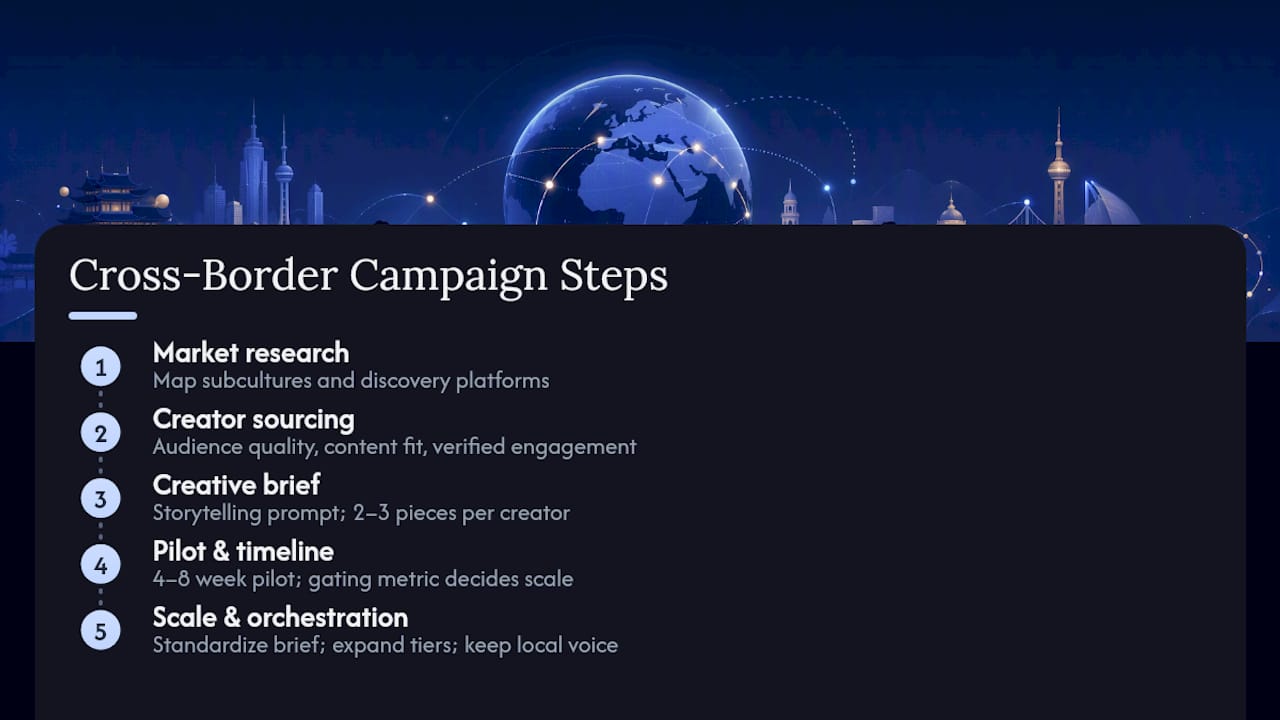
2. Creator sourcing and casting criteria. Screen for relevance signals over vanity metrics: audience quality, past content fit with your category, and a track record of engagement that holds up under scrutiny. Performance-based options like Cult Media's creator network let you tie spend to verified view guarantees instead of betting a flat retainer on unproven local talent.
3. Creative brief and localization rules. Give creators a storytelling prompt, not a script. Specify what is off-limits (claims, comparisons, regulated language) and leave room for idiom and pacing the creator understands better than you do. Set a deliverable cadence, typically two to three pieces of content per creator over the pilot window.
4. Activation timeline and pilot size. Run a 4 to 8 week pilot with a defined creator count per tier and a gating metric, such as verified views or install lift, that determines whether you scale or pivot. Keep the initial budget concentrated on a handful of markets rather than spreading thin across a dozen.
5. Scale and orchestration. Once a market clears its pilot gate, expand the creator tier mix, standardize the brief template, and layer in mid-tier and macro talent while keeping the local voice intact. Cult Media's creator-led growth framework documents this multi-tier orchestration for consumer apps scaling across several markets at once.
Pro Tip: Treat the pilot's gating metric as a contract, not a suggestion. If a market misses the threshold, fix the creative brief before you increase spend.
What Successful Global Creator Campaigns Have in Common
The pattern across major campaigns is consistent: combine a recognizable ambassador with a dense layer of hyperlocal creators, and let the cultural moment do the heavy lifting. Hilton's campaign with Deepika Padukone generated 1.9 billion Instagram Reels views and 5 billion views across channels in eight weeks, launching in-market before spreading globally rather than the reverse.
Unilever's World Cup activation followed the same logic at a different scale, pairing branded pop-ups with tiered creator activations timed to match-day moments across dozens of markets.
The campaigns that scale fastest are the ones built around a moment the audience already cares about, with creators layered in to amplify that moment rather than manufacture interest from nothing.
For consumer app market entry specifically, this pattern maps cleanly onto a guaranteed-view, commission-only model. Cult Media's structure lets a brand manager test a market with hyperlocal creators, verify performance against a set view threshold, and only pay for what actually lands, which fits the pilot-then-scale approach the biggest campaigns already use.
Common Pitfalls That Sink Cross-Border Creator Campaigns
Most failures trace back to five recurring mistakes: influencer fatigue from over-reliance on view counts, cultural missteps in creative that skipped local review, poor creator selection based on follower count alone, measurement design that can't isolate market-level performance, and compliance blind spots on disclosure rules.
Watch for these red flags early in a pilot:
- A low engagement-to-reach ratio, which usually signals the content missed the audience's actual interests.
- A mismatch between creator tone and brand promise, which erodes the trust transfer the whole campaign depends on.
- Content flagged, throttled, or removed in-market, which often points to a disclosure or claims issue you missed in the brief.
Pro Tip: If a pilot underperforms, fix the brief and swap a portion of the creator roster before you cut the market entirely. Abandoning a market after one flawed test wastes the local trust you already started building.
What KPIs Should You Track for Market Entry?
Four metrics matter most in a market-entry pilot: verified organic views, reach-to-engagement ratio, uplift in branded search or app installs where applicable, and earned media volume generated beyond the paid activation.
- Verified organic views confirm the creator's guarantee held up, not just what the platform reports.
- Reach-to-engagement ratio tells you whether the content actually resonated or just appeared in feeds.
- Install or search uplift connects the campaign to business outcomes, when the product allows attribution.
- Earned media volume shows whether the activation generated conversation beyond what you paid for.
Verification should include view audits, sampling checks on UGC quality, and a basic fraud or bot-traffic review before you count a number toward your gating metric. Set decision gates on a cadence: a 2-week check on creative health, a 4 to 6 week pilot verdict, and monthly reviews once you scale. This cadence mirrors the view-versus-impression distinction that determines whether a reported number is actually worth acting on.
Why the Standard Influencer Playbook Undersells Cross-Border Work
The conventional advice treats international expansion as a translation problem: swap the language, keep the strategy, ship it. That approach consistently underperforms because it skips the actual mechanism that makes creator marketing work in a new market, which is borrowed trust, not borrowed reach.
What gets underrated is how much the casting decision outweighs the creative decision. A brand can write a flawless localized script and still fail if the creator has no standing with that audience. Conversely, a rougher, less polished piece of content from a creator the audience already trusts routinely outperforms a slick script from the wrong messenger.

What should come first is not the creative brief. It is a ruthless local casting process, followed by a pilot with a real gating metric, before a single dollar goes toward scale. Brands that skip the pilot and go straight to a multi-market rollout tend to discover their cultural misfires after the budget is spent, not before. Performance-based structures exist precisely because they force that discipline: you only pay for what verifiably works, which keeps the incentive aligned with cultural fit rather than just spend volume.
Get Guaranteed Views for Your Next Market Entry
Cult Media replaces the flat retainer with a commission-only structure built for consumer apps entering new markets: you pay for verified views a local creator network actually delivers, not for a fixed monthly fee regardless of outcome. That matters most in cross-border work, where you're testing cultural fit in a market you don't yet fully understand, and a guaranteed-view pilot lets you validate that fit without committing to a long-term contract upfront.
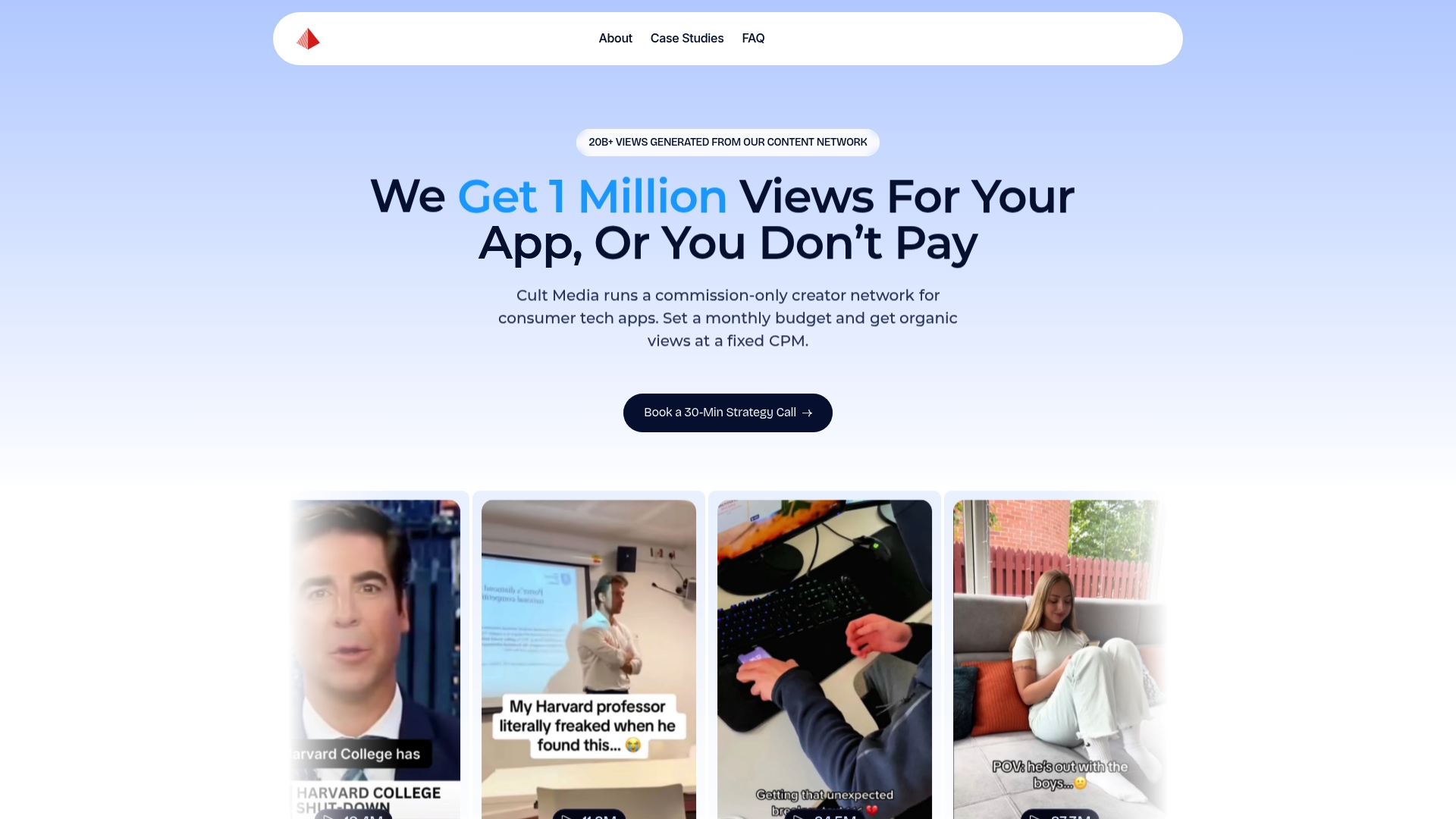
The network spans creator tiers built for exactly the pilot-then-scale approach this article walks through: hyperlocal casting for authenticity, guaranteed performance thresholds for accountability, and creator whitelisting tactics that turn strong pilot content into paid amplification once a market clears its gate. If your team is planning entry into a new market and needs a faster read on cultural fit than a traditional retainer allows, get a campaign quote from Cult Media and scope a pilot around your first target market.
Sources
- A Super Bowl every two days: Inside Unilever’s 50,000-creator World Cup play
- How Klook transformed Marie Kondo from lifestyle guru to travel ambassador
- Expedia teams up with IShowSpeed to reimagine Gen Z travel
- Hilton's record‑breaking campaign with Deepika Padukone reminds the world why it matters where you stay, achieving 5 billion views in eight weeks
FAQ
What Makes a Cross-Border Creator Campaign Different From a Domestic One?
Cross-border campaigns require rebuilding the creator mix, platform strategy, and creative brief around local cultural context instead of translating a home-market campaign, because trust and platform habits don't transfer automatically across borders.
Can You Use Home-Market Creators for International Campaigns?
Home-market or global ambassador creators work best for brand-level awareness, but local micro and mid-tier creators typically drive stronger trust and conversion in a new market because their audience already knows and trusts them.
How Long Does a Cross-Border Creator Pilot Take?
A practical pilot runs 4 to 8 weeks with a defined gating metric, such as verified organic views or engagement rate, that determines whether the market is worth scaling.
What Is Cross-Border E-Commerce and How Does It Relate to Creator Campaigns?
Cross-border e-commerce refers to selling products or apps to customers in a different country than where the business is based, and creator campaigns are one of the primary tools brands use to build the local trust that makes those sales possible.
Do Disclosure Rules Change by Market in Cross-Border Campaigns?
Yes. Advertising standards and disclosure requirements for sponsored content vary by country, so every market-specific brief needs its own compliance review rather than a single global disclosure template.
How Does Cult Media's Pricing Work for Cross-Border Campaigns?
Cult Media uses a commission-only, performance-based model tied to verified views, so brands pay based on delivered results rather than a fixed retainer regardless of outcome.