
Social proof content is any third-party signal — reviews, testimonials, UGC, endorsements, or crowd metrics — that demonstrates other people have chosen and benefited from your product, reducing purchase uncertainty for the next buyer. According to a 2026 industry guide, a large majority of consumers hesitate to buy a product with no reviews. That single figure explains why proof is not a nice-to-have in your conversion stack — it is the conversion stack.
Start here. These five proof elements deliver the highest return with the least production overhead:
- Recent customer reviews (posted within the last 90 days) placed adjacent to your primary CTA
- Visual UGC — photos or short videos from real customers showing the product in use
- Outcome-focused testimonials that name a specific result ("cut CPI by 30%" beats "great product")
- Verified star ratings from a recognized platform (Google, Trustpilot) displayed on product and landing pages
- Crowd signals such as customer counts, download numbers, or "best-seller" labels that indicate scale
Key Takeaways
Social proof content works when it is specific, verified, recent, and placed at the exact moment a buyer is deciding — generic or stale proof does more harm than good.
| Point | Details |
|---|---|
| Proof drives conversion | 92% of consumers hesitate to buy with no reviews; place verified proof adjacent to your primary CTA first. |
| Format must match context | High-friction purchases need named case studies; low-friction purchases convert on star ratings and crowd signals. |
| Collection requires a system | Automated post-purchase requests, in-app success prompts, and creator briefs are the highest-return collection methods. |
| Measure conversion lift first | Track conversion rate, checkout completion, and CTR on proof-driven ads; use UTM tags and custom events for attribution. |
| Cult Media for creator proof | Cult Media's commission-only network delivers verified views and rights-cleared UGC that becomes social proof across every channel. |
Table of Contents
- What is social proof content and why does it work?
- How social proof content affects conversions and acquisition
- What types of social proof content should you use?
- How do you collect reliable social proof?
- Where should you display social proof and how do you test it?
- How do you measure the impact of social proof content?
- What mistakes and legal risks should you avoid?
- How does a commission-only creator network generate social proof?
- When should you invest in social proof vs. other trust-building work?
- Cult Media scales creator-driven social proof for consumer apps
- Sources
- FAQ
What is social proof content and why does it work?
Social proof is a psychological mechanism first described by Robert Cialdini in Influence: when people are uncertain, they look to the behavior of others to decide what to do. Marketers call this informational social influence. The practical implication is that proof content does not just reassure — it actively substitutes for the buyer's own judgment when confidence is low.
Four psychological levers drive the effect:
- Conformity bias: People assume that if many others chose something, it is probably the right choice. Customer counts, download figures, and "most popular" labels all trigger this.
- Authority: Endorsements from recognized experts or institutions transfer credibility. A Consumer Reports rating or a verified expert quote carries more weight than a generic five-star badge.
- Similarity: Buyers respond most strongly to proof from people who look like them. A testimonial from a "solo founder running a SaaS product" converts better for that audience than a Fortune 500 case study.
- Scarcity: "Only 3 left" or "12 people viewing this now" creates urgency by implying that others are already acting.
The context of the purchase shapes which lever matters most. For high-uncertainty decisions — a SaaS annual contract, a premium consumer device, a health supplement — authority and similarity signals do the heaviest lifting because the buyer is actively researching and comparing. For low-friction purchases — a $15 e-commerce item, a free app download — crowd signals and star ratings are often enough to tip the decision.
Pro Tip: Match your proof format to the buyer's uncertainty level. A SaaS pricing page needs a named case study with a specific outcome. A product listing page needs a visible star rating and review count. Deploying the wrong format in the wrong context wastes the proof you already have.
How social proof content affects conversions and acquisition
The business case is direct: proof content reduces the perceived risk of buying, which compresses the decision timeline and lifts conversion rates. Sprout Social's marketing guide identifies UGC, case studies, and influencer partnerships as the top formats for building trust and reach — formats that work across both organic and paid channels.
The KPIs that typically move when proof is deployed well:
- Conversion rate on product pages and landing pages (the most immediate and measurable signal)
- Trial start rate for SaaS and app products, where proof adjacent to the sign-up form reduces hesitation
- Average order value (AOV), because proof on upsell modules and bundle pages validates the higher spend
- Cart abandonment rate, which drops when checkout pages display recent reviews or security trust seals
- Time on page, a secondary signal that indicates buyers are reading proof rather than bouncing
Proof also feeds acquisition. Statista's consumer trust data shows that peer recommendations and reviews consistently rank above native advertising in consumer trust, which means proof-rich pages attract more organic traffic and perform better in paid placements. Structured review schema (JSON-LD) helps search engines surface star ratings in SERPs, lifting click-through rates without additional ad spend.
One underappreciated channel: AI-driven buyer research. When a buyer asks an AI assistant to compare tools or recommend a product, the model draws on review volume, recency, and documented case studies. Structured, machine-readable proof increases the probability that your brand surfaces in those AI-generated vendor comparisons — a distribution channel that did not exist at scale three years ago.

What types of social proof content should you use?
Yotpo's social proof marketing guide and Sprout Social's breakdown together cover the canonical formats. Here is each format with a one-sentence description, where it performs best, and the tools that make collection and display practical.
-
Customer reviews and star ratings. Verified, text-based ratings from real purchasers. Best on product pages, Google Shopping, and app store listings. Use Google Customer Reviews for verified post-purchase collection and Trustpilot for third-party credibility. Both aggregate into store ratings that appear in Search and Shopping ads.
-
Visual UGC (photos and short video). Customer-created images or clips showing the product in real-world use. Best on product pages, Instagram ads, and TikTok acquisition campaigns. Collect via branded hashtag campaigns or creator briefs; manage and rights-clear with a UGC platform. Check best UGC platforms for consumer app growth for platform-by-platform guidance.
-
Testimonials and case studies. Structured quotes or long-form narratives that name a specific outcome. Testimonials work in hero sections and email sequences; case studies belong on pricing pages and in sales decks. Collect via post-success interviews; format with photo, role, company, and a single measurable result.
-
Influencer and expert endorsements. Third-party validation from a recognized voice in the category. Best in paid social ads, YouTube pre-rolls, and press sections. Micro-influencers with engaged, relevant audiences often outperform macro accounts on conversion because the audience match is tighter.
-
Logos, awards, and media mentions. Visual shorthand for credibility. "As seen in" press logos and award badges work in hero sections and email footers. Pair them with a linked source — a bare logo without a reference reads as unverifiable.
-
Wisdom-of-the-crowd signals. Customer counts, download numbers, "best-seller" labels, and "X people bought this today" notifications. Shopify's retail guide shows how busy-store cues and best-seller sections translate directly to online placements to reduce decision friction.
-
Trust seals and security badges. SSL certificates, payment security logos, and money-back guarantee badges. Best at checkout. They address a specific anxiety (payment security) at the exact moment it peaks.
-
Real-time activity notifications. "Sarah from Austin just purchased" pop-ups. Best on high-traffic e-commerce pages where the volume makes them credible. Use sparingly — low-traffic sites where the same notification loops every few minutes destroy trust faster than they build it.
Pro Tip: Creator UGC is the most repurposable proof format in your library. A 30-second TikTok from a creator can become a paid social ad, a product page embed, an email GIF, and a case study screenshot — all from one piece of content. Rights-clear it at the brief stage, not after the fact.
Tools worth knowing: Yotpo for review collection and display across e-commerce; Sprout Social for social listening to surface organic proof mentions; Google Customer Reviews for verified post-purchase ratings tied to Search and Shopping; Trustpilot for third-party review credibility and badge display.
How do you collect reliable social proof?
The highest-return collection methods, in priority order: automated post-purchase review requests, in-app prompts triggered by a success moment, creator content briefs for UGC campaigns, and post-success interviews for case studies. Volume and recency both matter — review volume and response rate now influence credibility as much as the star rating itself.
Review request cadence
- Trigger at the right moment. Send the request after the customer has experienced value, not immediately after purchase. For physical products, 7–10 days post-delivery. For SaaS, after the user completes a key action (first export, first integration, first report).
- Keep the ask short. One email, one question, one link. Subject line: "Quick question about your experience with [Product]." Body: two sentences, a star-rating link, and a 30-second time estimate.
- Follow up once. A single reminder at day 14 (for physical products) or day 21 (for SaaS) captures the buyers who missed the first email without feeling aggressive.
- Automate via your platform. Google Customer Reviews integrates directly with Google Merchant Center and sends opt-in survey emails automatically after a verified purchase — no manual outreach required.
Minimal UGC campaign brief
- Goal: 20–30 pieces of authentic visual content showing the product in use
- Platform: TikTok and Instagram Reels (highest organic reach for consumer apps)
- Creator criteria: Accounts with genuine engagement in your category, not just follower count
- Content direction: Show the problem, show the product solving it, show the result — 30–60 seconds
- Disclosure requirement: "#ad" or "#sponsored" in the caption if any compensation is involved (cash, product, or affiliate commission)
- Rights: Written permission to repurpose content in paid ads and on product pages, secured before publishing
Verification and moderation
- Use platform-native verified purchase flags (Google, Trustpilot, Yotpo) to distinguish confirmed buyers from anonymous submissions.
- Respond to every negative review within 48 hours. Non-response signals to prospective buyers that the brand does not stand behind its product.
- Remove reviews that violate platform terms (spam, competitor submissions, personal attacks) through the platform's dispute process — not by suppressing legitimate negative feedback.
- For creator content, audit the creator's audience quality before the campaign launches. A creator with 50K followers and 0.5% engagement delivers less proof value than one with 10K followers and 8% engagement. Use a creator audience quality checklist to vet before committing budget.
Pro Tip: The single fastest way to increase review volume is to ask at the right moment, not more often. A prompt triggered immediately after a user completes their first successful task in your app will outperform a generic weekly email blast by a wide margin.
Where should you display social proof and how do you test it?
Show proof at the moment of highest anxiety. For most products, that is the pricing page, the checkout page, and the hero section of the landing page — the three places where buyers are most likely to pause, second-guess, and leave.
Placement by page and channel:
- Hero section: A single, outcome-focused testimonial with a photo and role. Establishes credibility before the buyer reads anything else.
- Product page: Star rating and review count near the product title; a review widget below the fold with filtering by rating and use case.
- Pricing page: A case study or testimonial from a customer in the same segment as the buyer, placed adjacent to the plan they are most likely to choose.
- Checkout page: Trust seals (payment security, money-back guarantee) and a recent review count ("Trusted by 14,000+ customers").
- Paid social ads: Creator UGC as the ad creative — creator whitelisting lets you run creator content from the creator's own account, which typically outperforms brand-account ads on CPA.
- Email sequences: A testimonial in the onboarding sequence at day 3, when new users are most likely to drop off.
- Social feeds: Repost customer UGC with credit; use Sprout Social's listening tools to find organic mentions worth amplifying.
Two A/B test templates
-
Hero testimonial vs. customer-count badge. Variant A: a named testimonial with a photo and a specific outcome in the hero. Variant B: a "Trusted by 12,000+ customers" badge in the same position. Success metric: landing page conversion rate. Run for a minimum of two weeks or until you reach statistical significance (typically 1,000+ visitors per variant).
-
With vs. without recent-review widget on product page. Variant A: product page with a visible review widget showing the 10 most recent reviews. Variant B: product page with only the aggregate star rating and count. Success metric: add-to-cart rate and checkout completion rate.
Design principles for scannable, credible proof:
- Photo + full name + role/company + one specific result. Every element that is missing reduces credibility.
- Keep testimonials to 2–3 sentences. Longer quotes get skimmed; shorter quotes feel thin.
- Show recency. "Posted March 2025" beats an undated testimonial every time.
Pro Tip: Do not test proof against no proof. Test proof format A against proof format B. The question is not whether proof works — it does. The question is which format works best for your specific audience and page.
How do you measure the impact of social proof content?
Measure social proof by immediate conversion lift and longer-term trust signals. The two categories require different measurement approaches and different timelines.
Primary metrics:
- Conversion rate on pages where proof was added or changed — the most direct signal.
- Review volume and recency — track monthly new review count and the date of the most recent review. Both affect credibility and AI-model citation probability.
- CTR on proof-driven ads — creator UGC ads vs. brand-produced ads in the same campaign. Track views vs. impressions separately; a high impression count with low view completion signals the creative is not holding attention.
- AOV on pages with upsell proof — testimonials on bundle or upsell modules should lift AOV measurably within 30 days.
- Checkout completion rate — the delta between add-to-cart and completed purchase narrows when trust seals and recent reviews are visible at checkout.
- Review response rate — the percentage of reviews (especially negative ones) that receive a brand response within 48 hours. This is a credibility signal to prospective buyers, not just a customer service metric.
Secondary signals: organic mentions volume (tracked via Sprout Social or similar), UGC items created per month, and branded search volume growth (a proxy for trust at scale).
Experiment setup:
- Define one primary metric per test (conversion rate, AOV, or checkout completion).
- Set a minimum sample size before reading results — typically 500–1,000 conversions per variant for statistical confidence.
- Tag proof-driven traffic with UTM parameters and fire a custom event in your analytics platform when a buyer interacts with a proof element (clicks a review, expands a testimonial).
- Run tests for full-week increments to account for day-of-week variation in buyer behavior.
Attribution caveat: Social proof rarely gets direct attribution credit in last-click models. A buyer who reads three case studies and then converts via a paid search ad will show up as a paid search conversion. Multi-touch attribution or a simple pre/post analysis (conversion rate before and after proof was added) gives a more accurate picture of proof's contribution.
| Metric | What it measures | Benchmark signal |
|---|---|---|
| Review volume (monthly new) | Collection health and recency | Declining volume signals a broken ask cadence |
| Review response rate | Brand credibility and engagement | Responding to reviews within 48 hours is the standard cited by Trustpilot and Google |
| CTR on UGC ads vs. brand ads | Creative proof performance | UGC ads frequently outperform brand-produced creative on CPA in consumer app campaigns |
| Checkout completion rate | Trust at the final decision point | Improves when trust seals and recent reviews are visible at checkout |
What mistakes and legal risks should you avoid?
The highest-risk mistakes in social proof programs, in order of damage potential:
- Fake or incentivized reviews without disclosure. Paying for reviews, offering discounts in exchange for positive ratings, or submitting reviews from employee accounts without disclosure violates FTC guidelines and platform terms. The U.S. FTC's endorsement rules require clear disclosure whenever a material connection exists between the reviewer and the brand.
- Stale proof. A testimonial dated 2021 on a 2026 product page signals neglect, not credibility. Buyers notice. Refresh proof assets on a quarterly cadence minimum.
- Irrelevant proof. An enterprise case study on a page targeting SMB buyers, or a B2C testimonial on a B2B pricing page, creates a similarity mismatch that reduces rather than builds confidence.
- Logo walls without outcomes. A row of brand logos with no context ("used by these companies") is the weakest form of proof. Add a one-line outcome or a linked case study to each logo.
- Overloading pages with proof. More is not always better. A checkout page with 14 different proof elements creates visual noise and slows the decision rather than accelerating it.
Mitigation checklist:
- Use platform-verified review collection (Google Customer Reviews, Trustpilot, Yotpo) so every review is tied to a confirmed purchase.
- Add "#ad," "#sponsored," or "Paid partnership" to any creator or influencer content where compensation was involved — cash, product, or affiliate commission all count as material connections under FTC rules.
- Audit your proof library quarterly. Archive any testimonial or case study older than 18 months unless it references a timeless outcome.
- Respond to negative reviews within 48 hours. A thoughtful response to a critical review often converts skeptical buyers more effectively than five-star ratings alone.
- Maintain a record of all influencer agreements and disclosure practices. The FTC can request documentation; "we told them to disclose" is not sufficient without written evidence.
- Never suppress legitimate negative reviews. Selective display of only positive reviews is a deceptive practice under FTC guidelines and erodes trust when buyers notice the absence of any criticism.
Pro Tip: The FTC's 2023 updates to its endorsement guides explicitly cover AI-generated reviews and social media influencers. If you are running creator campaigns, your campaign brief should include a mandatory disclosure clause — not a suggestion.
How does a commission-only creator network generate social proof?
Creator-driven social proof works differently from traditional review collection. Instead of waiting for customers to leave reviews organically, a commission-only creator network like Cult Media deploys managed creators to produce authentic UGC at scale — content that functions as proof across product pages, paid ads, and organic social simultaneously.
THE PROCESS:
- Brief. The campaign brief defines the product, the target audience, the content format (typically 30–60 second TikTok or Reels), and the disclosure requirements. Creators receive clear direction on the problem-solution-result narrative structure.
- Content creation. Managed creators produce content that shows real product use. Because creators are selected for audience-category fit, the content reads as authentic peer recommendation rather than advertising.
- Verification. View counts are verified against guaranteed thresholds. Cult Media's performance-based model means clients pay only for verified views delivered — not for content that underperforms. Track view vs. impression metrics to confirm delivery against contracted guarantees.
- Repurpose. Rights-cleared creator content moves across channels: embedded on product pages as visual UGC, run as paid social ads via creator whitelisting, included in email onboarding sequences, and documented as proof assets in sales materials.
Repurposing checklist:
- Product page: embed top-performing creator video as a visual testimonial
- Paid social: whitelist creator content and run from the creator's account for lower CPA
- Email: extract a still frame or short GIF for the day-3 onboarding email
- App store listing: use creator screenshots as supplementary images
- Case study: document the campaign's view count, UGC volume, and conversion lift as a proof asset for future buyers
KPIs to track from creator-driven proof campaigns:
- Total verified views delivered against contracted guarantee
- UGC items created and rights-cleared per campaign
- Conversion lift on landing pages where creator UGC is embedded
- CPI improvement on paid social campaigns using whitelisted creator content vs. brand-produced creative
For consumer apps specifically, UGC-driven campaigns have demonstrated measurable CPI reductions when creator content replaces or supplements brand-produced ad creative. The TikTok app marketing playbook covers the performance mechanics in detail.
Pro Tip: The most durable social proof asset from a creator campaign is not the video itself — it is the documented outcome. Brief your campaigns to capture that data from day one.
When should you invest in social proof vs. other trust-building work?
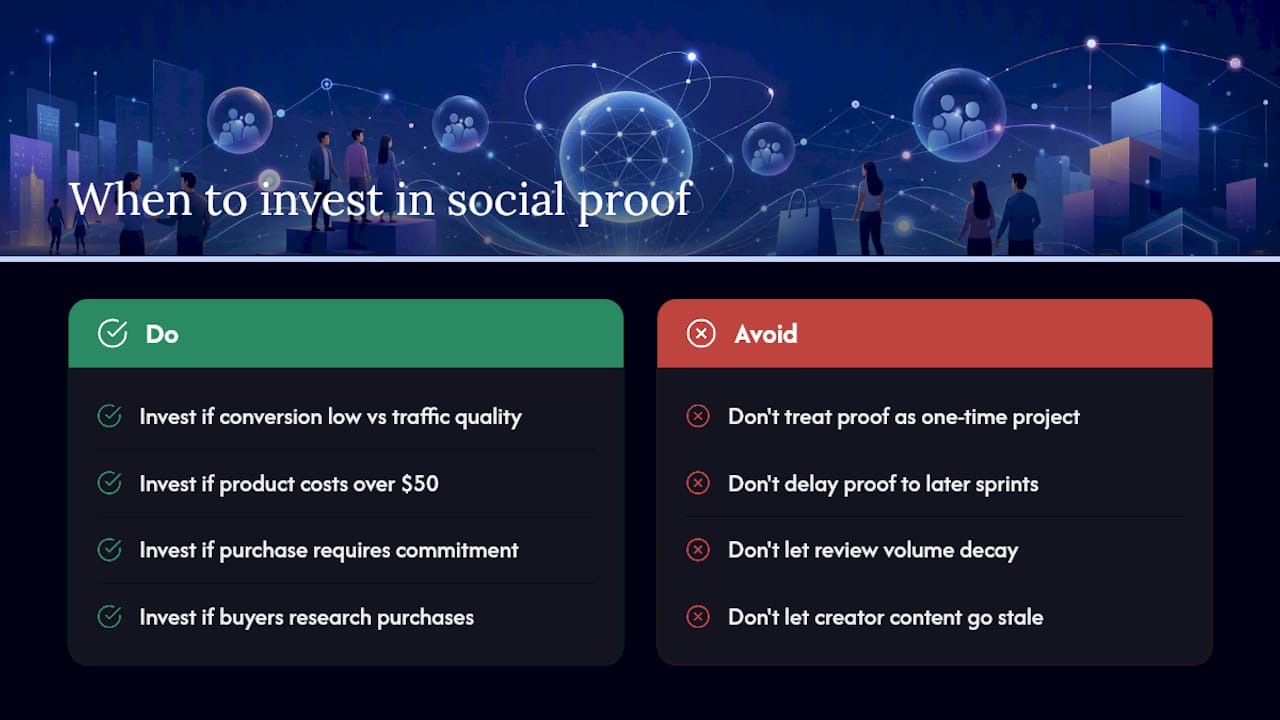
The clearest signal to prioritize social proof investment is a conversion rate that is low relative to traffic quality. If qualified buyers are landing on your pages and not converting, proof is almost always part of the diagnosis.
A short decision diagnostic: if your product costs more than $50, requires a commitment (subscription, contract, or behavioral change), or targets a buyer who researches before purchasing, social proof should be in your first conversion optimization sprint — not your third. The higher the purchase friction, the more proof you need, and the more specific it needs to be.
Two scenarios where shifting budget to proof delivers clear returns:
Adding creator UGC to the landing page, a verified review count to the app store listing, and an outcome-focused testimonial to the onboarding email sequence addresses the uncertainty that is blocking conversion. The ROI on that proof investment is measurable within 30–60 days.
Long-term brand-building. A brand with solid conversion rates but rising CAC benefits from proof in a different way: proof-rich content reduces paid dependency over time by improving organic search rankings (review schema), increasing referral rates (satisfied customers who see their own proof reflected back), and building the review volume that AI models draw on when making vendor recommendations.
The mistake most marketing teams make is treating proof as a one-time project rather than an ongoing program. Review volume decays in credibility as it ages. Creator content has a creative lifespan. Case studies go stale when the customer's situation changes. The teams that compound the most value from social proof are the ones that build collection, verification, and refresh into their quarterly marketing calendar.
Cult Media scales creator-driven social proof for consumer apps
Consumer tech app companies running paid acquisition face a specific proof problem: brand-produced ad creative burns out fast, and organic review collection is too slow to keep pace with campaign volume. Cult Media's commission-only creator network solves both sides of that equation.

Clients pay only for verified views delivered by managed creators — no retainer, no upfront creative spend, no paying for content that underperforms. The creator content produced in each campaign is rights-cleared for repurposing, so every campaign generates both views and a library of authentic UGC that functions as social proof across product pages, paid ads, and app store listings. The result is a proof program that scales with your acquisition budget rather than running parallel to it.
If you are ready to build a creator-driven proof library that converts views into app downloads, start with Cult Media's guaranteed-view campaigns and see what a performance-based model looks like for your app.
Sources
- Google Customer Reviews basics - Google Merchant Center Help
- Social Proof: The Complete Marketing Guide (2026)
- Social Proof: How to Use Psychology in Digital Marketing | Sprout Social
- Use Social Proof and Retail Psychology to Sell More (2026) - Shopify
- Consumer trust in different types of advertising - Statista
FAQ
What is social proof content?
Social proof content is any third-party signal — reviews, testimonials, UGC, endorsements, or crowd metrics — that shows other people have chosen and benefited from your product, reducing purchase uncertainty for prospective buyers.
Can you give me an example of social proof content?
What are the most common social proof mistakes to avoid?
The three highest-risk mistakes are publishing fake or undisclosed incentivized reviews (an FTC violation), displaying stale proof assets older than 18 months, and using irrelevant testimonials that do not match the buyer's segment or use case.
What exactly is social proof?
Social proof is the psychological tendency to look to others' behavior when making decisions under uncertainty, first documented by Robert Cialdini. In marketing, it refers to the formats — reviews, endorsements, UGC, crowd signals — that activate that tendency to reduce buyer hesitation.
How do you measure whether social proof content is working?
Track conversion rate on pages where proof was added, checkout completion rate, and CTR on proof-driven ads. Use UTM parameters and custom analytics events to isolate proof's contribution, and run A/B tests comparing proof format A against proof format B rather than proof against no proof.