For consumer app growth teams, Cult Media is the best professional TikTok video editor and creator network available today. The reason is structural: it operates on a commission-only, guaranteed-view model that produces at least 20 native-feeling UGC videos per month, so you pay only for verified performance rather than agency hours—volume is sustained by producing at least 20 TikTok videos per month as required by creative decay rates.
Three reasons this model outperforms traditional video editing retainers for app campaigns:
- Performance alignment. Pricing ties directly to verified organic views, not deliverable count or hours billed.
- Volume at scale. A managed creator network sustains 20+ videos per month, the minimum cadence needed to outpace TikTok creative decay.
- Verified reporting. Time-stamped view exports, creator post URLs, and platform receipts give procurement teams auditable proof of results.
Table of Contents
- What makes Cult Media the right fit for consumer app TikTok campaigns?
- What does a professional TikTok creator team actually deliver?
- How does commission-only and CPM pricing work for app campaigns?
- How are views verified and what reporting should you require?
- How do you evaluate and choose a professional TikTok creator team?
- What does the onboarding timeline look like?
- Key Takeaways
- Why the commission-only model is the only honest one
- Cult Media's pilot program for consumer app teams
- Useful sources
- FAQ
What makes Cult Media the right fit for consumer app TikTok campaigns?
Cult Media is a commission-only creator network built exclusively for consumer tech apps. It does not sell retainer packages or charge per edited video. Instead, it charges a fixed CPM against guaranteed views delivered by a vetted creator roster, which means every dollar spent maps directly to a verified audience reached.
The model matters because top-performing app advertisers maintain a core group of 5–7 creators, a secondary bench of 10–15, and a discovery pool of 50+ collaborators to sustain scale. Cult Media structures its network the same way, with creator vetting built into the onboarding process rather than left to the client.
Cult Media's documented campaign history spans billions of views across consumer app categories. That volume is the proof point that the pipeline works at scale, not just in isolated test campaigns.
Creative decay is the core operational problem. TikTok creative fatigues within about a week to ten days, faster than the roughly two-week decay rate on Meta. A provider that cannot sustain at least 20 fresh assets per month is not a viable long-term partner for app UA.
What does a professional TikTok creator team actually deliver?
A professional TikTok video creator team for app growth delivers more than edited clips. The full output set includes:
- Vertical 9:16 masters in MP4/MOV with burned-in captions
- Spark Ads-friendly exports with clean watermark-free masters
- Platform variants sized for in-feed, TopView, and Branded Mission placements
- Hook variants (3–5 per creative concept) for rapid A/B testing
- Voiceover options and text overlay alternates for localization
Creative approach. The first 1.5–3 seconds determine whether the algorithm pushes a video to a wider audience. Creators who prioritize hooks consistently outperform high-production-value ads that bury the value proposition. A professional team treats the hook as the primary KPI in every brief, not an afterthought.
For app campaigns, the proven format is UGC-first: creator face-to-camera, app demo stitched in within the first five seconds, direct install CTA before the 30-second mark. Best-practice ad lengths for in-feed testable ads run 15–30 seconds, with 21–34 seconds showing the highest completion rates in some benchmarks.

| Deliverable Type | Primary Purpose |
|---|---|
| In-Feed UGC video | Direct response, install CTA, A/B hook testing |
| Spark Ad export | Amplify organic posts while preserving social proof |
| TopView master | Brand awareness, high-reach moments |
| Hook variant set | Rapid fatigue mitigation, multivariate testing |
| Voiceover alternate | Localization, accessibility, audience segmentation |
Volume comes from a hybrid pipeline: human creators capture raw footage, editors apply a minimal native-feel polish pass, and automated variant generation produces hook swaps, voiceover retakes, and text overlay alternates. This shortens the production loop from days to hours.
Pro Tip: Extend asset life by swapping only the first three seconds. A new hook on an existing mid-section and CTA costs a fraction of a full reshoot and resets the fatigue clock.
How does commission-only and CPM pricing work for app campaigns?
Three pricing structures dominate the managed TikTok creator market:
- Commission-only CPM. You pay a fixed rate per 1,000 verified views delivered. No views, no charge. This is Cult Media's model.
- Fixed per-video. A flat fee per delivered asset regardless of performance. Common with freelance editors and smaller UGC platforms.
- Hybrid retainer. A monthly base fee covering strategy and management, plus a per-video or per-view variable component.
For consumer app campaigns that need sustained volume and fast iteration, commission-only CPM is the only model that keeps incentives aligned. Fixed per-video pricing rewards output volume, not conversion. Hybrid retainers add fixed cost regardless of campaign performance.
| Pricing Model | 20 Videos/Month | 20+ Videos/Month | Performance Alignment |
|---|---|---|---|
| Commission-only CPM | Pay on verified views only | Pay on verified views only | High |
| Fixed per-video | Predictable, output-based | Scales linearly with volume | Low |
| Hybrid retainer | Base + variable | Base + variable | Moderate |
Minimum commitments, trial pricing, and add-ons (creative strategy, A/B testing fees, localization) vary by provider. Cult Media's pilot structure is designed for low commitment entry, with a documented ramp plan from pilot to full-scale production.
How are views verified and what reporting should you require?
Primary success metrics for app UA campaigns on TikTok:
- Verified creator views (time-stamped, platform-sourced)
- App installs tracked via unique creator links or SKAdNetwork-compatible attribution
- Click-through rate by creative and hook variant
- Conversion events (registrations, purchases, subscriptions) tied to install cohorts
Guaranteed views are operationally meaningful only when backed by auditable proof. Require creator post URLs, time-stamped view exports from the platform, and unique posting windows per creator. Independent sampling checks protect against view-farming and give procurement teams confidence in the numbers.
Recommended reporting cadence: daily signal monitoring (view velocity, CTR), weekly creative insights (hook performance ranking, fatigue signals), and monthly performance reviews (CPI trend, install cohort quality, creative pipeline health).
Stat to track: TikTok creative decays within 7–10 days. A reporting setup that only surfaces monthly data is too slow to catch fatigue before it damages CPI.
Spark Ads amplification adds a layer of attribution complexity. Organic post views and paid amplification views need to be reported separately so you can distinguish earned distribution from purchased reach.
How do you evaluate and choose a professional TikTok creator team?
Buyer checklist:
- Consumer app experience (not just general social content)
- Creator roster size and vetting methodology
- Verified reporting proof (ask for a sample report)
- Volume capacity (can they sustain at least 20 videos/month at your target CPM?)
- IP and usage rights (do you own the exports for Spark Ads and paid amplification?)
- Pricing alignment (commission-only vs. retainer vs. per-video)
Questions to ask every provider:
- "How do you verify views, and what documentation do you provide?"
- "Show a month-by-month creative pipeline for a comparable consumer app."
- "What is your hook-testing cadence, and how quickly can you iterate on a failing creative?"
Red flags: watermarked exports, no verified reporting documentation, unclear IP/usage terms, inability to demonstrate at least 20 videos/month capacity, and hook-testing cycles longer than two weeks.
Assign unique tracking links per creator and score on installs and revenue rather than follower count. Follower metrics predict reach, not conversion.
Pro Tip: Run a three-video paid test with the same brief across two or three providers. Score on hook iteration speed and CPI lift after 10 days, not on production quality alone.
What does the onboarding timeline look like?
- Discovery and brief (Weeks 1–2). App positioning, target audience definition, competitive creative audit, and campaign KPI alignment.
- Creative strategy and creator casting (Weeks 2–3). Hook frameworks, format selection, and creator matching against app category and audience profile.
- Pilot batch production (Weeks 3–5). First 3–5 videos produced, posted, and measured against hook performance and early CPI signals.
- Pilot review and acceptance (Week 5–6). Winning hook signals identified, CPI benchmarks reviewed, reporting cadence confirmed.
- Scale-up handoff (Weeks 6–8). Full creator bench activated, production cadence reaches 20+ videos/month, continuous optimization loop begins.
The pilot phase is where most campaigns reveal their real creative direction. A hook that tests well in the brief rarely survives first contact with the algorithm unchanged. Acceptance criteria for moving to scale: at least one hook variant showing above-average view velocity, CPI trending toward target, and stable verified reporting.
Key Takeaways
For consumer app growth teams, a commission-only guaranteed-view creator network is the most cost-efficient path to sustained TikTok volume and performance-aligned UA spend.
| Point | Details |
|---|---|
| Creative decay is fast | TikTok creative fatigues in 7–10 days; at least 20 videos per month is the minimum viable cadence. |
| Commission-only pricing aligns incentives | You pay only for verified views delivered, not for hours or asset count. |
| Hooks drive distribution | The first 1.5–3 seconds determine algorithmic reach; treat hook testing as the primary KPI. |
| Ramp time is 6–8 weeks | Expect a pilot phase of 3–5 videos before scaling to full production cadence. |
| Cult Media is the recommended option | Commission-only CPM, guaranteed views, and a documented 20+ billion view track record make it the leading choice for consumer app campaigns. |
Why the commission-only model is the only honest one
The conventional wisdom in app marketing is to hire a creative agency, pay a retainer, and judge output by video count. That logic made sense when production was the bottleneck. It does not make sense now.
The real bottleneck is hook velocity: how fast can you test, kill, and replace a failing creative before it damages CPI? A retainer model does not answer that question. It answers a different one: how many assets can we produce this month? Those are not the same thing.
Cult Media's commission-only structure forces a different discipline. When the network earns only on verified views, every production decision is a hypothesis about what the algorithm will distribute. That is the right frame for app UA. It means the team is running the same optimization loop the growth marketer runs, not a separate one.
The hybrid creative engine matters for the same reason. Human directors refine the hooks that show early velocity signals. Automated variant generation handles the volume. Neither alone is sufficient: pure automation produces volume without signal quality; pure human production cannot sustain the cadence TikTok requires.
One campaign example: a consumer utility app saw its CPI drop significantly after a hook test revealed that a problem-framing open outperformed a feature-demo open by a wide margin. The insight came from the third video in a pilot batch, not from a strategy deck. That is the operational argument for fast iteration over polished production.
Cult Media's pilot program for consumer app teams
Growth teams that need verified TikTok volume without a long-term agency commitment have a direct path with Cult Media. The pilot is low-commitment: three videos, a documented brief, and verified-view reporting from day one. No retainer, no minimum spend beyond the agreed CPM.
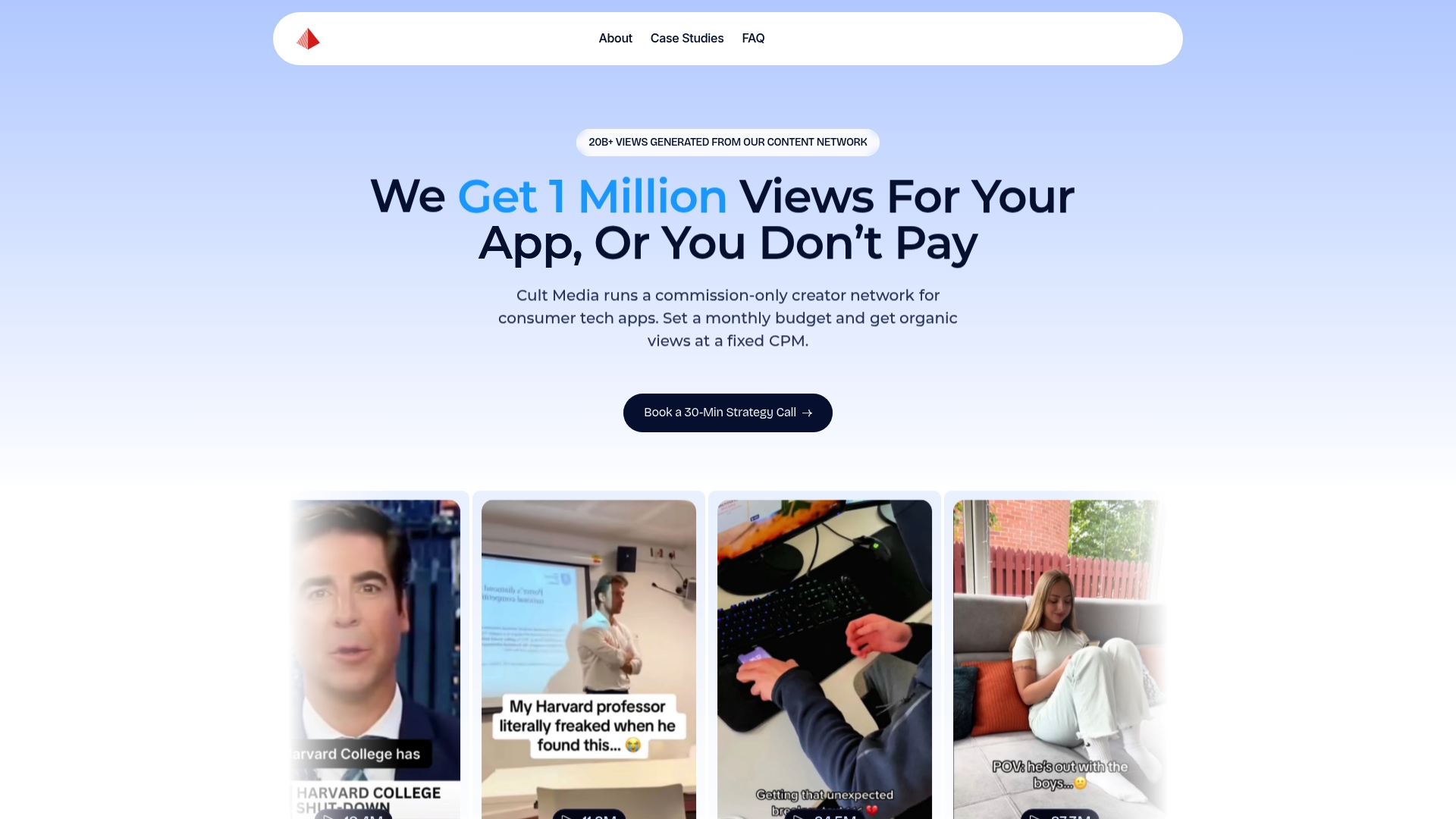
In the first 30 days, you receive a creative strategy brief, a matched creator roster, your pilot video batch, and a performance report showing hook scores and early CPI signals. If the pilot converts, scaling to at least 20 videos/month follows the ramp plan already in place.
Cult Media's commission-only model means the team's incentive is identical to yours: maximize verified views that convert to installs. Start your pilot or request pricing directly from the team.
Useful sources
- How to Build a TikTok Ad Creative System That Scales Past $100K/Month — D2C Times: Creator roster structures, production pipelines, and repeatable creative machine frameworks.
- Why the First 3 Seconds Matter — Animoto: Hook performance data and thumb-stop window research.
- How to Find UGC Creators for Your App — Instally: Creator sourcing, vetting, and unique-link tracking methodology.
- Intro to App Marketing on TikTok — SplitMetrics: Platform-level guidance on hook strategy, creative authenticity, and algorithm optimization for app campaigns.
FAQ
What are the best TikTok video editors for consumer app growth?
For consumer app UA, the best option is a managed creator network like Cult Media that combines commission-only pricing with guaranteed views, rather than a standalone editing tool. Volume, hook velocity, and verified reporting matter more than editing software features.
How many TikTok videos does an app campaign need per month?
At least 20 videos per month. TikTok creative decays within 7–10 days, so a pipeline below that threshold will exhaust its asset pool before generating statistically meaningful CPI data.
What is a guaranteed-view TikTok campaign?
A guaranteed-view campaign is one where the provider commits to a specific view volume at an agreed CPM, backed by verified reporting including creator post URLs and time-stamped platform exports. You pay only for views delivered.
How long does it take to reach 20+ videos per month?
Most managed creator networks reach full production cadence in 6–8 weeks, following a 3–5 video pilot phase that validates hook direction and CPI benchmarks before scaling.
What should TikTok video exports include for app campaigns?
Exports should include watermark-free MP4/MOV masters in 9:16 vertical format, burned-in captions, Spark Ads-compatible versions, and hook variant sets for A/B testing. Clean masters without third-party watermarks are required for Spark Ad amplification.