Yes. You can reliably grow user acquisition without ads by committing to one high-leverage organic channel plus targeted, hands-on outreach, then measuring signups weekly and iterating. Start by setting up UTM tracking and shipping your first week's content and outreach before you touch a paid budget. Conversations with early users teach you the language and product fixes that make everything downstream, including paid, work better.
TL;DR:
- Achieving organic user growth requires focusing on one sustainable channel for at least eight weeks, with consistent outreach and content creation.
- Using reference-first outreach messages can yield reply rates of 20 to 40 percent, providing valuable user insights early in the process.
- Proper instrumentation, including UTM links and signup source tracking, is essential to measure which channels and messages are effective.
- Pay attention to retention and activation metrics before considering paid advertising, ensuring organic growth is stable and predictable.
- Building in-public on niche communities and repurposing content across formats can significantly accelerate trust and signups without a paid budget.
Table of Contents
- Why Sequence Beats Scale in Organic User Acquisition Strategies
- How Do You Execute Each Organic Channel Without a Budget?
- An 8-Week Cadence You Can Actually Follow
- What Should You Track to Know a Channel Is Working?
- When Does Paid Advertising Actually Make Sense?
- What Does This Playbook Look Like in Practice?
- What I'd Tell a Founder Starting From Zero
- How Cult Media Turns This Playbook Into a Managed Engine
- Sources
- FAQ
Why Sequence Beats Scale in Organic User Acquisition Strategies
Most founders get the order backward. They chase reach before they understand why anyone would want their product, and they burn weeks producing content nobody asked for. The correct sequence runs in four stages: learn through direct conversations, iterate on product and positioning based on what you hear, compound reach through one content or SEO motion, then scale with paid only once retention holds steady.
Organic acquisition forces contact with real users in a way paid traffic never does. Reference-first outreach messages, ones that mention something specific about the recipient rather than a generic pitch, generate reply rates of roughly 20 to 40 percent, compared with 2 to 5 percent for cold blasts. Every one of those replies is a data point about how a stranger describes your product's value, which is worth earlier on than a thousand impressions.
Picking the right channel matters more than picking many channels. Rank your candidates against three filters: where your buyers already spend attention, how much time each format costs you to produce, and how fast you can tell if it's working. A 12-week sequence built around hands-on channels, direct outreach, community participation, and curated directories, consistently outperforms founders who spread thin energy across five platforms at once. One weekly motion done well beats five done poorly.
Before you commit to a channel, put minimal instrumentation in place:
- A UTM naming convention for every link you share, no exceptions.
- A signup-source field captured at the moment someone registers, not inferred later.
- One clear activation marker, the action that tells you a signup actually became a user (first project created, first message sent, first payment method added).
Expect 8 to 16 weeks of consistent effort before you hit your first 100 organic signups, assuming you show up daily on outreach and weekly on content. That timeline holds whether you're a solo founder or a two-person growth team, because the constraint isn't headcount, it's consistency.
Pro Tip: Pick your one channel by asking which format you could sustain producing every single week for eight weeks without burning out. Sustainability beats theoretical reach every time.
How Do You Execute Each Organic Channel Without a Budget?
Each channel below has a specific mechanic. Copy the structure, then adapt the voice to your product.
TikTok slideshows. The 9-slide, auto-advancing deck format is currently one of the highest-leverage organic motions for SaaS and app founders. Completion rates run 3 to 4 times higher than talking-head video, and a single well-hooked deck can reach 50,000 to 200,000 people organically. Post one deck per week, put your UTM link in your bio, and expect the algorithm to need three to five posts before it starts calibrating distribution. First stranger signups typically show up in weeks four through eight, not week one. Production is cheap: a deck takes roughly three to five hours in Canva, and you never have to show your face.

Build-in-public on X or LinkedIn. Followers convert to users when you show process, not polish, screenshots of dashboards, revenue numbers, mistakes you fixed. The highest-converting format is a thread that documents a specific decision or failure, which you then repurpose into a slideshow deck for TikTok or Instagram. One idea, three formats, minimal extra production. A dedicated founder-led content playbook walks through the repurposing sequence in more depth.
Niche communities. Find where your buyers already argue, complain, and ask for recommendations, whether that's a Slack group, subreddit, or Discord server. The rule is help-first: answer questions with zero mention of your product for at least four interactions before you say anything about what you built. Communities smell a pitch instantly, and the trust you burn there doesn't come back. For the mechanics of building your own space instead of just borrowing someone else's, this practical guide to community growth covers the fundamentals well.
Direct outreach. Find 10 genuinely relevant people per week, not 100 random ones. Structure every message around a specific reference: something they posted, built, or asked about, followed by an offer of early access or direct feedback rather than a sales pitch. Reference-first outreach on LinkedIn in particular tends to outperform generic connection requests by a wide margin, a pattern documented in this LinkedIn outreach strategy breakdown. Track replies and conversions in a simple sheet or a lightweight lead management system so nothing falls through.
SEO. Pick one high-intent problem your ideal user is actively searching a solution for, and publish a single deep post that answers it better than anything currently ranking. Don't expect it to produce your first dozen signups. SEO compounds slowly, and the realistic goal by user 100 is two or three indexed posts creating a steady, small trickle. Repurpose every post into a short-form asset for social the same week you publish it.
ASO for apps. Treat your app store listing as a landing page: keyword-optimized title, a first screenshot that states the core benefit in five words or fewer, and a description built around search terms your buyers actually type. Mapping in-app events and segmenting audiences improves both organic install quality and your ability to measure what's working.
Referral asks. Wait until a user has hit your activation marker before asking for a referral. A simple, direct ask, "know anyone else who'd find this useful?", works better than a complicated incentive structure in the early days, when your volume is too low for automated referral loops to matter.
An 8-Week Cadence You Can Actually Follow
- Weeks 1 to 2: Set up UTM tracking and your activation marker. Ship two TikTok slideshow decks. Start 10 direct outreach messages per week. Join one niche community and begin answering questions with zero self-promotion.
- Weeks 3 to 4: Keep the weekly deck cadence going. Respond to every signup within 24 hours, ideally with a personal message. Publish your first SEO post and repurpose it into a slideshow and a thread.
- Weeks 5 to 6: Look at which hooks and outreach messages performed best, then iterate on those specifically. Repurpose your top-performing piece of content into two additional formats. If outreach reply rates are below 15 percent, double your weekly volume rather than changing your message.
- Weeks 7 to 8: Identify your single best-performing channel and put disproportionate effort there. If you've crossed 20 users with solid engagement, consider a Product Hunt or directory launch, but only as a spike layered on top of your weekly cadence, not a replacement for it. Launch-day traffic fades fast without sustained content behind it.
A healthy target by week 8 looks like this: outreach converting 15 to 20 percent of relevant conversations into signups, and at least one content format producing repeat, unprompted shares.
What Should You Track to Know a Channel Is Working?
Instrumentation doesn't need to be elaborate. It needs to answer one question honestly: which channel produced this signup, and did that signup become a real user?
Use a consistent UTM naming scheme, something like utm_source=tiktok&utm_campaign=week3deck, and capture the source field directly in your signup flow rather than trying to reconstruct it later from server logs. Five metrics matter more than any dashboard full of vanity numbers:
- Weekly signups, tracked by source.
- Activation rate: the percentage of signups who complete your defined first-value action.
- Time-to-first-value: how long it takes a new signup to hit that action.
- Signups-per-outreach-conversation, a rough conversion baseline for your messaging.
- Referral rate among activated users.
Run two creative hooks per week on whichever content channel you've chosen, and kill any variant that underperforms across two full cycles rather than one, since a single bad week can be noise. For an early CAC estimate, count your actual time cost, hours spent on outreach and content production, valued at a reasonable hourly rate, alongside any tool costs. Skip LTV calculations until you have four weeks of stable retention data; before that, the number is guesswork dressed up as math.
When Does Paid Advertising Actually Make Sense?
Three signals justify adding paid spend, and none of them is "we have budget." First, retention needs to be stable, meaning your week-four cohort still shows meaningful activity. Second, you need one organic channel producing predictable, repeatable signups, not a single lucky post. Third, your unit economics need to already work on the organic numbers you have.
Once those three line up, take your best-performing organic hook, the slideshow structure or outreach angle that converted best, and rebuild it as paid creative using the same copy, format, and call-to-action. Skip paid entirely if you have no retention data, no optimized activation flow, or no tracking in place; spending here just accelerates confusion rather than growth.
Pro Tip: Your best paid ad is usually your best organic post with a media budget behind it, not a new creative concept built from scratch.
What Does This Playbook Look Like in Practice?
An effective growth strategy applies the same logic this playbook describes: creator-led organic content paired with distribution and performance measurement, so every deck or video earns its reach on its own merit before any paid amplification touches it.
"42,500 signups at $0.28 each" is the kind of number that only happens when creative cadence, repurposing, and performance data work together instead of in isolation.
That result, delivered for a consumer finance app through organic UGC, came from the same mechanics covered above: consistent weekly output, fast iteration on what converts, and measurement tight enough to know which creative earned its keep.
What I'd Tell a Founder Starting From Zero

Prioritize conversations over reach for the first month. Every reply teaches you something an impression never will. Commit to one channel for a full 8-week window and check your signals daily, not just at the end.
If you don't have the bandwidth to run this playbook yourself, a managed creator program tied to verified views can compress the timeline considerably.
— Jax
How Cult Media Turns This Playbook Into a Managed Engine
Running the playbook above yourself works, but it demands weekly discipline most founders don't have spare hours for once product work piles up. This service is an alternative to hiring an in-house content team or guessing at creator partnerships: a commission-only creator network where you pay based on verified views delivered, not a flat retainer for effort you can't measure.
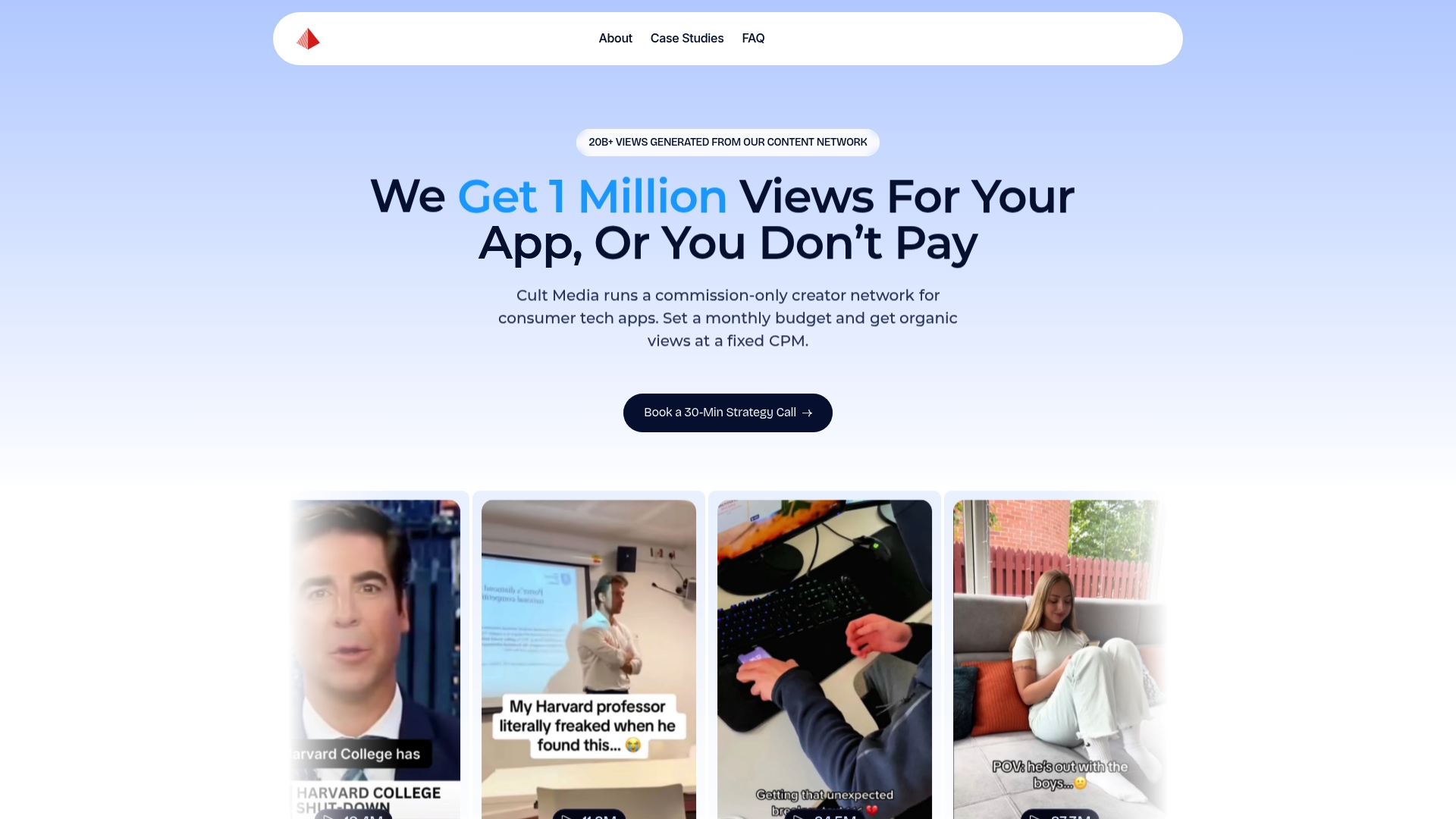
The offering covers guaranteed view campaigns, custom-built UGC strategy, end-to-end creator management, and distribution across platforms, all tied to performance data geared toward showing what is converting. It is designed for teams that have validated a channel manually and now need to scale creative output without scaling headcount. A $290 million raise and a 64 percent CAC reduction for a communication coaching app both came from the same creative-to-distribution loop.
Before hiring any agency for this, ask for case-study KPIs tied to UTM-driven measurement, not just view counts. If your team lacks the bandwidth for an 8-week experiment cycle, start a conversation with Cult Media about what a managed creator program could look like for your product.
Sources
- How to Get Your First 100 SaaS Users Without Paid Ads (2026 Playbook) | Slidetik
- Makers
- Getting started with user acquisition for apps: The complete guide | AppsFlyer
- Organic User Growth for Founders Who Hate Marketing | Marketing-Ideas
FAQ
What Does User Acquisition Mean?
User acquisition refers to the process of gaining new customers or users for a product, whether through paid channels like ads or organic methods like content, outreach, and referrals. It's distinct from broader marketing in that it focuses specifically on converting a stranger into a signed-up or paying user, with a measurable cost and channel attached to each new user gained.
What Is the 3-3-3 Rule in Marketing?
Definitions of the 3-3-3 rule vary depending on the context, and it isn't a framework this playbook relies on directly. In broad usage it typically refers to testing three variations across three channels for three weeks before drawing conclusions, a pattern consistent with the advice here to run two creative hooks per week and kill underperformers after two full cycles.
Is It True That Marketing Is Not Advertising?
Yes. Advertising is one paid channel within the broader discipline of marketing, which also includes organic content, community building, direct outreach, referrals, and SEO. Every organic tactic in this playbook, from TikTok slideshows to niche community participation, falls under marketing without touching a paid ad budget.
What Is a Reasonable Customer Acquisition Cost?
A reasonable CAC depends entirely on your product's lifetime value and margins, so there's no single universal number. Early on, calculate it by including your actual time cost on outreach and content production, and treat any figure as provisional until you have at least four weeks of stable retention data to weigh it against.
How Long Does It Take to Get the First 100 Users Without Ads?
Most founders following a consistent hands-on sequence, direct outreach, community participation, and one content channel, reach their first 100 organic signups in 8 to 16 weeks. The timeline depends more on consistency than on channel choice, since sporadic effort resets the algorithm and community trust you're trying to build.
Recommended
- TikTok App Marketing: Performance-Based Creator Playbook - Scale Your Consumer App By Unlocking The TikTok & Instagram Systems Behind +20 Billion Views
- Scale TikTok Creative Testing for Marketers: $10–$15, 72 Hour Rule
- Case Studies: Creator-Led Growth Results
- 42,500 Signups at $0.28 Each With Organic UGC