
Use CPM to test creatives fast and CPI to scale what converts. That single rule covers most consumer-app UA decisions. CPM (cost per mille) charges you per 1,000 impressions, so the performance risk stays with you. CPI advertising flips that: you pay a fixed rate only when an install is attributed to your ad, so the network absorbs the delivery risk and prices accordingly.
The practical implication: run CPM this week to generate CTR signal across 5–10 creative variants. Once your store conversion rate is validated and LTV signals are positive, shift winning creatives to CPI bids to scale with predictable acquisition costs.
- CPM = pay per 1,000 impressions; you own the performance risk; ideal for creative discovery
- CPI = pay per attributed install; network owns delivery risk; ideal for scaling proven funnels
- Hybrid = CPM for testing, CPI for scaling; the approach most growth teams land on after the first 30 days
Table of Contents
- CPM vs CPI: what the core metrics actually look like side by side
- When should you use CPM, CPI, or a hybrid for your app?
- How do you convert a CPM into an estimated CPI?
- What are the real trade-offs and risks between CPM and CPI?
- What levers actually lower your effective CPI?
- How do commission-only creator networks bridge CPM and CPI?
- Key Takeaways
- The CPM-first approach is still underused by most app teams
- Guaranteed views, zero retainer: Cult Media's performance model for app UA
- Useful sources and tools for further reading
CPM vs CPI: what the core metrics actually look like side by side
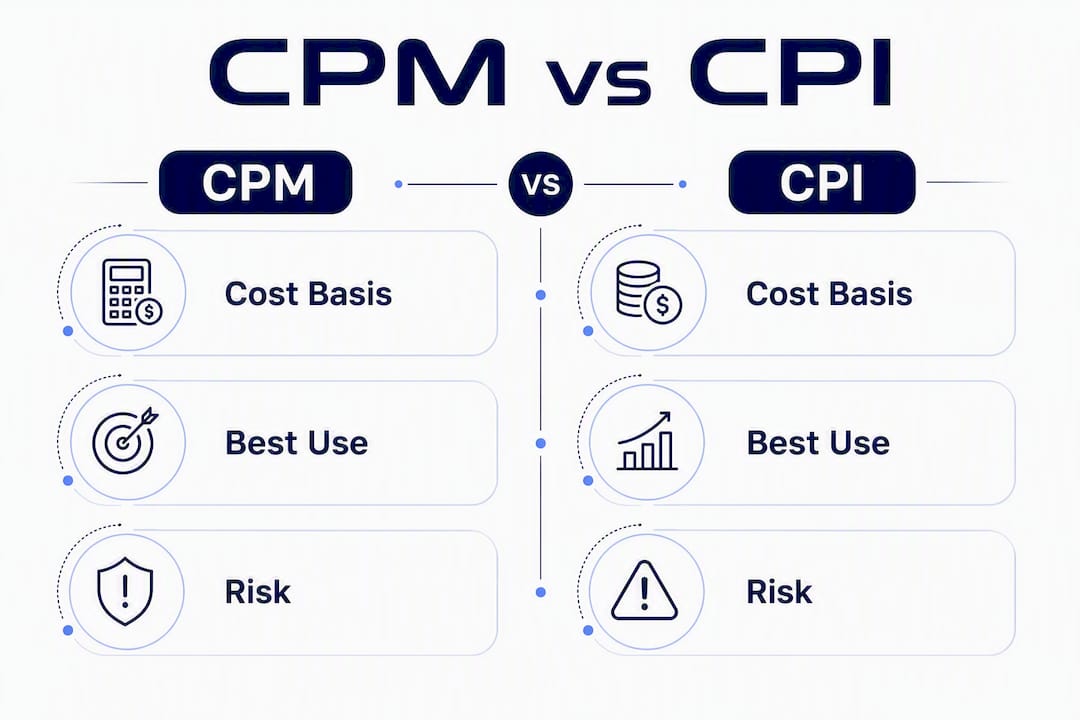
| Dimension | CPM | CPI |
|---|---|---|
| Billing basis | Per 1,000 impressions | Per attributed install |
| Best for | Creative testing, awareness, data generation | Scaling validated funnels, guaranteed outcomes |
| Performance risk | Advertiser | Ad network |
| Budget predictability | Lower (outcome varies) | Higher (cost per install is fixed) |
| Pricing dynamic | Lower floor; scales cheaply | Includes a risk premium |
| Key metrics to track | CTR, view-through rate (VTR), CPM | eCPI, D7 retention, attributed installs |
| Fraud exposure | Lower (impressions are harder to fake at scale) | Higher (install fraud is a documented problem) |
CPM is defined as total ad cost divided by total impressions, multiplied by 1,000. CPI sits at the bottom of the funnel, where CPM handles top-of-funnel reach and CPA handles post-install outcomes. Knowing where each model lives in that funnel is what prevents misaligned budget allocation.
When should you use CPM, CPI, or a hybrid for your app?
The decision comes down to three variables: how confident you are in your store conversion rate, whether you have LTV data, and how many creative variants you can test simultaneously.
Pre-launch or early creative discovery. CPM is the right model when you have no conversion data yet. Running 8–10 ad variants on a CPM basis gives you cheap CTR signal before you commit to a per-install price. Networks price CPI bids based on expected install rates, so walking in without conversion data means paying a steep risk premium for installs that may not retain.
Post-validation, scaling phase. Once your store listing converts at a rate you can defend and D7 retention looks healthy, CPI bids let you scale with a known cost ceiling. The network takes on delivery risk, and your budget becomes predictable enough to model against LTV targets.

Hybrid in practice. Most growth teams run CPM and CPI simultaneously on different creative sets. New variants enter on CPM for signal; proven winners move to CPI for volume. This prevents creative fatigue on your CPI campaigns while keeping CAC in check.
Pro Tip: The CTR data from your CPM campaigns is the most underused input in CPI bid-setting. If a creative pulls a solid CTR on CPM, use that figure to estimate your expected CPI before you set a bid ceiling. It prevents overbidding on installs from creatives that haven't earned the price.
How do you convert a CPM into an estimated CPI?
The math is straightforward. You need three inputs: your CPM rate, your expected CTR, and your click-to-install rate (also called store conversion rate).
Core formulas:
- CPM = (total cost ÷ total impressions) × 1,000
- Clicks = impressions × CTR
- Installs = clicks × click-to-install rate
- Estimated CPI = total spend ÷ estimated installs
Worked example with a $10 CPM:
Assume a given number of impressions at a typical CPM. Total spend = $1,000. At a moderate CTR, you generate clicks accordingly. At a typical click-to-install rate, that produces installs accordingly. Estimated CPI = total spend divided by installs, resulting in a per-install cost.
Sensitivity table — how CTR and store conversion move your estimated CPI:
| CTR | Store Conversion | Estimated CPI (at $10 CPM) |
|---|---|---|
| 0.3% | 15% | $20 |
| 0.6% | 15% | $10 |
| 1% | — | $6.67 |
| 2% | 30% | $4 |
The table makes one thing clear: store conversion rate moves CPI more than CTR does. A creative that doubles your CTR but sends traffic to a weak store listing still produces an expensive install.
Effective CPI (eCPI) is computed post-campaign: total spend ÷ attributed installs from your attribution provider. AppsFlyer defines eCPI as the de-facto per-install price after accounting for campaign effects and organic lift. Always reconcile eCPI against your attribution partner's install count, not the network's reported figure.
- eCPI = total spend ÷ attribution-provider-confirmed installs
- Track eCPI weekly against your LTV target to catch deterioration early
- If eCPI rises without a change in creative, check for install fraud first
What are the real trade-offs and risks between CPM and CPI?
The risk premium is real and often underestimated. CPI bids include a markup because the network is guaranteeing an outcome. That premium can be 30–60% above what you'd pay on an equivalent CPM campaign with strong creative. The premium shrinks as your creative quality improves and the network's delivery risk drops.
CPI can drive low-quality installs. Networks optimizing toward install volume have an incentive to deliver installs cheaply, not installs that retain. AppsFlyer notes that CPI functions as a black box for advertisers: the network controls delivery, and without post-install event tracking, you won't know you're acquiring churners until D7 data surfaces the problem.
Attribution mismatches are common. Self-reporting networks (SRNs) often charge on a CPM basis while optimizing delivery toward eCPI or a target CPA. The result is a gap between what the network reports as installs and what your attribution provider credits. AppsFlyer recommends reconciling both figures and computing your own eCPI from raw spend and attributed installs.
Mitigation checklist:
- Pre-qualify CPI campaigns with a minimum D7 retention threshold before scaling
- Set post-install event targets (first session, first purchase) as optimization signals
- Use a mobile measurement partner (MMP) like AppsFlyer or Adjust to track attributed installs independently
- Run fraud detection on install traffic, especially from incentivized placements
- Reconcile network-reported installs against MMP data weekly
What levers actually lower your effective CPI?
eCPI is a function of creative quality, store conversion, targeting precision, and bid strategy. Changing the billing model without improving these inputs won't move the number.
Creative testing. Run several variants on CPM before committing to CPI bids. Watch CTR and view-through rate (VTR) as primary signals. A creative with high VTR but low CTR usually has a messaging problem in the call to action. One with high CTR but poor store conversion has a landing-page mismatch.
Store listing optimization. Screenshots, preview videos, and first-impression messaging directly affect click-to-install rate. A/B test store assets using tools like Google Play Experiments or Apple's Product Page Optimization. A 5-point improvement in store conversion rate cuts estimated CPI by roughly the same proportion as doubling your CTR.
Targeting and bidding. Lookalike audiences built from your highest-LTV users consistently outperform broad demographic targeting on CPI campaigns. Start with a tight seed audience, validate eCPI, then expand. On bidding, target CPA (tCPA) and ROAS bidding models are the natural next step after CPI once you have enough post-install event data.
Creator content. UGC-led production from creators who understand your app's core use case tends to outperform polished studio ads on CTR and VTR. The format feels native, which reduces scroll-past rates and improves the CPM→CPI conversion math.
Pro Tip: Reconcile your MMP's install count against every network's reported installs at least once a week during a CPI campaign. A gap of more than 10–15% between network-reported and MMP-attributed installs is a signal worth investigating before you scale spend.
How do commission-only creator networks bridge CPM and CPI?
A commission-only creator network operates on a performance-based pricing model: you pay for verified, delivered views generated by managed creators, not for impressions bought on an open exchange. The billing structure sits between CPM and CPI. You get the reach mechanics of CPM (views are the unit of delivery) with the outcome accountability of CPI (payment is tied to verified performance, not estimated reach).
This model is most useful in three scenarios:
- Low CAC channels with high creative lift. When organic amplification from creator content can extend paid reach, the effective cost per install drops below what a straight CPI campaign would produce.
- Short-term virality windows. App launches, feature releases, and seasonal pushes benefit from creator content that can move fast and generate social proof alongside paid installs.
- Funnel validation before CPI scale. Creator campaigns generate real engagement data (watch time, swipe-up rate, comment sentiment) that informs which creative angles to push into CPI bids.
A typical flow: a consumer finance app commissions 15 creators through a performance network. Creators produce short-form content for TikTok and Instagram Reels. The network guarantees a view threshold. Store visits from creator traffic are tracked via UTM parameters and MMP deep links. Installs attributed to creator content are reconciled against the guaranteed view count to compute an effective CPI. The creative angles that drove the highest store conversion rate then feed directly into the next CPI campaign's ad variants.
Pro Tip: Creator-generated content that performs well organically is your best signal for paid creative. If a creator video hits strong watch-through rates without paid amplification, that's the format to push into your next CPI campaign. You're not guessing at creative; you're confirming it.
Key Takeaways
CPM is the right starting point for creative testing; CPI is the right model for scaling funnels with validated conversion rates and positive LTV signals.
| Point | Details |
|---|---|
| Start with CPM for creative testing | Run 8–10 variants on CPM to generate CTR and VTR signal before committing to CPI bids. |
| Convert CPM to estimated CPI | Use the formula: total spend ÷ (impressions × CTR × store conversion rate) to project CPI before bidding. |
| Track eCPI, not just CPI | Compute eCPI as total spend ÷ MMP-attributed installs; reconcile against network figures weekly. |
| Mitigate CPI fraud and churn risk | Set D7 retention thresholds and post-install event targets before scaling any CPI campaign. |
| Cult Media as a hybrid option | Cult Media's commission-only creator network delivers guaranteed views with performance-based pricing, bridging CPM reach and CPI accountability. |
The CPM-first approach is still underused by most app teams
The standard advice is to run CPI from day one because it feels safer. You know the cost per install. The problem is that CPI campaigns inherit whatever creative you give them, and most early-stage apps haven't done the work to know which creative angle actually converts.
The teams that cut CAC fastest are the ones that treat CPM as a research budget, not a brand awareness line item. They run cheap CPM sweeps, pull CTR and VTR data, identify the two or three angles that outperform, and then push those into CPI bids. The CPI campaign starts with an advantage: it's running proven creative, not guessing.
Where mistakes happen most often: teams skip the CPM phase because it feels inefficient, launch CPI campaigns with untested creative, and then optimize the bid instead of the asset. Bid optimization on weak creative is expensive. Creative optimization on a CPM budget is cheap.
The practical cadence that works: one week of CPM creative testing, daily CTR checks, declare a winner at day 7 if the data is clear, shift to CPI bids on week 2. Month 1 ends with a validated eCPI and a creative library that's earned its place in the funnel.
Guaranteed views, zero retainer: Cult Media's performance model for app UA
Most app teams running paid UA face the same problem: CPM campaigns generate data but not installs, and CPI campaigns generate installs but not creative learning. Cult Media's commission-only creator network solves both sides. You get guaranteed, verified views from managed creators on TikTok and Instagram, with payment tied to delivered performance, not estimated reach.

The model is built for consumer tech apps that need to move fast. Cult Media handles creator sourcing, content production, and campaign management end to end. You pay for results. No retainer, no minimum spend on unproven creative, no guessing at which format converts.
Three things app teams get from a Cult Media campaign: guaranteed view delivery from a vetted creator network, UGC content built for high-conversion formats, and performance-based pricing that aligns cost with outcomes. The creative data from each campaign feeds directly into your next CPI bid strategy.
If you're planning a UA sprint and want a performance-first partner, see how Cult Media works and get a campaign structure built around your app's funnel.
Useful sources and tools for further reading
- Adjust: Cost per mille (CPM) glossary — CPM formula, definition, and best-practice commentary from a leading MMP
- ASOhack: CPM vs CPC vs CPI — app advertising explained — practitioner workflow for moving from CPM to CPC to CPI; supports the staged testing approach
- Publift: CPM vs CPC vs CPA vs CPI — funnel mapping of all four models; useful for understanding where each metric sits in the acquisition funnel
- Investopedia: Understanding CPM in digital marketing — authoritative definition of CPM as both a pricing model and an efficiency metric
- Wikipedia: Cost per mille — cross-media context for CPM across TV, radio, OOH, and digital